| Support Material | How It Comes Off | Best Matches (Typical) | Where It Shines on Complex Prints | What You Must Watch | Printer Setup |
|---|---|---|---|---|---|
| Same-Material Support | Peel / cut / snap | Any single-material print (PLA with PLA, PETG with PETG, etc.) | Fastest workflow, zero extra material handling, great for “good enough” undersides | Contact scars, hard-to-reach cavities, risk to thin features during removal | Single extruder |
| Breakaway Support | Snap / peel (engineered for clean release) | Broad, depends on brand and temps | Cleaner separation than same-material, good for tall supports that must stay rigid | Still mechanical removal, needs access, can leave faint witness marks | Single or dual extruder |
| PVA (Water-Soluble) | Dissolves in water | PLA, some PETG/TPU blends (temp overlap matters) | Internal channels, lattice cages, organic shapes, fine detail undersides | Moisture sensitivity, stringing, nozzle ooze during idle time | Dual extruder / multi-material system (or used only as interface) |
| BVOH (Water-Soluble) | Dissolves in water | Often wider pairing window than PVA (check temps) | Complex supports with easier post-processing and cleaner cavities | Still hygroscopic, costs more than basic supports | Dual extruder / multi-material system (or interface-only) |
| HIPS (Solvent-Soluble) | Dissolves in limonene | ABS / ASA family prints | Strong, stable supports for higher-temp parts with tricky overhangs | Solvent handling, soak time management, odor control and cleanup | Dual extruder / multi-material system |
Complex prints don’t fail because the model is “too hard.” They fail because gravity, cooling shrink, and toolpath decisions can’t agree on what should exist in mid-air. Supports are the negotiation layer: temporary geometry that holds the real geometry in place until the part becomes self-supporting.
Table of Contents
🧩 What Support Materials Are
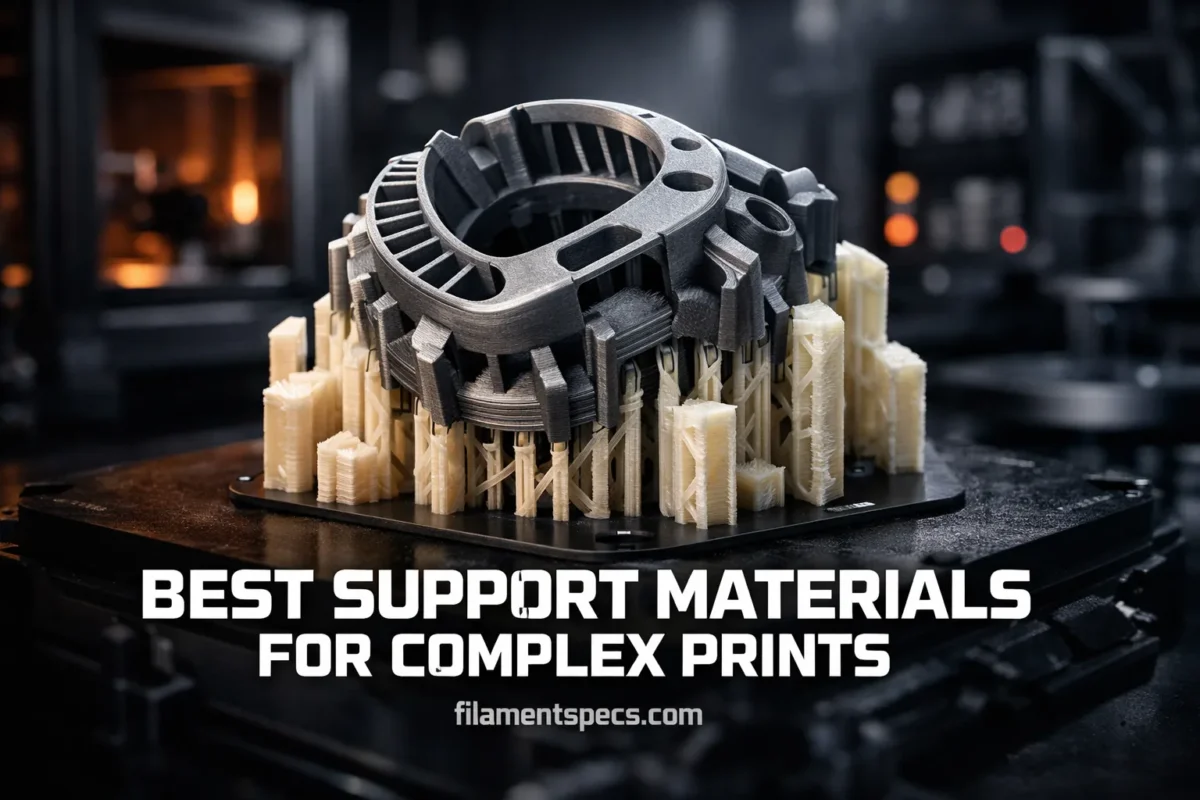
In material-extrusion printing (often called FDM/FFF), each new layer needs a stable foundation. When geometry creates air-gaps (overhangs, bridges that exceed your machine’s tuning, steep undersides, internal ceilings), you add temporary geometry that prints first and gets removed later. That temporary geometry is the support.
- Support Body
- The bulk scaffold that carries load and prevents sag. Most of the material and print time sits here.
- Support Interface
- The thin “contact zone” between support and model. This zone controls underside finish more than almost any other setting.
- Support Gap
- Designed micro-separation (Z and sometimes XY) so the support can release without tearing the part.
Even terminology is standardized in additive manufacturing vocabulary, which helps keep “support,” “material extrusion,” and related process terms consistent across manufacturers and research.[a]
🧱 Support Material Families
🧩 Mechanical Removal Supports
- Same-material supports: simplest setup; removal depends on gap tuning, model access, and how “grabby” the polymer is once cooled.
- Breakaway supports: formulated to separate more cleanly; often stiffer than typical model materials at room temperature, so tall scaffolds stay stable.
These options work well when the support is reachable with fingers or flush cutters and the underside finish can tolerate light witness marks.
💧 Soluble Removal Supports
- Water-soluble: commonly PVA or BVOH families; excellent for internal cavities and fragile details.
- Solvent-soluble: commonly HIPS for ABS/ASA ecosystems; supports dissolve while the main polymer remains intact when the solvent is chosen correctly.
Soluble supports change the geometry limit: “can I reach it?” becomes “can I dissolve it?”
PVA’s water solubility is a true polymer-chemistry variable: it depends on factors like degree of hydrolysis and molecular weight, so different PVA grades can behave noticeably differently during dissolution and printing stability.[c]
🧠 Choosing the Right Support
The best support material is rarely “the strongest.” It’s the one that matches your model material’s print window, bonds predictably at the interface, and releases with the least risk to the part.
Compatibility Variables That Actually Decide the Outcome
- Temperature overlap: nozzle temps must work for both materials without burning one or under-extruding the other.
- Shrink behavior: mixing a low-shrink model with a higher-shrink support can curl interfaces and break contact mid-print.
- Adhesion band: you want “enough to hold” but not “so much it welds.” Interface tuning is your lever.
- Chemical resistance during removal: the model must remain stable in the support’s solvent (water, limonene, etc.).
- Tooling limits: nozzle size, retraction performance, purge volume, and multi-material changeover behavior.
Common Pairing Logic (Material-System Thinking)
- For low-to-mid temperature model polymers, water-soluble supports are often preferred when internal voids and delicate features dominate.
- For higher-temp, styrenic model polymers (ABS/ASA), solvent-soluble supports can provide a stable scaffold at similar print temperatures.
- When you only need a perfect underside finish (not fully soluble scaffolds), consider “interface-only soluble” to reduce cost and reduce clog risk.
Relative Behavior (Typical) Complex Geometry Focus
🧩 Interface-Only Soluble
This is one of the highest-leverage strategies for complex prints: print the big, cheap scaffold in a standard material, then print only the last “contact” layers (the interface) in soluble support. The model peels away cleanly because the only material truly bonded to the underside is the dissolvable layer.
What Changes When Only the Interface Is Soluble
- Support body becomes structural: you can keep it stiff and stable (PLA/PETG/ABS depending on the job).
- Support interface becomes cosmetic: it exists to protect surfaces, not to carry tall loads.
- Dissolution time drops because your soluble volume is smaller, but the benefit on internal channels can remain dramatic.
Interface Parameters That Matter (and Why)
- Interface layers / thickness: more layers can improve underside finish, but also raises purge needs and can amplify ooze if the soluble material sits hot and idle.
- Interface density: higher density supports smooth undersides, but can reduce solvent flow paths; balance is part finish vs. dissolve speed.
- Z contact distance: for soluble interface, the “gap” can often be tighter than for peel-away supports because the goal is controlled bonding and later dissolution.
- XY separation: adds safety for thin walls and delicate pins when mechanical separation would otherwise chip edges.
🧪 Dissolving and Cleanup
Dissolving is not just “waiting.” It’s mass transfer: solvent must reach the polymer surface, the polymer must swell or solvate, and the boundary layer must be refreshed so the process keeps moving.
Water-Soluble Supports (PVA/BVOH Families)
- Temperature: warmer water usually increases dissolution speed, but keep it compatible with your model polymer’s heat sensitivity and dimensional stability.
- Agitation and circulation: fresh water at the surface is the difference between “hours” and “forever,” especially for dense interfaces.
- Geometry-aware removal: breaking off bulky external chunks (without stressing delicate features) can expose fresh surface area and accelerate dissolution.
- Flow paths: support patterns that create channels help solvent reach internal interfaces; fully “solid” contact zones can slow the last 10% dramatically.
Solvent-Soluble Supports (HIPS + Limonene)
- Why it works: HIPS is polystyrene-based, and d-limonene is a known solvent for polystyrene systems; solvent quality for polystyrene in d-limonene has been quantitatively studied in polymer science literature.[d]
- Soak management: controlled immersion and periodic movement help dissolved polymer diffuse away instead of re-depositing in crevices.
- Rinse stage: a clean solvent rinse (or a compatible intermediate wash if you use one) helps reduce residue in micro-details.
🧰 Reliability and Storage
Complex prints amplify small instabilities. A 2% flow variation that’s invisible on a simple bracket becomes a failed lattice, a torn bridge, or a fused internal mechanism.
💧 Moisture Control (Soluble and Not)
- Hygroscopic behavior: water-soluble supports readily absorb moisture, which can create bubbling, stringing, and weak layer bonding.
- Dry storage: sealed container + desiccant is the baseline; a drybox feed is often the difference between “works once” and “works always.”
- Drying discipline: consistent drying is more reliable than aggressive, high-heat drying that risks spool deformation.
🔥 Multi-Material Print Stability
- Standby temperature: soluble materials can degrade or thicken if left sitting hot during long tool-change gaps.
- Purge planning: purge towers and wipe strategies reduce contamination at the interface, which directly affects underside finish and support release.
- Nozzle hygiene: partial clogs show up first as inconsistent interfaces; fix the interface, and you often fix the print.
When you use limonene-based dissolution, treat it like a serious chemical workflow: ventilation, skin/eye protection, ignition avoidance, and storage discipline all matter because safety and hazard properties for limonene are well documented in chemical references.[e]
🧬 Advanced Complex Geometry
Internal Channels, Manifolds, and “No-Tool” Cavities
- Soluble wins when access is impossible: if you cannot physically reach the support with tools, the removal method must be chemical (water or solvent).
- Channel diameter reality: tiny internal passages can trap softened support; design solvent flow routes or choose support patterns that create removal channels.
- Interface-only soluble is often the cost/performance sweet spot for channels that need clean walls but don’t need a fully soluble scaffold.
Thin Walls, Pins, and Flex Features
- Mechanical removal can bend thin features during peeling; soluble interfaces reduce applied force on the part.
- Support density affects force: lower-density scaffolds break away easier, but may sag under tall spans—use a rigid body with a tuned interface instead.
Print-in-Place Mechanisms and Assemblies
- Objective: prevent supports from fusing moving joints while still supporting overhangs.
- Use blockers and targeted support painting so supports do not enter joint clearances.
- Soluble interface layers can protect cosmetic faces while leaving joint zones untouched.
Why This Topic Keeps Evolving
Support structures are still a major area of research and optimization in additive manufacturing because they directly affect material usage, time, energy, and post-processing work on complex geometries.[b]
❓ FAQ
Do I always need soluble supports for complex prints?
No. If supports are reachable and the underside finish can tolerate light contact marks, breakaway or same-material supports can be faster and simpler. Soluble supports earn their keep when geometry is enclosed, delicate, or visually critical.
What’s the practical difference between PVA and BVOH supports?
Both are water-soluble families used for complex support removal. In day-to-day printing, the differences show up as handling behavior (especially moisture sensitivity), print stability during idle time, and how quickly supports clear from tight cavities once submerged. Pairing and storage discipline matter more than the label on the spool.
Can I use soluble material only where the support touches the model?
Yes. Many slicers can assign a different material to the dense interface layers. This reduces soluble volume, often improves reliability, and can still deliver near-soluble-quality undersides on complex shapes.
What settings most affect the underside surface quality?
Support interface density, number of interface layers (or thickness), Z contact distance, and XY separation. These settings decide whether the interface “prints as a smooth floor” or “prints as a textured ceiling.”
How do I speed up water-soluble support removal without risking the part?
Use water temperature suitable for your model polymer, add gentle movement or circulation, refresh the water when it becomes saturated, and expose more surface area by removing large external chunks only when the part is robust enough.
Why do soluble supports sometimes clog or print inconsistently?
Moisture absorption, long idle time at high nozzle temperature, and insufficient purging during tool changes are the usual causes. A dry feed path, sensible standby temperatures, and regular purge routines fix most of it.
Is HIPS only for ABS-style materials?
HIPS is most often used alongside ABS/ASA because print temperatures and dimensional behavior align well. If you consider other pairings, verify temperature overlap and confirm the model polymer remains stable during the solvent removal step.
What should I do with used water or solvent after dissolving supports?
Filter out solids when possible, avoid dumping concentrated solutions into places where they don’t belong, and follow local disposal guidance—especially for solvents. Good cleanup habits keep your workspace and workflow predictable.
{
“@context”: “https://schema.org”,
“@type”: “FAQPage”,
“mainEntity”: [
{
“@type”: “Question”,
“name”: “Do I always need soluble supports for complex prints?”,
“acceptedAnswer”: {
“@type”: “Answer”,
“text”: “No. If supports are reachable and underside finish can tolerate light contact marks, breakaway or same-material supports can be simpler and faster. Soluble supports are most valuable when geometry is enclosed, delicate, or visually critical.”
}
},
{
“@type”: “Question”,
“name”: “What’s the practical difference between PVA and BVOH supports?”,
“acceptedAnswer”: {
“@type”: “Answer”,
“text”: “Both are water-soluble support families. In practice the differences show up in handling (especially moisture sensitivity), print stability during idle time, and how quickly supports clear from tight cavities once submerged. Storage and pairing discipline are key.”
}
},
{
“@type”: “Question”,
“name”: “Can I use soluble material only where the support touches the model?”,
“acceptedAnswer”: {
“@type”: “Answer”,
“text”: “Yes. Many slicers allow a different material for dense support interface layers, so you can keep the support body inexpensive while using soluble material only at the contact zone.”
}
},
{
“@type”: “Question”,
“name”: “What settings most affect underside surface quality?”,
“acceptedAnswer”: {
“@type”: “Answer”,
“text”: “Support interface density, number of interface layers (or thickness), Z contact distance, and XY separation have the strongest influence on underside texture and how cleanly supports release.”
}
},
{
“@type”: “Question”,
“name”: “How do I speed up water-soluble support removal without risking the part?”,
“acceptedAnswer”: {
“@type”: “Answer”,
“text”: “Use a water temperature compatible with the model polymer, add gentle agitation or circulation, refresh water when saturated, and expose more surface area by removing large external chunks only when the part can handle it.”
}
},
{
“@type”: “Question”,
“name”: “Why do soluble supports sometimes clog or print inconsistently?”,
“acceptedAnswer”: {
“@type”: “Answer”,
“text”: “Moisture absorption, long idle time at high nozzle temperature, and insufficient purging during tool changes are common causes. A dry feed path, sensible standby temperatures, and consistent purge routines resolve most cases.”
}
},
{
“@type”: “Question”,
“name”: “Is HIPS only for ABS-style materials?”,
“acceptedAnswer”: {
“@type”: “Answer”,
“text”: “HIPS is most often paired with ABS/ASA because print temperatures and dimensional behavior align well. For other pairings, verify temperature overlap and confirm the model polymer is stable during solvent removal.”
}
},
{
“@type”: “Question”,
“name”: “What should I do with used water or solvent after dissolving supports?”,
“acceptedAnswer”: {
“@type”: “Answer”,
“text”: “Filter out solids when possible, avoid dumping concentrated solutions into inappropriate drains or environments, and follow local disposal guidance—especially for solvents.”
}
}
]
}
📚 Sources
- [a] ISO/ASTM 52900:2021 (Additive manufacturing — Fundamentals and vocabulary) — Terminology baseline for additive manufacturing process language (reliable because it is an ISO/ASTM International standard publication).
- [b] Support Structures for Additive Manufacturing: A Review (MDPI) — Research overview explaining why supports drive waste/time and remain a major optimization topic (reliable because it is a peer-reviewed review article with formal citations).
- [c] Water Solubility Characteristics of Poly(vinyl alcohol) (Springer) — Polymer-chemistry explanation of what controls PVA’s water solubility (reliable because it is an academic book chapter from a major scholarly publisher).
- [d] Polystyrene and d-limonene interactions (Polymer Journal, nature.com) — Quantitative discussion of d-limonene as a solvent for polystyrene systems (reliable because it is a peer-reviewed journal article hosted by a major academic publisher).
- [e] Limonene (PubChem CID 22311) — Chemical identity and safety/hazard property references for limonene (reliable because PubChem is maintained by the U.S. National Library of Medicine/NIH with curated and linked data sources).