Skip to content
A spool of PEEK and ULTEM filament on a dark background.

PEEK and ULTEM: High-Performance Industrial Filaments

Spec / Behavior PEEK Filament (PEEK Polymer Baseline)[a] ULTEM Filament (PEI Resin Baseline)[b] Polymer Family PolyEtherEtherKetone (PEEK), semi-crystalline Polyetherimide (PEI), amorphous (ULTEM is a trade name) Density 1.30 g/cm³ (crystalline) 1.27 g/cm³ Glass Transition Temperature… 

A spool of white polypropylene filament on a black 3D printer part.

Polypropylene (PP) Filament Guide

Polypropylene (PP) filament is a semi-crystalline polyolefin that prints into parts that feel “real-world plastic”: light, tough, and naturally resistant to many everyday chemicals. It can also test your patience if you treat it like… 

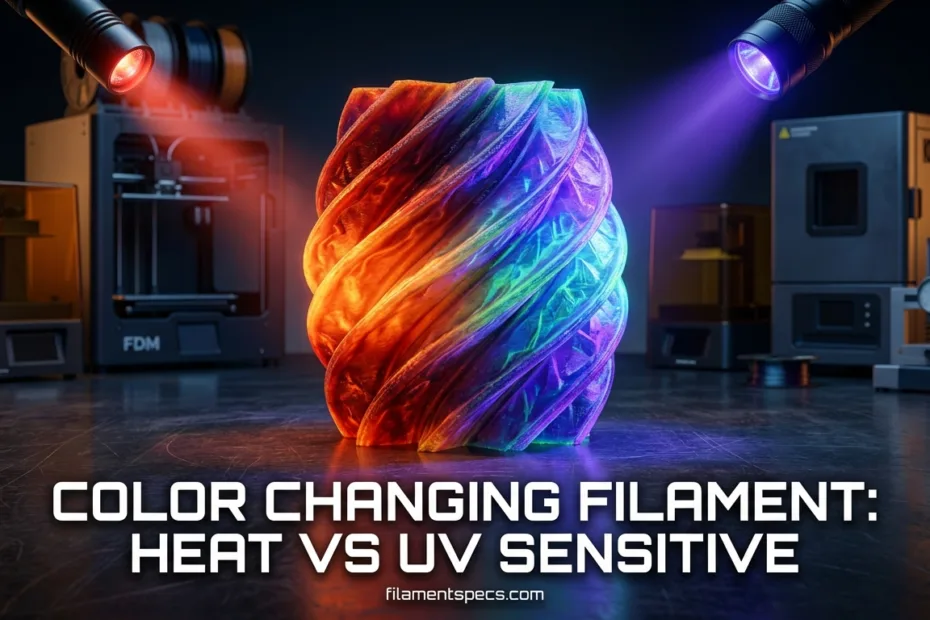
Color changing filament glowing with heat and UV light in a 3D printing setup.

Color Changing Filament: Heat vs UV Sensitive

Color-changing filament is one of those “looks like magic” materials that’s actually built on very real chemistry. In 3D printing, you’ll mostly meet two families: heat-sensitive (thermochromic) and UV-sensitive (photochromic). They can look similar in… 

A shiny Silk PLA filament spool with a smooth, glossy surface.

Silk PLA Guide: Achieving Shiny Surfaces

Shine Lever What To Control What It Changes On The Surface Practical Starting Point How You Know It’s Working Extrusion Smoothness Nozzle temperature + consistent flow More uniform “skin” so light reflects instead of scattering… 

A spool of glow in the dark filament emitting a bright green light in the dark.

Glow in the Dark Filament: Tips and Tricks

Focus What To Watch Why It Changes The Result Glow Pigment Family SrAl₂O₄-based persistent phosphors (commonly rare-earth activated, e.g., Eu/Dy systems)[d] The polymer is mostly the carrier; the glow comes from an inorganic phosphor that… 

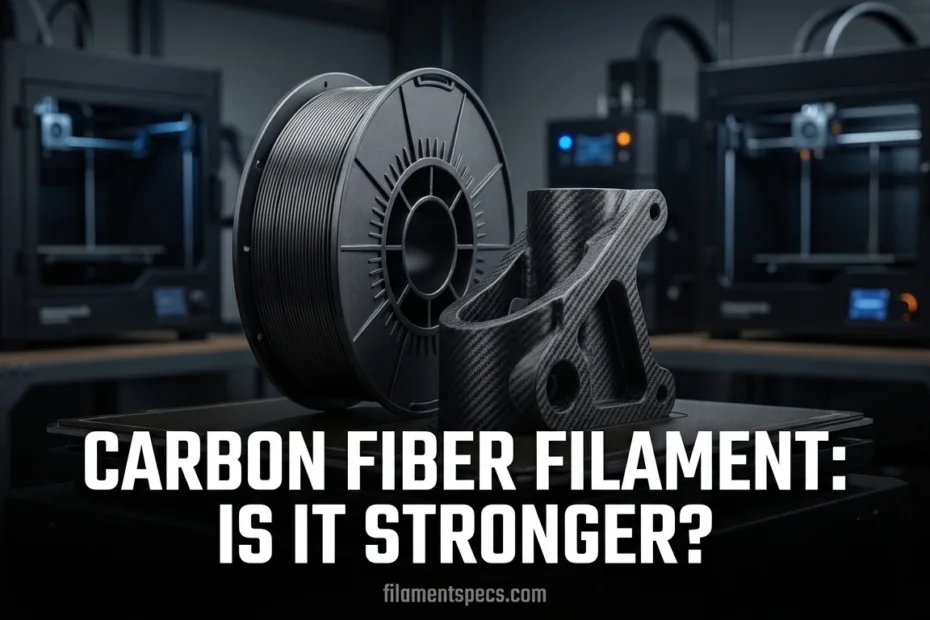
A spool of black carbon fiber filament on a 3D printer bed.

Carbon Fiber Filament: Is It Stronger?

Carbon fiber filament has a reputation: “print this and everything becomes stronger.” Real life is more interesting than that. Most carbon fiber filaments are a base plastic (like PLA, PETG, or nylon) mixed with chopped… 

HIPS filament spools in a 3D printing workshop scene showcasing support material.

HIPS Filament: Support Material and More

Printed-Part Metric (Industrial FFF Reference) On-Edge (XZ) Upright (ZX) Test Standard What It Changes In Real Prints Glass Transition, Tg (°C) 101 ASTM D7426 Past Tg, stiff parts start to soften; think car dashboards, warm… 

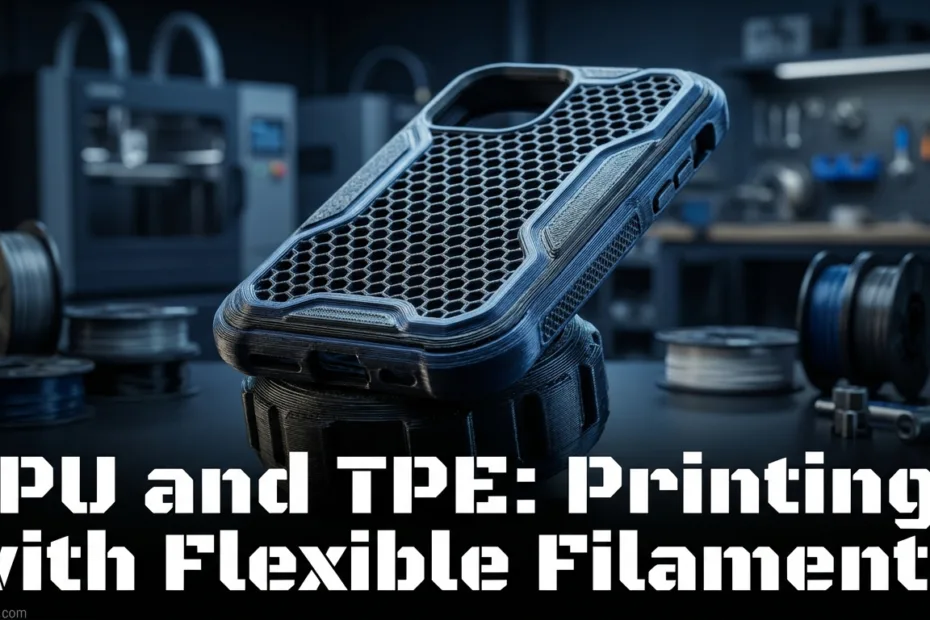
A flexible phone case with a honeycomb pattern printed using TPU filament.

TPU and TPE: Printing with Flexible Filaments

TPU vs TPE (SEBS) Flexible Filaments: Practical Differences for FDM/FFF Printing Attribute TPU Flexible Filament (Example: 82A Grade) TPE Flexible Filament (Example: SEBS Grade) What It Changes in Real Prints Polymer Family Thermoplastic polyurethane (TPU)… 

A close-up of two 3D printer filament spools, one labeled PLA and the other PLA+.

PLA vs PLA+: What is the Real Difference?

Comparison Point PLA (Example Data: Prusament PLA [a]) PLA+ (Example Data: eSUN PLA+ [b]) What The Label Usually Means Standard PLA formulation with predictable behavior and wide profile support. “PLA-based, modified” blend. The recipe varies… 

A spool of bright blue PLA filament on a 3D printer with gears in the background.

All About PLA: Properties, Settings, and Uses

PLA Filament Technical Snapshot Spec / Behavior Typical Numbers (Real-World Range) What It Changes In Prints Polymer Type Thermoplastic polyester (PLA; polylactide) Flows cleanly, sharp detail, predictable cooling and layer stacking. Specific Gravity / Density… 

A spool of PETG filament in a 3D printing setup for the PETG filament guide.

PETG Filament Guide: The Best of Both Worlds?

PETG Filament Technical Profile (Numbers That Actually Matter) Spec / Behavior Why It Matters Typical Baseline What To Keep In Mind Polymer Family Sets the “feel” of printing: flow, bonding, and stability Glycol-modified PET (copolyester)…