| Spec Detail | 0.03 mm Tolerance | 0.05 mm Tolerance | Why It Matters |
|---|---|---|---|
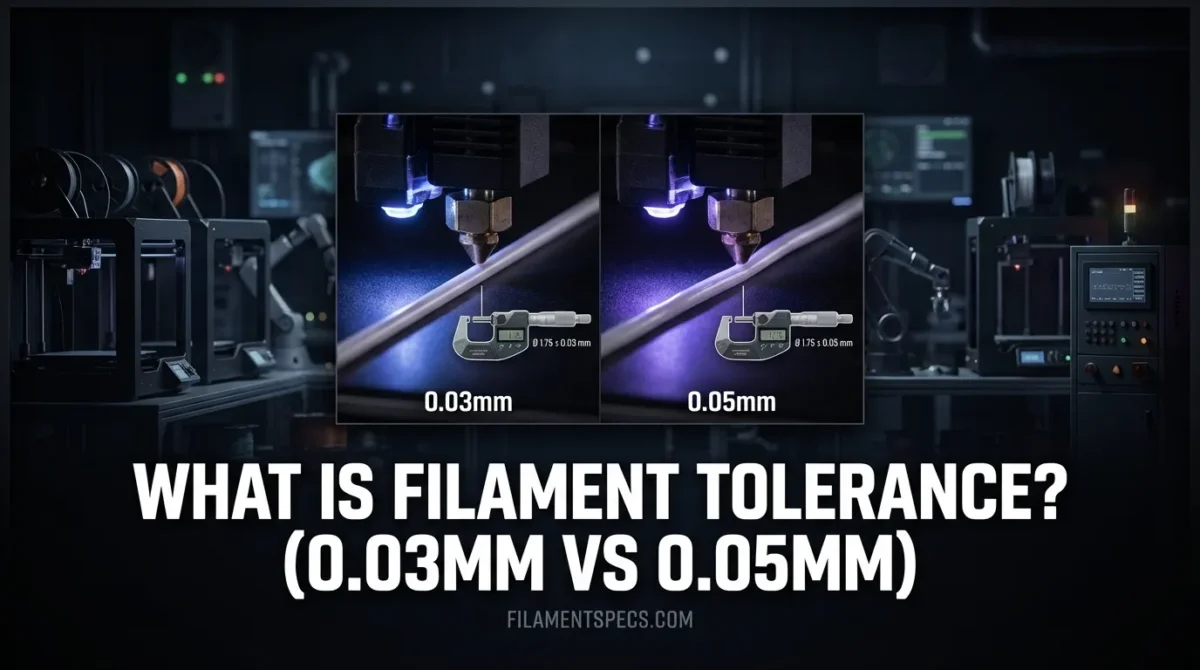
| Typical Meaning | Diameter stays within ±0.03 mm of nominal | Diameter stays within ±0.05 mm of nominal | Tighter bands reduce how much volumetric flow can drift if your slicer assumes a single filament diameter. |
| Total Diameter Band | 0.06 mm (60 μm) | 0.10 mm (100 μm) | The band is what the extruder “feels” over time—especially on long prints. |
| 1.75 mm Nominal Range | 1.72–1.78 mm | 1.70–1.80 mm | Small diameter shifts become bigger extrusion shifts because volume scales with diameter squared. |
| 1.75 mm Worst-Case Volume Error (vs 1.75 mm assumption) | -3.40% to +3.46% | -5.63% to +5.80% | These percentages translate into under/over-extrusion if everything else is held constant. |
| 2.85 mm Nominal Range | 2.82–2.88 mm | 2.80–2.90 mm | Same absolute tolerance is a smaller fraction of 2.85 mm, so the relative error is typically smaller. |
| 2.85 mm Worst-Case Volume Error (vs 2.85 mm assumption) | -2.09% to +2.12% | -3.48% to +3.54% | If you print 2.85 mm, the same tolerance numbers often “hit” less hard than they do at 1.75 mm. |
| Most Noticeable Scenarios | Thin walls, small nozzles, long Bowden paths, consistent high-speed flow | Same scenarios, but drift can be more visible if diameter swings are frequent | Consistency over the whole spool often matters more than a single headline number. |
| What To Check Beyond Tolerance | Ovality, surface smoothness, moisture control, material consistency | Same | “Tight tolerance” and “round filament” are related but not identical; both affect feeding and flow stability. |
Notes: “Volume error” here is computed from cross-sectional area (area ∝ diameter²). If your slicer assumes a fixed filament diameter but the actual diameter shifts, the extruded volume shifts by the same percentage.
Filament tolerance is one of those specs that looks tiny on paper and then quietly decides how predictable your extrusion will be over hours of printing. The core idea is simple: printers push filament by length, but prints need plastic by volume. If the diameter changes, the volume per millimeter changes too. That’s the whole story—then the details start to matter.
- Nominal Diameter: 1.75 mm or 2.85 mm
- Tolerance Band: allowed diameter variation
- Ovality: how round (or not) the filament is
- Flow Stability: how consistent the extrusion looks
Table of Contents
🧵 What Is Filament Tolerance
- Filament Tolerance
- The allowed diameter deviation from the nominal diameter (most often expressed as ± mm).
- What It Controls
- How much the filament’s cross-sectional area can vary, which directly affects volume delivered per millimeter of filament.
- What It Does Not Guarantee
- Perfect prints by itself—temperature stability, moisture, slicer settings, and mechanical tuning still matter.
In material extrusion printing, filament is a feedstock that gets heated and forced through a nozzle, building parts layer by layer. That process family and its vocabulary are standardized in additive manufacturing terminology. [a]
When a brand says “±0.03 mm,” it’s basically saying: “Our filament diameter should stay inside this window.” A tighter window usually means fewer surprises in extrusion consistency, especially if your printer and profile are already well-tuned.
📏 How Tolerance Specs Are Written
Two Common Ways Specs Appear
- Plus/Minus Tolerance: written as ±0.03 mm or ±0.05 mm. This is the most common format.
- Total Variation: sometimes written as “0.06 mm” meaning the total band (min-to-max). It can be ambiguous unless the manufacturer clarifies.
If a spec does not explicitly show the ± symbol, treat it as a question mark until it’s clarified. The number might represent total swing, a typical value, or a specified limit. That’s not a “gotcha,” it’s just how marketing sheets sometimes compress technical detail.
In standards describing material extrusion feedstocks, filament is a recognized pathway (for example, pellets can be converted into filaments). That matters because “tolerance” is essentially a manufacturing and quality-control guarantee about the feedstock itself. [b]
🧮 The Math Behind Flow Error
Here’s the clean relationship: cross-sectional area is proportional to diameter squared. So a small diameter shift can create a noticeably larger volume shift.
Area Relationship
Area = π × (d²) ÷ 4
If your slicer assumes a fixed diameter, the relative flow error is approximately:
Flow error ≈ (d_actual / d_nominal)² − 1
What The Numbers Look Like (1.75 mm)
- ±0.03 mm: about ±3.4% worst-case volume shift
- ±0.05 mm: about ±5.8% worst-case volume shift
Same printer, same profile, different diameter drift.
Why This Hits 1.75 mm More: The same absolute tolerance (0.03 or 0.05 mm) is a larger fraction of 1.75 mm than it is of 2.85 mm, so the squared effect tends to be more pronounced on 1.75 mm setups.
Extrusion-based additive manufacturing can be filament-driven, and the flow depends on steady feedstock delivery through a nozzle—exactly why diameter control becomes a practical printing variable rather than a cosmetic spec. [d]
🖨️ Print Impact in Real Life
0.03 mm Tolerance Typically More Stable
0.05 mm Tolerance Can Still Be Excellent
Where Tolerance Differences Usually Show Up
- Single-wall or vase-mode prints: diameter drift can show as thickness variation.
- Pressure-driven flow: higher speeds and long Bowden paths can magnify inconsistency.
- Small nozzle diameters: less buffer, so extrusion variance is easier to notice.
- Long prints with many hours of continuous extrusion: small changes add up.
When The Difference Often Feels Smaller
- Profiles that are already calibrated for that exact spool’s real diameter.
- Parts with thicker walls and generous infill overlap (more “averaging”).
- Printers with consistently controlled melt zone and stable extrusion mechanics.
🧷 Tolerance vs Ovality
Filament can be “within tolerance” and still behave strangely if it’s not round. That’s because your extruder gear and your hotend don’t interact with a perfect math circle—they interact with real plastic.
| Attribute | What It Describes | How It Can Affect Printing |
|---|---|---|
| Diameter Tolerance | How far the diameter can deviate from nominal | Changes the delivered volume per mm; can shift extrusion thickness |
| Ovality (Out-of-Round) | Difference between the “wide” and “narrow” axis of the filament | Feeding feel, grip consistency, and intermittent flow changes |
| Surface Quality | How smooth/clean the filament surface is | Friction changes in guides/Bowden tubes; debris risk in the melt zone |
Friendly Reality: a “±0.03 mm” label is helpful, but it’s not the full quality story. If you’re comparing spools, try to compare how the brand reports the measurement method (how often, where measured, and whether roundness is also tracked).
🔬 Measuring and Interpreting
What You’re Actually Trying To Learn
- Average Diameter: what diameter value best represents the spool overall.
- Variation Pattern: whether changes are random, gradual, or “lumpy” in certain sections.
- Roundness: whether the filament is consistently circular.
A practical approach is to measure multiple points along the filament (and rotate the filament for a second reading at the same point to spot ovality). Record the numbers, then look at the spread. The point is not to chase perfection; it’s to understand what your printer will experience over time.
Measurement Matters: any measurement has uncertainty—tool resolution, hand pressure, alignment, and technique all influence readings. In metrology, uncertainty isn’t an excuse; it’s part of reporting a measurement responsibly. [c]
Interpreting Your Results Without Overthinking
- If the average diameter is consistently off nominal, adjusting the filament diameter in your slicer can reduce systematic flow error.
- If the diameter swings are frequent, you may see small texture or thickness shifts even after calibration.
- If ovality is notable, you can sometimes feel it as periodic changes in feeding resistance.
🧾 What To Look For on a Spool
Specs That Usually Help
- Diameter tolerance format: clearly shown as ± (less ambiguity).
- Roundness/ovality reporting: even a simple statement helps.
- Quality consistency notes: how the manufacturer controls and checks diameter along production.
Context That Changes The “Right” Choice
- Small nozzles or thin walls: tighter tolerance tends to be easier to dial in.
- General parts at standard speeds: 0.05 mm can be perfectly solid.
- 2.85 mm ecosystems: the relative impact of the same tolerance number is often smaller.
- If You’re Comparing 0.03 vs 0.05
- Focus on consistency over the whole spool, not just the headline number. A stable 0.05 mm spool can print more predictably than a tighter spec that varies in “waves.”
- If You See Mixed Results
- Separate “systematic” issues (average diameter mismatch, flow calibration) from “random” issues (diameter swings, ovality, moisture). They respond to different fixes.
🎥 Watching Diameter Tolerance in Practice
❓ FAQ
Does 0.03 mm tolerance automatically mean better prints?
It usually means the filament diameter can vary less, which can make flow consistency easier to maintain. Print quality still depends on profile tuning, temperature control, and the filament’s overall consistency (including ovality and moisture).
Is 0.05 mm tolerance “bad”?
No. Many excellent spools are labeled ±0.05 mm and print cleanly, especially on typical nozzle sizes and moderate speeds. What matters most is whether the diameter is consistent over time, not only the headline tolerance.
Should I change my slicer filament diameter setting if the spool is not exactly nominal?
If your measurements show a stable average diameter that is different from nominal, setting that value can reduce systematic extrusion bias. If the diameter swings a lot, changing one number won’t fully remove variability, but it can still help with the overall baseline.
Why does the same tolerance number matter more on 1.75 mm than 2.85 mm?
Because the same absolute deviation is a larger fraction of 1.75 mm. Since extrusion volume scales with diameter squared, the percentage impact on volumetric output tends to be bigger at smaller nominal diameters.
Does tolerance cause clogs?
Diameter variation alone rarely “causes” clogs, but it can raise the risk of inconsistent feeding or pressure changes in certain setups. Clogs are more commonly tied to contaminants, degraded material, moisture-related bubbling, or an incompatible temperature/profile. Tolerance is one factor in the overall stability picture.
📚 References
- [a] ISO/ASTM 52900:2021 — Additive manufacturing — Fundamentals and vocabulary (ISO)
- [b] ISO/ASTM 52903-1 — Material extrusion-based AM of plastic materials — Feedstock materials (ASTM Store)
- [c] JCGM 100:2008 — Guide to the Expression of Uncertainty in Measurement (BIPM)
- [d] Altıparmak et al. (2022) — Extrusion-based additive manufacturing technologies (ScienceDirect, open access)