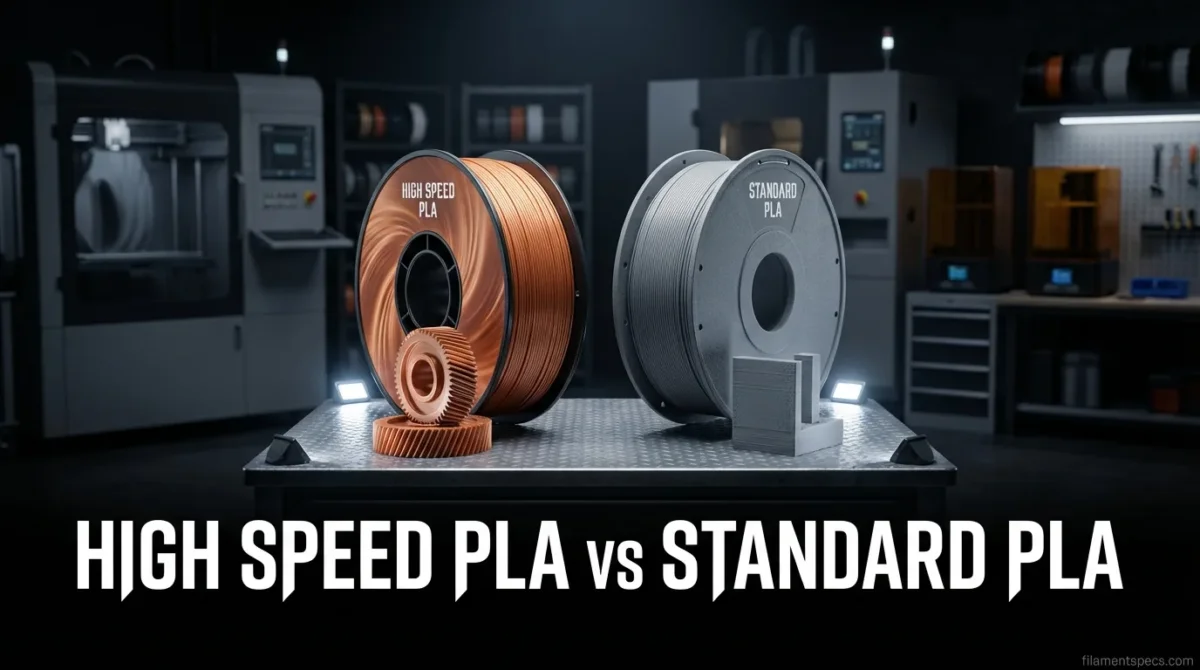
| Category | Standard PLA | High Speed PLA |
|---|---|---|
| Core Intent | Balanced, forgiving printing with wide compatibility across printers and hotends. | Higher throughput printing by sustaining higher melt delivery without obvious under-extrusion. |
| Flow Behavior Under Test | Typically moderate melt flow; often tuned for stability and surface finish over maximum flow. | Usually formulated to achieve higher melt flow under standardized conditions (often reflected as higher MFR/MVR in a datasheet when provided). |
| Volumetric Flow Focus | Often hits the printer’s melt capacity sooner when you push speed aggressively. | Better chance to “keep up” when the slicer demands higher volumetric flow (still limited by the hotend and nozzle). |
| Thermal Transitions (PLA Reference) | PLA commonly shows glass transition around 60 °C and melting peaks often in the 150–170 °C region (grade-dependent). [d] | Still PLA-based, so thermal transitions are typically in a similar neighborhood, with variation by formulation and crystallinity management. |
| Cooling Rate Sensitivity | Usually tolerant, but quality still depends on cooling, minimum layer time, and geometry. | More sensitive at the edge of performance: cooling, layer time, and melt delivery must stay in balance to avoid soft corners or weak bonds. |
| Corner Sharpness at High Acceleration | Good at moderate speeds; can soften corners if pressure control is not tuned. | Can stay crisp at higher throughput when tuned well; pressure control becomes more critical. |
| Layer Adhesion at Speed | Often strong at normal speeds; can lose strength if the part cools too fast between layers. | Can keep bonding solid if melt temperature and layer timing are managed; too much cooling can still reduce fusion. |
| Surface Finish | Often smoother at conservative speeds because the extrusion is less stressed. | Can be excellent, but surface may show more “speed artifacts” if flow, resonance, or cooling is off. |
| Small Features (Text, Pins, Thin Walls) | Predictable with good detail at normal speeds. | Can work well, but minimum layer time and cooling strategy become the limiter before raw speed does. |
| Best-Fit Use Cases | General printing, display parts, prototypes, education, broad compatibility. | Fast iteration, production-style runs, large parts, time-sensitive prototypes where speed matters. |
Numbers like speed (mm/s) are printer-dependent; the more universal comparison is how well each filament sustains higher volumetric flow without quality loss.
High Speed PLA and Standard PLA both live under the “PLA” umbrella, but they behave differently when you ask your printer to move fast and still lay down clean, consistent extrusion. The practical difference isn’t a single magic setting. It’s a chain of linked behaviors: how the filament melts, how it flows through the hotend, how quickly it solidifies, and how stable that flow stays as acceleration ramps up.
Table of Contents
✅ What “High Speed” Usually Means in Practice
- Higher melt delivery
- More stable extrusion
- Less flow starvation
- Better speed headroom
- Still PLA-based
“High Speed PLA” is typically a PLA-based filament engineered so your printer can sustain higher material throughput before you hit under-extrusion. That can come from how the polymer chains are tuned, how the melt viscosity behaves, and how consistently the filament feeds and melts at elevated rates. The label does not guarantee a specific mm/s number; it points to flow capacity and process stability.
🧪 Material Definition and Where the Labels Can Mislead
- Standard PLA
- General-purpose PLA designed to print well across a wide range of printers, hotends, and cooling setups.
- High Speed PLA
- PLA-based filament intended to keep extrusion consistent at higher throughput (higher demanded melt flow), typically with a narrower “best zone” of temperature, cooling, and pressure control.
- Why the Same Printer Can “Agree” with One but Not the Other
- Speed is a system outcome: hotend heating length, nozzle geometry, part cooling, acceleration limits, and the filament’s melt behavior all stack together.
Common misunderstanding: “High Speed PLA is always stronger.” In reality, speed-focused formulation often targets flow consistency first. Strength depends heavily on layer fusion, temperature history, and cooling balance. A slower print with Standard PLA can outperform a fast print with High Speed PLA if the fast profile is not tuned.
📏 Flow Metrics That Actually Predict Speed Headroom
Standardized Melt Flow: MFR and MVR
When a manufacturer publishes real flow data, the most transferable numbers are usually MFR (melt mass-flow rate) and MVR (melt volume-flow rate). ISO describes procedures that determine MFR/MVR under specified temperature and load, and notes the importance of melt density when converting between mass and volume flow. [a]
ASTM’s equivalent framing matters too: the melt flow rate from an extrusion plastometer is an empirically defined parameter, influenced by polymer structure and test conditions, and it should not be treated as a fundamental property on its own. [b]
🧠 How to Read a Filament Datasheet Without Guesswork
- Prefer datasheets that list MFR/MVR test conditions (temperature + load) rather than just a single number.
- Look for consistency indicators: batch-to-batch tolerances, diameter tolerance, ovality, and any mention of QC method.
- If a datasheet only says “prints faster,” treat it as marketing until you see measurable flow data or verified machine profiles.
🧮 Volumetric Flow Math You Can Use Across Any Printer
Speed (mm/s) is not the real limiter. What the hotend must deliver is volumetric flow (mm³/s). That’s why two printers can both “print at 200 mm/s” on paper, while only one produces clean walls.
Volumetric Flow Formula
Volumetric flow (mm³/s) = line width (mm) × layer height (mm) × print speed (mm/s)
- Example: 0.45 mm line width × 0.20 mm layer height × 200 mm/s = 18 mm³/s
- If you change nozzle size, line width usually follows. Bigger nozzle = bigger flow demand at the same speed.
- If you raise layer height, you raise flow demand instantly, even if speed stays the same.
Relative Headroom (Typical Trend, Not a Guarantee)
These bars illustrate the common goal: High Speed PLA is usually designed to hold extrusion stability farther into the high-flow zone, but the printer’s hotend still sets the ceiling.
🔥 Hotend Ceiling: Why the Printer Often Matters More Than the Filament
At high throughput, the hotend becomes a heat-transfer device with a deadline. If the polymer doesn’t absorb enough heat quickly enough, you get partial melting, pressure spikes, and then under-extrusion.
What Research Says About Hotend Constraints
Experimental and numerical work comparing hotends found that filament feeding rate is highly influential for extrusion outcomes, and that the length of the heating region and the polymer’s properties affect how the melt evolves through the hotend. [c]
Why “High Speed PLA” Helps (When It Helps)
- Lower effective melt resistance can reduce how quickly pressure builds as you demand more flow.
- More predictable flow makes pressure control (Pressure Advance / Linear Advance) easier to dial in.
- It may postpone the point where the hotend becomes the limiting factor, especially on long straight extrusions and thick walls.
One more nuance: at higher filament speeds, in-situ X-ray CT work observed that less area of the nozzle wall is in contact with the melt, with a larger air gap occupying part of the barrel section. That can reduce heat transfer right when you need it most. [e]
🌡️ Thermal Behavior: Cooling Rate, Crystallinity, and Why Speed Changes the Rules
PLA is not just “melt and freeze.” Its thermal history matters. Differential scanning calorimetry work on PLA shows Tg around 60 °C, melting peaks around 150–170 °C, and even highlights how cooling conditions change what you later observe in melting behavior. [d]
How This Maps to Real Printing
- Higher print speed often means less time for each segment to stay hot enough for interlayer diffusion, especially on small features.
- Cooling strategy becomes a structural choice: strong part cooling improves bridges and overhangs, but it can also reduce layer-to-layer fusion if it chills too aggressively.
- Crystallinity and stereochemistry influence how PLA solidifies; different PLA grades can behave differently under fast cooling, which is exactly what high-speed printing forces. That’s why two PLAs can “feel” like different materials at the same nominal temperature.
Heat resistance reality check: printed PLA parts typically soften near the glass transition region. If a project needs dimensional stability around ~60 °C, the print’s crystallinity, geometry, and load path matter as much as the filament label.
🛠️ Print Behavior Differences You Can See on the Part
1) Extrusion Consistency and Pressure Dynamics
- Standard PLA is often forgiving with retraction and coasting, especially at moderate speeds.
- High Speed PLA can be smoother at high throughput, but it’s more sensitive to pressure control calibration because small mismatches show up faster as blobbing, corner rounding, or thin walls.
2) Corners, Seam Quality, and “Speed Artifacts”
- If the printer resonates (ringing/ghosting), both filaments will show it. High Speed PLA doesn’t remove resonance; it just keeps extrusion from starving.
- Seams often look cleaner when flow is stable. That’s a major practical win of a well-made High Speed PLA.
3) Small Features and Minimum Layer Time
Fast printing breaks on tiny geometry first. When a layer finishes in a few seconds, you’re printing onto plastic that may still be soft. The fix is usually not “different filament,” it’s thermal pacing: minimum layer time, localized cooling, or printing multiple parts to share layer time.
4) Supports, Bridges, and Overhangs
- Standard PLA: predictable bridging when tuned, often with strong fan cooling.
- High Speed PLA: can bridge well, but the best point is where it stays fluid enough to bond and stiffens quickly enough to hold shape.
🧩 Troubleshooting: Symptoms and What They Usually Mean
| Symptom | Most Likely Cause | Best Check to Run |
|---|---|---|
| Thin walls, missing lines at high speed | Hotend melt capacity exceeded; partial melting; pressure collapse | Reduce volumetric flow target and re-test; confirm extrusion is stable on long straight lines |
| Soft corners, rounded edges | Pressure control not tuned; too high acceleration for the melt delivery response | Recalibrate pressure advance/linear advance; compare corner cubes at different accelerations |
| Stringing increases when speeding up | Higher melt temperature/pressure; retraction timing mismatch | Retraction test at the same volumetric flow; validate travel moves and wipe settings |
| Weak layer bonding on tall thin parts | Overcooling or too little time above fusion temperature between layers | Lower fan for those features or increase minimum layer time; compare a simple pull test on a split coupon |
| Overhangs look rough at speed | Cooling and solidification not keeping pace; geometry-limited layer time | Overhang tower with controlled fan steps; watch for the “best zone” rather than max fan |
| Sudden quality drop after a long fast print | Heat soak, filament path friction, spool drag, or inconsistent feeding | Check spool holder friction and filament path; run the same print with relaxed acceleration |
Moisture and PLA: PLA can be sensitive to hydrolytic chain scission at temperature. If a spool has absorbed moisture, fast printing can amplify the symptoms (bubbles, rough surfaces, inconsistent flow). If you suspect moisture, dry the filament using a method appropriate for PLA and retest extrusion consistency.
❓ FAQ
What is the most reliable way to compare “speed capability” between two PLA filaments?
Use volumetric flow as the common language. Keep nozzle size, line width, and layer height fixed, then raise speed until you see sustained under-extrusion or quality collapse. That threshold is the usable flow limit for that filament-printer combo.
Does High Speed PLA always print at lower temperature?
No. Many high-throughput profiles use a carefully chosen temperature that keeps the melt stable at higher flow. The best point is where extrusion is consistent without causing excessive stringing or surface softening.
Can I print High Speed PLA slowly using my normal PLA profile?
Usually yes. Because it’s still PLA-based, it typically prints well at moderate speeds. You may still want to validate retraction and seam behavior, since flow-oriented formulations can respond differently to pressure changes.
Is Standard PLA “better” for surface quality?
At conservative speeds, Standard PLA often looks excellent because the process is less stressed. At higher speeds, a good High Speed PLA can keep walls cleaner by avoiding flow starvation, but resonance and cooling still control the final look.
What printer upgrade most increases the benefit of High Speed PLA?
A hotend with higher melt capacity (effective heating length and heat transfer) plus stable feeding. If your printer already runs near the melt limit, High Speed PLA shows a bigger advantage.
Will High Speed PLA improve heat resistance of printed parts?
Not automatically. Heat resistance is tied closely to the glass transition region and the part’s thermal history. Crystallinity management can matter for some PLA grades, but the filament label alone is not a guarantee.
{
“@context”: “https://schema.org”,
“@type”: “FAQPage”,
“mainEntity”: [
{
“@type”: “Question”,
“name”: “What is the most reliable way to compare speed capability between two PLA filaments?”,
“acceptedAnswer”: {
“@type”: “Answer”,
“text”: “Compare by volumetric flow (mm3/s), not just mm/s. Hold nozzle size, line width, and layer height constant, then increase speed until sustained under-extrusion or a clear quality collapse appears. That threshold is the usable flow limit for that filament on that printer.”
}
},
{
“@type”: “Question”,
“name”: “Does High Speed PLA always print at lower temperature?”,
“acceptedAnswer”: {
“@type”: “Answer”,
“text”: “No. High-throughput profiles often use a temperature that maintains stable melt flow at higher demand. The best point balances consistent extrusion with controlled stringing and good layer bonding.”
}
},
{
“@type”: “Question”,
“name”: “Can High Speed PLA be printed slowly using a normal PLA profile?”,
“acceptedAnswer”: {
“@type”: “Answer”,
“text”: “In many cases, yes. High Speed PLA is PLA-based and often behaves well at moderate speeds. It can still benefit from checking retraction and seam behavior because pressure response can differ by formulation.”
}
},
{
“@type”: “Question”,
“name”: “Is Standard PLA better for surface quality?”,
“acceptedAnswer”: {
“@type”: “Answer”,
“text”: “At conservative speeds, Standard PLA often looks very smooth because the process is less stressed. At higher speeds, a well-made High Speed PLA can maintain cleaner extrusion by avoiding flow starvation, but resonance and cooling still dominate the final appearance.”
}
},
{
“@type”: “Question”,
“name”: “What printer capability most increases the benefit of High Speed PLA?”,
“acceptedAnswer”: {
“@type”: “Answer”,
“text”: “Higher hotend melt capacity and stable feeding. When the printer is close to its melt limit, High Speed PLA typically shows a clearer advantage in sustained high-flow printing.”
}
},
{
“@type”: “Question”,
“name”: “Will High Speed PLA automatically improve heat resistance of printed parts?”,
“acceptedAnswer”: {
“@type”: “Answer”,
“text”: “Not automatically. Heat resistance is strongly influenced by the glass transition region and the part’s thermal history. Crystallinity can matter for some PLA grades, but the filament label alone is not a guarantee.”
}
}
]
}
🔎 Sources
-
[a]
ISO 1133-1:2022 — Plastics — Determination of the melt mass-flow rate (MFR) and melt volume-flow rate (MVR)
(Supports the standardized definition and procedures for MFR/MVR; ISO is an international standards body.) -
[b]
ASTM D1238 — Standard Test Method for Melt Flow Rates of Thermoplastics by Extrusion Plastometer
(Supports how melt flow is used and interpreted as an empirically defined QC parameter; ASTM is a global standards organization.) -
[c]
Springer Nature — Numerical and experimental analysis of 3D printer hot ends
(Supports the role of feed rate and heating length in extrusion stability; peer-reviewed academic publisher.) -
[d]
Hitachi High-Tech — Thermal analysis of polylactic acid (DSC/TG application note)
(Supports PLA thermal transitions such as Tg ~60°C and melting peaks in the 150–170°C region; established scientific instrumentation organization.) -
[e]
Additive Manufacturing (ScienceDirect) — Analysis of melting and flow in the hot-end using X-ray computed tomography
(Supports observed melt contact changes and air-gap behavior at higher filament speeds; open-access research in a peer-reviewed journal.)