| Printed-Part Metric (Industrial FFF Reference) | On-Edge (XZ) | Upright (ZX) | Test Standard | What It Changes In Real Prints |
|---|---|---|---|---|
| Glass Transition, Tg (°C) | 101 | ASTM D7426 | Past Tg, stiff parts start to soften; think car dashboards, warm enclosures, and snug press-fits. | |
| Heat Deflection @ 66 psi (°C) | 102.8 | 101.5 | ASTM D648 (Method B) | Good clue for heat-shape stability under light load (not a “melting point” number). |
| Tensile Yield Strength (MPa) | 26.0 | 23.5 | ASTM D638 | Shows print-direction dependence; upright walls can yield earlier if layers are the weak link. |
| Elastic Modulus (GPa) | 1.98 | 1.93 | ASTM D638 | How “springy” the part feels; helpful for clips, snap details, and vibration response. |
| Elongation @ Break (%) | 8.7 | 2.8 | ASTM D638 | Layer stacking matters: flat or on-edge prints often survive bending better than tall, upright ones. |
| Notched Izod Impact (J/m) | 74.7 | 44.6 | ASTM D256 / D4812 | HIPS earns its name on impact; orientation still changes how cracks travel. |
| Unnotched Impact (J/m) | 827 | 132 | ASTM D256 / D4812 | Big gap between orientations—great reminder that anisotropy is real in FFF. |
These values are typical results from printed specimens and are best used as a reference baseline for how HIPS behaves when layered. [a]
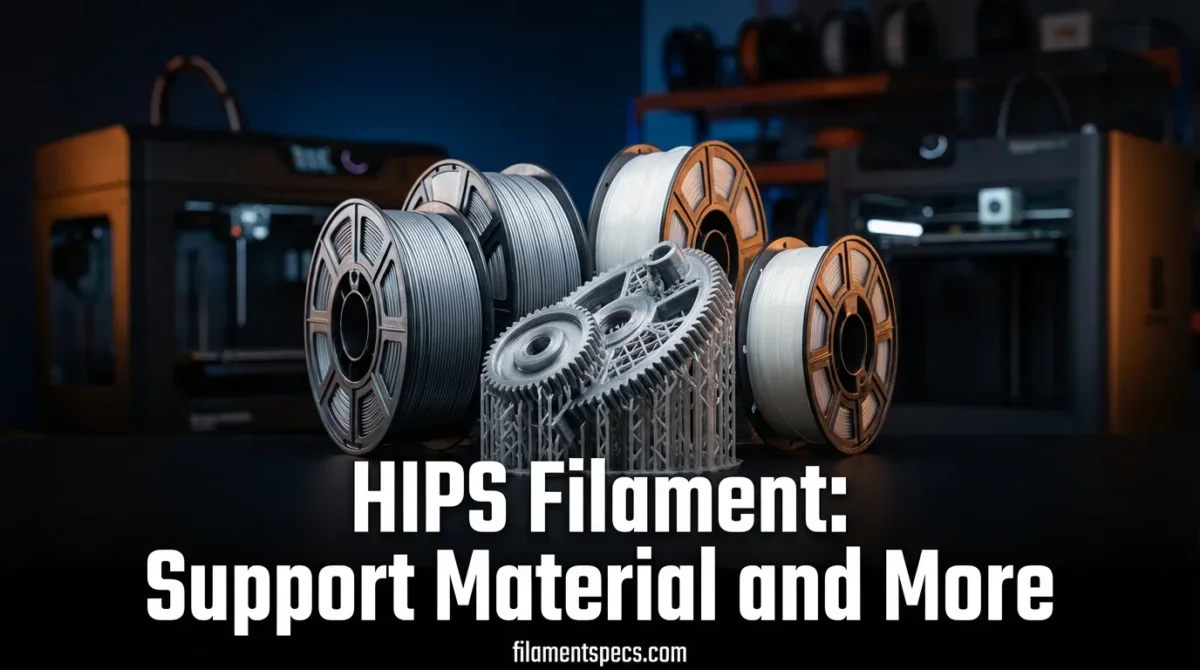
HIPS filament is often introduced as “that soluble support for ABS,” yet it’s a full material family with its own feel, quirks, and strengths. The big idea: it’s a styrenic plastic that prints like a workhorse, can be post-processed cleanly, and—when you want it to—can disappear from complex geometries without chisels or sanding scars.
Table of Contents
🧪 What HIPS Is
HIPS stands for High-Impact Polystyrene: a polystyrene base toughened by rubbery modifiers so it snaps less and absorbs knocks better than “plain” polystyrene. In industrial terms, a common approach is blending polystyrene with a small percentage of butadiene rubber to improve impact strength and reduce brittleness. [b]
In filament form, that chemistry tends to translate into a material that feels rigid but not glassy. It sands well, takes paint nicely, and can be tuned for either “model material” behavior or “support material” behavior depending on how you slice it.
- Polymer family: styrenics (same broad neighborhood as ABS/ASA, with different balance points)
- Texture & finish: typically matte to satin; hides small layer lines better than very glossy plastics
- Strength profile: “good-enough” tensile numbers, stronger personality in impact and dimensional stability
- Support identity: can be removed mechanically, and can also be removed by solvent methods when you design for it
🧩 Why Supports Work
The core “magic trick” is that polystyrene has strong interactions with certain solvents, and d-limonene is a documented solvent environment for polystyrene chains. That’s the chemical doorway that makes soluble support workflows possible with HIPS. [d]
In practical printing terms, HIPS supports are most valuable when the geometry punishes manual removal:
- Internal channels: fluid paths, ducts, labyrinths, and curved tunnels that you can’t reach with pliers
- Delicate surfaces: thin ribs, fine typography, and sculpted faces where breakaway supports leave scars
- Overhang stacks: multiple ceilings over multiple cavities, where traditional supports become a puzzle box
Support success with HIPS is less about “a special filament” and more about designing the interface: give the main model a predictable contact pattern, keep solvent access in mind, and avoid sealing HIPS inside a watertight cavity.
🔁 Behavior While Printing
A useful resin-grade reference point (not a promise for every spool):
- Density: 1.04 g/cm³
- Water absorption: < 0.1%
- Moulding shrinkage: 0.4–0.7%
These numbers are typical values from a commercial high-impact polystyrene grade and help explain why HIPS often feels dimensionally calm compared to more warp-prone plastics. [f]
HIPS is still an amorphous plastic. That means it doesn’t have a sharp crystalline melting transition the way some semi-crystalline filaments do. You’ll notice this most in how it cools: edges can pull in if the environment is cold, and tall upright parts can show layer-direction weaknesses if you push cooling too hard.
What HIPS Likes
- Even heat around the part (drafts are the sneaky enemy)
- Steady extrusion (smooth flow beats “max speed”)
- Clean bed contact for wide parts and support rafts
What Usually Causes Trouble
- Over-cooling thin walls (weak layer bonds)
- Sharp corners on big footprints (edge lift starts there)
- Support islands with tiny contact patches (they can detach mid-print)
🖨️ Print Settings
HIPS prints in a familiar “ABS-like” temperature neighborhood, but brands can vary. A widely used baseline range is 225–255 °C for nozzle temperature and 100–110 °C for bed temperature. [c]
Start conservative: pick a nozzle temperature that produces fully fused perimeters without stringy, overheated edges. Then adjust cooling and speed before you chase temperature extremes.
- Bed adhesion: HIPS often benefits from a warm bed and a clean surface. For large footprints, a brim can be more effective than “more glue.”
- Cooling: Keep fan low for strength-critical walls. For supports, you can allow more cooling to make them easier to snap and dissolve.
- Layer bonding: If vertical parts feel weak, slow down external walls and raise nozzle temp slightly rather than increasing fan.
- Retraction: Use moderate values; HIPS can string if too hot, but aggressive retraction can cause inconsistent flow on long prints.
- Dual extrusion notes: Match nozzle sizes when possible, keep purge volumes realistic, and avoid mixing very different flow rates in the same layer.
One extra lever that matters with HIPS: the purpose. If you’re printing a functional part, you usually want toughness and bonding. If you’re printing a dissolvable scaffold, you often want predictable separation and fast solvent access. That’s slicer strategy, not just temperature.
🧱 Support Interfaces
The “interface” is where soluble supports either feel like a cheat code or like a long, sticky weekend. Dial these with intent and HIPS becomes far more predictable.
Interface Contact
- Interface layers: More layers = cleaner underside, slower dissolving.
- Z gap: Smaller gap = better surface, higher risk of bonding too hard.
- Pattern choice: Lines dissolve faster than dense grids in many cases.
Dissolve-Friendly Geometry
- Solvent access: Add openings to reach trapped support zones.
- Avoid sealed cavities: HIPS can’t dissolve if solvent can’t circulate.
- Thin supports: Use just enough density for stability, not “solid pillars.”
If your goal is pristine surfaces, treat HIPS like a planned sacrificial structure. The best results come when the support is strong during printing and then becomes easy to remove by design—low mass, plenty of solvent pathways, and a controlled contact zone.
🧼 Post-Processing
HIPS is friendly to common finishing workflows: sanding, priming, and painting. It also responds to solvent-based removal when used as a support material, which is one reason terpene solvents like limonene show up frequently in polystyrene dissolution and recovery discussions. [e]
Surface prep that pays off: start with light sanding to knock down layer ridges, then prime. HIPS tends to reward gentle passes over aggressive grit.
- Sanding: work from medium to fine grits; keep pressure light on edges to avoid rounding details.
- Painting: primer improves consistency; thin coats look better than thick ones on layer lines.
- Bonding: cyanoacrylate often works well; test fit first because tight joints can stress the plastic.
- Support removal: if dissolving, aim for circulation (agitation helps) and plan for drying time so surfaces stop feeling “oily.”
✅ When To Skip HIPS
HIPS is versatile, yet it isn’t the answer to every print. Sometimes another filament simply matches the requirement more directly.
- High heat service parts: if the part will live in sustained heat, consider materials designed for higher temperature margins.
- Outdoor UV exposure: for sun-heavy use, pick a filament known for weather stability.
- Maximum stiffness needed: if flex is the enemy, stiffer engineering filaments can feel more confidence-inspiring.
- Support removal without solvents: if you want supports that pop away cleanly with no baths, a dedicated breakaway support or tuned same-material supports may fit better.
Still, for the sweet spot of clean support removal, decent toughness, and approachable finishing, HIPS keeps a strong place in a serious filament lineup—especially when you treat it as a system: material + interface design + settings.
❓ FAQ
Is HIPS only for support material?
No—HIPS can be a main build material for prototypes, fixtures, and parts where impact friendliness and easy finishing matter. The “support material” reputation comes from how well it can be planned as a sacrificial structure.
Does HIPS need an enclosure?
Many setups print fine without a full enclosure for smaller parts. For larger footprints and tall prints, a stable, draft-free environment improves dimensional stability and reduces edge lift.
Why do my HIPS supports fuse too hard to the model?
Most of the time it’s the interface: too many interface layers, too small a gap, or a very dense contact pattern. Adjust those before making big temperature changes—supports can be strong during printing while still being easy to remove afterward.
Why are upright HIPS parts weaker than flat ones?
FFF parts are layered composites. Upright prints load the part across layer boundaries, so strength depends heavily on layer bonding. Slower outer walls, slightly higher nozzle temperature, and less fan usually help more than “more infill.”
Can HIPS be sanded and painted easily?
Yes. It generally sands cleanly and accepts primer and paint well. Use light pressure, progress through grits, and let primer do the heavy lifting for a smooth final look.
Why does HIPS sometimes warp on big parts?
Large footprints store more thermal stress as they cool. Warm bed, solid first-layer contact, and reduced drafts are the practical fix. Corner geometry matters too—rounded corners lift less than sharp ones.
Is HIPS compatible with dual-extrusion workflows?
Yes. It’s commonly used in dual-material printing where supports need to be removed cleanly. Success comes from matching flow behavior, keeping purge realistic, and designing supports so solvent can reach them.
Sources
- [a] Stratasys — FDM HIPS Data Sheet (PDF)
- [b] Encyclopaedia Britannica — Polystyrene (includes HIPS description)
- [c] Prusa Knowledge Base — HIPS (recommended nozzle/bed temperatures and handling notes)
- [d] Polymer Journal (Springer Nature) — Polystyrene and d-Limonene Solvent Interaction Study (PDF)
- [e] Journal of Hazardous Materials (ScienceDirect) — Study on Polystyrene Dissolution Using Terpenic Solvents (includes limonene)
- [f] TotalEnergies Polymers — Polystyrene Impact 5240 Technical Datasheet (PDF)