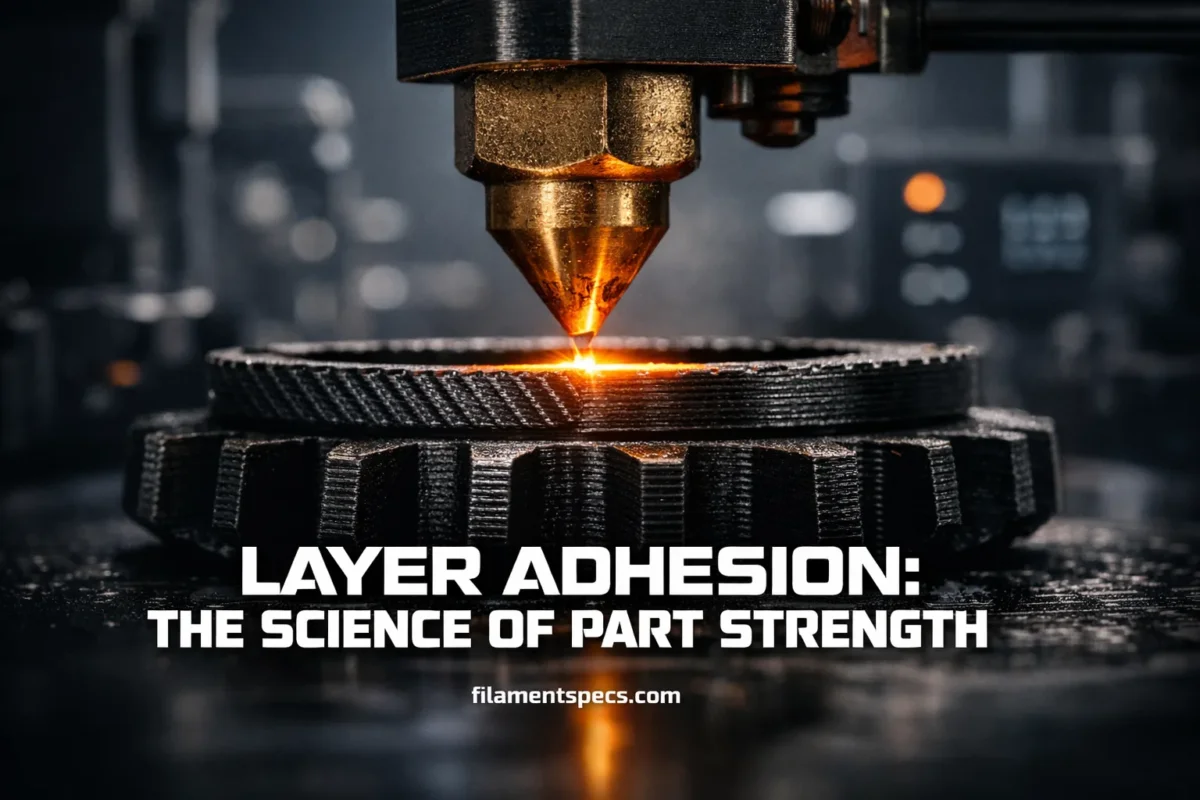
Layer adhesion decides whether a printed part behaves like one body or like a stack of thin roads that only look connected. Additive manufacturing is, by definition, a process that builds 3D geometry by successive addition of material.[a] In filament printing, the real strength question starts at the interface: a fresh bead must wet the surface below, stay warm enough for chain motion, and form enough entanglement before that interface freezes by glass formation or crystallization.[b]
Table of Contents
| Lever | What It Changes | What Usually Helps | What to Watch |
|---|---|---|---|
| Nozzle Temperature | Interface temperature and time available for chain motion | Raise it within the safe material window so the bead wets and fuses better[e] | Too high can soften details, raise stringing, or overheat the polymer |
| Layer Height | Contact width, number of welds, and void distribution | Thinner layers often give a stronger interface and denser packing[d] | Print time rises, and some materials stop gaining after a point |
| Print Speed | Wetting time, reheating, and thermal gradient | Moderate speed usually leaves more time for fusion[d] | Very fast moves can create under-extrusion and porosity |
| Bed or Chamber Temperature | Cooling rate of the lower layer and the weld zone | Warm surroundings help keep the interface mobile for longer[f] | Material response differs; some polymers also change crystallinity[e] |
| Flow and Bead Overlap | Real contact area and void content | Enough flow to avoid gaps and weak seams[d] | Too much flow hurts dimensions and surface quality |
| Moisture Control | Melt viscosity, bubble formation, and surface defects | Dry spools before printing, especially hygroscopic materials[j] | Wet filament can foam, pit, and weaken the interface |
| Part Orientation | Whether the service load follows roads or tears across layers | Place the part so the main load path stays within layers when possible[g] | A pretty orientation may be a weak orientation |
- The Physics in Plain English
- Good bonds need heat, wetting, contact area, and time for polymer chains to move.
- Where Strength Is Lost
- Weak welds usually come from fast cooling, residual orientation, voids, or moisture-driven defects.
- What Makes a Print Feel Strong
- Low porosity, broad bead contact, and a load path that does not peel layers apart.
🧪 What Layer Adhesion Really Means
In filament printing, each extruded line is a small welded joint. That is the useful mental model. The nozzle does not merely place plastic; it creates a moving weld line between the fresh bead and the surface below.
Part strength is therefore not controlled by the bulk filament alone. A spool may have a nice data sheet and still produce a weak part if the interface quality is poor. This is why two prints made from the same filament can fail very differently. One snaps across the whole section. Another unzips neatly along a layer plane.
Researchers studying polymer AM describe bond formation in terms of interdiffusion and re-entanglement. If adjacent layers do not exchange enough chain segments before they freeze, the bond remains shallow, and the part keeps a laminated character instead of acting like a nearly uniform solid.[b]
🔥 What Happens at the Weld Zone
The weld zone is the thin region where one layer meets the next. It is small, but it rules a large share of the mechanical story. For amorphous thermoplastics, chain mobility drops hard below the glass transition region. For semi-crystalline thermoplastics, diffusion is also cut short when crystallization starts to lock chains into ordered regions.[e]
This is why thermal history matters so much. A hotter bead or a warmer local environment keeps the interface alive for longer. More time above the mobility window means more diffusion. More diffusion usually means a tougher bond.
A PLA study linked mechanical behavior to interlayer diffusion and found low crystallinity in the printed samples, which means the parts were governed more by bonding and entanglement than by crystal build-up. The same study also found poorer adhesion farther from the heated plate, where local elastic modulus dropped from about 500 MPa in the central region to about 220 MPa in the upper region of the specimen.[c]
Think of the print as a stack of thermal events, not a stack of lines. Every new pass reheats the layer below. That reheating can help or hurt, depending on polymer family, cooling rate, and how much time the interface spends in the useful bonding window.
📉 Why the Z Direction Is Often the Weak Link
The easy answer is “layers are weaker than roads,” but that is only the surface explanation. The deeper reason is that loading in the build direction asks the part to trust the weld line more than the bulk strand. If that weld line is shallow, porous, or partly frozen before chain movement finishes, the crack finds a simple path between layers.
Peer-reviewed work on FFF repeatedly describes poor fusion between successive layers as the source of weaker z-direction performance. In nylon copolymer printing, the interlayer interface is explicitly treated as a weld zone, and weak fusion there is tied to lower part properties compared with more traditional polymer processing routes.[e]
That is why orientation is not a cosmetic choice. A bracket printed upright may look efficient on the build plate, yet it can place the main service load right across the weakest planes. A different orientation can let shells and rasters carry more of the force inside the layer plane, where the material usually behaves better.
⚙️ Process Settings That Move Strength Up or Down
Nozzle Temperature Is a Bonding Lever, not Just a Flow Lever
Higher nozzle temperature usually helps because it improves wetting and lengthens the time before the interface falls below the mobility window. In semi-crystalline systems, a higher liquefier temperature can also remelt part of the previous layer locally, which helps diffusion at the interface.[e]
There is still a ceiling. Too much heat can blur geometry, swell corners, or overcook the polymer. The useful target is not “as hot as possible.” It is “hot enough to widen the bonding window without pushing the material into unstable behavior.”
Layer Height Changes More Than Surface Look
Layer height alters contact width, number of interfaces, and the shape of the load path. Thinner layers often give stronger parts because each new road has more opportunity to flatten, overlap, and create a wider bond region. A controlled PLA study reported that increasing layer thickness reduced tensile and flexural strength, while 0.1 mm layers paired with 58 mm/s print speed and 199 °C nozzle temperature produced smoother, better-bonded layers than the poorer set at 0.2 mm, 70 mm/s, and 195 °C.[d]
Speed Controls Time, and Time Controls Fusion
Fast printing shortens the period available for wetting and diffusion, and it raises the chance of under-extrusion if the hot end cannot keep up volumetrically. In the same PLA work, higher speed was tied to porosity and poorer bonding, while the mid-speed condition gave cleaner fracture surfaces and better tensile response.[d]
Bed and Chamber Temperature Set the Cooling Story
A warm bed helps early layers. A warm chamber helps the whole part. They do not do the same job. Bed heat mainly supports the lower region, while chamber control reduces thermal shock across a larger height range.
For high-temperature composites, the effect can be huge. In one CF/PEEK study, a heated print chamber at 230 °C raised layer-to-layer tensile strength by more than five times, from 6.96 MPa to 36.28 MPa. That result belongs to a demanding composite system, not a casual desktop PLA setup, but it shows how much cooling control can matter when bonding is the limit.[f]
Flow, Bead Shape, and Voids Quietly Decide Real Contact Area
A slicer can display 100% infill and still leave a print full of weak internal geometry if the actual extrudate shape and overlap are wrong. The bond cares about real contact area, not nominal intent. Under-extrusion, unstable diameter, and poor overlap leave voids that turn into stress risers.
That is one reason a slightly thicker line width or a carefully tuned flow multiplier can help part strength more than a random jump in infill percentage. The strongest gains often come from better shell continuity and fewer internal gaps, not from decorative density changes.
Moisture Can Break the Interface Before the Part Even Forms
Wet filament does not only make noisy extrusion. It changes the melt. In a recent nylon study, even the virgin filament contained about 1 wt.% water, and material held at 40 °C and 80% RH reached roughly 5.5 wt.% moisture after 72 hours without clear saturation. The resulting strands showed surface defects, bubble-driven damage, lower viscosity, and poorer morphology as moisture content rose.[j]
If the spool is hygroscopic, drying is part of the print profile. It is not a side chore. Nylon needs the most attention, but many engineering filaments and fiber-filled grades also punish loose storage.
🧵 Filament Behavior by Polymer Family
Low-Crystallinity PLA
PLA is often treated as “easy,” yet easy printing and strong interlayer welding are not identical. In the PLA study cited above, crystallinity stayed below 3%, and part strength tracked bond quality and entanglement more than crystal build-up. That makes PLA a good example of how a friendly filament can still produce weak z-strength if the thermal window is poorly tuned.[c]
Semi-Crystalline Nylons, PEEK, and Similar Grades
These materials add another timing problem: crystallization can shut the door on diffusion. Once the interface cools to crystallization onset, chain movement becomes much more limited. That means nozzle temperature, interlayer time, and environmental heat control matter even more than they do in many amorphous systems.[e]
The reward is clear. When managed well, these polymers can produce parts with excellent chemical and thermal usefulness. When managed badly, they punish the weld line early.
Fiber-Filled Filaments
Filled filaments bring stiffness, dimensional stability, and sometimes better heat resistance, but they also narrow the process window. Fibers can disturb interfacial continuity, and porosity at layer interfaces becomes a larger issue. The CF/PEEK chamber-heating example shows that strong printed composites usually demand better thermal control than ordinary desktop conditions provide.[f]
Material Choice and Layer Adhesion Are Not the Same Decision
A filament can have high bulk strength on paper and still print weak parts if its weld window is narrow, its moisture handling is poor, or its cooling profile is wrong. When choosing a material, ask two separate questions: How strong is the polymer itself? and How easy is it to form a good weld on my machine?
🧱 Part Design Choices That Matter as Much as Print Settings
A strong print begins in CAD. Slicer tuning cannot fully rescue a geometry that peels layers apart by design.
- Place the part so the main service load runs along shells and roads as much as possible, not straight across layer planes.
- Use generous fillets at root sections. Sharp internal corners invite crack start and crack turning into the weld line.
- Prefer more perimeter support for loaded walls instead of chasing a high infill number alone.
- Reduce unsupported tall thin regions that cool fast and receive little reheating from later passes.
- Keep bead continuity in mind. A part with many tiny segmented roads often has more start-stop defects than a part with longer clean paths.
The design question is simple: where will the crack want to go? If the answer is “right between layers,” the print is asking too much from the weakest zone.
📏 How to Measure Strength Without Fooling Yourself
Many printed part comparisons are not really material comparisons. They are mixed comparisons of material, part orientation, bead layout, specimen shape, humidity, and test speed. That is why proper reporting matters.
For tensile testing, ASTM D638 is the common plastics method and explicitly notes that results vary with specimen preparation, test speed, and environment; the standard also uses defined dumbbell-shaped specimens under controlled conditions.[h] ISO 527-1 serves the same wider purpose on the ISO side, covering general principles for tensile behavior of plastics and plastic composites under defined conditions.[i]
Orientation reporting should also be standardized. ISO 17295 exists for part positioning, coordinates, and orientation in additive manufacturing so test results are reported in a way others can repeat and compare.[g]
NIST has pointed out that polymer AM still needs better ways to quantify filament adhesion to previous layers and to track localized thermal history during printing. That is exactly why casual “I pulled it by hand and it felt strong” testing tells very little.[k]
When comparing strength data, always check these fields: material brand and grade, nozzle size, layer height, print temperature, speed, chamber or enclosure condition, specimen orientation, test standard, and humidity handling before printing.
❓ Common Questions About Layer Adhesion
What Causes Poor Layer Adhesion in 3D Printing?
Usually one of four things: the interface cools too fast, the bead does not wet the layer below, the print carries too many voids, or the filament arrives wet and unstable. Poor orientation then makes the weakness easy to expose under load.
Does Higher Nozzle Temperature Always Improve Bonding?
No. It often helps, because it extends the bonding window, but only inside the safe range for the polymer. Above that range, shape control, dimensional accuracy, and even polymer health can go the wrong way. The useful move is controlled heat, not blind heat.
Does Smaller Layer Height Make a Part Stronger?
Very often, yes. Thinner layers can widen the effective contact region and reduce empty space between layers. A controlled PLA study found lower tensile and flexural performance as layer thickness increased, which fits the weld-area explanation.[d]
Why Are FDM Parts Often Weaker in the Z Direction?
Because z-loading depends more on interlayer weld quality than on the bulk strand itself. If the weld is shallow or porous, cracks can travel along that plane more easily than through a continuous road.
Can Annealing Improve Part Strength?
It can help some materials, mainly by changing crystallinity and heat resistance, but it is not a repair method for empty welds or wet-print defects. If the interface formed poorly during printing, annealing cannot fully rebuild that lost entanglement network.
Which Is Better for Strength: More Infill or Better Walls?
For many loaded parts, wall continuity matters more. Continuous perimeters build a cleaner load path than a fancy infill pattern with weak shell bonding. Infill still matters, but shells usually meet the highest stress first.
FAQ
What is layer adhesion in filament printing?
It is the bond strength between one deposited layer and the next. In practice, it reflects how well the fresh bead wets, fuses with, and entangles into the layer below.
Why do printed parts split along layer lines?
Because the interface can be weaker than the bulk strand. Fast cooling, low interface temperature, voids, wet filament, or an unfavorable part orientation make that split easier.
Is layer adhesion the same as first-layer bed adhesion?
No. Bed adhesion is the bond between the print and the build surface. Layer adhesion is the bond between printed layers inside the part.
Does drying filament really affect part strength?
Yes, especially for hygroscopic materials such as nylon. Moisture can create bubbles, unstable extrusion, surface defects, and weaker internal interfaces.
Should I print hotter or slower for stronger parts?
Usually both are tuned together. A slightly hotter and slightly slower profile often improves fusion, but each material has a safe window that should not be exceeded.
How should I compare strength results between two filaments?
Use the same geometry, same print orientation, same humidity control, same layer height, same nozzle, and the same tensile standard. Without that, the comparison is mixed and unreliable.
Sources and Notes
- [a] Used for the base additive manufacturing definition and the layer-by-layer wording. (Reliable because it is the ASTM-hosted ISO/ASTM 52900 terminology standard.)
- [b] Used for the explanation that adjacent strands must interdiffuse and entangle before freezing by glass formation or crystallization. (Reliable because NIST is the U.S. national metrology institute and this page summarizes active polymer AM measurement work.)
- [c] Used for PLA interlayer adhesion, low crystallinity during FFF, and the modulus difference measured across specimen regions. (Reliable because it is a peer-reviewed open-access paper archived by PubMed Central.)
- [d] Used for the PLA process window example showing 0.1 mm layer height, 58 mm/s print speed, and 199 °C as the better-performing condition in that study. (Reliable because it is a peer-reviewed open-access paper archived by PubMed Central.)
- [e] Used for the weld-zone concept, the role of glass transition and crystallization onset, and the effect of liquefier temperature on interlayer diffusion. (Reliable because it is a peer-reviewed open-access paper archived by PubMed Central.)
- [f] Used for the heated-chamber CF/PEEK case where layer-layer tensile strength rose from 6.96 MPa to 36.28 MPa. (Reliable because it is a peer-reviewed journal article hosted by ScienceDirect.)
- [g] Used for part positioning, coordinates, and orientation reporting in additive manufacturing. (Reliable because it is the official ISO page for ISO 17295:2023.)
- [h] Used for tensile testing scope, specimen form, and the warning that preparation, speed, and environment affect results. (Reliable because it is the official ASTM page for ASTM D638-22.)
- [i] Used for the ISO-side general principles for tensile testing of plastics and plastic composites. (Reliable because it is the official ISO page for ISO 527-1:2019, confirmed current in 2025.)
- [j] Used for nylon moisture uptake, the roughly 5.5 wt.% value after 72 hours at 40 °C and 80% RH, and the observed bubble-related strand defects. (Reliable because it is a peer-reviewed journal article with full experimental details.)
- [k] Used for the measurement need to quantify filament adhesion to previous layers and localized thermal history in polymer additive manufacturing. (Reliable because it is a NIST measurement science roadmap.)