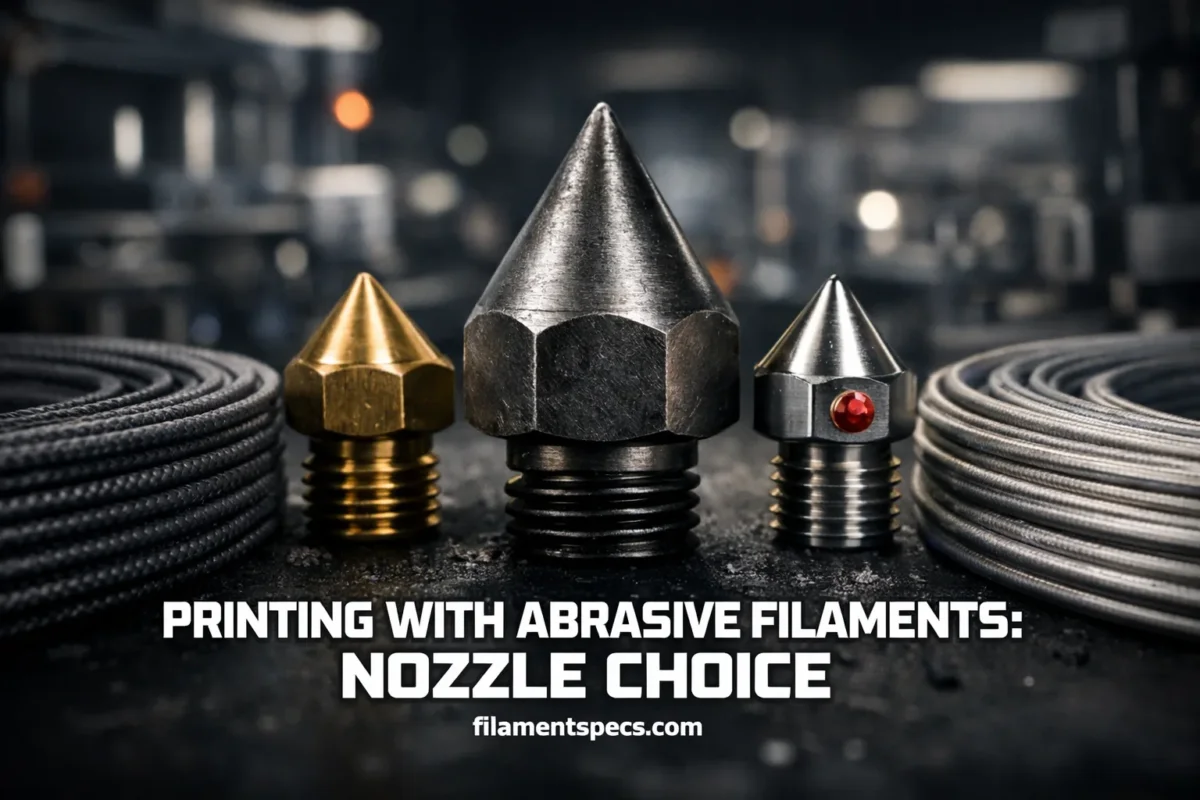
Printing abrasive filaments stops being simple the moment hard particles start scraping the inside of the nozzle. Carbon fiber, glass fiber, glow additives, metal powder, wood flour, and ceramic or mineral fillers do not all behave the same way, so the right nozzle is not just a material choice. Diameter, hotend compatibility, heat transfer, and how often you run these blends matter just as much. Prusa’s nozzle documentation makes the first part very clear: brass transfers heat very well, but abrasive filaments wear it fast.[a]
| Filament Family | What Causes Trouble | Wear Risk to Brass | Safer Nozzle Starting Point | Diameter That Usually Gives Fewer Problems | What to Expect in Practice |
|---|---|---|---|---|---|
| Carbon Fiber Filled | Short chopped fibers abrade the bore and can raise clog risk in small nozzles. | High | Hardened steel or coated wear-resistant steel | 0.6 mm is usually the safest place to start | Stiffer feel, matte finish, lower warp on some blends, less fine detail than plain base resin |
| Glass Fiber Filled | Hard fibers wear the nozzle and can jam small openings. | High | Hardened steel or premium abrasion-resistant nozzle | 0.6 mm is commonly preferred | Good dimensional stability on many engineering blends, but the nozzle path must stay clean |
| Glow in the Dark | Glow particles are abrasive even when the base polymer prints like standard PLA or PETG. | High to Very High | Hardened steel minimum | 0.6 mm preferred when the blend is coarse | Easy to underestimate because the base resin feels familiar |
| Metal Filled | Metal powder raises wear and may also make flow heavier. | High | Hardened steel, coated tool steel, carbide, or diamond-tipped | 0.4 mm to 0.6 mm depending on the filler and brand | Decorative surface and weight gains are common; flow is not as forgiving as plain filament |
| Wood Filled | Larger particles raise clog risk more than raw abrasion in many cases. | Medium | Wear-resistant nozzle is nice; larger diameter matters even more | 0.6 mm minimum is the safer default | Texture can look great, but tiny details and thin walls can get messy fast |
| Ceramic or Mineral Filled | Hard fillers can wear the bore and roughen the flow path over time. | Medium to High | Hardened steel or premium wear-resistant nozzle | Usually 0.4 mm to 0.6 mm, depending on filler size | Often better treated like an engineering composite than a normal decorative filament |
Across official manufacturer guidance, two patterns repeat: abrasion resistance matters for filled filaments, and 0.6 mm is often the calmer choice once fibers or coarse particles enter the mix.[c]
A safe starting setup: if you are not sure what to buy for abrasive work, start with a 0.6 mm hardened steel nozzle that matches your hotend standard exactly. It is usually the cleanest balance between wear resistance, flow stability, cost, and spare-part availability.
Table of Contents
🧪 What Makes a Filament Abrasive
A filament becomes abrasive when the additives inside it are harder than the nozzle material and keep sliding across the inner bore under pressure. That is why a blend can print at almost the same temperature as plain PLA or PETG and still eat through a soft nozzle. The base polymer sets the temperature window. The filler decides how harsh the ride is.
Carbon fiber and glass fiber blends are the examples most people think about first, and for good reason. Bambu’s material pages repeatedly recommend a 0.6 mm nozzle for carbon- and glass-fiber filaments because these blends raise the chance of clogging in addition to wearing the nozzle.[c]
Glow filament is the sneaky one. It often looks like a harmless novelty spool because the base resin can be ordinary PLA or PETG, yet the glow particles are abrasive enough that both Prusa and Bambu call for a hardened nozzle on their glow products. That catches many users after they already widened a brass 0.4 mm nozzle and start wondering why the printer suddenly over-extrudes on normal PLA.[g]
Wood-filled and metal-filled filaments need to be split apart, not lumped together. Wood blends are often more about particle size and clog risk than raw wear alone. Metal-filled blends do both: they can clog more easily and they can wear the nozzle fast. Prusa’s material notes make that difference plain by recommending hardened steel for metal-filled materials and at least a 0.6 mm nozzle for wood-filled and other coarse-particle composites.[d]
What Most Buyers Miss
- Abrasive and clog-prone are related, but they are not the same thing.
- A 0.4 mm nozzle can still work for some filled filaments, especially when the brand provides a tuned profile.
- Once the filler is coarse, a larger opening often fixes more problems than another slicer tweak.
- Printer compatibility still comes first: V6, MK8, Revo, Nextruder, and Bambu hotend families are not interchangeable just because the nozzle material sounds right.[a]
🔩 Which Nozzle Material Fits Which Job
The default choice for ordinary printing is still brass. It heats easily, prints cleanly, and is cheap enough to keep as a spare. It is also the wrong answer for regular abrasive printing. Prusa’s nozzle notes and hardened steel product page both say the same thing in plain language: abrasive filaments wear a standard brass nozzle quickly.[b]
| Nozzle Material | Best Use Case | Heat Transfer | Abrasion Resistance | Price Level | Who It Fits Best |
|---|---|---|---|---|---|
| Brass | PLA, PETG, ABS, ASA, TPU, standard daily printing | Very good | Low | Low | Users who rarely touch filled or glow filaments |
| Hardened Steel | First upgrade for CF, GF, glow, metal-filled, mineral-filled | Lower than brass | High | Low to Medium | Most hobby and workshop users printing abrasive spools now and then |
| Coated Tool Steel | Abrasive printing with better stick resistance and longer service life | Better than plain steel in many premium designs, but varies by nozzle | High to Very High | Medium to High | Users who print abrasive blends often enough to care about downtime |
| Tungsten Carbide or Diamond-Tipped | Frequent abrasive work, long runs, fewer swaps, premium setups | Often better than plain hardened steel, depending on design | Very High | High | Production-minded users and anyone tired of treating nozzles like consumables |
Hardened steel is the baseline recommendation because it solves the biggest problem first: fast wear. That alone makes it the safest upgrade for most people. There is one catch. Steel does not move heat like brass, and Prusa explicitly notes that you may need to raise hotend temperature by about 5°C when switching to hardened steel.[b]
Coated wear-resistant nozzles sit one step above that. Products such as Nozzle X are built around hardened tool steel with surface treatments aimed at long life and lower sticking. They are not magic, though. You still need the right diameter and the right hotend geometry, and you still need to keep filled filament dry enough to avoid extra friction and partial clogs.[j]
Buy by printing pattern, not by hype. One spool of glow PLA each season does not call for a luxury nozzle. Weekly PA-CF, PET-CF, or metal-filled printing usually does.
📏 Where a 0.4 mm Nozzle Still Works and Where 0.6 mm Wins
Diameter is where many articles go too flat. They say “use hardened steel,” then stop there. That is only half the decision. A tiny abrasion-resistant nozzle can still clog if the filler is coarse enough, and a larger nozzle can often turn a frustrating filament into a routine one.
For carbon- and glass-fiber blends, 0.6 mm is usually the smarter first choice. Bambu states this directly on several CF and GF material pages because the wider opening lowers the chance of clogging. That does not mean 0.4 mm is impossible; it means 0.6 mm gives you more margin when the blend, drying, or flow rate is not ideal.[c]
Prusa’s own composite guidance lands in a similar place, but with a useful nuance. For carbon, kevlar, and glass composites, Prusa notes that 0.4 mm is the lowest optimal diameter. For wood-filled and other coarse-particle composites, the advice becomes more conservative: use at least 0.6 mm to reduce clogging.[d]
- 0.4 mm
- Use it when the filament maker supports it, detail still matters, and the filler is fine enough to flow cleanly.
- 0.6 mm
- The best default for most abrasive blends. It trades a little fine detail for calmer extrusion and fewer clogs.
- 0.8 mm
- Useful for chunky wood blends, heavy-filled decorative materials, or large functional parts where reliability matters more than sharp detail.
There is one diameter to avoid for abrasive work on many consumer printers: 0.2 mm. Bambu’s 0.2 mm nozzle FAQ says the small stainless-steel nozzle is not abrasion resistant and should not be used for carbon-fiber-infused materials or other particle-loaded filaments.[f]
💎 Where Premium Nozzles Earn Their Price
If you print abrasive filaments once in a while, a normal hardened steel nozzle is enough. Premium nozzles start to make sense when the printer sees abrasive material often, when downtime is costing you time, or when you want better heat behavior than plain steel usually gives.
That is where coated tool steel, tungsten carbide, and diamond-tipped designs come in. Slice Engineering markets its DiamondBack nozzle as a nozzle with best-in-class thermal conductivity that can print from standard PLA to abrasive carbon-fiber blends. Whether you choose that exact product or another premium design, the bigger idea is the same: less wear without giving up so much heat transfer.[i]
Premium nozzles also make more sense on printers already built for harder service. Bambu’s abrasive upgrade notes for the P1S are a good example: the stock stainless setup is fine for standard materials, but hardened steel parts are the recommended path when abrasive filaments enter the picture. A strong nozzle is nice. A strong nozzle paired with a feeder path that can handle the same abuse is better.[e]
- Choose premium when abrasive printing is part of your normal weekly workflow.
- Choose premium when you want fewer nozzle swaps and less recalibration.
- Choose premium when you print filled engineering filaments hot and fast enough that plain hardened steel starts to feel limiting.
⚙️ What Changes After You Swap the Nozzle
Changing the nozzle material without touching settings is one of the easiest ways to get confused by abrasive filament. The printer still moves the same. The slicer still looks familiar. The melt behavior at the tip can be different enough to change the result.
- Retune nozzle temperature. With hardened steel, start a little warmer than your brass profile. Prusa gives a simple baseline: about +5°C may be needed.[b]
- Lower your expectations for tiny details if you moved from 0.4 mm to 0.6 mm. Reliability is the trade.
- Recheck flow and pressure behavior. If the filament was on the edge of clogging before, a bigger nozzle may let you reduce pressure and print more calmly.
- Keep the filament dry. Wet filled filament can add bubbling, rough extrusion, and extra deposits that look like nozzle problems even when the nozzle is fine.
- Confirm the feeder path. On some printers, abrasive work also calls for hardened extruder gears or a hardened extruder assembly, not just a hardened nozzle.[e]
One easy mistake: people blame the filament first. The real problem is often a mismatch between small nozzle diameter, abrasive filler, and settings tuned for brass.
🛠️ Wear Signs You Should Not Ignore
Nozzles usually do not fail with a dramatic break. They drift. The bore wears, the opening changes shape, or residue and filler start acting like a partial clog. The print slowly gets harder to trust.
Bambu’s maintenance guidance says abrasive materials can wear the hotend enough to justify replacement, and its abrasive upgrade notes say worn nozzles may develop irregular or enlarged openings that lead to inconsistent extrusion, weaker layer bonding, and lower print quality. Prusa’s clog guides add a second layer of warning signs: filament curling at the nozzle during loading, gaps, missing layers, and extruder clicking are all signs that the nozzle path needs inspection.[h]
- Line width looks fatter than expected even when the slicer profile has not changed.
- Small holes close up more than they used to.
- Top surfaces look rougher with the same filament and same profile.
- The printer begins to click, skip, or curl filament during a free-air extrusion test.
- You clear one “clog,” then get another one soon after.
Do not keep pushing an abrasive spool through a nozzle that is already acting strange. Once the bore shape drifts, the printer can look like it has a slicer problem, a flow problem, or a moisture problem all at once.
🧵 Nozzle Choice by Filament Family
Carbon Fiber Filled PLA, PETG, PA, PPA, or PPS
Start with a 0.6 mm hardened steel nozzle. Move to coated tool steel or a premium carbide or diamond option if carbon-fiber printing is part of your routine. Drop to 0.4 mm only when the brand supports it and detail matters enough to accept narrower flow margin.[c]
Glass Fiber Filled Engineering Filaments
Treat these much like carbon fiber, but stay even more careful with small nozzles. 0.6 mm remains the safer default, and a hardened feeder path matters if your printer maker calls for it.[e]
Glow in the Dark PLA or PETG
Do not let the familiar base polymer fool you. Use a hardened nozzle. Prusa’s Ultraglow notes go further and recommend 0.6 mm, with standard non-high-flow nozzles often working better for that filament than chasing fancy flow tricks.[g]
Wood Filled Filament
The bigger concern is often particle size. A 0.6 mm nozzle is the safer default, and 0.8 mm can make life easier on chunky blends. A brass nozzle may survive longer here than it would on carbon fiber, but the larger opening still does more for print stability than gambling on a tiny wear-resistant nozzle.[d]
Metal Filled Decorative Filaments
Use a hardened nozzle at minimum. If you print them often, premium wear-resistant nozzles make more sense because these filaments can abrade the bore while also asking for smoother flow. Detail lovers can try 0.4 mm, but 0.6 mm is less stressful if the filler is heavy.[d]
Ceramic, Mineral, and Other Specialty Filled Blends
Read the manufacturer sheet first. If the brand is vague, treat the spool like an abrasive composite: hardened steel, careful drying, moderate flow, and a willingness to move up to 0.6 mm if the material feels rough or unstable through a 0.4 mm path.
Three Buying Paths That Usually Work
- Occasional abrasive printing: 0.6 mm hardened steel.
- Regular workshop use: 0.6 mm coated tool steel or premium hardened nozzle.
- Frequent abrasive production: premium carbide or diamond-tipped nozzle sized for the part detail you actually need.
Sources and Notes
- Prusa Knowledge Base — Different Nozzle Types. Used for brass heat transfer, abrasive wear risk, and hotend compatibility context. (Official manufacturer support documentation.)
- Prusa Store — Hardened Steel Nozzle E3D V6 0.4 mm. Used for hardened steel guidance, abrasive filament examples, and the note about raising hotend temperature by about 5°C. (Official manufacturer product documentation.)
- Bambu Lab Wiki — PET-CF / PPA-CF / PPS-CF / PA6 CF Usage Guide. Used for the recommendation that 0.6 mm nozzles give better performance on carbon- and glass-fiber blends. (Official manufacturer material guide.)
- Prusa Knowledge Base — Composite Materials With Metal or Wood Particles. Used for metal-filled hardened-nozzle guidance and the 0.6 mm recommendation for wood-filled and other coarse-particle composites. (Official manufacturer material guide.)
- Bambu Lab Wiki — P1S Abrasive Filament Extruder Upgrade Guide. Used for the distinction between stock stainless parts for standard filaments and hardened upgrades for abrasive work. (Official manufacturer upgrade documentation.)
- Bambu Lab Wiki — Printing With 0.2 mm Nozzles FAQ. Used for the note that the 0.2 mm stainless nozzle is not abrasion resistant and should not be used with particle-loaded abrasive filaments. (Official manufacturer support page.)
- Prusa Knowledge Base — Prusament PETG Ultraglow Troubleshooting. Used for hardened-nozzle and 0.6 mm recommendations on a very abrasive glow filament. (Official manufacturer material troubleshooting page.)
- Prusa Knowledge Base — Clogged Nozzle. Used for warning signs such as inconsistent extrusion, curling filament, gaps, missing layers, and extruder clicking. (Official manufacturer troubleshooting documentation.)
- Slice Engineering — DiamondBack Nozzle. Used for premium abrasion-resistant nozzle positioning and the claim of strong thermal behavior with abrasive materials. (Official manufacturer product page.)
- Prusa Store — Nozzle X E3D V6. Used for coated tool-steel nozzle positioning, longevity, and abrasive-filament suitability. (Official manufacturer product documentation.)
❓ FAQ
Does carbon fiber filament always need a 0.6 mm nozzle?
No. Some carbon-fiber filaments run on 0.4 mm nozzles when the brand supports it and the filler is fine enough. A 0.6 mm nozzle is still the safer default because it gives more room for fibers to pass and usually lowers clog risk.
Is hardened steel enough, or should I buy carbide or diamond right away?
For most users, hardened steel is enough. Move to carbide or diamond-tipped nozzles when abrasive printing is frequent, downtime matters, or you want better thermal behavior and longer life from the same nozzle.
Why do people raise temperature after switching from brass to hardened steel?
Because brass transfers heat more easily than hardened steel. With plain hardened steel, the nozzle tip may not pass heat into the filament as quickly, so a small temperature increase often restores smoother flow.
Can glow-in-the-dark PLA damage a brass nozzle?
Yes. Glow additives are abrasive. Even when the base polymer feels like normal PLA, the particles can wear a brass nozzle fast enough to change print quality and effective nozzle size.
Is a larger nozzle only about avoiding clogs?
No. A larger nozzle also lowers pressure in the melt path, which can make filled filaments feed more calmly. The trade is less fine detail and wider extruded lines.
What is the best default nozzle for someone who prints many different abrasive spools?
A 0.6 mm hardened steel nozzle is usually the easiest starting point. It fits the widest range of abrasive filaments without turning every new spool into a troubleshooting project.