| Point | Shore A | Shore D | Why It Matters for Filament |
|---|---|---|---|
| Best Fit | Softer elastomers, rubber-like grades, many flexible TPU and TPE materials | Harder plastics, semi-rigid polymers, hard TPU, and rigid printable materials | It tells you which side of the hardness spectrum the material belongs to before you even look at print settings. |
| Scale Range | 0 to 100 A | 0 to 100 D | The number looks familiar, but the scale is different. A 95A and a 95D are not close to each other. |
| Test Logic | Indentation hardness with a durometer matched to softer materials | Indentation hardness with a durometer matched to harder materials | Shore hardness is an indentation reading, not a full mechanical profile. |
| Reading Style | Used when the surface can deform easily under a softer probe setup | Used when the material needs a harder-scale setup to avoid a misleading reading | The chosen scale affects the number, so scale selection is part of the result. |
| What It Often Means in 3D Printing | Grip, damping, seals, sleeves, wearable contact, bendable parts | Wheels, guards, housings, guides, clips, stiff protective parts | You can connect the hardness scale to part behavior faster, especially when comparing TPU grades. |
| Most Common Mistake | Assuming a high A number is the same as a D number with the same digits | Assuming Shore D alone tells you toughness, impact resistance, or brittleness | It does not. Hardness is one property. It must be read with the rest of the datasheet. |
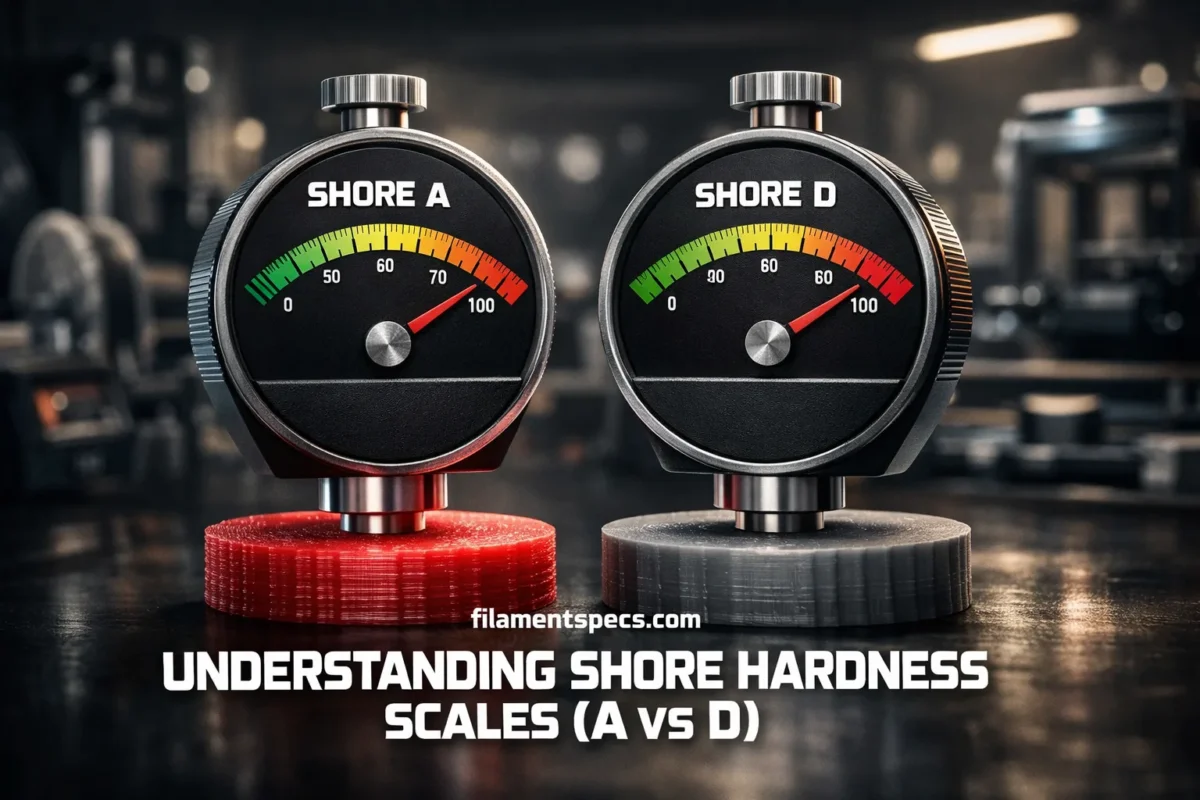
Shore hardness is one of the most useful numbers in a filament datasheet, but it is also one of the easiest to misread. The headline idea is simple: Shore A is used for softer materials, while Shore D is used for harder ones. The part that causes confusion is the overlap zone, where a flexible filament can be described on both scales, and where the same printed part can feel much stiffer or much softer than the headline number suggests.[a]
Table of Contents
🧪 What Shore Hardness Measures
Shore hardness measures how much a material resists indentation under a defined durometer setup. That sounds technical, but the practical reading is clear: the number tells you how easily a surface yields when pressed under a standard method. A lower value means easier indentation. A higher value means stronger resistance to that indentation.[b]
This matters because many filament buyers treat the number as a full description of flexibility. It is not. Hardness is only one part of the picture. It does not replace tensile modulus, elongation, rebound, impact behavior, abrasion resistance, wall thickness, or part geometry. A material can have a soft feel and still resist wear very well. Another can be fairly hard and still flex if the part is thin enough.
Useful reading rule: Shore hardness tells you how a surface resists a standard push. It does not tell you everything about how a printed part bends, returns, grips, or survives repeated use.
Why This Number Appears So Often
In polymer and filament listings, hardness is fast to communicate and easy to compare inside the same family. That is why flexible filament pages often put Shore values near the top. It gives a quick signal about whether the material feels closer to a shoe sole, a wheel tread, a bendable sleeve, or a stiffer engineering part. It is a practical filter. Just not a complete one.
📏 Where Shore A and Shore D Split
ISO 868 states the split plainly: type A is used for softer materials, while type D is used for harder materials. That is the cleanest way to think about it. When the material is soft and rubber-like, Shore A is usually the natural language. When the material becomes much stiffer, Shore D becomes the better fit.[c]
The catch is the transition zone. Some materials live near the border. Hard TPU is the classic example. At that point, manufacturers may report the same material on the A scale, the D scale, or both. That is not a contradiction. It is the overlap doing exactly what overlap does.
- Shore A is the language most people see on soft and medium-flex filaments.
- Shore D becomes more useful as the material shifts toward semi-rigid and rigid behavior.
- Borderline materials may be described both ways, especially when the product is flexible in use but no longer feels soft in the hand.
A Better Way to Think About the Split
Do not treat Shore A and Shore D as two rival systems. Treat them as two matched measuring zones. One covers softer surfaces well. The other covers harder ones well. The number only makes sense when the letter travels with it.
🔄 Why Two 95s Are Not Equal
The biggest reading error is this: seeing 95A and assuming it sits near 95D because the digits match. That is wrong. ASTM D2240 is explicit that readings from one durometer type do not have a simple relationship to readings from another type, because the indenter geometry and applied force change with the durometer type.[a]
That single detail fixes a lot of confusion. A Shore number is never just a number. It is always number plus scale. So 85A, 95A, 48D, and 75D belong to different reading contexts even before you start talking about part design.
Read it like this: 95A is a hard reading inside the A family. 95D is a hard reading inside the D family. They are not interchangeable labels.
The Overlap Zone Is Real
Near the upper end of Shore A and the lower-middle end of Shore D, the two scales begin to describe materials that sit in the same real-world neighborhood. That is why some hard TPU grades can appear as high A numbers or mid D numbers. The important move is not to force a perfect conversion. The important move is to recognize that the material is crossing from soft-elastomer language into hard-elastomer or semi-rigid language.
🧵 Filament Examples That Make the Scales Easier to Read
| Filament Example | Published Hardness | What the Listing Tells You |
|---|---|---|
| UltiMaker TPU 95A | 96 Shore A and 48 Shore D | The same material can sit on both scales near the overlap. This is one of the clearest real-world reminders that scale letter matters as much as the number. |
| NinjaTek NinjaFlex | 85A | Soft flexible zone. Better for stretch, grip, and comfort than for rigid feel. |
| NinjaTek Cheetah | 95A | Harder flexible zone. Often a friendlier entry point for users who want TPU without the softest feeding behavior. |
| NinjaTek Armadillo | 75D | This is a very hard member of the flexible family, useful when wear resistance and shape retention matter more than squeeze feel. |
UltiMaker’s TPU 95A data sheet is especially useful because it publishes both values for the same material: 96 Shore A and 48 Shore D.[d]
NinjaTek’s comparison page is also revealing because it places soft, medium, hard, and very hard flexible products on one lineup: 75A, 83A, 85A, 90A, 95A, and 75D.[e]
What This Means for Common Filament Families
- Soft TPU and TPE usually live comfortably on Shore A.
- Hard TPU often sits in the overlap and may be shown as high A, mid D, or both.
- Rigid engineering filaments are read much more naturally on the D side when Shore is used at all.
A Simple Visual Map
🛠️ Why Printed Parts Can Feel Harder or Softer Than the Number
This is where many articles stop too early. A hardness value belongs to the material under a defined test. A printed part adds wall count, infill, shell thickness, pattern, orientation, local geometry, and feature size. So the hand-feel of the final object can drift far away from what beginners expect from the raw Shore number.
Prusa’s flexible-material guidance points to this directly: more infill and more perimeters can improve resistance, while fewer perimeters and lighter sections help preserve flexibility.[f]
- Thick walls make the same material feel stiffer.
- Thin sections make the same material feel softer and easier to bend.
- Dense infill pushes the part toward firmness and shape retention.
- Sparse infill lets the material show more of its natural compliance.
- Small features can feel much more rigid than broad, thin surfaces made from the same spool.
Important design point: a 95A TPU phone bumper, a 95A hinge strap, and a 95A thick machine foot will not feel the same in the hand. The material is the same. The structure is doing extra work.
Why Soft Filament Also Gets Harder to Print
As flexible filament gets softer, it tends to become less cooperative in the feed path. Prusa’s general flexible-material notes mention slower print speeds, higher print difficulty, stringing, poor bridging, moisture sensitivity, and the need to manage idler pressure carefully. That is one reason many users start with harder flexible grades before moving into the softer end of the spectrum.[g]
📚 How to Read the Right Scale for Real Filament Decisions
If the product page shows Shore A, read it as a flexible-material signal first. If the page shows Shore D, read it as a harder-plastic signal first. If a product shows both, stop trying to force a single mental label and accept that the material sits in the overlap. That is usually a better reading than trying to convert everything into one favorite scale.
- Choose Shore A when the part needs bend, grip, compression, or skin-contact comfort.
- Choose Shore D when the part needs shape retention, stiffer support, abrasion-focused use, or a harder surface feel.
- Check both scales carefully for hard TPU or crossover materials.
- Read the rest of the sheet when durability matters. Hardness alone is not enough.
- Best Question to Ask First
- Do I need the part to bend, compress, grip, or stay shape-stable?
- Best Question to Ask Second
- Will the part be thick, thin, hollow, dense, or highly loaded in use?
- Best Question to Ask Third
- Does the datasheet also support the application with elongation, modulus, wear, chemical, or temperature data?
⚠️ Common Reading Mistakes
- Comparing numbers without the letter. A Shore value is incomplete without A or D.
- Assuming hardness equals stiffness in every printed shape. Geometry can change the feel of the same filament dramatically.
- Treating hardness as a full performance summary. Abrasion, tensile strength, tear behavior, and layer bonding still matter.
- Using Shore A language for rigid materials by habit. Some materials are better understood on the D side.
- Assuming a soft number always means hard printing failure. It raises difficulty, but printer path, idler tension, retraction, and speed still change the outcome.
The Most Practical Takeaway
Shore A tells you that you are in soft-material territory. Shore D tells you that you are in hard-material territory. The overlap zone is where the best questions begin, not where the data becomes useless.
❓ FAQ
Is Shore A Always Better for Flexible Filament?
No. Shore A is usually the more natural scale for softer flexible filament, but some hard TPU materials sit near the overlap and may be listed on Shore D as well.
Can I Convert Shore A to Shore D Exactly?
Not exactly. The test methods do not support a simple one-to-one conversion across durometer types, so the safest move is to read the published scale as given.
Why Can a 95A Filament Still Feel Fairly Stiff?
Because part thickness, wall count, infill, and shape can make the same material feel much firmer in the finished print than the raw Shore number suggests.
Is Hardness Enough to Choose a Filament?
No. It helps narrow the field, but you should also read elongation, modulus, abrasion resistance, temperature limits, chemical behavior, and printability notes.
Which Scale Is More Common in Flexible 3D Printing?
Shore A appears more often on soft and medium-flex TPU or TPE listings. Shore D becomes more common as the material moves toward hard TPU or rigid engineering behavior.
Sources
- [a] ASTM D2240-15(2021): Standard Test Method for Rubber Property—Durometer Hardness — Used for the method logic, the warning that readings from different durometer types do not have a simple relationship, and the scope of Shore durometer testing. (Reliable because ASTM is a primary standards organization and this is the formal test-method record.)
- [b] ISO 868:2003 — Plastics and Ebonite — Determination of Indentation Hardness by Means of a Durometer (Shore Hardness) — Used for the definition of Shore hardness as an indentation method and the note that it is an empirical control method rather than a full material-property replacement. (Reliable because ISO is an international standards body and this page is the official standard record.)
- [c] ISO 868:2003 — Plastics and Ebonite — Determination of Indentation Hardness by Means of a Durometer (Shore Hardness) — Used for the direct split between type A for softer materials and type D for harder materials. (Reliable because ISO publishes the authoritative standard metadata and abstract.)
- [d] UltiMaker TPU 95A Technical Data Sheet — Used for the real material example showing the same filament listed as 96 Shore A and 48 Shore D. (Reliable because it is a manufacturer technical data sheet with named test methods and published property values.)
- [e] NinjaTek Compare Filaments — Used for the lineup example showing flexible materials across 75A, 83A, 85A, 90A, 95A, and 75D. (Reliable because it is an official manufacturer comparison page for actual commercial filament grades.)
- [f] Prusa Knowledge Base: Flexible Materials — Used for the design point that infill and perimeters change how flexible a printed part feels. (Reliable because it is a technical support document from a major 3D printer manufacturer focused on print behavior and settings.)
- [g] Prusa Knowledge Base: Prusament TPU 95A Material Guide — Used for print settings, handling notes, temperature guidance, and practical printability details for a hard flexible TPU. (Reliable because it is an official product support guide tied to a named filament.)