| Print Variable | What It Changes | Why Warping Grows | Where It Shows Up First |
|---|---|---|---|
| High Temperature Gap | Raises the difference between nozzle heat, part temperature, and room air | Bigger cooling gradients create more contraction mismatch through the part thickness | Long edges, outside corners, and thin flat bases |
| Semi-Crystalline Behavior | Adds crystallization shrinkage on top of ordinary cooling shrinkage | Material volume drops more as it solidifies, so residual stress builds faster | PP, many nylons, and other engineering polymers |
| Weak First-Layer Restraint | Lowers the force holding the base to the plate | The part curls once internal pull exceeds adhesion and friction | Bottom corners and outer perimeter |
| Drafts and Uneven Cooling | Cools one side or one height band faster than the rest | Stress stops being balanced, so the part bends instead of shrinking evenly | Sides facing a fan, window, or open room airflow |
| Large Flat Footprint | Increases total restrained area | More area means more cumulative pull during cooling | Boxes, lids, trays, covers, and panels |
| Sharp Corners | Creates local stress concentration | Corner stresses from two directions meet in one small zone | Square bases and polygon parts with tight interior angles |
| Wet Hygroscopic Filament | Changes melt behavior and later dimensional stability | Moisture can add defects while printing and swelling after printing | Nylon, some blends, and other moisture-sensitive filaments |
| Fiber Reinforcement | Usually lowers thermal expansion in the flow direction | Warping often drops, but expansion becomes more directional | Carbon-fiber-filled nylon, PETG, ABS, and similar blends |
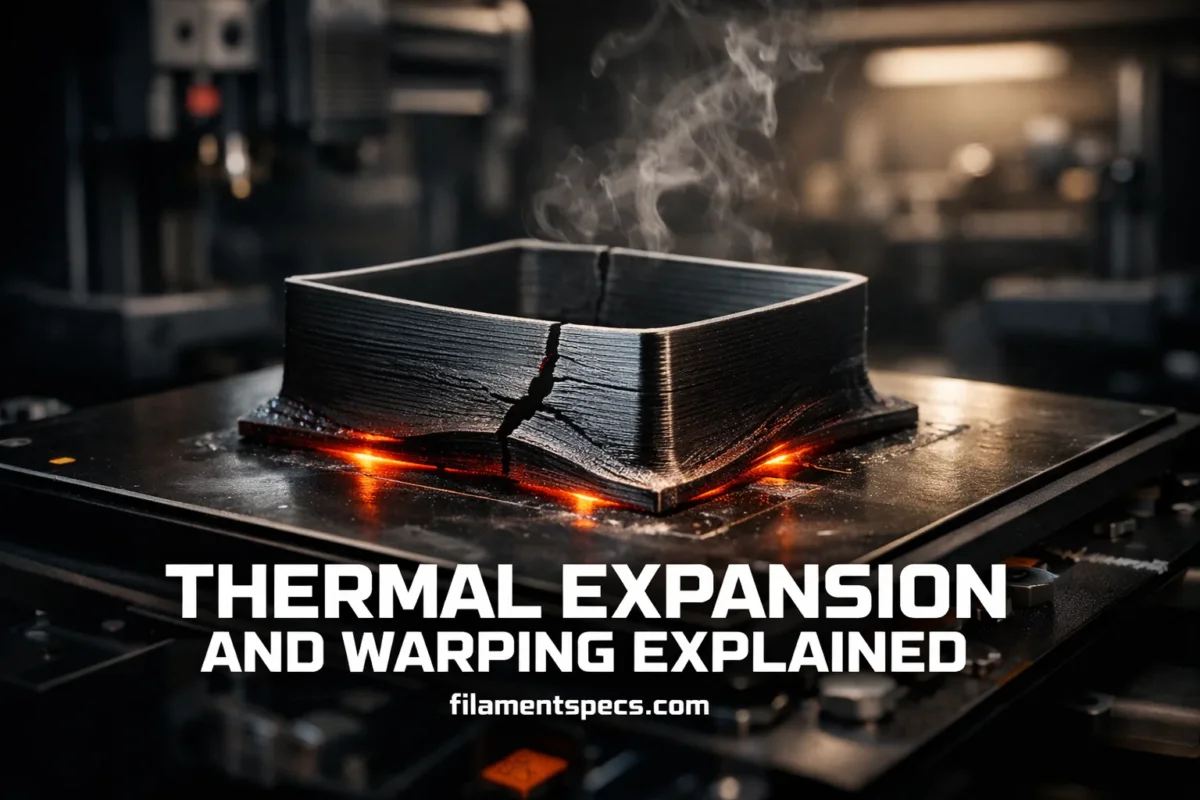
Thermal expansion and warping get mixed together all the time, yet they are not the same thing. Thermal expansion is the material getting larger as temperature rises. Warping starts later, when the printed road cools, contracts, and cannot move freely because the build plate, the surrounding layers, and the part geometry hold it back. That restraint turns ordinary size change into residual stress. Once that stress beats bed adhesion or local stiffness, the print bends, curls, or lifts from the plate.[b]
The practical idea is simple: warping is rarely a single-setting problem. It is the combined result of material shrinkage, cooling rate, first-layer restraint, and part shape. Change only one of those, and the part may still lift. Change the right pair, and the problem often disappears.
Table of Contents
🔥 What Warping Actually Is
A hot filament strand leaves the nozzle in an expanded state. Then it cools. Then it wants to get smaller. If it were free, that size change would mostly stay dimensional. In a real print, it is not free. The road is attached to the bed, fused to older roads, reheated by new roads, and cooled by room air at the same time. That is why a simple relation like ΔL = α × L × ΔT matters, but never tells the whole story by itself. CTE matters. Constraint matters just as much.
- Coefficient of Thermal Expansion (CTE)
- How strongly a material changes length with temperature.
- Thermal Contraction
- The size drop that happens as the deposited road cools from print temperature toward room or chamber temperature.
- Residual Stress
- Locked-in stress left behind because different regions did not cool and shrink in the same way.
- Warping
- The visible bending or lifting caused when those locked-in stresses exceed the restraint of the build plate or the stiffness of the part.
What Causes Warping in 3D Printing?
Warping grows from non-uniform cooling. NIST researchers studying material extrusion in PLA describe residual stresses forming when the sample cools non-uniformly on the build plate. In other words, different parts of the same print are trying to shrink by different amounts at different moments. That mismatch bends the part before it ever leaves the printer.[a]
Does Thermal Expansion Cause Warping by Itself?
Not by itself. Expansion is the temperature response. Warping is the shape change that appears when the later contraction is restrained. A filament can have a fairly ordinary thermal expansion value and still warp badly if cooling is fast, the part is broad and flat, or the material picks up extra shrinkage during crystallization. That is why two filaments with similar print temperatures can behave very differently on the same machine.[c]
📏 How Stress Builds Through the Part
The path from clean extrusion to curled corners is usually predictable. Once you see the order of events, tuning gets easier and a lot less random.
- The nozzle lays down a road that is much hotter than the surrounding print.
- The new road cools first at the surface and later in the center.
- Older layers below are reheated, then cool again.
- The build plate restrains the bottom while upper layers keep shrinking.
- Stress accumulates most strongly near the outer perimeter.
- The base starts to bend. Corners usually show it first.
- If adhesion loses the fight, the print lifts. If adhesion holds but the part is weak, it may crack instead.
Why Does a Part Warp Even When the First Layer Looks Perfect?
Because the first layer only proves that adhesion was good at the beginning. It says nothing about the pull that will build two, five, or twenty millimeters later. Many failed prints look fine for a long stretch and then peel up near the end because the cumulative contraction force finally gets larger than the holding force of the base. Late failure is still thermal failure.
Does a Heated Bed Stop Warping?
No. A heated bed slows the stress build-up; it does not erase shrinkage. Scientific work on ABS warpage and practical guidance from Prusa both point in the same direction: the bottom of the part stays warmer, so the temperature jump becomes smaller and the first layer stays attached longer. That helps a lot. It is not a magic switch, especially on large flat parts or high-shrink materials.[d]
What the bed really does: it buys time. It keeps the lower layers closer to a stable temperature so the part can cool more evenly instead of fighting a sharp hot-to-cold jump right above the plate.
🧩 Why Corners Lift First
Outside corners are where shrink forces from two directions meet in one small zone. Add a long straight edge on both sides, and that corner becomes the first place where the print tries to rotate upward. Peer-reviewed work on thermoplastic warping also found that part shape matters: larger interior angles resist warping better, and brim structures can reduce lifting by increasing the base restraint.[k]
This is why a round lid often behaves better than a square lid of the same area. It is also why a rectangle with sharp outside corners may fail while a version with generous radii stays flat on the same printer, with the same filament, on the same day.
- Sharp corners concentrate stress.
- Large flat bottoms accumulate more restrained shrinkage.
- Thin bases bend sooner than ribbed or thicker bases.
- Big thickness jumps near the bottom create uneven cooling zones.
Why Do Large Flat Prints Warp More?
Area matters. The wider the footprint, the more total contraction force the print can develop while the bed is trying to hold it still. Thickness matters too, but not in the same way. Thin sheet-like geometry bends more easily; very thick geometry can store more heat and keep gradients alive for longer. Either way, broad flat parts are the classic warping trap.
🧪 Material Behavior Changes Everything
Material choice decides how much a print wants to move while cooling. That choice also decides whether shrinkage is mostly ordinary thermal contraction or a mix of contraction and crystallization. That second path is where many warping headaches start.
| Material Family | General Warp Tendency | Why It Behaves That Way | Typical Print Environment |
|---|---|---|---|
| PLA | Low | Moderate print temperatures and usually low effective crystallinity during normal FFF | Open printer works in many cases |
| PETG | Low to Low-Medium | Low shrink tendency and strong layer adhesion, though it can string | Open printer is common; full enclosure often unnecessary |
| ABS / ASA | Medium to High | Hotter printing and faster shrink pull if the room is cool or drafty | Heated bed plus enclosure is often helpful |
| PA / Nylon | High | Higher shrink tendency and strong moisture sensitivity | Stable heat and dry material matter a lot |
| PP | High | Semi-crystalline behavior adds extra shrinkage during solidification | Warm stable environment and careful bed strategy |
| CF-Filled Blends | Often Lower Visible Warp | Fibers can lower expansion and raise stiffness, but behavior becomes more directional | Printer setup depends on the base polymer |
Which Filaments Warp the Most?
In ordinary desktop FFF, the usual ranking is simple: PLA and PETG are easier, ABS and ASA need more temperature control, and nylon or PP usually demand the most respect. Prusa’s material documentation lines up with that real-world pattern: PLA and PETG are commonly used without an enclosure, while ASA, ABS, PC, PA, and PP often benefit from one.[e]
Why Does PLA Usually Behave Better Than ABS?
PLA prints at lower temperatures, often around 190–210 °C with a 50–60 °C bed, and it is widely valued for dimensional accuracy. ABS runs hotter, commonly around 220–260 °C, and is much more likely to benefit from an enclosed machine. That hotter thermal cycle makes temperature imbalance harder to control.[h]
There is another layer to it. PLA is chemically a semi-crystalline polymer, but many printed PLA parts end up with a very low degree of crystallinity because the roads cool so quickly. Research on printed PLA notes that this low crystallinity is helpful because more crystallinity means more shrinkage and more warpage risk.[l]
Is PETG Really Low-Warp?
Usually, yes. Prusa’s PETG material page describes PETG as a low-warp material with very little shrink or lift in normal use, which is one reason it is so common for machine parts, fixtures, and larger functional prints. The tradeoff is elsewhere: stringing, strong bed adhesion, and softer bridge behavior show up more often than corner lift.[g]
Why Do Semi-Crystalline Filaments Warp More?
Semi-crystalline materials do not only cool; they also organize into crystalline regions as they solidify. That extra structure formation reduces specific volume and adds more shrinkage. Reviews focused on semi-crystalline feedstock for filament printing point to this as one of the main reasons PP and many nylons are harder to keep flat than more forgiving materials.[c]
🛠️ Print Controls That Change Warping the Most
When a print is curling, random tuning wastes time. A steadier order works better.
- Stabilize the room and remove drafts.
- Make the first layer reliable and clean the build surface.
- Use the right bed temperature for the material family.
- Set cooling so the part is not chilled too fast or left too soft.
- Add enclosure heat only where the material actually needs it.
- Reduce geometric stress with radii, ribs, or smaller contact zones.
- Keep hygroscopic materials dry before and during printing.
- Consider a different filament if the part geometry is naturally warp-prone.
Do Enclosures Always Help?
No. This point gets missed a lot. Prusa explicitly notes that higher-temperature materials such as ASA, ABS, PC, PA, and PP often need an enclosure because their upper layers can cool too fast and pull the lower region upward. The same source also notes that low-temperature materials like PLA and PETG shrink by a much smaller amount, so a full enclosure is often unnecessary for them.[e]
Can Fan Speed Cause Warping?
Yes, in both directions. Prusa’s troubleshooting notes make this very clear: PLA and PETG often need enough cooling for detail and shape control, while too much fan on ABS-like materials can increase lift and weaken layer bonding. That is why controlled cooling beats maximum cooling. The goal is not to make the part cold fast. The goal is to make it cool evenly.[d]
Why Does Moisture Make Some Filaments Harder to Keep Stable?
Moisture adds a second dimensional problem after heat. A wide study on twelve FFF filaments found swelling strain rising with moisture content, reaching up to 0.5% for some materials and as much as 2.5% for nylon. That means a part can print, cool, and still drift later if the polymer is strongly hygroscopic. For nylon, drying is not just about nicer extrusion. It is also about size stability.[i]
Relative Warp Tendency in Everyday FFF
General Trend, Not a Fixed Law
Brand chemistry, chamber temperature, fiber fill, part size, and build surface can move a filament up or down this scale.
📐 Design Changes That Often Beat Slicer Tuning
Printer settings matter, but design can remove the stress before it ever forms.
- Round outside corners so the shrink pull is spread over a wider path.
- Break up large solid bases with ribs, relief slots, or segmented contact zones where the part function allows it.
- Avoid sudden thickness jumps in the first layers because those zones cool at different rates.
- Use extra first-layer anchor area when the model has obvious hot-spot corners.
- Prefer material changes over forceful settings when geometry is naturally difficult. PETG often saves parts that keep failing in ABS on open machines.
Peer-reviewed work on thermoplastic warping found that larger interior angles improve resistance to warping, and that brim-based restraint can reduce lift. That matches what many experienced operators already see in practice: the first cure for a square warp-prone part is often a shape change, not a hotter bed.[k]
Design rule that saves time: if the part is a broad thin plate with sharp corners, expect warping before the slicer even opens. Choose a lower-shrink filament, add corner radii, or widen the anchor region early.
🧵 Material-by-Material Notes
PETG
Best fit: mechanical parts, brackets, holders, larger functional prints.
Warp profile: low. PETG is widely described as having very little shrink and low thermal expansion in practical printing, so it often stays flat without a chamber. The tradeoff is stronger bed grip and more stringing.[g]
ABS and ASA
Best fit: tougher functional parts, warmer service conditions, outdoor use for ASA.
Warp profile: medium to high. These materials print hotter, are more sensitive to drafts, and commonly benefit from an enclosure. If an ABS part keeps lifting, the room is often part of the problem.[e]
Nylon / PA
Best fit: wear parts, tough mechanical parts, flexible engineering use.
Warp profile: high. Nylon often needs more thermal control during printing and more moisture control before and after printing. Moisture can change both extrusion quality and final dimensions.[i]
PP
Best fit: chemically resistant parts and living-hinge style applications.
Warp profile: high. PP is a classic semi-crystalline challenge because crystallization adds extra shrinkage on top of simple cooling contraction. Flat parts are especially demanding.[c]
Carbon-Fiber-Filled Filaments
Best fit: stiffer parts, lower visible warp, better dimensional control in some directions.
Warp profile: often lower, but not automatically simpler. Research on printed nylon composites found that carbon reinforcement can drop expansion strongly in the flow direction while making behavior much more anisotropic. That means flatter prints are possible, though expansion becomes less uniform from one direction to another.[j]
❓ FAQ
Is warping mainly a bed adhesion problem or a shrinkage problem?
It starts as a shrinkage problem. Bed adhesion decides whether that shrinkage becomes visible lift. Good adhesion helps, but it cannot fully cancel internal stress if the material and cooling conditions are fighting the part.
Why do corners lift while the middle still looks flat?
Corners collect pull from two edges at once, so they reach the failure point first. The middle of the base may still be restrained while the corner starts rotating upward.
Should bed temperature always be raised when a print warps?
Not always. A warmer bed can help, but too much heat can soften the lower layers for too long or create other shape issues. The goal is balanced cooling, not the hottest possible plate.
Does a closed chamber help PLA?
Usually less than people expect. PLA already shrinks by a small amount in ordinary printing, so a chamber is often unnecessary unless the room is unusually drafty or the part is difficult.
Are carbon-fiber filaments always more dimensionally stable?
Often flatter, yes. Always simpler, no. They can reduce expansion and visible warp, but the dimensional response becomes more directional because fiber alignment changes behavior by axis.
Why can nylon change size even after printing is over?
Nylon absorbs moisture from the air. That moisture can lead to swelling and a measurable dimensional shift, so storage and drying matter even after the part is printed.
References
- [a] NIST / Additive Manufacturing (2025) — Quantifying Residual Orientation and Thermal Stress Contributions to Birefringence — Used for the explanation of residual stress forming when printed PLA cools non-uniformly on the build plate. (Reliable because it is a NIST publication and peer-reviewed research output.)
- [b] Materials (2021) — Thermal Deformations of Thermoplast during 3D Printing: Warping in the Case of ABS — Used for the plain-language definition of warping as deformation caused by temperature differences and shrinkage during printing. (Reliable because it is a peer-reviewed journal article.)
- [c] Progress in Polymer Science (2021) — Semi-Crystalline Feedstock for Filament-Based 3D Printing of Polymers — Used for the role of crystallization, excess shrinkage, and why PP or many nylons are harder to keep flat. (Reliable because it is a peer-reviewed review in a long-established polymer journal.)
- [d] Prusa Knowledge Base — Warping — Used for practical control points such as ambient stability, fan behavior, glue layer use, and how sudden temperature differences lead to curling. (Reliable because it is official documentation from a major printer manufacturer with material-specific operating guidance.)
- [e] Prusa Knowledge Base — Enclosure Guidepost — Used for which filament families usually benefit from an enclosure and why PLA/PETG often do not need one. (Reliable because it is official manufacturer guidance tied to real printer operating conditions.)
- [g] Prusa Knowledge Base — PETG — Used for PETG’s low-warp behavior, strong bed adhesion, print temperatures, and typical use in functional parts. (Reliable because it is official material documentation from a filament and printer manufacturer.)
- [h] UltiMaker — What Materials Can Be Used for 3D Printing? — Used for common PLA and ABS printing temperature windows and the practical difference in print environment between them. (Reliable because it is official technical education material from a major industrial FFF brand.)
- [i] Polymers / PMC (2023) — Moisture Sorption and Degradation of Polymer Filaments Used in 3D Printing — Used for moisture swelling, nylon sensitivity, and why humidity affects dimensional stability after printing. (Reliable because it is a peer-reviewed article hosted in PubMed Central.)
- [j] 3D Printing and Additive Manufacturing / PMC (2021) — Effects of Coefficient of Thermal Expansion and Moisture Absorption on the Dimensional Accuracy of Carbon-Reinforced 3D Printed Parts — Used for measured CTE anisotropy in printed nylons and the note that fiber reinforcement can reduce expansion while making it more directional. (Reliable because it is a peer-reviewed journal article with measured dimensional data.)
- [k] Materials Letters (2023) — Resolving Warping in 3D Printing of Thermoplastic Parts via Heterostructure Brim — Used for shape effects such as interior angle behavior, brim-assisted restraint, and the geometric side of warping resistance. (Reliable because it is a peer-reviewed journal article from Elsevier.)
- [l] University of Connecticut / Polymer Composites (2017) — The Microstructure and Mechanical Properties of 3D Printed Carbon Nanotube-PLA Composites — Used for the point that printed PLA can remain at low crystallinity under fast cooling, which helps reduce shrinkage and warpage. (Reliable because it is a university-hosted copy of a peer-reviewed journal paper.)