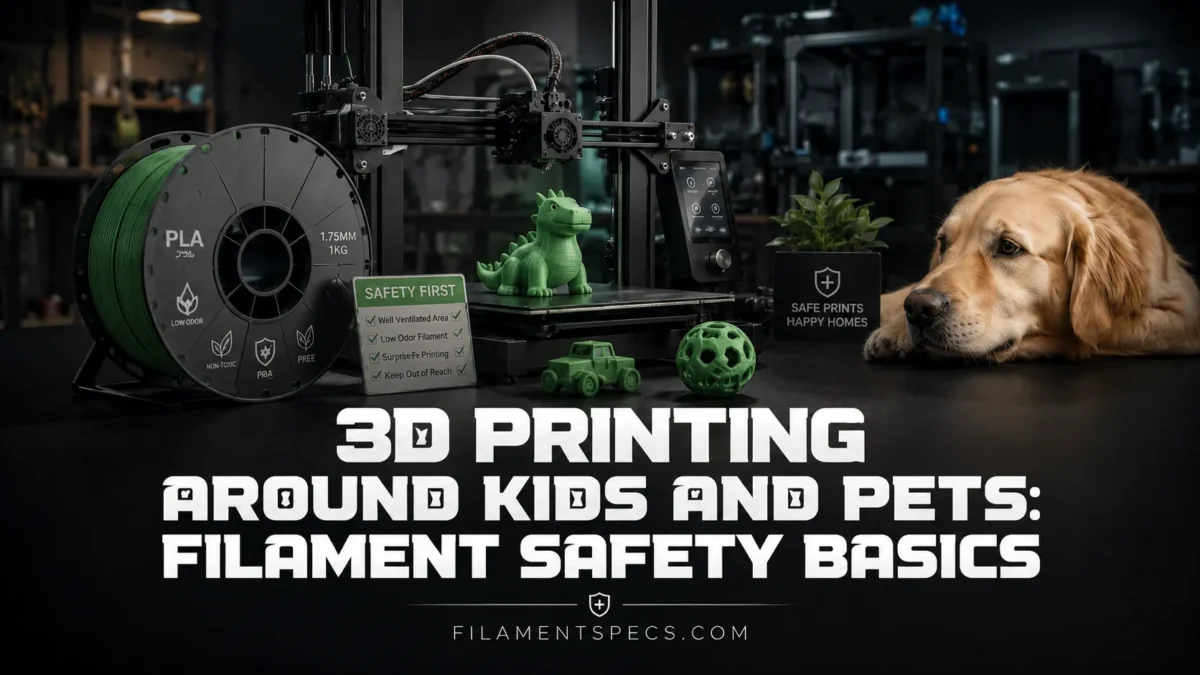
Printing around children and pets is mostly about controlling four ordinary things: air emissions, hot moving parts, loose plastic pieces, and storage. FDM/FFF printers heat thermoplastic filament until it flows through a nozzle, and that heating step can release ultrafine particles and volatile organic compounds. The safer setup is not complicated, but it does need a few non-negotiable habits: a stable printer location, ventilation that actually moves air away from people, supervised access, and filament choices that match the room.
| Filament | Typical Nozzle Range | Typical Bed Range | Air Emission Profile | Child and Pet Safety Notes | Better Use Case Around Kids/Pets |
|---|---|---|---|---|---|
| PLA | 190–220°C | 0–60°C | Usually lower odor than ABS, but still can emit ultrafine particles and VOCs during printing. | Often the easiest starting point, but scraps, purge lines, supports, and brittle shards should still be kept away from mouths and paws. | Basic household prints, school projects, decorative parts, low-temperature room use. |
| PETG | 230–250°C | 70–90°C | Usually moderate odor; higher printing temperature than PLA can raise the need for airflow control. | Stringing creates thin plastic hairs that cats and curious puppies may chew. Store failed prints and wipe strings from the printer area. | Durable utility parts, clips, storage items, lightly flexible parts. |
| TPU | 210–240°C | 30–60°C | Varies by brand and hardness; print slow and avoid overheated extrusion. | Flexible scraps can look like chew toys. Finished parts should be sized so they cannot be swallowed. | Soft bumpers, grips, vibration pads, flexible covers. |
| ABS | 230–260°C | 90–110°C | Known for stronger odor and styrene-related emissions; enclosure and exhaust matter more. | Not ideal for an open living room, bedroom, pet area, or child-accessible workspace. | Only when heat resistance is needed and the printer is enclosed and vented. |
| ASA | 240–260°C | 90–110°C | Similar handling category to ABS; odor and VOC control should be planned. | Best kept in a controlled workshop setup, not a shared family room. | Outdoor parts where UV resistance is needed. |
| Nylon | 240–280°C | 70–100°C | Higher-temperature printing; emissions and drying requirements vary widely. | Dry boxes, hot ends, and stringing add more touch and storage points to manage. | Mechanical parts when strength and wear resistance are needed. |
| Carbon-Fiber Filled Filaments | Usually 220–280°C, depending on base polymer | Depends on base polymer | Depends on the base filament; abrasive fillers add handling concerns during cleanup. | Avoid sanding, drilling, or cutting finished parts indoors without dust control. Use a hardened nozzle. | Stiff brackets, fixtures, and low-flex mechanical parts. |
Table of Contents
🧩 What Changes Around Kids and Pets
A 3D printer is not just a small appliance. It has a heated nozzle, a heated bed, belts, fans, moving axes, removable parts, small plastic waste, and a material path that can snap or tangle. Around adults, these details are mostly workflow issues. Around children and pets, they become access issues.
The main safety question is not whether PLA, PETG, or ABS is “safe” as a label. A better question is: safe under what printing conditions? A filament that behaves well in an enclosed, ventilated printer can be a poor choice in a small bedroom with the door closed. A low-odor material can still create particles. A finished print can be harmless as a shelf item but risky if it becomes a chew object.
Useful rule: treat an active printer like a hot tool, not like a toy. Children can watch, learn, and help with planning, but the printer should stay in an adult-controlled zone while it is heating, printing, cooling, or being cleaned.
Why Children Need a Different Safety Margin
Children are closer to the printer height in many home and classroom setups. They touch surfaces more often. They may also spend long stretches in the same room while a print runs. EPA notes that 3D printers can release VOCs and ultrafine particles, and it also points out why children and teenagers deserve special attention in educational settings.[a]
- Hands move fast. A curious child can reach toward a moving print before an adult finishes saying “don’t touch.”
- Small scraps are attractive. Colorful failed prints, purge blobs, brim strips, and broken supports can look like craft pieces.
- Room choice matters. Bedrooms, nurseries, playrooms, and homework desks are poor places for long prints.
- Learning is good; unsupervised access is not.
Why Pets Add Their Own Risks
Pets do not read labels, and they do not care that a part took six hours to print. Cats may chase moving belts, paw at filament strings, or chew flexible scrap. Dogs may treat support material as a chewable object. Birds and small mammals have sensitive respiratory systems, so placing a printer near cages, litter areas, bedding, or feeding zones is a poor match.
Printed plastic is also not the only object in the room. Spools, silica gel packets, glue sticks, scrapers, flush cutters, isopropyl alcohol, nozzles, and tiny screws can all end up on the floor. The floor is part of the workspace.
🌬️ Air Quality: Particles, VOCs, Odor, and Heat
FDM printing works by heating plastic. Heated thermoplastics can release ultrafine particles and volatile organic compounds, often shortened to VOCs. Ultrafine particles are tiny enough to behave differently from visible dust; VOCs are gases from materials as they warm, melt, or degrade. You may smell some of them. Some are odorless.
NIOSH has measured particle and VOC emissions from desktop 3D printers and recommends controls such as ventilation, enclosures, and lower-emitting printer/filament choices where possible.[b] That does not mean every home print is automatically hazardous. It means the printer deserves a controlled spot and sensible habits, especially when children or pets share the building.
Odor Is Not a Safety Meter
PLA may smell slightly sweet. ABS may smell sharper. PETG can seem almost neutral. None of these smells gives a full picture of particle release or VOC mixture. A low-odor print can still affect indoor air. A strong smell does not tell you the exact compound level either.
🧪 What Affects Emissions
- Material type: PLA, PETG, ABS, ASA, nylon, TPU, PC, and filled blends behave differently.
- Nozzle temperature: printing hotter than needed can increase thermal breakdown.
- Printer design: open-frame printers release emissions directly into the room.
- Print duration: a 14-hour print adds more exposure time than a 30-minute test cube.
- Room size and airflow: a small closed room is less forgiving.
- Number of printers: two or three printers running together change the room load.
Ventilation That Actually Helps
Opening a window may help dilute room air, but dilution is not the same as capture. The more reliable setup is to place the printer in an enclosure and move emissions away from people. Washington State Department of Health describes best practice for school settings as enclosing printers and exhausting emissions directly outside the building.[c]
For many homes, direct outdoor exhaust is not always easy. Still, the safety direction is clear:
- Use a room that children and pets do not sleep in.
- Keep the printer away from return-air vents that spread air through the home.
- Prefer an enclosure for higher-temperature materials.
- Run prints when the room can be aired out afterward.
- Do not place the printer next to a crib, pet bed, litter box, cage, aquarium, food bowl, or homework table.
Filtration Helps Only When It Fits the Job
HEPA filtration is aimed at particles. Activated carbon is aimed at many odors and some VOCs. A small decorative “air purifier” beside an open printer is not the same as a well-sealed enclosure with planned airflow. Filters also age. Once saturated, carbon becomes less useful.
For an open-frame PLA printer in a hobby room, fresh air plus distance may be enough for many users. For ABS, ASA, nylon, PC, or multiple machines, enclosure plus exhaust or verified filtration is a much better standard.
🧵 Filament Choice for Family and Pet Spaces
Filament choice is not about finding a magic “non-toxic” spool. It is about matching the material to the room, printer, project, temperature, and people nearby. The safest material for a decorative name tag may not be the best material for a hot car bracket. The best mechanical filament may not belong in a child’s bedroom printer.
PLA: Usually the Easiest Starting Material
PLA is popular because it prints at lower temperatures, warps less, and usually has a lighter odor than ABS. It is a sensible default for many family-friendly projects: labels, organizers, models, classroom prototypes, board-game accessories, simple brackets, and decorative parts.
Still, PLA is not a free pass. Research on desktop printer emissions has shown that common materials can release ultrafine particles and VOCs during printing, and emissions vary by printer, filament, and settings.[d]
PLA Around Children and Pets
- Good for learning prints when the printer is supervised.
- Better than ABS for open-room beginner use, but not ideal in sleeping areas.
- Scraps can be sharp after support removal.
- Do not let pets chew PLA parts. “Plant-based” does not mean edible.
PETG: Durable, Useful, but Stringy
PETG is a strong middle option for many household prints. It is tougher than standard PLA, less brittle, and more heat tolerant. It also prints hotter, so airflow control deserves more attention. PETG often creates fine strings and wisps, especially when retraction or moisture control is not dialed in.
Those strings matter around cats. Long thin plastic pieces can be interesting to paw at, chase, chew, or swallow. Keep the printer area clean after each job. Simple habit. Big difference.
TPU: Flexible Parts Need Size Control
TPU makes soft parts: grips, pads, bumpers, cases, and vibration dampers. That flexibility is useful, but it can make scraps feel chewable. For homes with pets, TPU waste should go straight into a closed bin. Finished parts should be too large to swallow and should not be used as pet toys unless the design and material are made for that purpose.
ABS and ASA: Better for Controlled Workspaces
ABS and ASA can make strong, heat-resistant parts, but they usually need a higher-temperature setup and better emission control. ABS is also linked with styrene emissions, so an open printer in a shared room is not a good match. Chemical Insights materials for 3D printer safety list ABS as typically higher-emitting among common filament types, with nylon and PLA generally lower in that comparison.[e]
ASA has outdoor durability and UV resistance. That makes it useful, but it sits in a similar safety category for home planning: enclosure, ventilation, and adult-only access.
Nylon, PC, and Filled Filaments
Nylon and polycarbonate are engineering materials. They often need higher nozzle temperatures, dry storage, stronger bed adhesion, and more controlled printing conditions. Carbon-fiber filled blends add stiffness and reduce warping in some cases, but they are abrasive and can create dust concerns during post-processing.
Use these materials when the part truly needs them. Not for a casual toy bin. Not beside a pet bed.
Food-contact note: a filament marketed with friendly wording does not automatically make a printed object safe for repeated food or pet-bowl use. Layer lines, pigments, additives, nozzle history, and cleaning limits all matter. For children and pets, printed parts are usually better treated as dry, non-food objects unless the full material and process are intended for food contact.
🏠 Printer Location and Room Setup
A safe printer room does three jobs: it keeps people and animals away from hot moving parts, controls air, and keeps small waste from spreading. A neat setup also makes printing less stressful. You can see problems sooner, remove waste faster, and stop curious hands before they reach the machine.
Better Rooms
- A spare room with a door.
- A workshop, utility room, garage area, or maker space with planned airflow.
- A classroom corner only if access, ventilation, and supervision are managed.
- A room where the printer can cool before children or pets enter.
Rooms to Avoid
- Bedrooms, especially children’s rooms.
- Nursery spaces.
- Pet sleeping areas.
- Kitchen counters and dining rooms.
- Small closed rooms with poor airflow.
- Anywhere a child or pet can pull the cord, bump the table, or reach the hot end.
Table, Cords, and Stability
Use a solid table that does not wobble during fast infill moves. Keep cords routed behind the table or inside cable channels. Do not let the spool holder hang where a cat can bat the filament or where a dog can pull it. A falling spool can damage a printer. It can also scare a pet enough to make the situation worse.
🔒 Access Setup That Works
- Use a door, baby gate, or enclosure latch.
- Keep flush cutters, scrapers, spare nozzles, and glue out of reach.
- Let the bed cool before removing prints with children nearby.
- Use a closed trash container for purge lines, brims, supports, and failed prints.
- Label filament storage if multiple adults use the same space.
🧤 Handling, Storage, and Cleanup
Good safety is mostly boring. That is the point. When every spool has a place and every scrap goes into a bin, the printer becomes easier to manage around family life.
Before Printing
- Check that the filament path is clear and the spool turns smoothly.
- Confirm that the printer is on a stable surface.
- Move toys, pet bowls, craft supplies, and loose paper away from the printer.
- Choose the lowest effective nozzle temperature within the filament maker’s recommended range.
- Start the print while an adult can watch the first layers.
That first-layer check is not just about print quality. It also catches dragging filament, loose adhesion, spaghetti failures, and early blobs before they become a hot plastic mess.
During Printing
Children can observe from a distance. They can learn slicing, model design, measurement, and material choice. But the active printer should not become a hands-on station. The nozzle is hot. The bed may be hot. The print head moves without asking for permission.
- Do not let children remove prints from a hot bed.
- Do not let pets enter the room during long prints.
- Do not leave scraps hanging from the nozzle area.
- Pause or stop the print if filament tangles, spaghetti forms, or the printer begins making unusual sounds.
After Printing
Cooling time is safety time. Wait before removing the part, especially when the bed has been running at PETG, ABS, or ASA temperatures. Remove support material over a tray, not over carpet. Small support needles disappear fast.
For cleanup, use a small closed container near the printer. Not an open bin. Pets notice open bins.
Storage Rules for Filament and Tools
- Keep spools in sealed bags, dry boxes, or lidded containers.
- Store silica gel packets away from children and pets.
- Keep filament clips on spool ends so loose filament does not unwind.
- Put scrapers and flush cutters in a drawer or tool case after each use.
- Store failed prints until you can dispose of or recycle them properly.
The safest filament is the one that is not scattered across the floor.
🐾 Pets, Chewing, Swallowing, and Printed Parts
Pets add a simple test to every printed object: could this be chewed, cracked, swallowed, or dragged under furniture? If the answer is yes, the object needs a safer location or a different design.
Why Filament Scraps Are a Pet Issue
Filament pieces are small, colorful, and sometimes springy. PETG strings, TPU scraps, PLA support fragments, brim rings, and purge lines can all look interesting. Veterinary sources warn that swallowed foreign objects can cause vomiting, appetite changes, abdominal pain, lethargy, and obstruction; Cornell’s veterinary resource notes that many gastrointestinal foreign body obstructions in dogs require surgery.[f]
This is not meant to make printing scary. It is a storage lesson. Keep plastic waste contained.
Finished Prints Around Pets
- Avoid small parts that fit fully inside a pet’s mouth.
- Avoid thin rings or loops that can catch on teeth, paws, collars, or claws.
- Avoid brittle decorative parts in pet-accessible areas.
- Do not use printed parts as chew toys.
- Inspect utility prints for cracks before leaving them where pets can reach them.
Birds, Reptiles, Fish, and Small Mammals
Do not place a printer near cages, terrariums, aquariums, or small-animal enclosures. These spaces often have their own heat, humidity, bedding dust, water surfaces, or airflow patterns. Keep printing equipment separate. If a room houses animals full time, choose another room for printing.
Simple pet rule: if the printer is running, the pet is not in the room. If the printer is cooling, the pet is still not in the room. If cleanup is done and waste is sealed, the room can go back to normal.
🎓 Letting Kids Learn Without Letting Them Operate Everything
3D printing is a great learning tool when roles are clear. Children can design models, measure parts, choose colors, compare materials, learn tolerances, and watch how layers form. The unsafe part is treating the machine like a hands-on toy during operation.
Good Child-Friendly Tasks
- Sketching the object before modeling.
- Measuring with a ruler or caliper under supervision.
- Choosing PLA colors for simple projects.
- Learning what infill, wall count, supports, and layer height mean.
- Watching the first layer from a safe distance.
- Helping label finished parts after they cool.
Adult-Only Tasks
- Nozzle changes.
- Bed scraping while warm.
- Removing stuck prints.
- Handling flush cutters and sharp support-removal tools.
- Clearing hot-end clogs.
- Working with ABS, ASA, nylon, PC, or abrasive filled filaments.
For schools and clubs, written room rules help. So does a physical barrier. A clear enclosure lets students see the process without inviting hands into the motion area.
🌡️ Temperature, Degradation, and Print Settings
Printing too hot is rarely useful around children and pets. It can worsen stringing, cause discoloration, create odor, and increase the chance of material degradation. Use the filament maker’s recommended range, then tune from the lower end upward only when needed for layer bonding.
Settings That Reduce Trouble
- Use the correct filament profile. Do not print ABS with a PLA profile or PETG with random high temperatures.
- Dry moisture-sensitive materials. Wet PETG, nylon, TPU, and some blends can pop, string, and print poorly.
- Avoid needless speed extremes. Very fast printing can require higher temperatures and stronger cooling changes.
- Use supports only where needed. Less support means fewer sharp plastic scraps.
- Choose simple part orientation. A stable print is safer than a tall unstable print that fails halfway through.
When to Stop a Print
Stop the print if plastic collects around the nozzle, the print detaches from the bed, filament tangles around the spool, smoke appears, a fan stops, or the printer makes unusual grinding sounds. Do not let a “maybe it will recover” print continue while children or pets are in the home environment. Plastic spaghetti can turn into a hot blob around the heater block.
📌 Safer Choices by Situation
| Situation | Better Material Direction | Setup Notes | Avoid |
|---|---|---|---|
| Child’s first design project | PLA | Adult starts the print, child watches from a distance, print is removed after cooling. | ABS/ASA in an open room, tiny loose parts for young children. |
| Classroom demonstration | PLA or low-emission certified printer/material combination where available | Use enclosure, room ventilation, access rules, and planned cleanup. | Multiple open printers running near seated students. |
| Pet-accessible household item | PETG or PLA depending on strength need | Design large, smooth parts without chewable loose ends. | Thin rings, brittle hooks, small caps, flexible chew-like shapes. |
| Outdoor bracket | ASA or PETG, depending on heat and UV exposure | Print ASA only with enclosure and ventilation control. | ASA in a small shared room without airflow planning. |
| Flexible pad or bumper | TPU | Keep scraps sealed; size the finished part so it cannot be swallowed. | Leaving flexible test pieces on the floor. |
| High-strength workshop part | Nylon, PC, or filled filament only if needed | Use adult-only workspace, dry storage, enclosure, and careful post-processing. | Printing engineering materials in children’s rooms or pet areas. |
🏷️ Low-Emission Claims and Certification
Marketing words can be vague. “Eco,” “natural,” “odorless,” and “safe” do not all mean the same thing. For printers and materials, one useful reference point is ANSI/CAN/UL 2904, a standard for testing and assessing particle and chemical emissions from 3D printers. UL states that the standard applies to freestanding 3D printers found in schools, offices, libraries, homes, and other non-industrial indoor spaces.[g]
When shopping for a printer or filament for a family space, look for plain details:
- Material Safety Data Sheet availability.
- Recommended nozzle and bed temperatures.
- Clear statement of base polymer and additives.
- Printer enclosure compatibility.
- Emission certification where available.
- Manufacturer guidance for ventilation and use.
Be careful with unknown blends. A spool labeled “PLA+” or “high-speed PLA” may print well, but the additive package is not always clear. That does not make it bad. It means the room setup should not rely on the label alone.
🛠️ Maintenance Habits That Protect the Room
Maintenance is safety work. A dusty printer, loose wires, worn fans, clogged nozzles, and filament crumbs make printing less predictable. Around children and pets, predictable is better.
Weekly or Regular Checks
- Check that fans spin freely.
- Inspect the hot-end area for plastic buildup.
- Remove old filament strings from belts, pulleys, and spool paths.
- Clean the bed after it cools.
- Check that the printer table is stable.
- Empty the closed waste container.
- Inspect power cables and connectors for damage.
Post-Processing Safety
Support removal, sanding, drilling, and cutting can add new risks. A printed part may be cool, but a sharp scraper or plastic dust can still be a problem. Do dusty work away from children and pets. Clean the surface afterward. If a filled filament is involved, be more careful with dust control and tool cleanup.
📍 Practical Room Rules for Homes and Classrooms
- Printer Status
- Running, heating, and cooling all count as active states. Access stays limited until cleanup is finished.
- Child Access
- Children may observe and learn, but an adult handles hot parts, tools, failed prints, and printer maintenance.
- Pet Access
- Pets stay out of the room during printing and cleanup. Finished prints are stored away unless they are too large, smooth, and unsuitable for chewing.
- Material Choice
- PLA is the easier default for shared spaces. ABS, ASA, nylon, PC, and many filled materials belong in a more controlled setup.
- Waste
- All purge lines, support pieces, brims, failed prints, filament clips, and broken pieces go into a closed container.
A calm system beats a complicated one. One printer. One controlled room. One closed waste bin. Clear rules.
FAQ
Is PLA safe to print around children?
PLA is one of the more practical choices for family and school printing because it usually prints at lower temperatures and with less odor than ABS. It should still be used with ventilation, adult supervision, and cleanup. Do not place a running printer in a child’s bedroom or play area.
Can pets be in the same room as a 3D printer?
It is better to keep pets out while the printer is running, heating, cooling, or being cleaned. Pets may chew filament, chase moving parts, knock into the printer, or swallow plastic scraps.
Is PETG safer than ABS for homes?
PETG is often a better home choice than ABS because it usually has less odor and does not need the same enclosed high-heat environment. It still prints hotter than PLA and can create stringy waste, so ventilation and cleanup still matter.
Should ABS be used in a house with kids or pets?
ABS is best reserved for a controlled workspace with an enclosure and good ventilation. It is not a good choice for an open bedroom, playroom, pet area, or small room with poor airflow.
Are 3D printed toys safe for children?
They can be suitable for display or supervised play when the design is large, smooth, strong, and age-appropriate. Avoid small parts, sharp edges, brittle pieces, weak layer adhesion, and anything a child may put in the mouth.
Can dogs or cats chew 3D printed parts?
No. Printed plastic parts are not chew toys. Chewing can create sharp fragments or swallowable pieces. Keep printed objects and filament scraps away from pets unless the part is large, smooth, and placed where it cannot be chewed.
Does an enclosure make 3D printing safe by itself?
An enclosure helps with access control, heat stability, and emission capture, but it works best with planned airflow, exhaust, or suitable filtration. A sealed box with no thought to air handling is not the same as a controlled setup.
Are filament fumes dangerous if there is no smell?
No smell does not prove clean air. Some VOCs have little odor, and ultrafine particles are not visible. Use ventilation and sensible material choices even when a print smells mild.
What should I do if a pet swallows filament or a printed piece?
Contact a veterinarian promptly, especially if there is vomiting, loss of appetite, lethargy, abdominal pain, drooling, or straining. Do not wait to see whether a sharp or long piece “passes” on its own.
Is resin printing covered by the same filament safety rules?
No. Resin printing uses liquid photopolymer resin, not filament. It needs different handling, gloves, spill control, curing, storage, and ventilation rules. Keep resin printing separate from child and pet areas.
References
- [a] EPA 3D Printing Research — supports the discussion of VOCs, ultrafine particles, and why children and teenagers may need extra care in educational settings. (U.S. government source)
- [b] NIOSH “Approaches to Safe 3D Printing” — supports ventilation, enclosure, and exposure-control practices for schools, libraries, makerspaces, and small workplaces. (CDC/NIOSH government occupational safety source)
- [c] Washington State Department of Health, 3D Printers — supports enclosing printers and exhausting emissions outside as a best-practice approach in school environments. (State public health agency)
- [d] Environmental Science & Technology study on desktop 3D printer emissions — supports the statement that common desktop printers can emit ultrafine particles and VOCs depending on material and conditions. (Peer-reviewed ACS journal article)
- [e] Chemical Insights / UL 3D Printer Safety handout — supports the material-emission comparison and practical ventilation recommendations. (UL-affiliated research and safety organization)
- [f] Cornell University College of Veterinary Medicine, gastrointestinal foreign body obstruction in dogs — supports the pet-ingestion risk discussion. (University veterinary medicine source)
- [g] Underwriters Laboratories announcement on ANSI/CAN/UL 2904 — supports the explanation of low-emission testing for freestanding 3D printers in homes, schools, offices, and libraries. (Standards and safety organization)