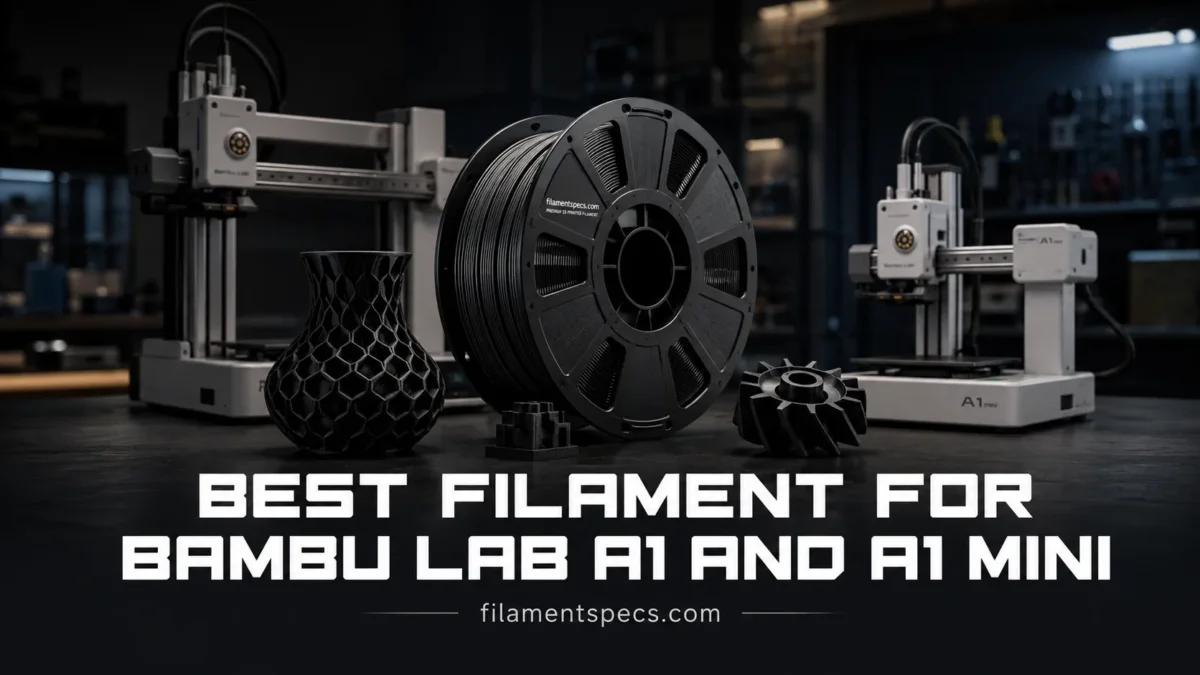
For the Bambu Lab A1 and A1 mini, the safest everyday answer is simple: PLA is the best first filament, PETG is the better choice for tougher functional parts, and TPU is worth using when the part needs controlled flex. These printers are fast, open-frame machines with smart calibration, a direct-drive toolhead, and very good default profiles, but they still work best when the filament matches the machine’s real thermal limits, bed motion, nozzle type, and AMS Lite behavior.
| Filament | Best Use on A1 / A1 mini | Print Difficulty | Typical Nozzle Range | Typical Bed Range | AMS Lite Use | Verdict |
|---|---|---|---|---|---|---|
| PLA / PLA+ | Decor, models, toys, draft parts, school projects, color prints, low-stress brackets | Very easy | 190–230°C | 35–65°C | Excellent | Best all-around starter filament |
| Matte PLA | Clean-looking display parts, models where layer lines should look softer | Easy | 200–230°C | 35–60°C | Excellent | Best visual finish for most users |
| PETG / PETG HF | Functional parts, boxes, clips, outdoor-adjacent items, parts needing more heat resistance than PLA | Medium | 230–270°C | 60–80°C | Good when dry and not brittle | Best practical upgrade from PLA |
| TPU 95A / TPU HF | Flexible feet, bumpers, grips, gaskets, phone-case-like parts | Medium to hard | 220–250°C | 35–60°C | Use only if the specific TPU is AMS-compatible; many TPU spools should be external-fed | Best flexible material, not the best first material |
| PVA / Support Material | Dissolvable or breakaway support for complex PLA/PETG prints | Special-use | Follow brand profile | Follow matching base material | Possible, but moisture control matters | Useful, not an everyday filament |
| ABS / ASA / PC / PA / Fiber-Filled | Higher-heat engineering parts | Not a good match | Often high | Often high | Depends on spool and filament type | Not recommended for normal A1/A1 mini use |
Table of Contents
🏆 Best Choice for Most A1 and A1 Mini Owners
PLA is the best filament for most Bambu Lab A1 and A1 mini users. It prints cleanly, needs modest heat, works well with the Textured PEI plate, handles fast profiles better than many hobby materials, and is the least annoying material to run through the AMS Lite.
That does not mean PLA is always the strongest choice. It means PLA gives the best mix of surface quality, reliability, color range, low odor, low warping, and simple storage. For a printer like the A1 or A1 mini, that balance matters more than a material’s maximum strength on a datasheet.
Simple buying rule: start with PLA or Matte PLA, add PETG when parts need more toughness or heat resistance, and use TPU only when flexibility is part of the design.
The Practical Ranking
- Best first spool: PLA Basic, PLA+, or Matte PLA.
- Best visual finish: Matte PLA.
- Best functional everyday filament: PETG or PETG HF.
- Best flexible filament: TPU 95A or TPU HF, usually from an external spool unless the filament is specifically made for AMS use.
- Best support option: Bambu Support for PLA/PETG or PVA, depending on the project and moisture control.
- Best to avoid on stock A1/A1 mini: ABS, ASA, PC, PA, and abrasive carbon/glass-filled materials unless you fully understand the limits and hardware changes needed.
🧩 Why the A1 and A1 Mini Prefer Low-Temperature Filaments
Bambu Lab lists PLA, PETG, TPU, and PVA as ideal filament types for the A1 series, while ABS, ASA, PC, PA, PET, and carbon/glass fiber reinforced polymers are listed as not recommended for the A1 mini spec page. The A1 has a 300°C maximum hotend and 100°C maximum build plate, while the A1 mini has the same 300°C hotend limit but an 80°C maximum heatbed.[a]
Those numbers explain a lot. The hotend can melt many materials, but the open frame and bed temperature are the real limits. Materials such as ABS, ASA, PC, and nylon normally benefit from a warmer controlled chamber, stronger bed heat, slower cooling, and more careful moisture control. The A1 and A1 mini are not enclosed. They are built for convenience, speed, and clean daily printing.
Important machine difference: the full-size A1 gives more bed temperature headroom than the A1 mini, but that does not turn either printer into an enclosed engineering-material machine.
What the A1 Series Does Well
- Fast PLA and PETG printing with tuned Bambu Studio profiles.
- Good first-layer consistency thanks to automatic calibration.
- Direct-drive feeding, which helps with TPU compared with Bowden-only printers.
- Multi-color PLA and PETG prints with AMS Lite.
- Easy nozzle swaps for different detail levels and flow needs.
What Still Depends on the Filament
A smart printer cannot fully rescue wet PETG, brittle old PLA, badly wound spools, oversized filament, or a material that wants a warmer chamber. The A1 series is forgiving, not magic. Good filament still matters.
| Material Trait | Why It Matters on A1 / A1 mini | Best Filament Match |
|---|---|---|
| Low warping | The open frame has normal room-air movement around the print. | PLA, Matte PLA, PETG |
| Moderate bed heat | A1 mini tops out at 80°C; A1 reaches higher but is still open-frame. | PLA, PETG, TPU |
| AMS Lite feeding | Rigid, smooth filament feeds better through multi-material paths. | PLA, most PETG |
| Moisture resistance | Wet filament causes stringing, popping, rough surfaces, and weak layers. | PLA is easiest; PETG and TPU need more drying care |
| Abrasiveness | The stock stainless nozzle is not the best long-term match for abrasive fills. | Standard PLA/PETG/TPU unless using hardened nozzle |
🌽 PLA: The Best Everyday Filament
PLA is the material that makes the A1 and A1 mini feel easy. It does not need a hot chamber. It usually sticks well to PEI. It cools fast enough for small details, figures, organizers, labels, teaching models, game inserts, prototype shells, and colorful decorative parts.
For most owners, PLA Basic or PLA+ should be the first full spool. Matte PLA is the next smart choice when you want a softer finish and less visible layer shine. Silk PLA looks attractive but can be less forgiving on strength and layer bonding, especially on thin hooks, clips, and snap-fit parts.
Best PLA Types for A1 and A1 Mini
| PLA Type | Best For | Watch For | A1-Series Fit |
|---|---|---|---|
| PLA Basic | Clean daily prints, models, organizers, color projects | Can soften in hot cars or near heat sources | Excellent |
| PLA+ | Parts that need a little more toughness than standard PLA | Brand formulas vary a lot | Excellent |
| Matte PLA | Display pieces, miniatures, clean product-style prints | Some matte blends are slightly more abrasive than glossy PLA | Excellent |
| Silk PLA | Decorative items, vases, signs, low-stress objects | Layer adhesion can be weaker than normal PLA | Good for visual prints |
| High-Speed PLA | Fast draft parts and larger simple models | Needs correct flow profile at high speed | Very good with tuned profiles |
| Glow PLA | Decorative night-glow objects | Abrasive; better with hardened nozzle | Use with care |
PLA Settings That Usually Make Sense
- Nozzle: start around 200–220°C unless the spool profile says otherwise.
- Bed: 45–60°C is common on PEI plates.
- Fan: PLA likes cooling, especially for overhangs and small features.
- Drying: not always needed when new, but old PLA can become brittle or stringy.
- AMS Lite: PLA is the easiest material for multi-color printing.
Where PLA Is Not the Right Choice
Do not use PLA for parts that will sit in a hot car, press against warm electronics, hold constant load near heat, or flex repeatedly. It can work for many indoor functional parts, but it is not the material to choose when heat and impact are the main concerns.
🛠️ PETG: The Best Functional Upgrade
PETG is the natural second filament for A1 and A1 mini owners. It is tougher than PLA in many practical prints, less brittle, and more comfortable for parts that may see mild heat or outdoor-adjacent use. It also keeps the workflow fairly simple compared with ABS, ASA, nylon, or PC.
The tradeoff is print behavior. PETG can string, blob, stick too aggressively to some surfaces, and show messy corners if printed too hot or too wet. Dry PETG prints much better than damp PETG. That one detail changes the whole experience.
When PETG Beats PLA
- Clips and brackets that should bend slightly before breaking.
- Storage boxes, tool holders, cable guides, and shop fixtures.
- Parts near mild warmth where PLA may soften too easily.
- Outdoor-adjacent objects that need better moisture tolerance than PLA.
- Practical prints where surface shine is less important than durability.
PETG Basic vs PETG HF
Standard PETG is fine when the profile is tuned and the spool is dry. PETG HF-style filaments are made to print faster and more cleanly on modern high-speed printers. On the A1 and A1 mini, that can mean fewer slowdowns and less frustration on larger parts, though every brand formula is different.
| PETG Type | Why Choose It | Possible Issue | Best Use |
|---|---|---|---|
| Standard PETG | Easy to find, strong practical material, good value | Can string if damp or too hot | General functional parts |
| PETG HF | Better match for faster A1-style printing | Brand-specific profiles matter | Larger parts, repeat printing, faster workflow |
| Transparent PETG | Light-transmitting prints and containers | Shows bubbles and moisture defects clearly | Visual parts where clarity is acceptable, not glass-like |
| PETG-CF | Stiffer, more textured finish | Abrasive and not a normal stock-nozzle choice | Only with suitable nozzle and profile |
PETG Settings That Usually Make Sense
- Nozzle: often around 240–260°C, but use the filament profile first.
- Bed: commonly 65–80°C.
- Fan: less cooling than PLA; too much fan can weaken layer bonding.
- Drying: strongly recommended if stringing, popping, or rough surfaces appear.
- AMS Lite: usually fine with normal rigid PETG spools, as long as the spool rolls smoothly.
Best practical pairing: keep PLA for fast clean prints and PETG for parts that need more toughness. That two-spool setup covers a huge amount of A1 and A1 mini printing.
🧵 TPU: Best When the Part Needs Flex
TPU is useful on the A1 series because the printers use direct-drive feeding. That helps flexible filament move into the hotend with less buckling than on long Bowden-style setups. It still needs patience. TPU is soft, elastic, moisture-sensitive, and slower than PLA or PETG.
For most users, TPU 95A is the easiest flexible starting point. Softer TPU can be harder to feed. Very soft materials may need much slower printing and more careful path control. If the project only needs a little flex, a firmer TPU is usually the smarter choice.
TPU and AMS Lite Need Care
Bambu’s TPU printing information separates normal TPU behavior from AMS compatibility: standard TPU can be unsuitable for AMS-style feeding, while specific TPU formulas made for AMS use are treated differently. Bambu’s TPU printing page notes that AMS / AMS Lite / AMS 2 Pro are not compatible with ordinary TPU filament, while TPU for AMS is a separate product category designed for AMS use.[b]
Plain language: if the spool says normal TPU, feed it from an external spool path. If it says TPU for AMS or clearly lists AMS Lite compatibility, use the matching official profile and keep expectations realistic. Flexible multicolor prints can work, but they are not as carefree as PLA color swaps.
Good TPU Uses on A1 and A1 Mini
- Anti-slip feet for printed boxes, stands, and cases.
- Protective bumpers and soft corner pads.
- Flexible cable strain relief parts.
- Grips, sleeves, spacers, and vibration-damping pads.
- Simple gaskets where exact industrial sealing is not required.
TPU Settings That Usually Make Sense
- Nozzle: often around 220–240°C.
- Bed: usually 35–60°C.
- Speed: slower than PLA; flexible filament rewards patience.
- Retraction: keep it conservative to avoid feeding problems.
- Drying: very helpful. Wet TPU strings heavily and can look fuzzy.
Useful design note: TPU flexibility depends on both material hardness and model geometry. Fewer walls and lower infill make a part softer; more walls and higher infill make the same filament feel firmer.
🧪 Special Filaments: What Works, What Needs Caution
The A1 and A1 mini can tempt users into trying every 1.75 mm filament on the shelf. Some experiments are harmless. Others create nozzle wear, rough extrusion, poor adhesion, or warped parts. The safest approach is to separate decorative variants from true engineering materials.
Support Filaments
PVA and support materials are useful when a model has internal cavities, complex overhangs, or support contact areas that would scar the surface. They are not everyday materials. PVA is especially moisture-sensitive, so storage and drying matter more than with PLA. Use it when the geometry actually benefits from it.
Wood, Marble, Sparkle, and Glow Blends
Decorative PLA blends can print well on the A1 series, but filled materials may be more abrasive or clog-prone than plain PLA. A 0.4 mm nozzle can work for many blends, yet a 0.6 mm nozzle is often more forgiving for particle-filled filaments. Glow filament is usually abrasive. Marble and sparkle blends vary by brand.
Carbon Fiber and Glass Fiber Filaments
Fiber-filled filaments can be stiff and attractive, but they are not the right default for a stock A1 or A1 mini setup. They can wear a stainless nozzle faster, may require hardened hardware, and often belong with printer setups designed for abrasive or higher-temperature materials. Use a hardened nozzle if you choose an abrasive blend, and check the material table before printing.[c]
ABS, ASA, PC, and Nylon
These materials are popular for stronger or higher-heat applications, but they are not a natural fit for the stock open A1 series. The problem is not only nozzle temperature. Warping control, bed heat, chamber warmth, fumes, drying, and part cooling all matter. A different enclosed printer is usually the cleaner path for regular ABS, ASA, PC, or nylon work.
| Filament Family | Use on A1 / A1 mini | Main Concern | Better Choice |
|---|---|---|---|
| Support for PLA/PETG | Good for complex support cases | Moisture and profile matching | Use only when geometry needs it |
| PVA | Possible but delicate | Very moisture-sensitive | Dry storage and careful handling |
| Wood/Marble PLA | Often usable | Possible clogs or nozzle wear | Use known profiles; consider 0.6 mm nozzle |
| Glow PLA | Usable with caution | Abrasive | Hardened nozzle preferred |
| PLA-CF / PETG-CF | Not ideal as a first material | Abrasive; profile and nozzle matter | Hardened nozzle and material-specific profile |
| ABS / ASA | Not recommended for normal use | Open-frame warping and odor control | Enclosed printer setup |
| PC / PA | Not recommended for normal use | Heat, drying, warping, chamber needs | Enclosed high-temperature workflow |
🛒 How to Choose Filament for the A1 and A1 Mini
A good spool for the A1 series is not only about the polymer name. Diameter consistency, winding quality, dryness, spool fit, profile support, and colorant behavior can affect the print more than the label on the box.
Choose 1.75 mm Filament With a Good Spool
The A1 series uses 1.75 mm filament. Stay with reputable filament that lists diameter tolerance and gives basic print settings. A cleanly wound spool matters for long prints, especially when using AMS Lite. Tangled filament can ruin an otherwise perfect model.
Prefer Profiles That Already Exist in Bambu Studio
Bambu filament has the easiest setup because printer, slicer, and filament profile are designed to work together. Third-party filament can also print very well, but it may need small changes to temperature, flow, pressure advance, cooling, or maximum volumetric speed. Start with the closest generic profile. Change one thing at a time.
Match the Filament to the Part
- Display model: Matte PLA or Silk PLA.
- Fast prototype: PLA Basic or High-Speed PLA.
- Indoor functional part: PLA+ or PETG.
- Clip, bracket, or tool holder: PETG.
- Soft foot, grip, bumper: TPU.
- Complex support contact: support material matched to PLA or PETG.
Watch Spool Size on the A1 Mini
The A1 mini has a smaller build volume than the A1, but filament choice is still mostly the same. The bigger practical difference is workflow: smaller parts, shorter prints, and more frequent color/material changes. If using AMS Lite, make sure spools rotate cleanly and do not rub, wobble, or bind.
📊 Material Performance Meters
PLA Best starter
PETG Best functional upgrade
TPU Best flexible option
💧 Drying and Storage Matter More Than Many People Expect
PLA can often print well straight from a fresh spool, but PETG, TPU, PVA, and nylon-family materials are far more sensitive to moisture. Wet filament may hiss at the nozzle, leave tiny bubbles, create stringing, weaken layer bonding, or make surfaces look rough. The printer may still finish the job. The part just will not look or feel right.
| Filament | Moisture Sensitivity | What Wet Filament Looks Like | Storage Habit |
|---|---|---|---|
| PLA | Low to medium | Brittleness, light stringing, rougher finish | Sealed bag or dry box when not used often |
| PETG | Medium to high | Stringing, blobs, popping, fuzzy surfaces | Dry before important prints; store sealed |
| TPU | High | Heavy stringing, rough surface, inconsistent extrusion | Dry before use; store sealed with desiccant |
| PVA | Very high | Poor feeding, weak support, messy extrusion | Keep very dry; avoid leaving exposed |
A filament dryer is not required for every beginner, but it becomes very useful once PETG and TPU enter the rotation. A sealed box with fresh desiccant is a good baseline. For long prints, dry filament is quieter, cleaner, and more predictable.
🔩 Nozzle Choice and Filament Match
The standard 0.4 mm nozzle is the right default for PLA, PETG, and TPU. It balances detail, strength, and speed. A 0.2 mm nozzle is useful for tiny details but is less forgiving with filled materials and slower prints. A 0.6 mm nozzle is useful for stronger walls, faster large parts, and particle-filled decorative filaments.
- 0.2 mm nozzle: miniatures, small lettering, fine detail; avoid rough or filled filaments.
- 0.4 mm nozzle: default choice for most PLA, PETG, and TPU work.
- 0.6 mm nozzle: stronger functional prints, larger layers, wood/marble-style blends, faster big parts.
- Hardened nozzle: better for glow, carbon fiber, glass fiber, and other abrasive blends.
Do not judge a filament only by whether it melts. A material can melt at the nozzle and still be a poor match because it warps, absorbs moisture, wears the nozzle, or needs a warmer chamber.
🎯 Best Filament by Project Type
| Project Type | Best Filament | Why It Fits | Avoid |
|---|---|---|---|
| Decorative model | Matte PLA or Silk PLA | Clean surface, strong color choice, easy printing | PETG if the surface finish must be very crisp |
| Prototype part | PLA Basic | Fast, cheap, easy to revise | Expensive specialty materials for early drafts |
| Organizer or drawer insert | PLA or PETG | PLA for clean indoor use; PETG for tougher handling | TPU unless flex is needed |
| Tool holder | PETG | Better toughness and heat margin than PLA | Silk PLA for load-bearing hooks |
| Clip or latch | PETG or PLA+ | More give than brittle PLA blends | Basic PLA for thin snap features |
| Foot pad or bumper | TPU | Flexible, grippy, impact-absorbing | PLA if softness is needed |
| Multicolor sign | PLA | AMS Lite-friendly and clean color changes | Normal TPU through AMS Lite |
| Complex support print | PLA/PETG with support material | Cleaner support contact when used correctly | PVA left exposed to humidity |
✅ A Sensible Filament Setup for New Owners
A new A1 or A1 mini owner does not need ten materials. Three well-chosen spools are more useful than a shelf full of tricky filaments.
- One spool of PLA Basic: use it to learn the printer, test tolerances, and print practical items.
- One spool of Matte PLA: use it for clean-looking models, gifts, labels, and display pieces.
- One spool of PETG or PETG HF: use it for functional parts that need more toughness than PLA.
Add TPU later. It is useful, but it teaches a different printing style. Slower. Softer. More sensitive to moisture and feed path.
FAQ
What is the best filament for Bambu Lab A1?
PLA is the best filament for most Bambu Lab A1 users because it prints easily, works well with AMS Lite, needs modest temperatures, and produces clean results with default profiles. PETG is the better choice for tougher functional parts.
What is the best filament for Bambu Lab A1 mini?
PLA is the best first filament for the A1 mini. The smaller printer has an 80°C maximum bed temperature, so low-warp materials such as PLA, PETG, and TPU are better matches than high-temperature materials.
Can the Bambu Lab A1 print PETG?
Yes. PETG is one of the best functional materials for the A1. It needs more heat and more moisture control than PLA, but it is a good match for brackets, holders, boxes, and practical indoor parts.
Can the Bambu Lab A1 mini print PETG?
Yes. PETG works on the A1 mini, but keep the filament dry and use a suitable profile. The A1 mini’s 80°C bed limit is enough for many PETG prints, but very large flat PETG parts may need extra care with adhesion and cooling.
Can I print TPU on the A1 or A1 mini?
Yes, TPU can print on the A1 series, especially because the toolhead uses direct-drive feeding. For normal TPU, external spool feeding is usually the safer path. Use AMS Lite only with TPU that is clearly made for AMS use and has the right profile.
Is ABS good for Bambu Lab A1?
ABS is not a good normal choice for the A1 series. The printers are open-frame, and ABS usually benefits from a warm controlled chamber, stronger warp control, and careful ventilation. PLA and PETG are better matches for most A1 owners.
Is ASA good for Bambu Lab A1 mini?
ASA is not a good everyday match for the A1 mini. It usually wants more chamber control than an open-frame mini printer provides. PETG is the safer practical option when PLA is not tough enough.
Should I use Bambu filament or third-party filament?
Bambu filament is the easiest option because profiles are already tuned for the printer ecosystem. Good third-party filament can also print very well, but it may need small changes to temperature, flow, drying, or speed limits.
Do I need a hardened nozzle for PLA and PETG?
No, plain PLA and plain PETG do not normally require a hardened nozzle. A hardened nozzle becomes more useful for abrasive blends such as glow, carbon fiber, glass fiber, and some filled decorative filaments.
Which filament is best for AMS Lite?
PLA is the easiest AMS Lite filament. PETG can also work well when the spool is dry and rolls smoothly. Normal TPU is not the best AMS Lite material unless the filament is specifically designed and labeled for AMS use.
Sources
- [a] Bambu Lab A1 mini technical specifications, used for supported filament categories and the A1 mini hotend/bed limits. This is reliable because it is the manufacturer’s official specification page.
- [b] Bambu Lab TPU printing information, used for TPU and AMS compatibility notes. This is reliable because it is Bambu Lab’s official knowledge base.
- [c] Bambu Lab filament material table, used for material, nozzle, build plate, and compatibility context. This is reliable because it is the manufacturer’s official filament reference.
- [d] Bambu Lab A1 technical specifications, used for A1 build plate and hotend limits. This is reliable because it is the official product specification page.