
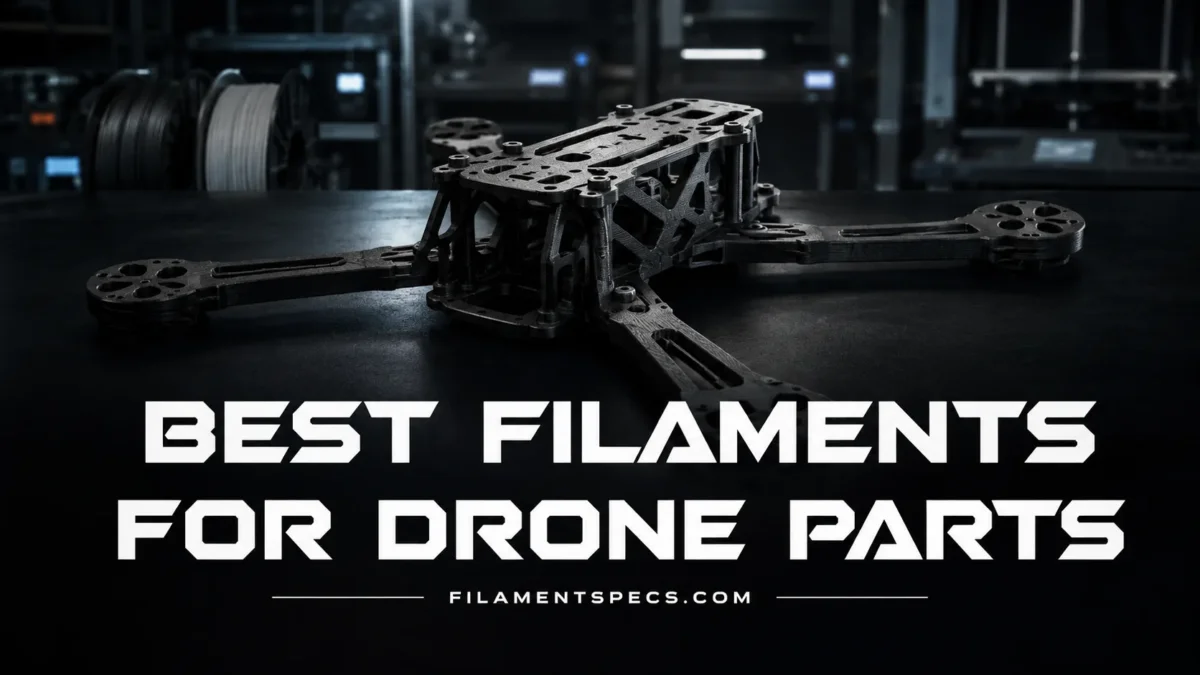
For 3D-printed drone parts, there is no single filament that is best for every component. PA-CF is one of the strongest choices for rigid structural parts, TPU works better where impact absorption and vibration isolation matter, ASA suits weather-exposed housings, PETG is practical for moderate-load accessories, and LW-PLA is most useful when extremely low weight matters more than concentrated-load strength. The correct choice depends on whether the part must resist bending, heat, crashes, vibration, moisture, sunlight, or repeated flexing.
| Drone Part | Preferred Material | Useful Alternative | Main Requirement | Main Limitation to Check |
|---|---|---|---|---|
| Structural frame or arm | PA-CF | PAHT-CF or PPA-CF | High stiffness with reasonable mass and heat resistance | Layer orientation, moisture control, print temperature |
| Motor mount | PA-CF | PC or PPA-CF | Stiffness, heat resistance, screw retention | Z-layer strength and heat near the motor |
| FPV or action-camera mount | TPU | Hard TPU or PETG | Vibration damping and impact absorption | Too much flexibility can allow camera movement |
| Antenna mount | TPU | ASA or PETG | Crash survival and controlled flexibility | Carbon-filled material near RF elements |
| GPS mount or cover | ASA or TPU | PETG | Weather resistance and physical protection | RF obstruction and unnecessary conductive fillers |
| Propeller guard or duct | TPU or tough PA | PETG | Impact tolerance and recovery after deformation | Added mass and excessive flex |
| Electronics tray | PETG or ASA | PA | Dimensional stability and moderate heat resistance | Heat from ESCs and enclosed electronics |
| Landing feet or bumpers | TPU | PA or PP-based filament | Repeated impact and controlled deformation | Excessive softness |
| Outdoor body cover | ASA | PETG | UV and weather exposure | Warping during printing |
| Fixed-wing UAV skin or large lightweight shell | LW-PLA | Thin-wall PETG or ASA | Minimum printed mass | Local fastener loads, heat and crash damage |
A drone usually benefits from multiple materials rather than one filament everywhere. A rigid PA-CF bracket and a flexible TPU camera mount solve different mechanical problems. Replacing both with the same material usually means accepting an unnecessary compromise.
What a Drone Part Needs from the Material
Mechanical strength alone does not determine whether a filament is suitable for flight hardware. Drone parts experience several different load types at the same time: continuous motor vibration, bending loads, bolt clamping, occasional impacts and repeated acceleration. Outdoor aircraft may also face direct sunlight, moisture and heat generated by motors, ESCs and batteries.
Stiffness and toughness should be treated separately. A frame arm needs enough stiffness to resist unwanted flex under motor thrust, while a camera bumper benefits from deformation that absorbs impact energy. A material that performs well in one position can therefore perform poorly in another.
Weight also has a different meaning on an aircraft than on a stationary printed object. Lower mass can improve flight time or payload capacity, but removing material is not useful if the part then needs thicker walls, larger fastener bosses or frequent replacement. The relevant target is not simply the lightest filament; it is the lightest printed design that provides adequate stiffness, heat resistance and durability for its location.
PA-CF for Structural Drone Parts
Carbon-fiber-filled polyamide, commonly described as PA-CF or carbon-fiber nylon, is one of the strongest FDM choices for printed drone frames, motor mounts, payload brackets and other rigid load-bearing components. Chopped carbon fiber generally raises stiffness and improves dimensional stability compared with an unfilled version of the same polymer, while the polyamide matrix can provide more useful impact behavior than highly rigid PLA-based materials.
Polymaker currently lists its Fiberon PA12-CF10 as a suggested material for a printed drone-frame application. That recommendation is useful as a real product example rather than proof that every PA12-CF formulation will behave the same way.[a]
PA6-CF, PA12-CF and PA612-CF Are Not Interchangeable
PA-CF is a family rather than one fixed material. PA6-based grades can deliver high stiffness and strength but are usually more sensitive to absorbed moisture. PA12-based grades are often selected where lower moisture sensitivity and better dimensional stability are desirable. PA612-based grades occupy another part of the range, combining a long-chain polyamide structure with properties that may suit humid, vibration-loaded applications.
Polymaker’s current Fiberon PA612-CF15 technical data illustrates why the exact grade and print direction matter. For its annealed, dry printed specimens tested to ISO 527, the manufacturer reports an XY tensile strength of 91.9 ± 2.0 MPa but a Z tensile strength of 48.3 ± 3.9 MPa.[b] Those values should not be treated as universal PA612-CF numbers, but they show how a strong filament can still produce a much weaker part when the primary load tries to separate printed layers.
For an arm, motor mount or payload bracket, print orientation is part of the material specification. A high datasheet tensile value measured in the XY plane does not guarantee the same performance across Z layers.
PA612-CF has also been used in an agricultural-drone application documented by Polymaker. The printed component carried water-pump hardware, with each pump weighing about 400 g and two or three pumps installed. PA612-CF was selected for the mounting plate where vibration, impact, temperature and humid operating conditions had to be considered.[c] This is a useful example of PA-CF being used as a functional drone material beyond lightweight hobby brackets.
PA-CF Is Not Necessary for Every Rigid Part
A small receiver tray, wire guide or non-load-bearing cover may gain little from PA-CF. The material usually requires stricter drying, higher nozzle temperatures and an abrasion-resistant nozzle. For moderate-load parts, PETG or ASA can reduce printing complexity while still providing adequate service performance.
PPA-CF and PAHT-CF for Higher Heat and Stiffness
PPA-CF and high-temperature PA-CF formulations become more relevant when a printed part sits close to a motor, supports a heavy payload, operates in a hot enclosure or must retain stiffness under conditions that push conventional nylons closer to their limits.
For example, Bambu Lab reports an XY dry-state bending modulus of 9,860 ± 480 MPa and a heat-deflection temperature of 227°C for its specific PPA-CF formulation. The same product calls for a hardened nozzle, a 280–310°C nozzle range and a 100–120°C bed.[d] These figures show the performance level available from some PPA-CF products, but they should not be assigned to PPA-CF as a whole because fiber loading, polymer chemistry, test specimen and conditioning differ between manufacturers.
For a racing-drone antenna holder or simple camera hood, that extra thermal and mechanical capability usually adds printing difficulty without solving a real problem. PPA-CF makes more sense for demanding motor-adjacent mounts, industrial UAV hardware and concentrated structural loads.
TPU for Camera Mounts, Antennas and Crash Protection
TPU solves a problem that stiff engineering filaments cannot: controlled deformation. It is particularly useful for FPV camera mounts, action-camera bumpers, antenna holders, receiver protection, landing feet and duct edges that must absorb energy instead of transferring the full impact into electronics or fasteners.
TPU hardness should match the job. Softer formulations can isolate vibration more effectively but may allow a camera, GPS module or antenna to move too much. Harder TPU keeps geometry more stable while retaining some impact absorption. Around 95A Shore hardness is a common starting point for protective drone accessories, but geometry, wall thickness and the supported mass can matter as much as nominal hardness.
Flexible does not mean suitable for a hot structural mount. UltiMaker’s TPU 95A TDS, for example, reports a heat-deflection temperature of 50.3 ± 1.1°C at 0.455 MPa for its printed test specimens.[e] That product-specific result is one reason TPU should normally be viewed as a damping and protection material rather than a replacement for a rigid motor mount.
ASA for Sun-Exposed Covers and Outdoor Hardware
ASA is well suited to drone parts that spend long periods outdoors but do not need the stiffness of a fiber-filled engineering polymer. GPS covers, electronics housings, payload enclosures, brackets and external body panels can benefit from its resistance to ultraviolet exposure and higher temperature capability compared with PLA.
Prusament ASA, as one current formulation example, is described by its manufacturer as UV-stable and suitable for long-term outdoor use, with a stated temperature resistance near 93°C.[f] The tradeoff is printing behavior: larger ASA parts can shrink or warp, so an enclosure and controlled build environment become more useful as part size increases.
ASA therefore fits the middle ground between easy-to-print general-purpose polymers and more demanding PA-CF grades. It is often a better choice for an outdoor cover than using expensive carbon-fiber nylon where the part carries little mechanical load.
PETG for Moderate-Load Functional Parts
PETG remains useful for battery retainers, electronics trays, cable-management parts, basic camera brackets, covers and prototypes that may progress into real flight testing. It is easier to process on many printers than high-temperature nylon or PPA, and it offers useful toughness for accessories that do not require very high stiffness.
A representative Prusament PETG profile uses a 250 ± 10°C nozzle and an 80 ± 10°C bed, illustrating the lower hardware demands compared with many carbon-fiber nylons and PPA-CF products.[g] Exact settings still depend on the filament manufacturer and printer.
PETG becomes less attractive for highly loaded arms, motor mounts or parts that stay hot under continuous load. Its practical advantage is not that it outperforms engineering polymers; it is that many moderate-load components do not require an engineering polymer in the first place.
Polycarbonate for Rigid Parts Exposed to Heat
Polycarbonate and PC blends are useful when a drone part needs rigidity, impact tolerance and better heat performance than ordinary PLA or PETG. Motor-adjacent brackets, electronics supports and rigid payload hardware are plausible applications when PA-CF is not preferred.
The cost is process difficulty. Prusament PC Blend, for example, specifies a 275 ± 10°C nozzle and 110 ± 10°C bed and recommends a skirt or enclosure.[h] A poorly controlled PC print can therefore provide less useful real-world performance than a well-printed material with lower nominal properties.
LW-PLA for Fixed-Wing UAV Skins and Large Lightweight Shells
LW-PLA has a specialized advantage: it can reduce the mass of large printed surfaces by foaming during extrusion. This makes it particularly useful for fixed-wing UAV fuselages, wing skins, aerodynamic fairings and other large parts where material volume is high but local loads are relatively low.
The weight reduction is not free. colorFabb’s LW-PLA TDS provides a clear example. Its printed specimens at 200°C and 100% flow were reported at about 3,334 MPa tensile modulus and 43.07 MPa tensile strength. At 250°C and 45% flow, where the material was heavily foamed, the reported tensile modulus fell to about 864 MPa and tensile strength to 10.83 MPa.[i] These numbers belong to that formulation and test setup, but the direction of the tradeoff matters: more expansion can reduce mass while also reducing stiffness and strength.
LW-PLA is better suited to distributed-load shells than concentrated-load joints. Motor mounts, arm roots, threaded bosses and hard landing points should not be selected for LW-PLA simply because the filament produces a lighter part.
This distinction also separates fixed-wing UAVs from compact multirotors. A fixed-wing aircraft may have a large fuselage and wing area where shaving mass from the skin is valuable. A small quadcopter has less low-load surface area, so using LW-PLA for structural arms may sacrifice too much stiffness for relatively little overall weight reduction.
PLA Is Better for Fit Checks Than Heat-Exposed Flight Hardware
Standard PLA is useful for checking dimensions, electronics placement, arm geometry, camera angle and assembly clearances before printing the final part in a more demanding material. Its stiffness and easy print behavior make it efficient for prototype iterations.
The limitation is temperature and outdoor exposure. Prusament notes that its PLA begins losing mechanical strength above roughly 60°C and does not recommend the material for outdoor use where heat and UV exposure matter.[k] A dark printed part left in direct sun or positioned close to a warm motor or ESC can therefore be a poor application even if it felt stiff during a room-temperature bench test.
Carbon-Filled Filament Near Antennas and GPS Modules
Carbon fiber can affect electromagnetic behavior. Research on carbon-fiber-reinforced polymer composites shows that these materials can provide electromagnetic-interference shielding, with performance depending on factors such as fiber concentration, fiber length, orientation and processing.[j]
That research does not prove that every chopped-fiber PA-CF antenna mount will cause measurable receiver loss. An FDM filament containing short carbon fibers is not identical to a continuous-carbon laminate, and formulations differ. It does mean that surrounding an antenna or GPS element with carbon-filled material should not be treated as electrically neutral without testing.
For antenna holders, GPS mounts and receiver covers, unfilled TPU, ASA or PETG are often simpler choices. If carbon-filled material is used nearby, antenna placement and range performance should be checked in the completed aircraft rather than assumed from the filament’s mechanical properties.
Material Choice Changes with Drone Type
| Drone Type | Material Combination That Often Fits | Main Selection Priority |
|---|---|---|
| FPV racing quad | PA-CF structural prints, TPU camera and antenna parts | Low mass, stiffness and crash survival |
| Cinewhoop | TPU protection with PA, PETG or other rigid material where needed | Duct impact, camera isolation and controlled flexibility |
| Long-range multirotor | PA12-CF or another moisture-stable engineering PA plus TPU and ASA | Mass, environmental stability and antenna placement |
| Fixed-wing UAV | LW-PLA skins with stronger materials at hard points | Low airframe mass over large printed surfaces |
| Agricultural or payload drone | PA-CF, PAHT-CF or similar engineering materials for loaded brackets | Payload, vibration, moisture and heat resistance |
High-performance FPV frames also illustrate an important boundary of FDM printing. A thermoplastic frame printed from PA-CF is not mechanically identical to a frame cut from continuous carbon-fiber laminate. A printed frame can be useful for custom geometry, prototypes and specialized aircraft, but the chopped fibers inside filament do not create the same continuous reinforcement path as laminated carbon plate.
Print Direction and Geometry Can Override the Filament Choice
Selecting PA-CF instead of PETG does not automatically produce a better arm or motor mount. The load path has to be carried through the printed geometry without forcing the part to split between layers.
- Align major bending loads with the stronger print plane when geometry allows. Avoid placing a highly loaded thin section so that the main force pulls directly across Z layers.
- Use enough wall thickness around screw holes and arm roots. Increasing infill does little for a thin outer shell if the local load enters through a weak fastener boss.
- Add fillets around abrupt section changes. Sharp internal corners concentrate stress where arms meet plates or where payload brackets change thickness.
- Keep nylon dry while printing. Moisture can change extrusion quality and layer bonding before the aircraft ever leaves the ground.
Carbon-filled filaments also require abrasion-resistant extrusion hardware. Polymaker’s PA12-CF10 TDS specifically warns that brass nozzle wear occurs rapidly with that formulation and recommends a wear-resistant nozzle.[a] A nozzle that has worn oversize can change extrusion width, dimensional accuracy and the fit of mechanically loaded parts.
Ground Checks Before a Printed Part Flies
Datasheet values cannot confirm that a particular printed component is safe. Layer height, wall count, orientation, moisture, printer calibration, fastener design and post-processing all change the finished part. A new structural print should be inspected and mechanically checked before it is relied upon in flight.
- Torsion: inspect arms and brackets for excessive twisting or visible layer opening under hand-applied load.
- Fasteners: check whether screw bosses crack, deform or loosen when hardware is tightened to its intended seating condition.
- Heat: inspect motor- and ESC-adjacent components after a stationary systems test for softening or permanent deformation.
- Vibration: check camera, GPS and electronics mounts for movement that could affect sensors, footage or wiring.
- Impact parts: inspect guards, landing feet and bumpers for hidden layer separation after a hard contact.
- Early flights: recheck bolt holes, inserts, arm roots and layer lines for creep, ovalized holes or new cracks.
Parts That Should Not Be Treated Like Ordinary FDM Components
Propellers are a different risk category from covers, mounts and guards. A propeller operates at high rotational speed and must maintain geometry, balance and material integrity under repeated centrifugal and aerodynamic loading. A filament that is suitable for an antenna mount or frame bracket should not be assumed suitable for a flight propeller.
Motor shafts, load-bearing metal fasteners and other components designed around metallic strength or wear behavior also should not be replaced with ordinary FDM polymer parts simply because the geometry can be printed. The more energy the aircraft carries and the heavier its payload, the more conservative the material and component validation should become.
Frequently Asked Questions
What is the best filament for a 3D-printed drone frame?
For a rigid FDM-printed structural frame, PA-CF is one of the strongest starting points because it can combine high stiffness, useful heat resistance and better dimensional control than many unfilled polymers. PA12-CF or PA612-CF may be attractive where moisture behavior matters. PPA-CF or PAHT-CF can suit more demanding heat and stiffness requirements. Print orientation and frame geometry remain as important as the material name.
Is PETG strong enough for drone parts?
Yes, for many moderate-load components. PETG works well for electronics trays, covers, cable guides, battery-related accessories and some brackets. It is less suitable where very high stiffness, high service temperature or maximum structural performance is required, such as heavily loaded motor mounts and structural arms.
Is TPU 95A suitable for FPV camera mounts?
TPU around 95A hardness is commonly suited to FPV camera mounts because it can absorb impact and isolate vibration while remaining firm enough for many small cameras. A heavy action camera or a mount with long flexible arms may need a harder TPU or thicker geometry to prevent excessive movement.
Should carbon-fiber filament be used for an antenna mount?
It is usually unnecessary. Carbon-fiber composites can interact with electromagnetic fields, and the exact shielding behavior depends on composition and geometry. TPU, ASA or PETG avoids that uncertainty and also provides useful mechanical properties for antenna mounts. If a CF-filled part is used close to an antenna, the completed installation should be range-tested rather than assumed to be RF-transparent.
Is LW-PLA suitable for multirotor arms?
Usually not as the first choice. LW-PLA is most valuable in large, lightly loaded shells where reducing material density saves meaningful airframe mass. Foaming reduces stiffness and strength, making concentrated motor, fastener and arm-root loads less suitable applications. It is much more compelling for fixed-wing UAV skins and fuselage sections.
Does carbon-fiber nylon need to be dried before printing?
Most PA-CF grades require controlled dry storage, and many manufacturers specify drying before printing or after the spool has absorbed moisture. The correct temperature and duration are formulation-specific. The manufacturer’s TDS should be followed because PA6-CF, PA12-CF, PA612-CF and PPA-CF products can require different conditions.
Can PLA be used for a drone prototype?
Yes. PLA is useful for checking fit, dimensions, electronics placement and assembly before committing to a more expensive engineering filament. Its lower heat resistance makes it less suitable for many final motor-adjacent or sun-exposed flight parts.
Sources
- Polymaker — Fiberon PA12-CF10 — Supports PA12-CF printing requirements, mechanical-property examples, moisture handling and the wear-resistant nozzle requirement. (Official manufacturer technical page.)
- Polymaker — Fiberon PA612-CF15 Technical Data Sheet — Supports the stated XY and Z mechanical-property values and ISO test methods. (Official manufacturer TDS.)
- Polymaker — Agricultural Drone Water-Pump Mount Application — Supports the PA612-CF drone application, pump mass and stated environmental requirements. (Manufacturer application case study.)
- Bambu Lab — PPA-CF Technical Parameters — Supports the cited bending modulus, heat-deflection temperature and printing conditions for Bambu PPA-CF. (Official manufacturer technical page.)
- UltiMaker — TPU 95A Technical Data Sheet — Supports the stated printed-specimen heat-deflection value and test condition. (Official manufacturer TDS.)
- Prusa Polymers — Prusament ASA — Supports UV stability, outdoor suitability, heat resistance and warping behavior. (Official manufacturer material page.)
- Prusa Polymers — Prusament PETG Technical Data Sheet — Supports the representative PETG printing temperatures. (Official manufacturer TDS.)
- Prusa Polymers — Prusament PC Blend — Supports the stated nozzle, bed and enclosure-related printing requirements. (Official manufacturer material page.)
- colorFabb — LW-PLA Technical Data Sheet — Supports the stated tensile modulus and strength values at different foaming conditions. (Official manufacturer TDS.)
- Journal of Materials Science: Materials in Electronics — Recent Advances in Electromagnetic Interference Shielding Properties of Carbon-Fibre-Reinforced Polymer Composites — Supports the discussion of carbon-fiber composites and electromagnetic shielding behavior. (Peer-reviewed open-access review.)
- Prusa Polymers — Prusament PLA — Supports the stated temperature and outdoor-use limitations for the cited PLA formulation. (Official manufacturer material page.)