
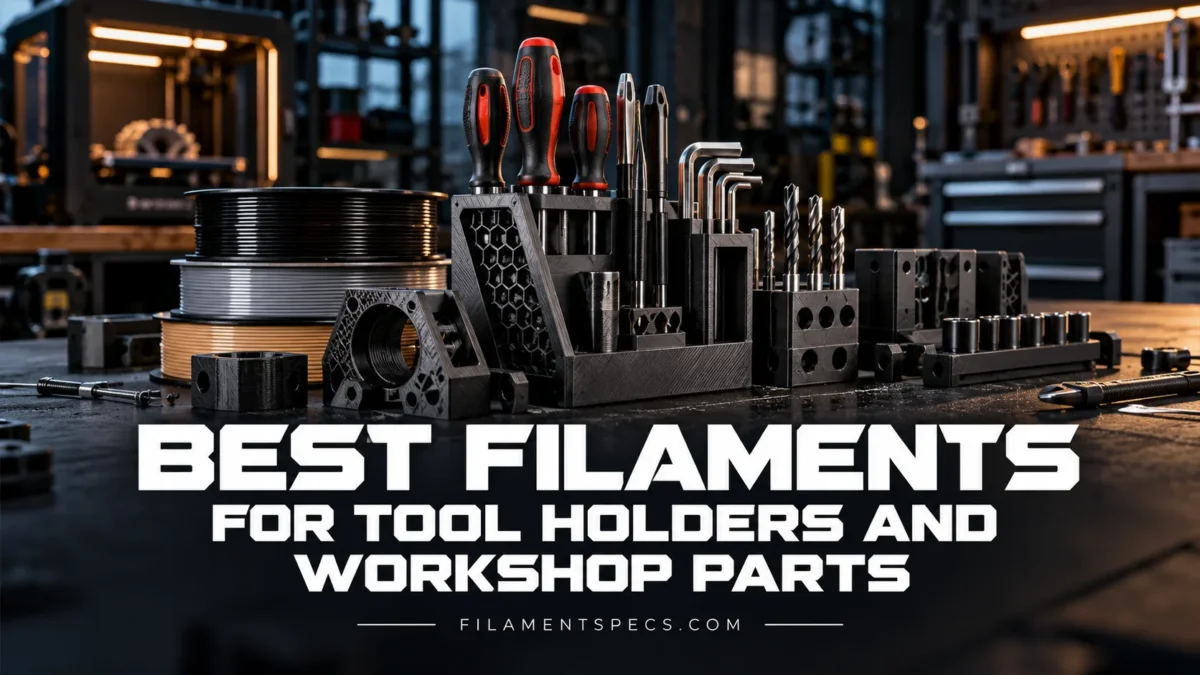
For most indoor wall-mounted tool holders, pegboard accessories, French-cleat mounts, racks, bins, hose adapters, and medium-load workshop parts, PETG is the most practical default filament. PLA can be the better choice for rigid, lightly loaded organizers kept in a cool room; ASA is more suitable for hot garages, sunlight, and outdoor storage; nylon works well for clips and wear surfaces; PA-CF fits stiff, heavily loaded mounts; PC is mainly justified when heat and mechanical load occur together; PP is useful around compatible oils and chemicals; and TPU works best as a flexible pad, foot, grip, or retaining insert rather than the main structural body.
| Material | Strongest Workshop Fit | Sustained Load | Heat / Sun Exposure | Repeated Flex or Wear | Main Limitation |
|---|---|---|---|---|---|
| PETG | General holders, brackets, racks, bins, adapters | Good for moderate loads with suitable geometry | Moderate; formulation-dependent | Good | Less rigid than PLA and some fiber-filled materials |
| PLA / PLA+ | Rigid indoor organizers, bit racks, drawer inserts | Best kept to light or moderate indoor loads | Low | Limited | Heat, impact, and long-term deformation can limit use |
| ASA | Hot garages, vans, outdoor and sun-exposed holders | Good | High for common desktop-filament use | Good | Warping makes enclosure control valuable |
| PA / Nylon | Clips, latches, sliding guides, wear-prone retainers | Good, but plain nylon may flex | Good | Very good | Moisture absorption and lower stiffness in some grades |
| PA-CF | Stiff heavy-tool mounts and machine-side brackets | Very good when dry and correctly designed | High, but product-specific | Good | Moisture control, abrasive fill, and anisotropy |
| PC | High-load parts near elevated temperatures | Very good | High | Good | High print temperature, warping, moisture sensitivity |
| PP | Chemical-contact trays, flexible utility parts | Limited where high stiffness is needed | Good, grade-dependent | Very good | Low stiffness and difficult bed adhesion |
| TPU | Pads, feet, liners, anti-rattle and soft retention parts | Poor choice for a rigid holder body | Grade-dependent | Excellent flexibility | Usually too compliant for structural mounts |
These ratings describe material families rather than guaranteed values for every spool. Additives, print direction, moisture condition, temperature, wall geometry, and the manufacturer’s formulation can change the result.
What a Workshop Holder Actually Has to Survive
A workshop part can fail even when its advertised tensile strength looks adequate. A wall hook carrying a cordless drill is exposed to a continuous bending moment. A socket clip is flexed every time a socket is removed. A machine-side bracket may be warmed for hours. A pegboard hook can receive impact when a tool is dropped onto it instead of placed gently.
For these parts, the useful properties are not limited to peak strength. Stiffness, creep resistance, impact behavior, layer adhesion, temperature resistance, fatigue behavior, wear, chemical compatibility, and printed-part orientation can all determine whether the holder remains usable.
A tool holder does not have to snap to fail. A cantilever arm that slowly bends downward can change the tool’s retention angle, allow a battery or drill to work loose, or put more stress around the wall screws. Time-dependent deformation under sustained load is therefore a design condition, not merely a material-property detail. Current research on material-extrusion thermoplastics continues to identify creep behavior as dependent on both the polymer and the way the part is printed.[b]
PETG Is the Practical Default for General Workshop Storage
PETG fits a large share of workshop-storage applications because it combines useful toughness and layer bonding with relatively manageable printing. Prusa specifically lists mechanical parts, holders, and clamps among common PETG applications and notes its low tendency to shrink or warp compared with more demanding engineering polymers.[a]
That makes PETG a sensible starting material for wall-mounted hand-tool holders, cordless-drill cradles, French-cleat accessories, pegboard attachments, wrench racks, large bins, shop-vac adapters, hose fittings, and general brackets. It is particularly useful when the holder may be knocked, loaded somewhat roughly, or printed at a size where warping would make ASA, PC, or some nylon formulations less convenient.
PETG is not automatically the stiffest choice. A long, thin PETG hook may visibly deflect even though it does not crack. For a heavy tool on a long cantilever, shortening the arm, increasing section depth, adding ribs or gussets, or moving to a stiffer composite can be more useful than simply increasing infill.
PETG is most convincing when the requirement is balanced rather than extreme: moderate load, ordinary workshop temperatures, occasional impact, good layer bonding, and a print process that does not require an enclosed high-temperature machine.
PLA Works Well for Rigid Organizers in Controlled Temperatures
PLA should not be dismissed simply because a part is functional. Its rigidity and low warping can be useful for socket trays, screwdriver racks, drill-bit holders, drawer inserts, measuring-tool organizers, templates for storage positions, and other parts whose main job is to preserve a clean shape rather than absorb impact or carry a heavy cantilevered load.
The limitations appear when temperature, impact, or sustained mechanical stress increase. Prusa describes PLA as unsuitable where high mechanical, chemical, or temperature resistance is required and notes softening and deformation around temperatures above 60 °C for its PLA guidance.[c] That manufacturer statement should not be treated as an exact failure temperature for every PLA formulation, but it illustrates why a PLA holder that behaves well in a climate-controlled workshop may be a poor choice for a sun-heated garage, vehicle, or enclosure near warm machinery.
PLA+ does not identify one universal formulation. Different manufacturers modify PLA for different combinations of toughness, flexibility, print speed, or heat behavior. A PLA+ spool should therefore be judged by its own technical data rather than assuming that the “+” guarantees better long-term load or temperature performance.
ASA Fits Hot Garages, Sunlight, and Outdoor Tool Storage
ASA becomes more attractive when the holder is mounted where sunlight and elevated ambient temperature are normal conditions. Typical applications include outdoor garden-tool racks, holders near an open garage door, vehicle or work-van organizers, exterior equipment brackets, and workshop storage mounted where afternoon sun heats the wall.
Prusa describes ASA as UV- and temperature-resistant and suitable for outdoor technical parts, while also warning that warping is one of its main printing difficulties.[d] This shifts the tradeoff: ASA can provide a more suitable service environment than PLA, but the printer may need an enclosure or otherwise controlled thermal conditions to produce a large bracket without corner lift or cracking.
ABS can serve many indoor technical uses, but where long-term UV exposure is part of the requirement, ASA is generally the more appropriate member of the two styrenic families. A separate ABS-versus-ASA decision is rarely needed for a simple indoor screwdriver rack; the distinction matters most when environmental exposure is part of the holder’s job.
Nylon and PA-CF Solve Different Workshop Problems
Plain Nylon for Clips, Wear, and Repeated Movement
Polyamide, commonly called nylon, is a strong candidate when a workshop part repeatedly bends, slides, or rubs. Prusa identifies abrasion resistance, low friction, high resilience, strong layer adhesion, and flexibility in thinner sections among nylon’s useful properties.[e]
Those characteristics fit snap-on socket clips, hose retainers, flexible tool-retention fingers, latches, sliding guides, and other parts that would be poorly served by a brittle material. Plain nylon is less convincing when the main need is maximum rigidity. A long wall arm can be tough enough to avoid fracture yet still flex more than desired.
Nylon is also hygroscopic. Moisture absorbed before printing can change extrusion quality, surface finish, and mechanical behavior. Drying and sealed storage are therefore part of the material choice rather than optional housekeeping for demanding nylon parts.[e]
PA-CF for Stiffer Heavy-Load Mounts
Adding chopped carbon fiber to a polyamide matrix can greatly increase stiffness and dimensional stability in suitable formulations. This makes PA-CF attractive for heavy cordless-tool mounts, stiff machine brackets, large tool-retention arms, mounting blocks, and other workshop hardware where plain nylon’s flexibility is undesirable.
Carbon fiber does not remove the moisture sensitivity of the polyamide matrix. A current Fiberon PA6-CF20 data set provides a useful product-specific example: the manufacturer reports an XY Young’s modulus of 7037.6 MPa in the dry condition and 2286.2 MPa when wet, while XY tensile strength changes from 109.3 MPa dry to 54.7 MPa wet. The values come from that particular printed PA6-CF20 formulation and should not be generalized to every PA-CF filament, but they show how strongly conditioning can alter a composite’s behavior.[f]
A dry PA-CF specification is not a promise of identical performance after moisture absorption. For a heavily loaded holder, check whether the manufacturer reports dry, conditioned, wet, annealed, or as-printed values before using a published modulus or strength number in a design decision.
PC, PP, and TPU Are Specialist Workshop Choices
PC When Heat and Mechanical Load Occur Together
Polycarbonate becomes relevant for brackets or mounts that are both mechanically loaded and exposed to more heat than ordinary PLA or PETG applications should see. Examples include some machine-side brackets, printer or electronics enclosures with warm internal components, and equipment mounts near sustained heat sources.
Prusa describes PC as a technical material with high tenacity, tensile strength, and heat resistance, but also notes high print temperatures, warping, moisture sensitivity, and the value of an enclosure.[g] Those requirements make PC unnecessary for most ordinary wall racks. A properly designed PETG or ASA holder is usually easier to produce when high-temperature performance is not actually required.
PP Where Chemical Resistance and Flexibility Matter
Polypropylene is more specialized. Its chemical resistance and bendability make it interesting for workshop trays, fluid-related accessories, containers, flexible retainers, or parts exposed to compatible lubricants and chemicals. Prusa lists chemical resistance among PP’s main advantages and also identifies warping and poor surface adhesion as major printing difficulties.[h]
PP is not an automatic upgrade for wall-mounted tool storage because high chemical resistance does not compensate for low stiffness in a long cantilever. It makes more sense when chemical exposure or repeated bending is part of the actual requirement.
TPU as the Contact Layer Rather Than the Main Holder
TPU and related flexible materials are particularly useful when the rigid structural filament should not contact the tool directly. Prusa’s flexible-material guidance highlights flexibility, tenacity, wear resistance, and chemical resistance as characteristic benefits of TPU/TPE-type filaments.[i]
- PETG holder body with a TPU anti-rattle pad
- PA-CF bracket with a TPU contact surface
- Rigid tool rack with TPU feet to reduce sliding
- Drill cradle with a replaceable soft insert
- Clamp or retaining arm with a flexible non-marring contact section
This two-material approach is often more useful than forcing one polymer to supply both structural stiffness and a soft contact surface.
Carbon-Fiber Fill Is Not a Universal Strength Upgrade
Carbon-fiber-filled PLA, PETG, PET, nylon, and other polymers can be useful for workshop parts, but the letters “CF” do not mean that every mechanical property improves. Chopped fiber often raises stiffness and may improve dimensional stability, while impact behavior, interlayer strength, elongation, and failure mode can move in different directions depending on the formulation.
The base polymer still matters. PLA-CF remains a PLA-based material. PETG-CF remains dependent on its PETG matrix. PA-CF still has a polyamide matrix whose moisture condition can alter performance. Selecting a composite only because it contains carbon fiber can therefore produce a holder that is stiffer but not necessarily more tolerant of impact or weak layer orientation.
Direction-specific data make this especially clear. UltiMaker’s PET CF TDS reports ISO 178 flexural strength of 102.8 MPa for its XY orientation, 122.3 MPa for YZ, and 41.9 MPa for Z on its 3D-printed test specimens.[j] Those numbers belong only to that product and test setup, but the spread demonstrates why a composite filament name cannot replace printed-part orientation data.
Filled filaments can also be abrasive. Prusa recommends hardened steel or another wear-resistant nozzle for abrasive composites such as carbon-filled materials because standard brass nozzles can wear much faster.[k]
Match the Filament to the Workshop Part
| Workshop Part | Good Starting Material | Consider an Upgrade When | Primary Failure Concern |
|---|---|---|---|
| Screwdriver rack | PLA or PETG | The rack is exposed to heat, impact, or sunlight | Cracking or heat distortion |
| Drill-bit organizer | PLA | Frequent impacts or a hotter environment are expected | Hole wear or brittle damage |
| Socket organizer | PLA or PETG | Flexible snap retention is needed | Clip fatigue or wear |
| Pegboard hook | PETG | The hook is long, heavily loaded, or frequently flexed | Root bending and creep |
| French-cleat tool holder | PETG | Heavy tools cause visible deflection | Sustained cantilever load |
| Cordless-drill holder | PETG | Higher stiffness or heavier tools are required | Long-term arm deflection |
| Battery mount | PETG | Heat, sunlight, or heavy repeated insertion is expected | Retention wear and temperature |
| Outdoor tool holder | ASA | Load or service temperature exceeds the selected ASA grade’s capability | UV, heat, and weather exposure |
| Flexible retaining clip | PA / Nylon | More stiffness is needed without losing a technical polymer base | Repeated flexing |
| Heavy machine bracket | PA-CF | Service temperature calls for a suitable PC or higher-temperature polymer | Combined stiffness, heat, and layer loading |
| Shop-vac or hose adapter | PETG | Higher heat or repeated flex changes the requirement | Impact, fit, and local stress |
| Chemical-contact tray | PP where chemically compatible | The exact fluid requires another documented polymer | Chemical attack and warping |
| Protective pad or foot | TPU | A different hardness is required | Wear and compression set |
The table is a starting-point matrix, not a load rating. A wall mount for a 300 g hand tool and one for a multi-kilogram cordless tool may use the same polymer but require very different section thickness, support geometry, fasteners, and print orientation.
Long-Term Load Can Matter More Than Peak Strength
Creep is time-dependent deformation while a material remains under load. It is especially relevant to workshop parts that stay loaded continuously: drill holders, battery racks, hooks, shelf brackets, spool supports, long French-cleat arms, and wall-mounted organizers.
A material can survive a short strength test and still move gradually during months of service. Temperature, stress level, print orientation, infill arrangement, polymer formulation, and geometry all influence that behavior. A 2026 peer-reviewed review of PLA, ABS, PETG, PC, and PP material-extrusion research documents the role of fabrication parameters in creep, impact, and hardness behavior.[b]
For a continuously loaded wall holder, reducing bending leverage can be more effective than changing filament. A shorter arm, deeper cross-section, triangular gusset, larger root radius, or support positioned closer to the tool’s center of mass reduces stress before any material upgrade is considered.
Heat Ratings Need Load and Test Context
Workshop filament comparisons often quote heat deflection temperature, or HDT, as if it were a universal maximum operating temperature. It is not. ASTM D648 measures the temperature at which a specified deflection occurs under prescribed flexural-loading conditions, and ASTM explicitly cautions against using the result to predict elevated-temperature behavior unless time, temperature, loading method, and fiber stress are comparable to the test conditions.[l]
This distinction matters in a garage. Air temperature, a sun-heated wall, a closed vehicle, nearby machinery, and a loaded cantilever do not create the same condition as a short laboratory HDT test. Published HDT values are useful for comparing documented formulations, but they should not be converted directly into a guaranteed long-term service-temperature limit.
For a cool indoor organizer, heat performance may barely influence the choice. For a battery rack inside a hot work van or a bracket close to warm equipment, it can become one of the first selection filters.
Print Orientation Can Change the Result More Than a Material Upgrade
Material-extrusion parts are anisotropic: their mechanical response depends on direction. A hook printed so that its root is pulled apart across weak interlayer interfaces can fail very differently from the same model oriented so the main load follows continuous extruded roads.
The UltiMaker PET CF example above shows how large a directional difference can appear even in a fiber-filled engineering material.[j] The practical lesson is not that one orientation is universally strongest. The load path in the actual holder must be compared with the manufacturer’s test orientation and with the way the model will be printed.
- Keep the highest bending stress away from an exposed layer-separation plane where practical.
- Increase section depth at the root of hooks and cantilever arms instead of only increasing global infill.
- Use fillets where a thin arm joins the wall plate to reduce an abrupt stress concentration.
- Add ribs or gussets when the part needs stiffness without turning the entire model into solid plastic.
- Place mounting bosses so screw loads spread into a substantial wall section rather than a thin shell.
More Infill Is Not the Same as a Better Load Path
High infill can help in some parts, but a workshop bracket commonly transfers load through its outer walls, hook root, fastener region, and local transitions. Adding material far from those stressed features may consume filament without solving the local weakness. Research across material-extrusion thermoplastics also shows that print parameters and internal structure can affect mechanical and creep behavior, so an infill percentage by itself is not a complete strength specification.[b]
Mounting Holes Are Part of the Structure
A strong holder can still fail around its screws. A small screw head can concentrate pressure into the plastic, an aggressively countersunk fastener can act like a wedge, and a mounting hole too close to an edge can leave too little material to distribute load.
Broad screw seats, washers where appropriate, thicker bosses, generous edge distance, and fillets around load transitions can make the mounting region more tolerant. Repeatedly removed hardware may justify a captive nut, threaded insert, sleeve, or other metal load-spreading feature, provided the surrounding printed geometry is designed to support it.
Do not treat an untested printed holder as safety hardware. Where failure could drop a heavy tool onto a person, vehicle, machine, or valuable equipment, use suitable mechanical retention, load-spreading hardware, and an adequate safety margin rather than relying only on the apparent strength of a test print.
Oil, Grease, Coolant, and Cleaner Exposure Need Exact Compatibility Data
A greasy hand touching a tool rack occasionally is different from continuous immersion in a lubricant or repeated contact with concentrated cleaner. Polymer compatibility depends on the exact chemical, concentration, temperature, exposure duration, and mechanical stress present at the same time.
PP is attractive when chemical resistance is a primary requirement, while TPU and some engineering polymers also offer useful resistance to selected substances.[h][i] That does not make any of them universally resistant to workshop fluids. Before printing a coolant tray, solvent-contact accessory, oil container, or repeatedly cleaned machine part, the exact filament manufacturer’s chemical-resistance information should take priority over a generic polymer-family label.
| Exposure | Selection Approach |
|---|---|
| Occasional grease from handling tools | Usually a secondary concern; verify the selected formulation if appearance or surface life matters. |
| Repeated lubricating-oil splash | Check the exact polymer and filament manufacturer’s compatibility information. |
| Coolant or cutting-fluid contact | Verify the exact fluid formulation, concentration, temperature, and duration. |
| Routine cleaner or IPA exposure | Check repeated-exposure data rather than assuming a one-time wipe represents long-term use. |
| Strong solvent exposure | Use documented compatibility data for the exact material and solvent. |
| Continuous immersion | Use product-specific test data or validation under the intended service conditions. |
Check the Printer Before Choosing the Filament
| Material | Enclosure | Moisture Control | Wear-Resistant Nozzle |
|---|---|---|---|
| PLA | Usually not required | Normal dry storage | Not for unfilled PLA |
| PETG | Usually not required | Dry storage recommended | Not for unfilled PETG |
| ASA | Recommended for stable large-part printing | Follow product guidance | Not normally required for unfilled ASA |
| PA / Nylon | Often helpful; grade-dependent | Drying and sealed storage are commonly required | Not inherently required when unfilled |
| PA-CF and other CF composites | Depends on base polymer | Depends on base polymer; especially important for PA | Yes |
| PC | Usually beneficial | Drying/storage can be important | Not inherently required when unfilled |
| PP | Often helpful for warping control | Follow product guidance | Not inherently required when unfilled |
| TPU | Usually not required | Follow product guidance | Normally no for unfilled TPU |
A technically superior filament is not useful if the printer cannot process it consistently. ASA and PC may need better thermal control than an open-frame machine provides. Nylon may need active drying. Carbon-filled materials need abrasion-resistant extrusion hardware. These requirements should be considered before replacing a successfully printable PETG design with a more demanding polymer.
Frequently Asked Questions
Is PETG or PLA better for wall-mounted tool holders?
PETG is usually the safer general-purpose starting point when the holder carries a tool continuously or may receive impact. PLA can be preferable for lightly loaded indoor organizers where rigidity and dimensional cleanliness matter more than heat or impact resistance. A long cantilever or a hot garage can change the decision.
What filament is suitable for a heavy cordless-drill holder?
PETG is a practical first choice for many designs. If the arm remains too flexible under sustained load, improve the geometry before changing materials. A suitable PA-CF formulation can provide much higher stiffness for demanding mounts, but moisture condition, print direction, nozzle wear, and manufacturer-specific mechanical data need to be considered.
Is 100% infill necessary for strong workshop brackets?
No. Strength depends on more than infill percentage. Outer walls, load direction, root thickness, ribs, gussets, mounting bosses, layer orientation, and local solid regions can matter more than filling the entire interior. The most effective configuration depends on how the bracket is loaded.
Is carbon-fiber filament always better for tool holders?
No. Carbon fiber can increase stiffness and improve dimensional behavior in suitable formulations, but impact behavior, Z-direction strength, elongation, moisture response, and heat performance still depend on the base polymer and product formulation. Carbon-filled filament also requires abrasion-resistant nozzle hardware.
Which filament is better for a workshop that becomes very hot in summer?
ASA is a practical option when heat and sunlight are expected, while PA-CF or PC may fit more demanding combinations of temperature and mechanical load. PLA is less suitable where the holder can approach its softening range. Published HDT values should be treated as standardized comparison data rather than guaranteed long-term service temperatures.
Can TPU be used to print an entire tool holder?
It can be used where flexibility is intended, but ordinary TPU grades are usually too compliant for a rigid wall bracket or long tool-support arm. TPU is more useful as a contact pad, soft retaining feature, anti-rattle insert, protective liner, foot, or grip combined with a stiffer structural material.
Does a nylon or PA-CF workshop part need to be dried before printing?
Polyamides are hygroscopic, and drying is commonly necessary for consistent technical prints. The exact drying temperature and duration must come from the filament manufacturer because polyamide families and composite formulations differ. Mechanical data should also be checked for whether specimens were tested dry, conditioned, wet, or annealed.
Sources
- Prusa Research — PETG — Supports PETG use for mechanical parts, holders and clamps, along with its general printing behavior. (Official printer and filament manufacturer technical guidance.)
- Journal of Materials Science: Materials in Engineering — The Influence of Fabrication Parameters on the Durability of Material Extrusion Thermoplastics (PLA, ABS, PETG, PC, and PP) — Supports the discussion of creep, impact behavior and process-dependent performance in printed thermoplastics. (Peer-reviewed review article.)
- Prusa Research — PLA — Supports PLA printing characteristics and limitations involving mechanical, UV and temperature exposure. (Official manufacturer technical guidance.)
- Prusa Research — ASA — Supports ASA’s UV and temperature resistance, outdoor use and warping considerations. (Official manufacturer technical guidance.)
- Prusa Research — Polyamide (Nylon) — Supports nylon abrasion resistance, flexibility, low friction and hygroscopic storage requirements. (Official manufacturer technical guidance.)
- Polymaker Fiberon — PA6-CF20 Technical Data — Supports the cited dry-versus-wet mechanical values and wear-resistant-nozzle requirement for this specific PA6-CF formulation. (Manufacturer product data and TDS resource.)
- Prusa Research — Polycarbonate (PC) — Supports PC heat and mechanical performance, hygroscopic behavior, high print temperatures and enclosure considerations. (Official manufacturer technical guidance.)
- Prusa Research — Polypropylene (PP) — Supports PP chemical resistance, flexibility, warping and build-surface adhesion limitations. (Official manufacturer technical guidance.)
- Prusa Research — Flexible Materials — Supports TPU/TPE flexibility, wear behavior and chemical-resistance characteristics. (Official manufacturer technical guidance.)
- UltiMaker — PET CF Technical Data Sheet — Supports direction-specific ISO 178 flexural data for 3D-printed PET CF specimens. (Manufacturer technical data sheet with test methods.)
- Prusa Research — E3D V6 Nozzles — Supports the use of hardened nozzles with abrasive carbon-filled filaments. (Official hardware technical guidance.)
- ASTM International — ASTM D648, Deflection Temperature of Plastics Under Flexural Load — Defines the HDT test context and its limitations for predicting elevated-temperature service behavior. (Official ASTM standard information.)