
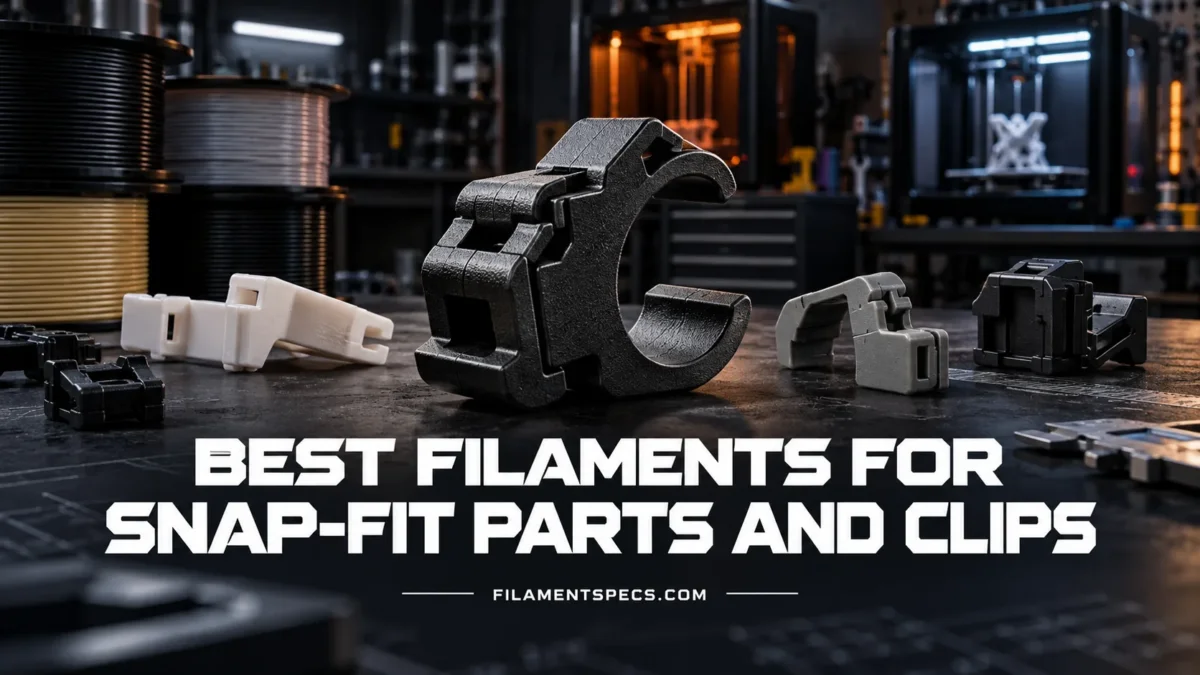
For most FFF snap-fit parts and clips, PETG is the most practical starting material because it combines useful ductility, good layer bonding, and comparatively easy printing. Unfilled nylon is usually the better choice when the arm must flex many times, while polypropylene is especially well suited to repeated bending but is harder to print reliably. Polycarbonate fits rigid, heat-exposed snaps; ASA fits outdoor clips; TPU fits soft retainers rather than a crisp locking snap. PLA and PLA+ can work for low-cycle indoor clips, but they leave less margin when deflection, temperature, or repeated cycling rises.
| Material | Snap Behavior | Repeated Cycling | Main Limitation | Best Fit |
|---|---|---|---|---|
| PETG | Balanced stiffness and give | Good | Retention can fall if the arm stays highly deflected for long periods | General enclosure tabs, covers, cable clips, removable holders |
| Unfilled nylon / PA | Tough, springy, formulation-dependent | Very good | Moisture changes printing and mechanical behavior | Frequently opened latches, durable clips, repeated flex |
| PP | Very compliant with strong flex recovery | Excellent | Build-surface adhesion and dimensional control can be difficult | High-cycle clips, flexible catches, hinge-like snap features |
| PC / PC blend | Rigid, high-force snap | Good when strain is controlled | High print temperatures, warping, moisture sensitivity | Heat-exposed rigid latches and technical enclosures |
| ASA | Firm snap with useful toughness | Moderate to good | Warping and enclosure needs | Outdoor and UV-exposed clips |
| PLA / PLA+ | Crisp and stiff | Limited to moderate, formulation-dependent | Lower tolerance for heat and repeated high strain | Low-cycle indoor tabs and fit checks |
| TPU | Soft and highly compliant | Very good for soft flexing | Often too soft for a positive rigid latch | Soft retainers, cable grips, friction catches |
| CF/GF-filled polymers | Stiffer, less forgiving in flex | Depends strongly on matrix and grade | Higher stiffness can reduce the strain margin needed by a snap arm | Rigid housings and supports around the clip rather than the flexing arm itself |
These are selection tendencies, not universal material ratings. Polymer grade, additives, moisture, print orientation, wall structure, temperature, and snap geometry can change the result.
A Snap-Fit Needs Strain Capacity, Recovery, and Fatigue Resistance
A cantilever snap works by temporarily bending far enough for its hook to pass an undercut, then returning toward its original position. That makes headline tensile strength a poor single-number selector. The arm also needs enough allowable strain to survive assembly, enough stiffness to produce the required insertion and retention force, and enough elastic recovery to avoid permanent set. Snap-fit design references therefore treat material strain and beam geometry together rather than selecting a polymer only by ultimate strength.[a]
Shorter and thicker arms generate higher strain for the same required deflection. Lengthening the cantilever, tapering it, reducing unnecessary hook height, and removing sharp stress concentrations can lower the strain seen at the root. A material that fails in one geometry can work reliably after the arm is redesigned, while a tougher filament can still fail quickly if the root is too short, thick, or sharply cornered.
Do not rank snap-fit filaments by tensile strength alone. A clip can have adequate static strength and still crack after repeated opening, take a permanent set while held closed, or split along a weak layer interface.
Fatigue and Long-Term Retention Are Different Problems
A clip that flexes only during assembly has a different duty cycle from one opened every day. Repeated bending makes fatigue resistance more relevant. A third case is a clip that remains deflected after engagement. Thermoplastics can relax under sustained strain, so a latch may stay intact yet lose retention force over time. Covestro’s joining guidance also warns that plastic interference fits can loosen through stress relaxation and recommends prototyping and testing rather than treating the initial fit as the final performance state.[j]
The practical design question is therefore not just “Will it snap into place?” It is also whether the arm returns after release, whether the locking force changes after hours or weeks in the engaged position, and whether repeated cycling creates whitening, cracking, or permanent bend.
PETG: The Practical Default for General-Purpose Clips
PETG is a strong first choice for enclosure tabs, battery covers, cable clips, tool holders, removable covers, and other parts that need more give than ordinary PLA without moving immediately into a high-temperature engineering-filament workflow. Prusa describes PETG as tough and durable with good layer adhesion and low warping, which are useful traits for small functional parts where the arm and hook must print cleanly and remain bonded through bending.[c]
Its main advantage is balance. PETG can provide a positive snap without being as rigid as PLA or as demanding to process as many nylon and PC grades. It is also widely printable on open-frame machines. For a clip used occasionally at normal room temperature, that balance often matters more than chasing the highest published modulus or tensile strength.
There is one design check PETG should not skip: test retention after the part has remained engaged for the real dwell time. If the arm stays heavily bent when locked, the design is asking the polymer to carry continuous strain. Reducing the locked deflection can improve long-term behavior more effectively than simply adding walls or infill.
Unfilled Nylon: Better for Clips That Flex Again and Again
Unfilled polyamide is one of the strongest candidates for frequently operated clips because many nylon grades combine toughness, useful flexibility, abrasion resistance, and fatigue resistance. UltiMaker lists its nylon as tough and fatigue resistant, and its current TDS shows why orientation still matters even when the base polymer is highly ductile.[d]
“Nylon” is not one fixed formulation. PA6, PA11, PA12, copolyamides, impact-modified grades, and other blends can differ substantially in stiffness, moisture uptake, heat behavior, and print requirements. The spool’s own TDS should therefore take priority over a generic material chart.
Moisture Changes More Than Surface Quality
Nylon is often discussed as a drying problem because wet filament can print with bubbles, stringing, rough surfaces, or inconsistent extrusion. For snap-fits, the finished part’s moisture condition also matters. A current PolyMide CoPA data sheet reports an XY Young’s modulus of about 2703 MPa in its stated dry condition and about 724 MPa after the manufacturer’s stated wet conditioning; the same document reports XY notched Charpy impact strength changing from 6.9 to 27.7 kJ/m² under those two conditions.[e] Those numbers belong to one product and one conditioning method, but they show why a nylon clip validated immediately after drying may not feel or deflect the same after environmental conditioning.
Dry to print; condition to validate. Dry filament is needed for repeatable extrusion, but the finished clip should also be tested after it has spent enough time in its intended environment to reach a realistic moisture state.
Polypropylene: The High-Cycle Specialist
Polypropylene deserves more attention for clips that bend many times. UltiMaker describes its PP as having high fatigue resistance and specifically lists living hinges and clamps among its intended applications.[b] That property set is closely aligned with a snap arm that must repeatedly flex and recover rather than merely survive a single installation.
PP is not automatically the best choice for every snap. Its lower stiffness can make a small clip feel too soft or reduce retention force unless the geometry compensates. Printing also requires a PP-compatible adhesion strategy; the material can be difficult to anchor to build surfaces that work well with PLA or PETG. For a daily-use latch, flexible catch, or hinge-like clip where repeated bending dominates the requirement, however, PP can be a better mechanical fit than a stiffer material.
PC and ASA Solve Different Environmental Problems
PC for Rigid Snaps Near Heat
Polycarbonate and PC blends make sense when the clip needs a firmer snap and must retain shape at temperatures where basic PLA or PETG may be unsuitable. Prusa characterizes PC as a technical material with high tenacity, tensile strength, and heat resistance, while also noting its high printing temperatures, warping tendency, and moisture sensitivity.[f]
The design still needs enough beam length. A very short, thick PC arm can create an excessive insertion force and drive the root strain too high. PC is most useful when the application genuinely needs its heat and rigidity rather than as a universal upgrade from PETG.
ASA for Outdoor Clips
ASA becomes more attractive when the clip will live outdoors. Prusa identifies UV and temperature resistance as central ASA advantages and recommends it for outdoor technical parts.[g] That makes ASA a sensible candidate for exterior covers, garden equipment, outdoor sensor housings, and clips exposed to sunlight.
ASA is not the first pick simply because a clip flexes. Its advantage is environmental durability. Large or warp-prone parts also benefit from an enclosure and controlled ambient conditions, so the printer setup can become part of the material-selection decision.
PLA+, TPU, and Filled Filaments Need Narrower Use Cases
PLA and PLA+ Work Best When Cycling Is Low
PLA can produce a crisp, precise latch because it is stiff and dimensionally easy to print. That can be useful for a tab installed once, a cover opened rarely, or an early fit-check prototype. The limitation appears when the snap requires high deflection, repeated cycling, or warm service conditions.
PLA+, Tough PLA, and PLA Pro are not standardized polymer grades. One product may be modified for impact behavior, another for faster printing, and another mainly for surface finish. A “plus” label should not be treated as proof of fatigue resistance. For a functional clip, use the product TDS and test the actual printed geometry.
TPU Is Better for a Soft Retainer Than a Crisp Latch
TPU can tolerate very large deformation, but high flexibility does not automatically make it a good rigid snap-fit material. UltiMaker’s current TPU 95A TDS, for example, reports an XY tensile elongation at break above 560% and an XY flexural modulus around 63 MPa for its printed specimens.[i] A material that compliant can bend easily yet produce less distinct detent force than a stiffer polymer.
TPU fits soft cable retainers, straps, friction catches, protective holders, and parts intended to squeeze around an object. For a small hook that must produce a clear click and resist pull-out through beam stiffness, PETG, nylon, PC, or ASA is usually a more direct starting point.
CF/GF Reinforcement Is Not an Automatic Upgrade
Carbon- and glass-fiber-filled filaments are often attractive for housings, brackets, and fixtures because reinforcement can raise stiffness and improve dimensional stability. A flexing snap arm has a different requirement: it needs strain margin. A current Fiberon PA6-CF20 TDS reports an XY Young’s modulus of about 8637 MPa and XY elongation at break of only 2.1% in the stated dry, annealed condition.[h] That does not mean every PA-CF grade is unsuitable, but it shows why a stiff composite should not be chosen merely because its strength number is high.
Filled polymers can still be useful around the mechanism: a rigid enclosure body, mounting boss, frame, or support may benefit from added stiffness while the moving arm is printed from a more ductile grade. Abrasive CF/GF filaments also require a wear-resistant nozzle.[k]
Print Orientation Can Overrule the Filament Choice
FFF parts are anisotropic: their properties depend on print direction. For a snap arm, the goal is generally to keep the main tensile and bending strain within well-bonded roads and walls rather than arranging the part so the root tends to peel layers apart. Formlabs also notes that FDM snap-fit strength varies by axis and recommends designing around the available strain in the chosen orientation.[a]
The size of the orientation effect can be much larger than the difference between two filament labels. In Polymaker’s PolyMide CoPA TDS, the stated dry specimen elongation at break is 12.7% in XY and 1.3% in Z after the manufacturer’s specified preparation.[e] UltiMaker’s nylon TDS also reports more than 120% elongation at break in XY but 1.7% in Z for its printed specimens under its own test conditions.[d] These are product-specific results from different test programs, not universal nylon values. They demonstrate why a clip printed in an unfavorable orientation can lose most of the ductility expected from the polymer family.
More infill does not repair a poor load path through the layer interfaces. For a thin snap arm, perimeter direction, layer bonding, root geometry, and part orientation can matter more than raising infill from a medium value to 100%.
Geometry Can Rescue or Ruin the Material Choice
A snap arm stores bending strain as it passes the mating feature. The root normally sees the highest stress, so small geometric changes there can decide whether the clip survives. Design references for cantilever snaps link permissible deflection to arm length, root thickness, and allowable strain; longer arms generally reduce the strain required for the same hook travel.[a]
- Increase arm length when more travel is needed instead of only making the material “stronger.”
- Avoid a sharp internal corner where the arm meets the body; use a smooth transition that lowers stress concentration.
- Do not make the arm thicker than necessary. Added thickness raises bending stiffness and can sharply increase assembly force.
- Keep the hook engagement only as deep as needed for retention. Excess engagement demands more deflection.
- Use a practical lead-in angle so the mating part bends the arm gradually rather than striking a near-vertical wall.
- Place seams and surface defects away from the most highly strained root region when possible.
A clip that breaks instantly should therefore be checked for geometry and orientation before switching materials. Moving from PLA to nylon can add ductility, but it cannot make an excessively short cantilever behave like a long spring.
Choose by the Clip’s Actual Duty
| Part Duty | Start With | Why | What Can Change the Choice |
|---|---|---|---|
| General electronics enclosure tab | PETG | Useful balance of toughness, layer bonding, and printability | High heat may favor PC; outdoor exposure may favor ASA |
| Latch opened many times | Unfilled nylon | Good toughness and repeated-flex potential | Moisture conditioning, grade, and print orientation must be controlled |
| Very high-cycle flexible catch | PP | Fatigue resistance fits repeated bending | Geometry may need more stiffness; bed adhesion needs a PP-compatible workflow |
| Rigid latch near heat | PC / suitable PC blend | High stiffness and better heat capability | Printer temperature limits, enclosure, and moisture control |
| Outdoor clip | ASA | UV and weather exposure are part of the requirement | Repeated high flex may still favor a suitable PA grade |
| Low-cycle indoor cover tab | PETG or a verified tough PLA grade | Easy dimensional tuning with adequate performance for light duty | Heat, high deflection, or repeated opening reduces PLA’s margin |
| Soft cable retainer or squeeze clip | TPU | High compliance and large deformation | Not ideal when a crisp rigid detent is required |
| Stiff housing with a flexible clip feature | Unfilled polymer for the arm; filled polymer only where stiffness is needed | Separates the need for ductility from the need for structural rigidity | Single-material printing may require a compromise geometry |
Print Settings That Matter More Than Chasing 100% Infill
A thin snap arm is often dominated by its outer walls rather than a large interior volume. That makes wall continuity and layer fusion more useful tuning targets than simply maximizing infill. Prusa’s PETG guidance, for example, recommends adding perimeters rather than only adding infill when stronger parts are needed and notes that higher filament temperature can improve layer merging within a suitable profile.[c]
- Use enough perimeters that the narrow arm is formed by continuous wall paths rather than a fragile shell around sparse infill.
- Keep nozzle temperature within the filament maker’s range and tune for reliable interlayer fusion; a cosmetically clean but under-bonded clip can split at the root.
- Avoid excessive cooling when the material relies on strong layer welding, while still preserving the hook geometry and overhang quality needed for the fit.
- Keep the seam away from the highest-strain root region when the slicer allows controlled seam placement.
- Dry moisture-sensitive filament before printing so voids, bubbles, and inconsistent extrusion do not become hidden stress raisers.
There is no universal wall count, fan percentage, or nozzle temperature for snap-fits. The correct profile depends on filament formulation, nozzle size, layer height, printer airflow, and arm thickness. Mechanical validation should therefore use the same print settings intended for the final part.
Validate the Printed Clip, Not Just the Datasheet
Published tensile bars are not snap arms. Wall count, raster direction, nozzle temperature, cooling, seam placement, moisture, voids, and the actual hook geometry all change the printed part. A small coupon that reproduces the real arm thickness, root radius, layer direction, and engagement depth is more useful than a generic calibration cube.
| Test | What to Watch | What Failure Suggests |
|---|---|---|
| First assembly | Insertion force, whitening, root cracking, layer splitting | Too much required strain, poor orientation, weak layer bonding, or brittle grade |
| Repeated cycles | Loss of spring-back, crack initiation, easier removal | Fatigue or permanent deformation |
| Engaged dwell | Retention force after hours or days in the locked position | Stress relaxation or excessive sustained deflection |
| Warm dwell | Shape and retention at the real service temperature | Material or geometry lacks thermal margin under load |
| Environmental conditioning | Fit and stiffness after realistic humidity exposure | Moisture-sensitive grade changes more than the tolerance allows |
| Real mating part | Tolerance stack, surface friction, hook engagement | Nominal CAD clearance does not match the printed assembly |
For nylon in particular, repeat the mechanical check after conditioning rather than judging the part only while it is freshly dried. For a clip that stays engaged, measure or compare retention after the intended dwell time. For a clip opened frequently, cycle it well beyond the number of operations expected during normal use before treating the material choice as settled.
FAQ
Is PETG or nylon better for snap-fit parts?
PETG is usually the easier general-purpose choice, especially on open-frame desktop printers. Unfilled nylon becomes more attractive when the clip will flex repeatedly or needs more toughness. The nylon grade, moisture condition, and print orientation can change the result enough that product-specific testing is necessary.
Is polypropylene better than nylon for a clip that opens every day?
PP has a strong case when repeated bending is the dominant requirement because fatigue resistance is one of its well-established strengths.[b] Nylon may still be preferable when the clip needs more stiffness, wear resistance, or a geometry that produces higher retention force. Printing constraints can also make nylon easier to integrate into an existing workflow than PP.
Should a snap-fit arm be printed flat or upright?
There is no universal “flat” rule because the correct orientation depends on the arm geometry and load direction. The main goal is to avoid making the highest tensile strain pull weak layer interfaces apart. Product TDS data can show a large XY-to-Z difference, so orient the real arm around its bending load rather than around cosmetic appearance alone.[d]
Is carbon-fiber nylon better than normal nylon for snap-fits?
Not automatically. Carbon-fiber nylon is useful when stiffness and dimensional stability matter, but a moving snap arm needs enough allowable strain. Some PA-CF products are very stiff and have low elongation at break, so an unfilled nylon grade can be the safer starting point for a part whose main job is repeated bending.[h]
Can PLA+ be used for enclosure clips?
Yes, when the clip is used at modest temperature, does not require large deflection, and is opened infrequently. Because PLA+ is not a standardized formulation, verify the actual product’s mechanical data and test the printed clip rather than assuming every PLA+ has the same toughness or fatigue behavior.
Why does a clip work once and then become loose?
The arm may be yielding during assembly, accumulating fatigue damage, or relaxing while held in a deflected position. Excessive hook engagement, a short thick arm, warm service temperature, and an unfavorable print orientation can all make the problem worse. Compare the unloaded shape before and after cycling and test retention after a realistic engaged dwell.
Sources
- Formlabs — How to Design and 3D Print Snap-Fit Joints for Enclosures, Boxes, Lids, and More — Supports strain-based snap design, cantilever geometry, and print-orientation considerations. (Printer manufacturer technical design resource.)
- UltiMaker — S Series PP — Supports polypropylene fatigue resistance and its use for repeated-flex parts such as clamps and living hinges. (Official material manufacturer page.)
- Prusa Research — PETG — Supports PETG toughness, layer adhesion, low warping, and functional-part use. (Official printer manufacturer knowledge base.)
- UltiMaker — Nylon Technical Data Sheet — Supports printed nylon mechanical properties and XY/YZ/Z orientation differences. (Official product TDS.)
- Polymaker — PolyMide CoPA Technical Data — Supports product-specific dry/wet mechanical values and XY/Z elongation differences. (Official manufacturer technical data.)
- Prusa Research — Polycarbonate (PC) — Supports PC heat resistance, mechanical use, moisture sensitivity, and printing demands. (Official printer manufacturer knowledge base.)
- Prusa Research — ASA — Supports ASA UV resistance, temperature resistance, outdoor use, and enclosure-related print behavior. (Official printer manufacturer knowledge base.)
- Fiberon by Polymaker — PA6-CF20 Technical Data Sheet — Supports the cited product-specific modulus, elongation, conditioning, and abrasive-nozzle requirements. (Official product TDS.)
- UltiMaker — TPU 95A Technical Data Sheet — Supports the cited printed TPU elongation and flexural-modulus values. (Official product TDS.)
- Covestro — Joining Techniques Design Guide — Supports snap-fit design guidance and the effect of stress relaxation on continuously stressed plastic fits. (Engineering polymer manufacturer design guide.)
- Prusa Research — Composite Materials Filled with Carbon, Kevlar or Glass — Supports composite-filament dimensional behavior and the need for an abrasion-resistant nozzle. (Official printer manufacturer knowledge base.)