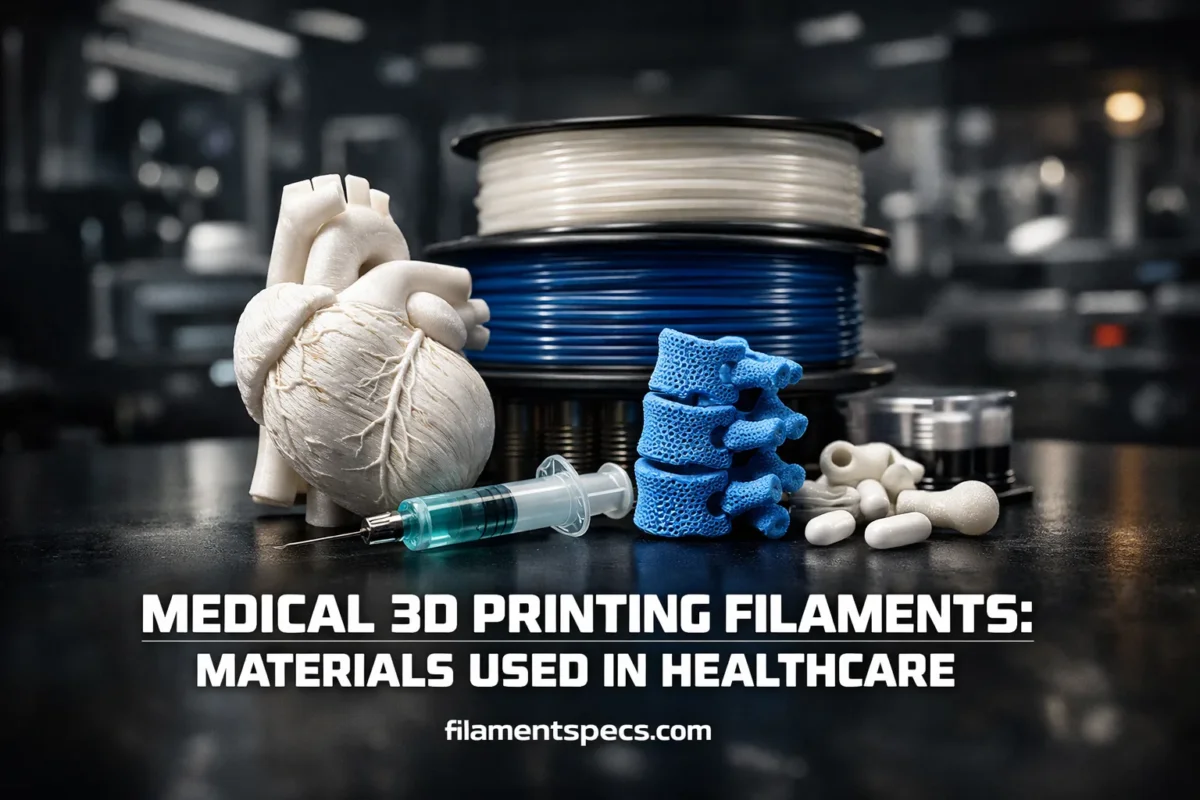
In healthcare, the word medical attached to a filament is only the starting point. Intended contact, sterilization route, dimensional stability, traceability, and evidence from the finished part determine whether a printed object fits a clinical use. A spool of PLA may work well for a dry planning model, while a patient-specific implant can require medical-grade PEEK, controlled manufacturing, and finished-device validation.[a]
| Material Family | Typical Healthcare Role | Direct Patient Contact Fit | Sterilization Reality | Best Match |
|---|---|---|---|---|
| PLA | Anatomical models, teaching pieces, workflow mockups | Usually low-risk visual or handling use unless a validated medical workflow says otherwise | In one vascular-template study, 121°C steam deformed PLA prints; lower-temperature or gas/plasma routes preserved shape better[f] | Fast, affordable pre-op and education models |
| PETG | Models, housings, guards, some lab tools | Possible for controlled external uses, but polymer name alone is not enough | The same study found 121°C steam also distorted PETG templates[f] | Tougher model parts and light-duty accessories |
| TPU | Flexible orthoses, splints, cushions, wearables | More promising for skin-contact or flexible medical parts when the grade and process are controlled | Medical-grade TPU filaments and gamma-sterilized device routes have been studied[l] | Comfort-focused external devices |
| PCL and PCL-Based Systems | Scaffolds, soft devices, tissue-engineering research parts | Used where biodegradation and softer mechanics matter more than heat endurance | Medical-grade PCL is discussed as a high-purity, traceable option for regulated work[k] | Research scaffolds and degradable concepts |
| Nylon / PA | Durable templates, clips, guides, functional parts | Can fit tougher short-term tools when the workflow is validated | In the aortic-template study, nylon kept geometry under 121°C steam better than PLA, PETG, and PP[f] | Hard-wearing functional components |
| PEEK / PAEK | Patient-specific implants, reusable high-heat parts, cranial and orthopedic applications | Strong candidate for advanced implant and sterile-device pathways when medical grade and process validation are in place | A point-of-care cranial-implant study found no clinically meaningful dimensional drift after 134–137°C steam sterilization[h] | High-heat, high-value clinical parts |
| PPSU | Reusable trays, handles, cases, instrument-adjacent parts | Well suited to reusable non-implant parts and some short-term contact uses | Solvay’s healthcare overview reports PPSU and PEEK-class materials handling over 1,000 steam cycles with only modest property change[i] | Reusable hospital hardware |
| PEI / ULTEM HU | Reusable device components and sterilizable housings | Useful when repeated steam or VHP exposure matters more than low print cost | SABIC reports ULTEM HU grades above 1,000 steam-autoclave cycles at 134°C and above 300 VHP cycles[j] | Repeated-sterilization parts |
One material name does not tell the whole story. A finished healthcare part is shaped by resin grade, additives, colorants, print settings, layer structure, support removal, cleaning, sterilization, packaging, and documented lot traceability. That full chain matters more than the spool label alone.[b]
What Counts as a Medical 3D Printing Filament
A healthcare filament can sit in one of four very different categories. Mixing them up creates bad decisions.
- Polymer family: PLA, PETG, TPU, PEEK, PPSU, PEI, nylon, and others.
- Medical-grade feedstock: the resin or filament is made with tighter control over purity, consistency, documentation, and traceability.
- Printed part: geometry, layer bonding, roughness, porosity, support scars, additives, and post-processing now matter.
- Finished medical device: the part is tied to intended use, biological evaluation, cleaning or sterilization, packaging, process records, and the applicable regulatory pathway.
That distinction matters. The FDA evaluates additively manufactured medical devices through the medical-device regulatory system, and its technical guidance focuses on design, material controls, manufacturing, process validation, post-processing, and testing of the finished device rather than polymer names by themselves.[b]
Biological safety is handled the same way. ISO 10993-1 ties biological evaluation to actual tissue contact, duration of contact, risk management, device design, and material selection. A polymer can have useful biological data and still be unsuitable for a particular finished part if printing, additives, surface condition, cleaning, or sterilization changes the relevant exposure.[c]
Patient-matched also does not automatically mean custom-exempt. FDA’s medical-applications information states that patient-matched devices do not automatically meet all requirements for the custom-device exemption.[n]
2026 U.S. Regulatory Context
The FDA’s Quality Management System Regulation (QMSR) became effective on February 2, 2026. It amended the medical-device current good manufacturing practice requirements in 21 CFR Part 820 and incorporates ISO 13485:2016, Medical devices — Quality management systems — Requirements for regulatory purposes, by reference.[p]
FDA states that the QMSR applies to finished device manufacturers that intend to commercially distribute medical devices. A finished device is a device or device accessory that is suitable for use or capable of functioning, whether or not it has already been packaged, labeled, or sterilized.[p]
This fits directly with the difference between medical-grade feedstock and a finished printed device. The QMSR is a manufacturing and quality-system regulation. It is not a filament-material certification. A spool carrying medical, FDA-related, ISO 10993, or ISO 13485 wording does not automatically make an object printed from that spool compliant with U.S. medical-device requirements.
ISO 13485 is not a material property. It addresses medical-device quality management systems. A filament supplier operating under an ISO 13485-certified system may offer stronger documentation and process control, but the finished printed device still has its own intended use, manufacturing records, validation, testing, biological evaluation, sterilization, and regulatory requirements.[p]
The distinction matters for hospitals and manufacturers using additive manufacturing because a documented spool is only one input to the production process. Printer qualification, material lots, build parameters, post-processing, inspection, nonconforming-product controls, records, and repeatability become part of the device-manufacturing system when a finished medical device is being produced for commercial distribution.
Where Filaments Fit in Healthcare
Extrusion-based printing is already used inside hospitals and device programs for more than visual prototypes. Peer-reviewed hospital reports describe clinical, diagnostic, and educational tools, plus patient-specific models, custom surgical tools, research tools, and on-demand parts.[d]
- Pre-op anatomy and communication models: PLA and PETG remain popular because they print fast, hold enough detail for visual planning, and keep cost low.
- External wearables and orthoses: TPU and other flexible systems are better when bending, comfort, and skin-following geometry matter.
- Surgical planning aids and templates: material choice tightens because cleaning, sterilization, and dimensional drift matter more.
- Reusable OR-adjacent hardware: PPSU, PEI/ULTEM, and PEEK-class materials stand out when the part must survive repeated sterilization cycles.
- Patient-specific implants: the material list becomes much narrower. Medical-grade PEEK and related high-performance polymers are among the materials studied for these uses.
The use case changes the material requirements. A filament suited to a trauma-planning model may be unsuitable for a reusable operating-room accessory. A polymer that survives 134°C steam may add cost and processing difficulty that a one-time teaching model does not need.
Main Filament Families Used in Healthcare
PLA and PETG
PLA remains an accessible material for many healthcare print labs. It prints cleanly, warps less than many engineering polymers, and is often adequate for anatomical models, surgeon communication pieces, and teaching tools. In a cadaver-based trauma study, PLA models were accurate enough for preoperative workup, helping explain why hospitals continue using it for low-cost model making.[e]
PETG sits close by. It usually provides more toughness and impact tolerance than PLA while staying easier to print than higher-temperature polymers. For housings, guards, and durable models, that balance can be useful.
The weak point for both materials is reprocessing headroom. A vascular-template study found that standard 121°C steam sterilization distorted PLA and PETG prints, while lower-temperature routes such as hydrogen peroxide plasma and ethylene oxide preserved their geometry much better. PLA and PETG can still be useful healthcare materials, but their sterilization route and intended use need to match the printed part.[f]
TPU and PCL-Based Flexible Systems
When comfort and flexibility matter, rigid filaments stop making sense. TPU is used for braces, splints, padding-rich wearables, and parts that need to bend rather than crack. Peer-reviewed work has described medical-grade TPU filament developed for FDM, with in vitro biocompatibility data and mechanical behavior aligned with medical-purpose elastomers.[l]
PCL and PCL-based polyurethane systems occupy another useful area. They are softer and attractive where biodegradation or scaffold behavior matters. Work on medical-grade PCL also emphasizes GMP production, purity, safety, and traceability as part of the material’s suitability for regulated translation.[k]
The flexible-material group therefore spans external wearables, research scaffolds, degradable concepts, and other patient-specific applications where low stiffness or controlled degradation is part of the design requirement.
Nylon and PP
Nylon sits in the durable middle ground. It can produce hard-wearing functional parts, clips, tools, and templates that need more toughness than PLA usually offers. In the aortic-template sterilization study, nylon kept its geometry under 121°C steam better than PLA, PETG, and PP.[f]
PP is appealing because of its low density and chemical resistance, but the same vascular-template work showed that printed PP deformed under 121°C steam. That makes sterilization-route validation necessary before treating an FDM-printed PP part as a steam-sterilized healthcare tool.[f]
PEEK and Other PAEK-Class Materials
PEEK sits in a different performance range from common desktop filaments. Victrex notes a long clinical history for implantable medical PEEK and use across orthopedic, drug-delivery, and other medical applications. That history is one reason medical-grade PEEK appears in high-value implant and sterile-device work.[g]
A point-of-care cranial-implant study provides a practical example. Material-extrusion PEEK implants were steam sterilized at 134–137°C for 18 minutes, and post-sterilization dimensional deviation remained within clinically acceptable limits, with most measured values under 1.0 mm.[h]
Repeated steam cycling can still change mechanical behavior. One study on a PEEK medical-device component found a drop in spring force after repeated autoclave exposure before the response stabilized. Sterilizable therefore does not mean that repeated-cycle behavior can be assumed without testing.[o]
PPSU and PEI / ULTEM HU
PPSU and medical PEI grades are useful where repeated hospital sterilization is expected. Solvay’s healthcare sterilization overview places PPSU, PEEK, and related high-performance plastics well above ordinary polymers for long-term steam-autoclave survival, with more than 1,000 cycles reported for better-performing materials in its testing overview.[i]
SABIC reports similar endurance for ULTEM HU medical grades, including more than 1,000 steam cycles at 134°C and more than 300 VHP cycles. Those properties suit reusable trays, housings, handles, and other parts expected to undergo repeated reprocessing.[j]
Sterilization and Reprocessing
In healthcare printing, printability is only the first material test. The selected polymer and finished geometry also need to tolerate the cleaning or sterilization route required by the intended use.
- Steam autoclave: commonly operates in the 121–134°C range for reusable medical devices. It fits high-performance polymers such as PPSU, PEEK, and certain medical PEI grades better than low-heat FDM materials. PLA and PETG can deform during steam exposure depending on geometry and process conditions.[i]
- VHP / gas plasma: useful when a lower-temperature route is needed. In the vascular-template study, hydrogen peroxide plasma kept PLA, PETG, PP, nylon, and resin templates dimensionally stable, while SABIC reports repeated VHP endurance for ULTEM HU grades.[j]
- Ethylene oxide: can preserve shape where high heat would not, but residue, aeration, packaging, and process controls remain part of validation.[f]
- Gamma or beam sterilization: appears in device-polymer and flexible-material studies, including TPU work, but effects on mechanics, color, molecular structure, and device performance still need to be checked for the finished part.[l]
Three Questions Sterilization Forces You to Ask
- Will the part keep its shape after the sterilization method actually used?
- Will it keep enough mechanical performance after one cycle or the required number of reuse cycles?
- Will the surface, cleanliness, packaging, and dimensional result stay inside the acceptance criteria for the intended use?
This is why low-cost planning models and reusable hospital-device components often require different polymers and different validation work. Their sterilization and reuse requirements are not the same.
Biocompatibility, Traceability, and Surface Finish
The phrase biocompatible filament is often used too broadly. ISO 10993-1 does not reduce biological evaluation to a label on a spool. It ties the evaluation to contact type, contact duration, device design, risk management, and the finished medical device. The same polymer family can therefore fit one use and fail another.[c]
Surface state matters too. Layer lines, micro-gaps, support scars, residues from post-processing, pigments, sealing steps, and cleaning methods can change how a printed object behaves during cleaning, sterilization, and patient contact. FDA’s additive-manufacturing guidance pays close attention to characterization, post-processing, and manufacturing controls for these reasons.[b]
- Medical Grade
- Controlled raw material with defined specifications, documentation, and lot traceability appropriate to the supplier’s stated medical use.
- Biological Evaluation
- Evidence tied to the finished device and its intended contact rather than only the base polymer family.
- Surface State
- Roughness, porosity, support damage, residues, and finishing steps can change cleanability and contact behavior.
- Process Window
- The printer, nozzle, material lot, layer strategy, post-processing, and sterilization route must remain controlled enough to reproduce an acceptable part.
- Quality System
- Documented manufacturing controls for producing conforming medical devices; under the U.S. QMSR, this is not a property granted to a filament by its material name.[p]
Medical-grade PCL provides a useful example. Published work emphasizes the medical-grade version because of purity, safety, and traceability under GMP production. The label “PCL” by itself does not establish that a printed device is suitable for a regulated medical use.[k]
How Material Teams Choose the Right Filament
Material selection in healthcare usually follows the same order.
- Map the contact first. Is this a dry visual model, external wearable, sterile tool, short-term contact device, reusable component, or implant?
- Choose the sterilization route before finalizing the print process. A material that prints well but fails after cleaning or sterilization is still the wrong material.
- Decide whether the part is single-use or reusable. Reuse introduces repeated-cycle testing rather than one-time performance alone.
- Lock the manufacturing process. Material lot, storage, printer, nozzle size, layer height, infill strategy, support removal, cleaning, and post-processing need defined controls.
- Test the finished part. Resin data do not replace measurements of printed geometry, surface, fit, mechanical behavior, biological evaluation, or performance after the actual sterilization route.
- Identify the regulatory role of the part. A model used only for visualization is not regulated in the same way as a finished medical device manufactured for commercial distribution under the QMSR.[p]
This sequence aligns with FDA additive-manufacturing guidance and with hospital point-of-care experience. Material selection is only one part of the medical-device manufacturing decision.[m]
Where Healthcare Filament Use Is Heading
Hospital programs are becoming more capable of producing patient-specific models, guides, and select end-use parts within controlled point-of-care workflows. Material selection is also separating more clearly into modeling materials, flexible external-device materials, and high-heat medical polymers intended for sterile, reusable, or implant-related applications.[d]
FDA’s point-of-care discussion material reflects the regulatory questions created when manufacturing moves closer to the hospital. The printer is only one part of that operation; design control, manufacturing responsibility, process records, validation, and the status of the finished device remain relevant.[m]
PLA and PETG remain useful for models. TPU and PCL-based systems serve flexible and degradable applications. PEEK, PPSU, and medical PEI grades become more relevant when repeated sterilization, reusable clinical hardware, or implant pathways require properties that common desktop filaments cannot provide.
FAQ
What filament is usually best for anatomical models in hospitals?
For dry planning, training, and communication models, PLA and PETG are common choices because they print cleanly, provide useful anatomical detail, and keep costs manageable. A trauma-model validation study found PLA models suitable for preoperative workup.[e]
Is PLA a medical filament?
PLA can be used in medical printing, particularly for anatomical models and educational parts, but the polymer name does not make a finished object suitable for patient contact or sterile use. Intended use, material grade, processing, surface condition, and biological or sterilization requirements still need to be evaluated.[c]
Can PETG be sterilized for healthcare work?
PETG can work with some lower-temperature sterilization methods, but one study found that 121°C steam autoclaving distorted PETG vascular templates. A PETG healthcare part should therefore use a sterilization process validated for that material, geometry, and intended use.[f]
Why is PEEK used for medical implants?
Medical PEEK has a long clinical history and offers higher temperature resistance than common desktop filaments. Published point-of-care work has also shown that material-extrusion PEEK cranial implants can retain useful dimensional accuracy after high-temperature steam sterilization.[g]
What makes a filament medical grade?
Medical grade generally refers to tighter control over raw-material specifications, purity, consistency, documentation, and traceability for a stated medical application. It does not automatically make every printed part suitable for patient use. The finished part and its manufacturing process still need evaluation.[k]
Does ISO 13485 on a filament or supplier document make the printed device FDA compliant?
No. ISO 13485:2016 is a medical-device quality-management-system standard incorporated by reference into the FDA’s QMSR. It does not certify a filament’s biological performance or automatically establish compliance of a finished printed medical device. FDA requirements still apply to the finished device manufacturer and the manufacturing process relevant to the intended medical use.[p]
Does patient-matched mean the part is automatically custom-exempt?
No. FDA states that patient-matched devices do not automatically meet all requirements for the custom-device exemption. Patient-specific geometry does not remove the need to identify the correct regulatory path for the device and intended use.[n]
Sources
- FDA — 3D Printing of Medical Devices — Supports the range of 3D-printed medical products and patient-specific device context. (Official U.S. medical-device regulator.)
- FDA — Technical Considerations for Additive Manufactured Medical Devices — Supports manufacturing controls, material characterization, post-processing, testing, and finished-device considerations. (Official FDA guidance.)
- ISO — ISO 10993-1 Biological Evaluation of Medical Devices — Supports biological-evaluation principles tied to intended contact, duration, material selection, and risk management. (Official ISO standard record.)
- PubMed Central — 3D Printing in a Hospital: Centralized Clinical Implementation and Applications — Supports hospital use cases including clinical, diagnostic, educational, and patient-specific parts. (Peer-reviewed hospital implementation study.)
- PubMed Central — Validation Study of 3D-Printed Anatomical Models Using Two PLA Printers for Preoperative Planning in Trauma Surgery — Supports PLA model accuracy in preoperative work. (Peer-reviewed validation study.)
- PubMed Central — Effects of Sterilization Methods on Different 3D Printable Materials for Templates of Physician-Modified Aortic Stent Grafts — Supports PLA, PETG, PP, and nylon behavior under steam, plasma, and ethylene-oxide sterilization. (Peer-reviewed materials study.)
- Victrex / Invibio — Implantable PEEK Materials — Supports medical PEEK implant history and application context. (Medical biomaterial manufacturer information.)
- PubMed Central — Can Steam Sterilization Affect the Accuracy of Point-of-Care 3D Printed PEEK Customized Cranial Implants? — Supports dimensional behavior of printed PEEK cranial implants after steam sterilization. (Peer-reviewed point-of-care implant study.)
- Solvay — Healthcare Sterilization Compatibility Overview — Supports repeated steam-cycle behavior of PPSU, PEEK, and related healthcare polymers. (Healthcare-polymer technical bulletin.)
- SABIC — ULTEM Resin for Medical Device Sterilization — Supports ULTEM HU steam and VHP sterilization-cycle information. (Medical-material application data from the polymer producer.)
- PubMed Central — Evaluation of Medical-Grade Polycaprolactone for 3D Printing — Supports medical-grade PCL purity, traceability, safety, and regulated-use context. (Peer-reviewed study.)
- PubMed Central — Flexible Medical-Grade TPU Filament for Fused Deposition Modeling — Supports medical-grade TPU development, mechanical properties, and biocompatibility discussion. (Peer-reviewed materials study.)
- FDA — 3D Printing Medical Devices at the Point of Care Discussion Paper — Supports regulatory considerations around hospital point-of-care manufacturing. (Official FDA discussion paper.)
- FDA — Medical Applications of 3D Printing — Supports the distinction between patient-matched devices and the custom-device exemption. (Official FDA medical-applications page.)
- PubMed Central — Effects of Sterilization Cycles on PEEK for Medical Device Application — Supports repeated-autoclave effects on a medical-grade PEEK device component. (Peer-reviewed sterilization study.)
- FDA — Quality Management System Regulation (QMSR) — Supports the February 2, 2026 effective date, amendment of 21 CFR Part 820, incorporation of ISO 13485:2016, and applicability to finished device manufacturers intending commercial distribution. (Official FDA QMSR page.)