| Material Family | Visual Style | Usual Starting Range | Heat Behavior | Where It Fits Best | Watch Closely |
|---|---|---|---|---|---|
| Rainbow PLA | Clean color travel, easy surface finish, strong detail | Nozzle around 200–215°C, bed around 50–60°C | Best kept away from heat; PLA can soften above about 60°C | Display prints, figurines, vases, decorative parts, low-warp models | Outdoor exposure, hot cars, very short prints that do not use enough filament |
| Silk Rainbow PLA+ | Glossy, reflective, more decorative than neutral PLA | Nozzle around 205–230°C, bed around 50–60°C | Still a low-heat decorative family; vendor sheets stay in the mid-50s °C range for softening | Gift prints, dragons, busts, ornaments, cosplay accents, curved show pieces | Patchy gloss from unstable speed, softer feel in warm environments, hidden seam marks |
| Rainbow PETG | Brighter translucent-like depth, tougher than PLA | Nozzle around 230–240°C, bed around 85–90°C | Better heat margin; PETG parts are commonly used below about 80°C | Organizers, lamp shades, plant accessories, functional display parts | Stringing, stronger bed grip, less crisp tiny detail than PLA |
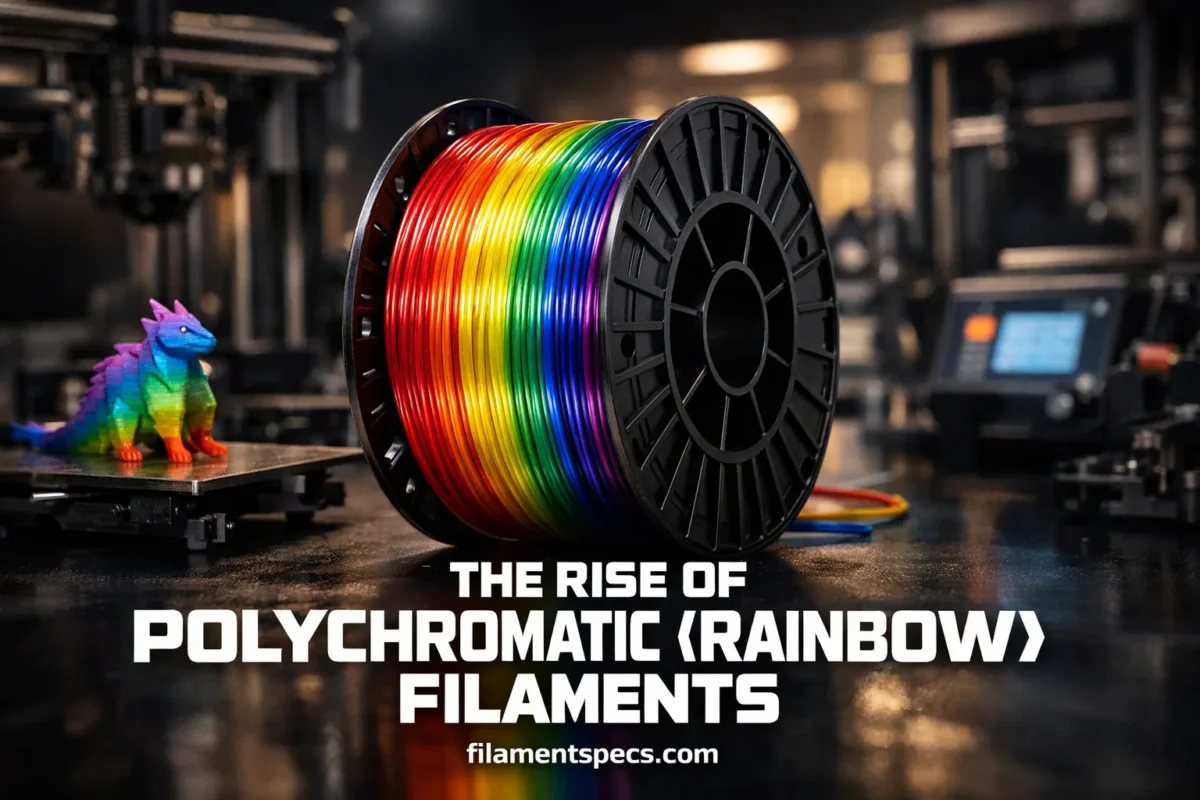
Rainbow filament stopped feeling like a novelty once makers realized it could change the whole look of a print without extra hardware, extra purge waste, or paint. One spool can turn a plain model into a height-driven color transition piece, and that makes geometry, wall count, and model height matter almost as much as the polymer itself. [e]
- Vases
- Articulated Creatures
- Busts
- Planters
- Helmet Shells
- Gift Prints
Table of Contents
🌈 What Rainbow Filament Actually Is
Most rainbow filament is a sequential polychromatic filament. The color changes along the length of the strand, so the printer does not switch colors mid-job in the way an AMS or MMU setup does. Instead, the spool feeds one hue after another through a single nozzle, and the print reveals those changes over time. [e]
That sounds simple, but there are two very different families hiding under the same shopping label:
- Sequential rainbow uses a gradient along the filament length. Taller prints usually show more of the story.
- Dual-, tri-, or four-color silk places multiple colors across the strand, so the look changes with angle and surface orientation, not just print height. [f]
Sequential rainbow is the better fit when you want color to travel from bottom to top. Angle-shift silk is the better fit when you want faces and curves to flip color as the part turns in light.
This difference matters. A dragon, vase, or planter can look great in either style, but the visual logic is not the same. One depends on how much filament the part consumes from start to finish. The other depends on how the outer walls catch light from different sides.
📈 Why Rainbow Filament Moved Into the Mainstream
The rise is easy to understand. Rainbow filament gives visible payoff on ordinary FDM machines. You do not need a paint booth, color swaps, or a multi-material unit to get a result that looks more deliberate than plain single-color PLA. For hobby printers, craft sellers, cosplay makers, and gift-print shops, that is a very practical jump in appeal.
Why people keep buying it:
- One spool can create a finished-looking part with very little post-processing.
- Tall or curved models gain visual depth without extra slicer complexity.
- Special-effect lines now split into clearer subtypes: rainbow PLA, silk rainbow, PETG rainbow, and angle-shift multi-color silk. [g]
That last point matters more than people think. The category is no longer just “PLA in a fun color.” It now behaves more like its own shelf in the filament market, with buyers choosing between finish style, transition speed, and base resin behavior instead of picking a single novelty spool and hoping for the best.
🧵 How Color Movement Works on the Spool
The single most useful term here is transition length. If a brand changes color every 8 meters, the print will move through hues faster than a spool that changes every 16 meters. SUNLU’s rainbow line explicitly separates those behaviors, and that explains why one rainbow spool produces tight bands while another gives broad, slow gradients. [e]
What you see on the finished model depends on several things at once:
- Model height. Taller prints usually consume more color travel in a readable way.
- Perimeter length. Wide outer walls eat filament faster per layer, which can compress or stretch the visible transition.
- Wall count. More shells consume more of the spool before the model gets much taller.
- Infill share. Heavy infill uses color where nobody sees it, which can shift the palette sooner than expected.
- Print mode. Vase mode often shows the cleanest gradient because the outer wall remains continuous.
Short print, short story. A 35 mm trinket can stay inside one band of color. A tall vase, mask shell, or articulated creature gives the rainbow room to travel.
| Model Shape | Typical Visual Result | Why It Happens |
|---|---|---|
| Tall vase | Long, readable gradient | Continuous outer wall makes color travel easy to follow |
| Articulated creature | Frequent band changes across segments | Many perimeters and repeated curves consume filament quickly |
| Short bust | One or two dominant colors | The print may not pass far enough through the spool transition |
| Helmet shell | Broad sweeping bands | Large surfaces and long walls stretch the gradient across the form |
| Flat plaque | Color looks less dramatic | Limited height reduces the sense of upward movement |
🧪 Choosing the Right Base Material
Rainbow PLA
Standard rainbow PLA is still the easiest entry point. It prints cleanly, holds fine detail well, and usually gives the most predictable result when you want a part to look neat straight off the bed. The trade-off is familiar: PLA is not the right pick for heat-heavy spots or long-term outdoor use, because it can soften above about 60°C and it degrades under UV exposure. [a]
Silk Rainbow PLA+
Silk rainbow sits in a more decorative lane. The finish is the point. You get a gloss-heavy surface that can make curves look fuller and more expensive-looking, but the same shine can soften tiny details and make seam management more visible. SUNLU’s multi-color silk PLA+ data also shows why this family should still be treated as a low-heat material: its published Vicat softening temperature is 54°C and heat deflection temperature is 57±3°C. [f]
Rainbow PETG
Rainbow PETG makes sense when you want the color effect but need a tougher print. PETG keeps more flexibility than PLA, resists heat better, and is commonly used for interior parts and many exterior uses below about 80°C. The price you pay is familiar too: more stringing, stronger bed grip, and slightly less crisp tiny detail. [b]
When ASA Makes More Sense
If the print will live outdoors, ASA is the material logic even when rainbow looks tempting. ASA is built for UV and higher heat exposure, and Prusa rates it as suitable for outdoor use up to about 93°C. So when the job is a real exterior part, material choice should outrank the special effect. [c]
- Display First
- Rainbow PLA or silk rainbow PLA+ usually gives the cleanest visual result with the least setup trouble.
- Function First
- Rainbow PETG is the safer step when the part needs more toughness or warmer service conditions.
- Outdoor First
- ASA beats PLA-family rainbow materials when weather, sun, and heat become part of the job.
⚙️ Print Settings That Matter More Than People Expect
The biggest mistake with rainbow filament is treating the color effect as if it changes the polymer entirely. It usually does not. Start from the base material profile, then tune for surface behavior. PLA rainbow should begin from a PLA profile. Rainbow PETG should begin from PETG. Silk rainbow may need a calmer outer wall speed and better seam control, but it still behaves like a silk PLA-family material first.
- Dry before chasing ghosts. Prusa’s drying page recommends 45°C for 6 hours for PLA and 55°C for 6 hours for PETG when moisture is the issue. Wet filament can turn rainbow prints into a stringy mess long before temperature tuning helps. [d]
- Keep the outer wall stable. Gloss changes can make the same color band look different, so wild speed swings often hurt silk finishes.
- Do not over-cool tall decorative shells. Too much fan on thin walls can make the surface look flatter and less unified.
- Use enough wall thickness. Decorative parts with only one thin wall can look pretty, but a few more shells often make the finish look fuller and less cheap.
- Plan your seam. A messy seam can interrupt the most beautiful gradient on the spool.
If the spool sounds wet, strings heavily, or leaves tiny pits in the line, fix moisture first. Drying is usually the fastest honest test before you change retraction, flow, or temperature. [d]
🧱 Model Shape and Slicer Choices That Bring Out Better Color
Rainbow filament rewards certain shapes. Not all of them. The best results tend to come from prints that expose a lot of continuous outer wall over time. That is why vases, spirals, scaled creatures, draped forms, and shell-like geometry keep showing up in good rainbow examples.
- Tall, continuous forms give the gradient room to stretch.
- Curved surfaces catch more variation in gloss and hue, especially with silk finishes.
- Vase mode often produces the cleanest sequential transition because the path stays simple.
- Short utility brackets rarely justify rainbow unless the print is mostly for looks.
- Support-heavy parts can waste some of the prettiest color on surfaces nobody sees.
A practical move many buyers miss: match the spool to the model, not just the color photo on the product page. A slow-transition rainbow suits helmets, lamps, and large vases. A faster-transition spool works better for articulated animals, small decor, and objects where you want more frequent palette changes in less height.
Two small slicer choices can change the whole result:
- Lower infill when strength is not the goal, so less hidden filament gets burned inside the part.
- Favor outer-wall continuity when appearance matters more than print time.
🛒 What to Check Before Buying a Spool
Shopping photos can be misleading because rainbow filament looks different on every geometry. A good buying decision starts with the data line, not the glamour shot.
- Effect type. Confirm whether the spool is sequential rainbow or angle-shift multi-color silk. Those are not the same look. [f]
- Transition length. An 8 m color cycle behaves very differently from a 16 m cycle. [e]
- Base resin. Decide between PLA, silk PLA+, and PETG before falling for the photo.
- Published tolerance. Official pages often list 1.75 mm with ±0.02 mm tolerance, which helps feeding consistency. [f]
- Drying and storage note. If the seller publishes humidity or drying guidance, take it seriously for decorative work where strings ruin the finish. [d]
- Repeatability. If you sell prints, remember that the next copy may start on a different hue unless you track spool position closely.
The smartest rainbow buyers do not ask only, “Which colorway looks best?” They ask, “How fast does it transition, what resin is under it, and what shape am I printing?” That question usually leads to better-looking parts.
🧰 Common Print Problems and What Usually Fixes Them
Colors Barely Change
The model is too short, too narrow, or too infill-heavy for the transition length. Print taller, choose a faster-cycle rainbow, reduce hidden filament use, or pick a geometry with more visible wall travel.
Gloss Looks Uneven
Silk finishes react strongly to changing wall speed and heat. Reduce abrupt speed swings, keep the outer wall calmer, and avoid treating a shiny silk spool like a speed-run PLA.
Stringing Takes Over the Print
Dry the spool first, then retest. PETG and wet silk-style materials can show strings fast, and moisture often appears before a deeper calibration problem does. [d]
The Print Looks Great but Feels Too Delicate
That is usually a material mismatch, not a color problem. Move from rainbow PLA to rainbow PETG when the part needs more toughness, or shift to ASA when the part belongs outside. [b]
The Photo Online Looked Better
Product photos often use tall or curved models chosen to flatter the effect. A flat, short part can never show the same amount of visible transition, even if the spool is identical.
🔍 Where Rainbow Filament Still Has Clear Limits
- It does not give exact color placement. If you need one stripe in one exact spot, a sequential rainbow spool is the wrong tool.
- It is not automatically better than plain filament. Some functional parts look cleaner in one solid color.
- Reprints are harder to match exactly. The same model can begin on a different hue if spool position changes.
- Small objects can waste the effect. They may never travel far enough through the color cycle.
- Decorative chemistry still obeys base-material limits. A stunning silk rainbow part can still soften like a PLA-family material in heat. [f]
❓ FAQ
Do Rainbow Filaments Need Multi-Material Hardware?
No. Most rainbow filament works on a standard single-nozzle printer because the color changes are already built into the filament strand itself.
Why Did My Model Show Only One or Two Colors?
The model probably did not consume enough filament to move far through the transition. Short parts, low wall count, and heavy hidden infill can all shrink the visible effect.
Is Rainbow Filament Usually PLA or PETG?
Most rainbow spools on the market are PLA-based, especially standard rainbow PLA and silk rainbow PLA+. PETG rainbow is available too and makes more sense when you need a tougher part.
Is Silk Rainbow Better Than Standard Rainbow PLA?
Not always. Silk rainbow gives more shine and visual drama, while standard rainbow PLA often keeps finer detail and can look cleaner on technical geometry.
Are Rainbow Filaments Good for Outdoor Prints?
Rainbow PLA and silk rainbow PLA+ are usually poor outdoor choices. Rainbow PETG is better for many warmer or semi-exposed uses, while ASA stays the safer logic for true outdoor duty.
How Do I Choose Between Sequential Rainbow and Dual- or Tri-Color Silk?
Choose sequential rainbow when you want the color to travel with print height. Choose dual-, tri-, or four-color silk when you want the surface to flip color from different viewing angles.
Referenced Material
- [a] PLA | Prusa Knowledge Base — used for PLA print temperatures, softening behavior above 60°C, UV limits, and common use cases (official material documentation from a widely trusted printer and materials manufacturer).
- [b] PETG | Prusa Knowledge Base — used for PETG starting temperatures, durability notes, and the common “below 80°C” service range for many parts (official material documentation from a widely trusted printer and materials manufacturer).
- [c] ASA | Prusa Knowledge Base — used for ASA outdoor suitability, UV resistance, and published temperature resistance up to about 93°C (official material documentation from a widely trusted printer and materials manufacturer).
- [d] Drying Filament | Prusa Knowledge Base — used for drying temperatures and times for PLA and PETG, plus storage advice around hygroscopic materials (official maintenance and material reference from a widely trusted printer and materials manufacturer).
- [e] SUNLU PLA & SILK Rainbow Filament — used for published 8 m rainbow transition behavior, material variants, diameter tolerance, and vendor print-temperature windows for rainbow PLA and silk rainbow lines (official manufacturer product page).
- [f] SUNLU Multi-Color SILK Filament — used for dual-, tri-, and four-color angle-shift behavior, silk PLA+ vendor temperatures, published humidity guidance, and the listed Vicat/HDT values for this multi-color silk line (official manufacturer product page with downloadable technical data references).
- [g] SUNLU Silk PLA Collection — used to support how effect filaments are now separated into clearer product families such as silk PLA, rainbow, and multi-color silk within a current official catalog (official manufacturer collection page).