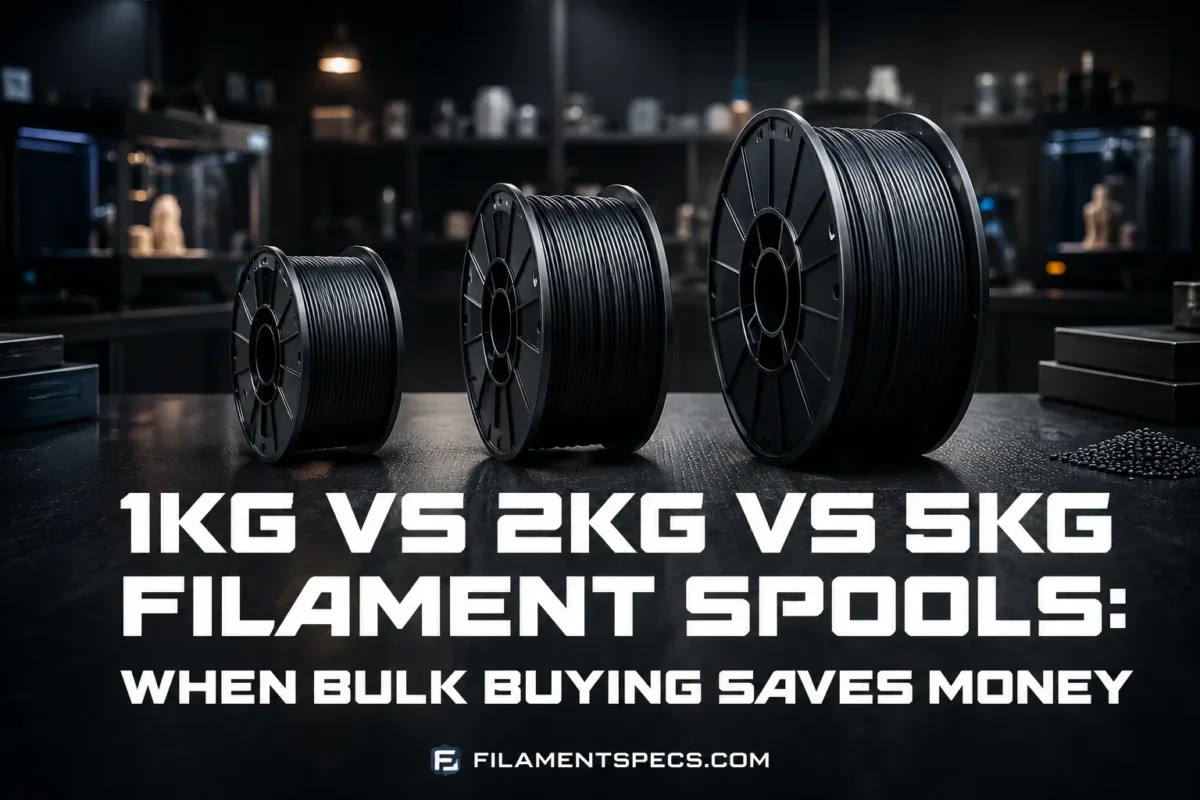
| Spool Size | Typical Net Filament | Main Saving Case | Hidden Cost To Check | Better Material Match | Buying Verdict |
|---|---|---|---|---|---|
| 1 kg spool | 1,000 g | Testing a new material, color, brand, or printer profile | Higher price per kg, more spool changes, more packaging | PLA, PETG, TPU, specialty colors, small-batch engineering filaments | Safest choice when usage is uncertain or many colors are needed |
| 2 kg spool | 2,000 g | Repeat printing in black, white, gray, clear, or a standard production color | May need an external holder, wider storage box, or dry storage plan | PLA, PETG, ABS, ASA, common functional colors | Most balanced size for regular home, school, workshop, and small-business use |
| 5 kg spool | 5,000 g | Large projects, print farms, farm-style batching, props, fixtures, prototypes, and long same-color runs | Spool drag, moisture exposure, shelf time, storage volume, and printer fit | PLA and PETG for steady use; nylon or TPU only with dry-box control | Cheapest only when usage is predictable and the spool can be kept clean, dry, and feeding smoothly |
Bulk filament buying looks like simple math: a bigger spool has a lower price per kilogram. The real number is different. The useful question is not “Which spool is cheaper?” but “Which spool gives the lowest cost per usable kilogram?” A 5 kg spool can be a bargain for a printer that runs the same PLA every week. The same spool can become expensive if half of it sits open, absorbs moisture, drags on a weak holder, or gets retired because the color is no longer needed. In material extrusion printing, filament is not just a roll of plastic; it is feedstock that must move, melt, and extrude consistently through a controlled process.[a]
Table of Contents
📐 Cost Per Usable Kilogram
The cleanest way to compare 1 kg, 2 kg, and 5 kg filament spools is to ignore the front-page discount for a moment and calculate the usable filament cost. This includes shipping, storage supplies, failed print waste, and the chance that some filament never gets used.
Effective cost per usable kg = (spool price + shipping + storage extras + expected waste cost) ÷ usable kilograms.
Usable kilograms are not always the same as the label weight. A 5 kg spool that gives 4.5 kg of clean, printable material is not really priced like a full 5 kg spool anymore.
The discount must be large enough to beat the extra handling. A 5 kg spool with a 10% sticker discount may not save money if it needs a new holder, a larger dry box, and a few failed prints while the feed path is being tuned. A 2 kg spool with a smaller discount can win because it is easier to finish.
| Scenario | Spool Price | Shipping / Extras | Expected Usable Filament | Effective Cost Per Usable kg |
|---|---|---|---|---|
| 1 kg spool | $22 | $4 | 0.98 kg | $26.53/kg |
| 2 kg spool | $38 | $5 | 1.90 kg | $22.63/kg |
| 5 kg spool, well managed | $82 | $8 | 4.75 kg | $18.95/kg |
| 5 kg spool, poorly managed | $82 | $8 | 3.60 kg | $25.00/kg |
The lesson is plain: bulk buying saves money when the discount survives storage, handling, and usage reality. The label price is only the opening number.
The Break-Even Test
Before buying a larger spool, compare it to the 1 kg price using this short test:
- Find the delivered price per kg for the 1 kg spool.
- Find the delivered price per kg for the 2 kg or 5 kg spool.
- Estimate how much of the larger spool will actually be used.
- Add any needed holder, dry box, desiccant, bag, or rack cost.
- Choose bulk only if the larger spool still wins after those numbers are included.
A Simple Buying Threshold
A 2 kg spool usually needs about a 10–15% delivered-price saving to feel worthwhile. A 5 kg spool often needs a 20–30% delivered-price saving unless it is used fast, because storage and feed control matter more at that size.
For print farms and workshop batches, 5 kg can beat that threshold easily. For occasional prints, it often does not.
🧵 1 kg Spools: Safer Buying, Less Bulk Savings
A 1 kg spool is the standard size because it fits most printers, most shelves, and most casual print habits. It is also easier to keep dry because it is opened, used, and replaced sooner. That matters when a material is new to the printer or when the color is only needed for one project.
For many users, 1 kg is not “small.” At 1.75 mm diameter, a 1 kg PLA spool usually contains roughly 330–340 meters of filament, depending on density. PETG is often slightly shorter per kg. ABS and ASA can be longer because they are usually less dense. The exact length changes by material and filler content.
Where 1 kg Still Makes Sense
- New brand testing: diameter consistency, winding, color, bed adhesion, and extrusion behavior can be checked with lower commitment.
- Specialty colors: silk, marble, translucent, glow, wood-filled, and color-shift filaments may be used slowly.
- Engineering filaments: nylon, PC blends, high-temperature materials, and carbon-filled filaments may need tighter storage control.
- Multi-color shelves: ten 1 kg colors can be more useful than one 5 kg spool in a single color.
- Small printers: compact machines, enclosed bays, and automatic material systems often favor standard spool geometry.
The price per kilogram is higher, but the decision risk is lower. That tradeoff is not wasteful when the material is unfamiliar.
Where 1 kg Costs More Than It Should
If the same black PLA or gray PETG is reordered every few weeks, 1 kg spools can become a packaging habit rather than a smart purchase. More spool swaps also mean more runout events, more leftover ends, and more time spent managing inventory.
Use 1 kg when uncertainty is high. Move up in size only after the material has proven itself on the printer, with the nozzle, bed surface, slicer profile, and parts that will actually be printed.
📦 2 kg Spools: The Practical Middle Size
A 2 kg spool is often the most forgiving bulk size. It can lower the delivered cost per kilogram without turning storage and feeding into a separate project. For regular PLA and PETG printing, this is where many users get real savings without the full 5 kg burden.
The best fit is boring in a good way: standard colors, known brands, repeat parts, workshop fixtures, cosplay armor sections, school projects, prototyping, jigs, trays, organizers, mounts, and functional prints that use the same material again and again.
Why 2 kg Often Wins
- It reduces spool-change frequency without creating as much drag as a 5 kg spool.
- It is easier to finish before open storage becomes a problem.
- It may still fit many external holders with only small changes.
- It gives enough volume for large prints without forcing a single-color shelf strategy.
- It works well for production colors such as black, white, gray, natural, and clear.
The weakness is compatibility. A 2 kg spool may be wider or larger in diameter than a standard 1 kg spool. Some printers handle it easily from an external holder. Others need a roller stand, top-mounted holder change, or a side feed path.
2 kg Buying Rule
Choose 2 kg when the material is already trusted, the color is used often, and the spool can be stored in a sealed box or bag between prints. This is the low-drama bulk size.
🏗️ 5 kg Spools: Cheap Only When Use Is Predictable
A 5 kg spool can offer the lowest sticker price per kg. It also exposes every weak point in the setup. The holder must carry the mass, the spool must unwind smoothly, the filament path must stay low-friction, and the material must be protected from dust and humidity for a longer period.
This size is not only for huge printers. It can work well on ordinary machines if the spool sits on a separate roller stand and feeds cleanly into the extruder. The printer should not have to pull hard enough to twist a frame, lift a light holder, or change extrusion tension.
Where 5 kg Saves Money
- Print farms: several printers using the same material can finish a 5 kg spool fast.
- Large single-color jobs: helmets, props, terrain, display parts, molds, panels, and fixtures reduce spool swaps.
- Repeat production: brackets, cases, holders, packaging tools, test fixtures, and prototypes benefit from stable feedstock.
- Known materials: PLA and PETG are common choices because they are easy to profile and widely available in large spools.
- Bulk shipping advantage: one large order can reduce freight cost per kg compared with several small shipments.
Where 5 kg Stops Being Cheap
A 5 kg spool becomes less attractive when it is bought for “maybe later.” Slow usage is the enemy. Moisture exposure, dust, color changes in future projects, and storage inconvenience can turn the discount into a locked-up shelf item.
- The printer uses a tight enclosed spool bay.
- The material is nylon, TPU, PVA, or another moisture-sensitive filament.
- The color is only needed for one project.
- The spool needs an accessory that costs more than the discount.
- The filament may sit open for many months.
- The brand or blend has not been tested in 1 kg form first.
Do not let the 5 kg discount hide the feed path. A large spool should roll freely, stay aligned, and feed without pulling the extruder sideways. Smooth unwinding is part of the cost calculation.
🧪 Material Behavior Changes the Break-Even Point
Bulk buying is not the same across materials. PLA in a sealed container behaves differently from nylon left in room air. PETG, TPU, ABS, ASA, and filled filaments each change the buying math because they store, dry, and print differently.
| Material Family | 1 kg Fit | 2 kg Fit | 5 kg Fit | Bulk Buying Note |
|---|---|---|---|---|
| PLA / PLA+ | Excellent for testing and colors | Very good for repeat use | Good when used often | Usually the easiest material for first bulk purchases. |
| PETG | Good for new brands | Very good for functional parts | Good with dry storage | Bulk works well for clear, black, white, and common workshop colors. |
| ABS | Good for profile testing | Good for repeat enclosed-printer use | Good for controlled production | Bulk only makes sense when the printer setup is already stable. |
| ASA | Good for outdoor-part testing | Good for repeat functional printing | Good for production colors | Buy larger only after bed adhesion, chamber control, and part cooling are tuned. |
| TPU | Best for most users | Moderate with dry storage | Niche use only | Flexible filament can be slower to print and more sensitive to storage conditions. |
| Nylon / PA | Best for testing | Only with dry storage | Only for heavy use with dry-box feeding | Moisture control matters enough to change the real cost quickly. |
| Carbon-Filled Filaments | Best for printer wear and profile testing | Good after nozzle and profile checks | Production-only choice | Check nozzle wear, spool brittleness, drying needs, and storage before bulk purchase. |
| Support Filaments | Usually best | Limited use | Rarely ideal | PVA and similar support materials can be storage-sensitive and may be used slowly. |
A humidity study on common FFF polymers compared PEEK, PLA, PETG, ABS, nylon, and TPU under different relative-humidity conditions, which is a useful reminder that storage conditions can change print behavior and mechanical results.[c] That does not mean every spool is fragile. It means bulk buying should be matched to the material.
Material-Specific Buying Patterns
- PLA: the easiest bulk candidate when the color is standard and prints are frequent.
- PETG: a strong 2 kg candidate; 5 kg works when stored dry and printed often.
- ABS / ASA: bulk-friendly only after chamber, odor control, shrinkage behavior, and bed adhesion are already known.
- TPU: buy small unless flexible parts are a regular workload.
- Nylon: bulk can save money in production, but only when drying and print-from-dry-box workflow are ready.
- Filled filaments: test first because abrasive fillers, stiffness, and brittleness can affect feed reliability.
⚙️ Printer Fit, Spool Drag, and Feed Path
Filament cost is not separate from the machine. Material extrusion depends on consistent feed, heating, and flow; NIST research on material extrusion notes that hot-end behavior and volumetric flow can affect melt temperature and extrusion consistency.[b] A heavy spool that pulls unevenly can make an otherwise good filament look worse than it is.
Fit Points To Measure Before Buying 2 kg or 5 kg
- Outer diameter: large spools may hit the printer frame, enclosure wall, shelf, or lid.
- Spool width: wider spools may not fit standard holders or dry boxes.
- Hub hole diameter: the center hole must sit properly on the holder or roller system.
- Spool mass: a 5 kg spool needs support that can handle weight without bending or wobble.
- Unwind resistance: high drag can cause under-extrusion, clicking, or uneven feed tension.
- Filament path angle: the filament should enter the extruder without sharp bends.
- Runout sensor path: large spools should not bypass sensors unless the setup is intentionally changed.
Bulk Spool Handling Load
The meter is not about quality. It shows handling demand. A larger spool asks more from the holder, the bearing surface, the dry box, and the feed path.
Automatic Material Systems and Large Spools
Many automatic material systems are designed around standard 1 kg spool geometry. Larger spools may need external feeding, respooling, or a separate buffer. That extra step can erase savings if the material is used only occasionally.
For multi-color printing, the cost story changes again. A cheap 5 kg spool in one color does not help much if the printer needs six different colors for the job. Bulk buying is strongest when the same filament runs for long periods.
💧 Storage, Drying, and Usable Shelf Time
Most FFF materials can take in moisture from the surrounding air. Prusa’s filament drying documentation describes many FFF materials as hygroscopic and recommends closed storage with desiccant, with extra care for materials such as polyamide, PVA, BVOH, and TPU.[d]
This is where 5 kg spools become different from 1 kg spools. A 1 kg spool may be used before storage matters much. A 5 kg spool might be opened dozens of times, moved between machines, and exposed to shop air for far longer. The cost of moisture is not theoretical when it causes stringing, surface roughness, popping, weak layers, or extra drying cycles.
Storage Cost Items To Include
- Airtight containers large enough for 2 kg or 5 kg spools
- Reusable vacuum bags that actually fit the spool diameter
- Fresh or rechargeable desiccant
- Humidity indicator cards or hygrometers
- Dry boxes that can feed filament during printing
- Drying time and energy cost for sensitive materials
- Shelf space away from heat, sunlight, dust, and floor moisture
Drying Is Not a Universal Reset Button
Drying can restore printability in many cases, but it is not a reason to buy more than can be managed. Some spools are not safe to heat at high temperatures. Some cardboard-core spools deform. Some low-temperature materials can soften or stick if overheated. Always check the filament maker’s drying recommendation for that exact material and spool type.
Bulk filament should be stored before it becomes a problem. Waiting until prints look bad means part of the saving has already been spent through time, drying, and failed output.
🧮 Buying Rules That Prevent False Savings
Bulk buying works when the buying pattern matches the printing pattern. These rules keep the decision practical and numbers-based.
Rule 1: Test 1 kg Before Buying 5 kg
A filament can look ordinary on a product page and behave differently on a real printer. Test one spool for winding, color, bed adhesion, layer bonding, stringing, cooling sensitivity, and dimensional behavior. If that spool prints cleanly across several parts, the larger spool becomes a safer buy.
Rule 2: Use Monthly Consumption, Not Hope
If a printer uses about 600 g of black PETG per month, a 2 kg spool is likely to move. A 5 kg spool may still be reasonable if the material is stored well. If the same printer uses 150 g per month, 5 kg is shelf inventory, not savings.
| Monthly Use Of One Material / Color | Likely Better Size | Reason |
|---|---|---|
| Under 300 g/month | 1 kg | The material may sit too long in larger sizes. |
| 300–800 g/month | 1 kg or 2 kg | 2 kg can save money if storage is controlled. |
| 800 g–2 kg/month | 2 kg | High enough use to justify fewer spool changes. |
| Over 2 kg/month | 5 kg | Large spools can be used before storage risk dominates. |
| Several printers using the same filament | 5 kg | Shared consumption makes bulk turnover faster. |
Rule 3: Count Leftover Ends
Small leftover coils can waste more than expected. If a user often stops with 80–120 g left on many 1 kg spools, a 2 kg spool can reduce the number of leftovers. For huge prints, a 5 kg spool can also reduce mid-print spool changes and runout stress.
Rule 4: Do Not Bulk Buy Rare Colors
Bulk buying is strongest for repeat colors. Black, white, gray, natural, clear, and brand-specific production colors make sense because they appear across many parts. Decorative colors are different. A color that looks useful now may not match future projects.
Rule 5: Include The Accessory Cost Once
A heavy-duty roller holder, dry box, storage bin, or shelf upgrade may be a one-time cost. After it is purchased, future bulk spools become cheaper. For the first bulk order, include that cost so the saving is not overstated.
Rule 6: Watch Batch Consistency
A larger spool can improve color and material consistency across a long project because more parts come from the same batch. This is useful for visible assemblies, product sets, and multi-part prints. A smaller spool can be better when changing color shade is acceptable and storage simplicity matters more.
🧾 Examples for Different Users
| User Type | Better Size | Why It Fits | What To Avoid |
|---|---|---|---|
| Beginner with one printer | 1 kg | Lower risk while learning materials and slicer profiles | Buying 5 kg before knowing preferred brands and colors |
| Hobby user printing weekly | 1 kg and 2 kg mix | Standard colors can move to 2 kg while special colors stay at 1 kg | Bulk buying every color on the shelf |
| School or makerspace | 2 kg for common colors | Frequent use, shared machines, and repeated projects support medium bulk | Moisture-sensitive materials without storage control |
| Print farm | 5 kg | Fast turnover and repeat jobs can use large spools efficiently | Untested filament in production volume |
| Cosplay and prop maker | 2 kg or 5 kg | Large same-color parts can consume material quickly | Buying a rare color in 5 kg for one costume |
| Functional-part workshop | 2 kg | Steady use of PETG, ASA, ABS, or PLA in practical colors | Large spool without holder and enclosure planning |
| Engineering filament user | 1 kg first, 2 kg later | Drying, nozzle wear, stiffness, and print settings should be proven first | 5 kg nylon or filled filament without dry-box feeding |
A Practical Spool Strategy
A balanced filament shelf often looks like this:
- 1 kg spools for new materials, decorative colors, TPU, nylon testing, and specialty blends.
- 2 kg spools for daily PLA, PETG, ABS, or ASA colors used every month.
- 5 kg spools for proven materials that are consumed fast, stored dry, and fed from a stable roller or dry-box setup.
This approach keeps the discount where it belongs: on materials that will actually become printed parts.
FAQ
Is a 5 kg filament spool always cheaper than five 1 kg spools?
No. It is cheaper only when the delivered price per usable kilogram is lower. If the 5 kg spool needs extra hardware, sits open too long, absorbs moisture, or causes feed problems, the real cost can move close to the 1 kg price.
Is 2 kg filament worth buying?
Yes, for many regular users. A 2 kg spool often gives a useful price drop while staying easier to store and finish than a 5 kg spool. It is a strong choice for common PLA and PETG colors that are printed often.
Which filament should be bought in 5 kg spools?
PLA and PETG are usually the easiest 5 kg candidates when they are used often. ABS and ASA can also work for controlled repeat printing. Nylon, TPU, PVA, and filled filaments should be bought in large spools only when drying, storage, nozzle choice, and feed path are already planned.
Can a normal 3D printer use a 5 kg spool?
Often, yes, but usually not on the stock spool holder. A 5 kg spool normally needs a separate roller holder, low-friction support, enough space, and a clean feed angle into the printer. The printer should not be forced to pull against heavy spool drag.
Does bulk filament go bad?
Filament does not become useless just because it is old, but storage conditions matter. Humidity, heat, dust, sunlight, poor sealing, and repeated handling can reduce print quality. Moisture-sensitive filaments need more care than basic PLA.
Should beginners buy bulk filament?
Beginners should usually start with 1 kg spools from known materials such as PLA or PETG. After the printer, slicer profile, bed surface, and preferred colors are known, 2 kg spools can make sense. A 5 kg spool is better after a clear usage pattern exists.
How much discount makes bulk filament worth it?
As a practical rule, 2 kg should save about 10–15% after shipping, while 5 kg should often save about 20–30% unless the filament will be used quickly. The larger the spool, the more storage and feed reliability matter.
Is it better to buy refills instead of bigger spools?
Refills can reduce packaging and storage volume, but they need a compatible reusable spool and careful loading. They make sense when the refill system is reliable, the material is already trusted, and the user wants lower waste without moving to a heavy 5 kg roll.
References Used for This Article
- ASTM Additive Manufacturing Standards — used for material extrusion and feedstock standards context. (ASTM is a long-standing international standards organization.) ↩
- NIST: Steady Melting in Material Extrusion Additive Manufacturing — used for the relationship between hot-end behavior, volumetric flow, and extrusion consistency. (NIST is a U.S. government measurement and standards institute.) ↩
- Polymers: Experimental Study on the Effect of Humidity on FFF Polymers — used for humidity exposure context across common FFF materials. (Polymers is a peer-reviewed academic journal published by MDPI.) ↩
- Prusa Knowledge Base: Drying Filament — used for practical filament storage, hygroscopic behavior, and drying guidance. (Prusa Research is an established 3D printer and filament manufacturer with maintained technical documentation.) ↩