
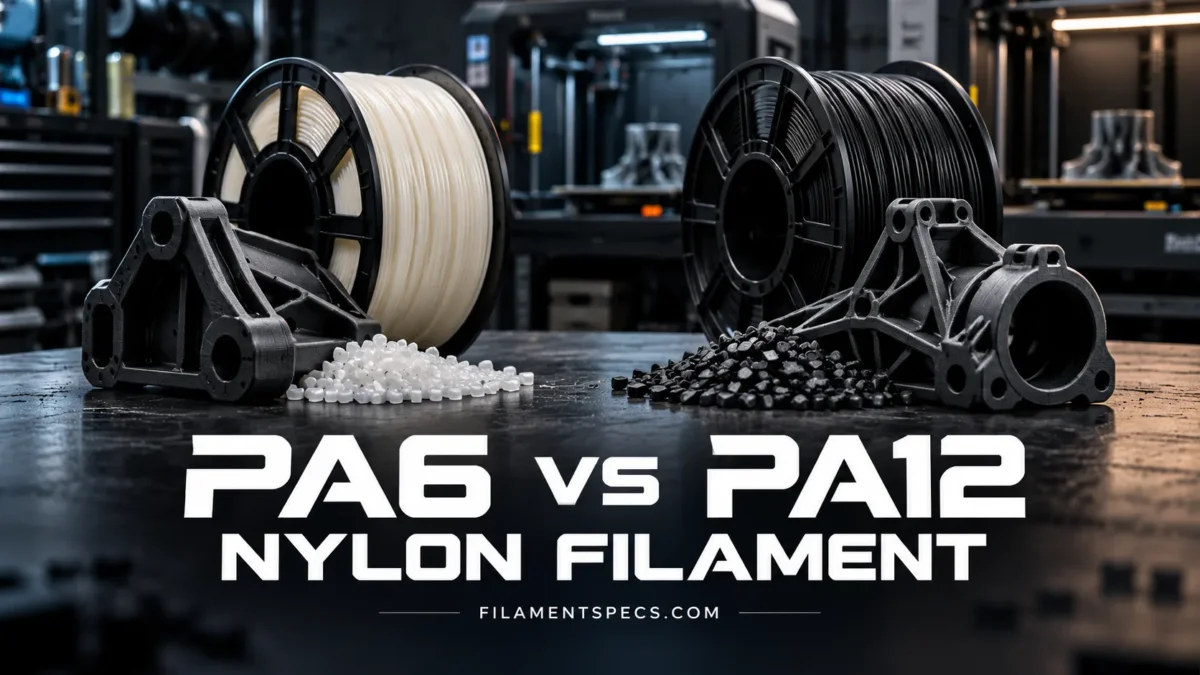
PA6 is usually the stronger starting point when a nylon part needs high dry stiffness and load-bearing rigidity, while PA12 is usually the better choice when low moisture uptake, dimensional stability, lower environmental sensitivity, and a more compliant response matter more. The difference cannot be reduced to “PA6 is stronger” and “PA12 prints easier”: moisture conditioning, additives, reinforcement, print orientation, annealing, and test conditions can change the ranking. For parts that will live outside a controlled dry environment, conditioned behavior can matter more than the highest dry tensile value on a datasheet.
| Property | PA6 | PA12 | Practical Effect |
|---|---|---|---|
| Dry stiffness | Generally higher | Generally lower | PA6 is often favored for rigid brackets, fixtures, and load paths. |
| Moisture uptake | Higher | Much lower | PA12 usually changes less as environmental humidity rises. |
| Dimensional stability in humidity | More condition-dependent | Generally better | PA12 is attractive for fitted parts and tolerance-sensitive assemblies. |
| Typical polymer melting point | About 220–221°C | About 178–180°C | Melting point does not directly determine the required nozzle temperature. |
| Representative density | About 1.14 g/cm³ | About 1.01–1.02 g/cm³ | Unfilled PA12 is normally lighter by volume. |
| Warping tendency | Often higher | Often lower | PA12 can be easier to keep dimensionally controlled, although formulation still matters. |
| Flexibility / compliance | Typically stiffer when dry | Typically more compliant | PA12 can suit clips, snap features, and parts expected to flex. |
| Wear resistance | Good to very good | Good to very good | Either can work for gears, guides, and sliding parts when the grade fits the load. |
| Chemical resistance | Good for many oils and lubricants | Often favored where low moisture uptake and chemical resistance are both needed | Actual compatibility must be checked against the chemical, concentration, temperature, and exposure time. |
| Drying requirement | High | Still required | PA12 is less moisture-sensitive than PA6, not moisture-proof. |
| Best general fit | Dry, rigid, mechanically loaded parts | Humidity-exposed, tolerance-sensitive, more compliant parts | The service environment should decide the choice. |
The entries describe family-level tendencies, not guaranteed filament specifications. Unfilled, carbon-fiber-filled, glass-fiber-filled, toughened, low-warp, and copolymer formulations can behave very differently.
Material-selection shortcut: choose PA6 first when dry stiffness and structural rigidity dominate. Choose PA12 first when humidity, dimensional consistency, chemical exposure, reduced warping, or controlled flexibility dominate. If the filament contains carbon or glass fiber, restart the comparison using the exact reinforced grades rather than assuming that the neat-polymer ranking still applies.
Why PA6 and PA12 Behave Differently
PA6 and PA12 are both semi-crystalline polyamides, but their repeat units contain different proportions of polar amide groups and hydrocarbon segments. PA6 has a shorter carbon sequence between amide groups. PA12 has a longer hydrocarbon portion, so the concentration of polar amide groups along the chain is lower. That structural difference helps explain why PA12 interacts less strongly with water and normally absorbs much less moisture than PA6. A recent review of PA6 and PA12 materials likewise identifies lower moisture absorption and better dimensional stability as characteristic PA12 advantages, while PA6 generally provides higher strength and elastic modulus. [a]
The difference is measurable even before FFF processing is considered. Ensinger lists 24-hour and 96-hour water absorption values of 0.3% and 0.6% for its unfilled PA6 stock material, compared with 0.04% and 0.07% for its unfilled PA12 under DIN EN ISO 62 conditions. The same product data list a tensile modulus of 3,300 MPa for PA6 and 1,800 MPa for PA12 under DIN EN ISO 527-2. [b] [c]
Those values are polymer reference points, not FFF guarantees. They come from manufactured stock shapes, not from a PA6 spool and PA12 spool printed on the same machine. Layer orientation, void content, thermal history, pigments, modifiers, reinforcement, moisture state, and annealing can move printed-part values far from base-material data.
Dry Strength Favors PA6 More Clearly Than In-Service Stability Does
When unfilled PA6 and PA12 are compared in a dry or tightly controlled condition, PA6 commonly shows the higher modulus and higher tensile strength. In the matched Ensinger reference data, PA6 has a tensile modulus of 3.3 GPa and tensile strength of 79 MPa, while PA12 is listed at 1.8 GPa and 53 MPa under the same DIN EN ISO 527-2 family of tests. [b] [c] That difference explains why PA6 is frequently selected when a bracket, jig, fixture, gear tooth, or structural feature must resist elastic deflection.
Strength, however, is not one property. Tensile strength, tensile modulus, flexural strength, impact resistance, elongation, fatigue behavior, layer adhesion, and creep describe different failure modes. PA12’s lower stiffness can be a disadvantage in a loaded bracket but useful in a snap feature that must deform repeatedly without behaving like a rigid beam.
Moisture Can Narrow the Dry-Property Gap
Water acts as a plasticizer in polyamides. As absorbed water increases molecular mobility, a nylon part can become less stiff and more ductile. The effect is especially relevant to PA6 because its moisture uptake is higher. A part can therefore leave the printer very rigid, then show a different modulus, deflection response, and dimensional condition after spending time in ambient humidity.
This does not mean that moisture simply makes every nylon property worse. Lower stiffness can be accompanied by higher ductility or impact-energy absorption. The engineering question is whether the part must remain rigid and dimensionally fixed or whether additional compliance is acceptable.
A 2026 study directly comparing short-carbon-fiber PA6 and PA12 under moisture exposure found much better mechanical-property retention in the PA12-based material after post-print annealing. The reported modulus reduction was about 3% for the PA12-CF system compared with 64% for the PA6-CF system used in that experiment. [d] These numbers should not be transferred to unfilled PA6 and PA12: the study involved particular reinforced formulations and post-processing. The useful lesson is that the polymer matrix still affects moisture response even after carbon fiber is added.
Print Orientation Can Matter as Much as the Polymer Name
FFF creates anisotropic parts. Material deposited within a layer does not experience the same load path as bonds between layers, so an XY tensile value should not be treated as a Z-direction strength value. A nominally stronger PA6 filament can therefore produce a weaker component if moisture, poor interlayer fusion, excessive cooling, or unsuitable orientation damages the load path. Likewise, a well-processed PA12 part may outperform a poorly processed PA6 part even when the PA6 base polymer has the higher dry modulus.
Moisture Is the Largest Practical Difference Between PA6 and PA12
Two separate moisture problems are often grouped together even though they affect different stages of the part’s life: wet filament during extrusion and moisture conditioning of the finished part.
Wet Filament Damages the Printing Process
Moisture inside filament can turn to vapor as the polymer passes through the hotend. Common symptoms include popping, bubbling, excessive stringing, rough or foamy extrusion, unstable flow, and poor surface definition. Severe moisture contamination can also reduce the reliability of interlayer fusion. Both PA6 and PA12 should therefore be treated as hygroscopic materials that benefit from sealed storage and controlled drying.
PA12’s lower equilibrium moisture sensitivity does not eliminate this requirement. Fiberlogy’s current unfilled PA12 instructions specify drying at 70°C for four hours, a 255–270°C printing range, a 110°C bed, and an enclosed chamber for that particular formulation. [e] Drying temperature and time should always come from the spool manufacturer’s current instructions because modifiers, pigments, spool construction, and resin grade affect what is safe.
Conditioned Parts Change After Printing
A finished nylon part continues interacting with its environment. As moisture enters the polymer, dimensions and mechanical properties can move away from the freshly dried condition. This is particularly important for bearing bores, locating pins, mating housings, bolt spacing, press fits, inspection fixtures, and assemblies that depend on a narrow clearance.
Print accuracy and service accuracy are different. A part can measure correctly immediately after printing yet drift after moisture conditioning, sustained load, or temperature exposure. PA12 is normally preferred when maintaining dimensions across changing humidity is more valuable than maximizing dry stiffness.
Creep Makes the Moisture Difference More Relevant
Creep is time-dependent deformation under sustained load. It matters in clamped fixtures, bolted brackets, bearing supports, motor mounts, spring-like features, and jigs that remain loaded for days or months. Because moisture can lower polyamide stiffness, a dry tensile test does not fully describe how a PA6 part will hold preload or resist deflection after environmental conditioning. PA12’s lower moisture uptake gives it an advantage when the design requires more consistent long-term geometry, although exact creep performance remains grade- and temperature-dependent.
PA6 and PA12 Printing Temperatures Overlap More Than Their Melting Points Suggest
PA6 has a much higher polymer melting point than PA12. Representative unfilled stock-material data place PA6 at about 221°C and PA12 at about 180°C under DSC-based testing. [b] [c] That difference does not translate directly into equally separated nozzle settings.
| Parameter | Spectrum PA6 Neat | Fiberlogy Nylon PA12 |
|---|---|---|
| Nozzle temperature | 250–280°C | 255–270°C |
| Bed temperature | 60–80°C in the current TDS | 110°C on the current product instructions |
| Part cooling | 0–10% | 0–10% |
| Enclosure | Recommended | Required for this formulation |
| Dry handling | Dry box recommended; drying necessary if wet | 70°C for 4 hours specified by manufacturer |
These are examples from two specific commercial filaments, not universal PA6 and PA12 settings. Spectrum’s PA6 Neat TDS and Fiberlogy’s PA12 instructions show why nozzle temperature must come from the filament formulation rather than from polymer melting point alone. [f] [e]
Why Nozzle Temperature Is Higher Than the Melting Point
The nozzle must do more than bring a polymer barely above its melting transition. The material needs sufficiently low viscosity to flow through a small orifice, wet the previous layer, and form a reliable interlayer bond within a short residence time. Resin viscosity, molecular weight, additives, fiber loading, print speed, nozzle diameter, and desired layer adhesion all affect the practical extrusion temperature. For that reason, polymer melting point and recommended nozzle temperature are not interchangeable values.
Warping and Thermal Contraction
Both PA6 and PA12 are semi-crystalline, so crystallization and cooling create dimensional contraction. PA6 formulations often demand tighter control of first-layer adhesion and temperature gradients, especially on broad, flat parts. PA12 is generally associated with better dimensional stability and lower moisture-driven change, but an unfilled PA12 filament can still require a hot bed and enclosure. The current Fiberlogy PA12 instructions, for example, call for a 110°C bed and an enclosed chamber. [e]
Filled formulations can alter this behavior dramatically. Chopped carbon or glass fibers restrict shrinkage in some directions and often make large engineering prints easier to keep flat. That is one reason a low-warp PA6 composite may print more predictably than an unfilled PA12 even though PA12 has the family-level advantage in dimensional stability.
Heat Resistance Depends on the Number Being Compared
PA6 has the higher base-polymer melting point, but melting temperature alone should not decide a high-temperature application. A printed part can soften, creep, or deflect under load well below the temperature at which the polymer melts.
- Melting temperature (Tm) describes the melting transition of the crystalline polymer regions.
- Heat deflection temperature (HDT) measures deformation under a specified load and must be compared at the same test stress.
- Vicat softening temperature uses an indentation-based softening test and is not equivalent to HDT.
- Continuous-use temperature is a different service-life concept and should not be substituted for a short laboratory deflection value.
Fiberlogy’s current PA12 data illustrate why the test load matters: the material is listed at 135°C HDT under 0.45 MPa but only 55°C under 1.8 MPa, both using ISO 75. [e] A comparison that places one material’s 0.45 MPa HDT beside another material’s 1.8 MPa HDT is not valid.
PA6 often provides more thermal headroom in highly reinforced engineering formulations, but this should be checked grade by grade rather than assumed from the polymer name. Polymaker’s current nylon table, for example, lists an annealed Fiberon PA6-CF20 at 215°C HDT under 0.45 MPa and an annealed Fiberon PA12-CF10 at 131°C. [g] Those products contain different carbon-fiber percentages, so they demonstrate the range available in commercial formulations rather than a controlled PA6-versus-PA12 polymer experiment.
Wear, Gears, Bushings, and Sliding Components
Both PA6 and PA12 can perform well in wear and sliding applications. The better choice depends on what limits the part. A gear whose teeth must resist elastic deflection may benefit from PA6’s higher dry stiffness. A mechanism that must retain fit through changing humidity may favor PA12. For a bushing, wear rate, shaft finish, contact pressure, speed, lubrication, operating temperature, moisture exposure, and dimensional clearance matter more than the nylon number by itself.
Representative Ensinger PA6 and PA12 materials are both specified as having good wear and sliding properties and resistance to many oils, greases, and fuels. [b] [c] This makes both families plausible for gears, guides, rollers, and bushings, but a generic statement such as “PA12 is better for gears” or “PA6 always wears better” is too broad for design work.
PA12 Has the Clearer Advantage Where Humidity and Chemical Exposure Coincide
PA12 is often selected for fluid-handling, tubing, automotive, and mechanical applications because its low moisture uptake is paired with good resistance to many oils, greases, and fuels. [c] The practical benefit is not just chemical resistance in isolation. A material that also absorbs relatively little water is easier to use where a part must maintain geometry while exposed to changing ambient conditions.
“Chemical resistant” is not a universal pass/fail property. Compatibility depends on the exact chemical, concentration, temperature, exposure duration, mechanical stress, and filament formulation. A PA12 family advantage does not replace a chemical-compatibility check for the actual end-use fluid.
PA6-CF vs PA12-CF Is a Separate Comparison
Carbon fiber changes stiffness, shrinkage, thermal behavior, surface finish, ductility, density, and nozzle requirements. Glass fiber changes the comparison again. A PA6-CF20 and PA12-CF10 pair is therefore not simply “PA6 versus PA12”; it is also a comparison between two different reinforcement levels and potentially different resin modifiers.
Short fibers typically raise stiffness and reduce shrinkage in the directions where the fibers become aligned by extrusion. They also make the filament abrasive, so a wear-resistant nozzle is normally required. Reinforcement does not eliminate the base polymer’s moisture behavior. The 2026 PA6-CF/PA12-CF study found that the PA12-based composite retained its modulus far better under the study’s humid conditions, showing that matrix chemistry remains relevant after reinforcement. [d]
Current commercial data also show why filler content has to be stated. Polymaker lists annealed PA6-CF20 at 109.3 MPa XY tensile strength and PA12-CF10 at 77.4 MPa, but the materials contain different fiber loadings. [g] That is useful product-selection data; it is not proof that every 20% PA6-CF formulation is stronger than every PA12-CF formulation.
Avoid these datasheet comparisons:
- Unfilled PA6 against PA12-CF or PA12-GF.
- PA6-CF20 against PA12-CF10 without accounting for fiber content.
- Dry PA6 against conditioned PA12.
- Annealed specimens against as-printed specimens.
- XY tensile strength against Z tensile strength.
- HDT at 0.45 MPa against HDT at 1.8 MPa.
- Injection-molded or stock-shape values against FFF specimen values as though the manufacturing process were identical.
Which Nylon Fits the Part?
| Part or Requirement | Better Starting Choice | Reason |
|---|---|---|
| Rigid machine bracket in a controlled dry environment | PA6 | Higher dry modulus is useful when limiting elastic deflection. |
| High-load jig or fixture | PA6, if humidity is controlled | Dry rigidity is often the primary requirement. |
| Precision jig in a humid workshop | PA12 | Lower moisture uptake reduces environment-driven dimensional change. |
| Snap-fit clip | Often PA12 | Lower stiffness and higher compliance can suit repeated flexing. |
| Large flat engineering print | Often PA12 | PA12 generally offers a more favorable dimensional-stability profile, though the exact formulation still controls warping. |
| Gear | Depends | PA6 favors rigidity; PA12 favors dimensional stability under humidity. Wear, load, heat, and lubrication must also be considered. |
| Bushing or sliding guide | Depends | Both families have useful wear properties; clearance and environment decide the better grade. |
| Oil- or fuel-adjacent component | Often PA12 | Low moisture uptake combined with good chemical resistance is attractive for this environment. |
| Part exposed to changing humidity | PA12 | Mechanical properties and dimensions generally remain more stable. |
| Part needing the highest possible reinforced-filament heat capability | Often PA6-based composite | Some reinforced PA6 grades reach very high HDT values, but the exact TDS must be checked. |
| Bolted component under continuous load | Application test recommended | Creep, temperature, moisture conditioning, and preload retention matter together. |
How to Read PA6 and PA12 Datasheets Without Creating a False Winner
A pair of large tensile-strength numbers is not enough to compare engineering nylon filaments. Before ranking two products, the conditions behind the values should match as closely as possible.
- Confirm the polymer. PA6, PA12, PA612, copolyamide, and manufacturer-specific “PA” blends should not be treated as identical materials.
- Check reinforcement. Record whether the grade is neat, carbon-fiber-filled, glass-fiber-filled, mineral-filled, or otherwise modified, including filler percentage where published.
- Match the moisture condition. Dry, conditioned, and water-immersed specimens can give very different modulus and strength results.
- Match the test method. ISO 527 and ASTM D638 tensile results should not be merged into one supposedly universal number without considering specimen and test differences.
- Check manufacturing method. Raw resin, injection-molded specimens, machined stock shapes, powder-bed parts, and FFF prints are different evidence categories.
- Check print orientation. XY and Z results describe different load paths in an FFF part.
- Check post-processing. Annealing can change crystallinity, shrinkage, modulus, and HDT.
- Match the HDT load. Compare 0.45 MPa with 0.45 MPa or 1.8 MPa with 1.8 MPa.
- Check whether a value is typical or guaranteed. A typical laboratory value should not be treated as a guaranteed minimum for every spool and geometry.
The practical result is that the question “Is PA6 stronger than PA12?” is incomplete. A more useful comparison is: which exact PA6 and PA12 formulations retain the properties this part needs under its expected temperature, humidity, load, and time in service?
PA6 vs PA12 FAQ
Is PA6 stronger than PA12?
PA6 generally has higher dry tensile strength and modulus than unfilled PA12, so it is normally the better starting point when stiffness and resistance to deflection dominate. The comparison can change after moisture conditioning or when different reinforcements are used. The exact filament TDS and specimen condition should therefore be checked before treating PA6 as universally stronger.
Does PA12 still need to be dried before printing?
Yes. PA12 absorbs less moisture than PA6, but it is still hygroscopic. Current Fiberlogy PA12 instructions specify 70°C for four hours for that product. Other PA12 formulations may require different temperatures or durations, so the filament manufacturer’s drying instructions take priority. [e]
Which warps less, PA6 or PA12?
PA12 is generally the more dimensionally stable family and often has the lower warping tendency, particularly when humidity response is also considered. This is not an absolute rule. Carbon fiber, glass fiber, low-warp modifiers, part geometry, bed adhesion, chamber temperature, and cooling can make a modified PA6 easier to print than an unfilled PA12.
Why can PA12 require almost the same nozzle temperature as PA6 if its melting point is lower?
Nozzle temperature is selected for extrusion flow and layer bonding, not merely to cross the polymer’s melting point. Commercial formulation, viscosity, print speed, additives, and required interlayer fusion all affect the setting. Current examples show Spectrum PA6 Neat at 250–280°C and Fiberlogy PA12 at 255–270°C despite the lower PA12 polymer melting point. [f] [e]
Is PA6 or PA12 better for gears?
Neither is automatically better. PA6’s higher dry stiffness can help a loaded tooth preserve its geometry, while PA12’s lower moisture uptake can make clearances and dimensions more stable in changing humidity. Gear load, speed, temperature, lubrication, tooth geometry, creep, and the exact filament formulation should decide the choice.
Is PA12 better for snap-fits and clips?
Often, but not universally. Unfilled PA12 is generally more compliant than PA6, which can be useful when a feature must flex during assembly or repeated use. A reinforced PA12 can be much stiffer and less extensible, so carbon-fiber-filled grades should not be selected for a flexible clip based on the behavior of neat PA12.
Is PA6-CF automatically stronger than PA12-CF?
No. PA6-CF products often target higher stiffness and heat capability, but fiber percentage, fiber geometry, resin modifiers, annealing, moisture state, and print orientation can change the result. Current commercial tables can show a PA6-CF product above a PA12-CF product while also using different carbon-fiber percentages. Moisture testing also shows that PA12-based composites can retain properties better in humid conditions. [d] [g]
Sources
- Polymers — Comprehensive Review: Technological Approaches, Properties, and Applications of Pure and Reinforced Polyamide 6 (PA6) and Polyamide 12 (PA12) Composite Materials — Supports the structural, moisture, dimensional-stability, and mechanical-property distinctions between PA6 and PA12. (Peer-reviewed review article.)
- Ensinger — TECAMID 6 Natural, PA6 Technical Properties — Provides PA6 density, tensile modulus, tensile strength, melting temperature, and DIN EN ISO 62 water-absorption values used as base-polymer reference data. (Manufacturer technical data.)
- Ensinger — TECAMID 12 Natural, PA12 Technical Properties — Provides comparable PA12 density, mechanical, thermal, water-absorption, wear, and chemical-resistance data. (Manufacturer technical data.)
- Composites Part A: Applied Science and Manufacturing — The Effect of Moisture on Low-Frequency Vibration Attenuation and High Load-Bearing Performance of Lightweight Composite Metastructure — Supports the comparison of moisture-related property retention in the tested PA6-CF and PA12-CF systems. (Peer-reviewed research article.)
- Fiberlogy — Nylon PA12 Technical Data Sheet — Provides PA12 printing temperature, density, ISO 527 mechanical data, ISO 75 HDT values, Vicat temperature, and melting temperature. (Manufacturer TDS.)
- Spectrum Filaments — PA6 Neat Technical Data Sheet — Provides the cited PA6 nozzle, bed, cooling, enclosure, dry-box, and storage guidance for the commercial PA6 example. (Manufacturer TDS.)
- Polymaker — Technical Data at a Glance — Provides current annealed PA6-CF20 and PA12-CF10 tensile, HDT, density, Vicat, and impact data used to illustrate formulation-dependent comparisons. (Manufacturer technical reference.)