
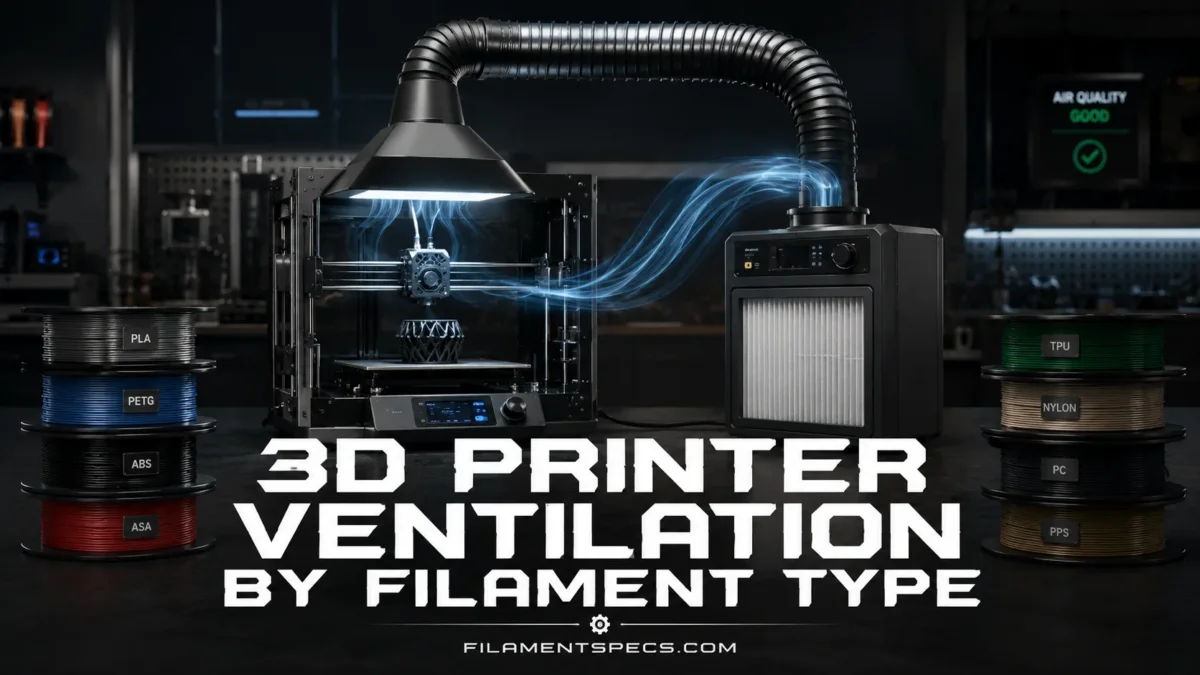
Filament ventilation is not only about smell. A clean-smelling print can still release ultrafine particles, and a filament with a strong odor is not automatically the only material worth controlling. The practical rule is simple: ventilation should follow the filament chemistry, nozzle temperature, print duration, enclosure design, room size, and how often the printer runs. One short PLA print in a ventilated hobby room is a different exposure situation from six ABS machines running all afternoon.
FDM and FFF printers heat thermoplastic until it softens and flows through a nozzle. During that heating step, printers can release volatile organic compounds, usually called VOCs, and very small airborne particles. EPA describes ultrafine particles as particles in the 1–100 nm size range, small enough to move deep into the respiratory system. [a]
Good ventilation starts at the source. A window across the room may dilute air, but it does not capture emissions as well as an enclosure, local exhaust, or filtration placed close to the printer. Capture first. Dilute second.
| Filament Type | Typical Nozzle Range | Typical Bed Range | Main Air Concerns | Ventilation Level | Best Setup | Room Use Notes |
|---|---|---|---|---|---|---|
| PLA | 190–220°C | 0–60°C | UFPs, low-to-moderate VOCs, possible lactide and aldehydes depending on formulation | Basic to moderate | Well-ventilated room for occasional use; source capture or a sealed filtered enclosure for frequent printing | Usually the easiest filament for casual indoor printing, but not emission-free. |
| PETG | 220–250°C | 70–90°C | UFPs, VOCs, mild odor, additives and colorants can change emissions | Moderate | Source capture or a sealed enclosure with HEPA + activated carbon for long or repeated jobs | Better treated as a “ventilate every time” material, especially in small rooms. |
| ABS | 235–260°C | 90–110°C | UFPs and styrene-dominant VOC odor | High | Source capture or a sealed enclosure with outdoor exhaust; HEPA + activated carbon when recirculating | Not a good fit for bedrooms, small offices, or shared living areas without source control. |
| ASA | 240–270°C | 90–110°C | UFPs and styrene-related VOCs; similar ventilation logic to ABS | High | Sealed enclosure with controlled exhaust or HEPA + activated carbon; maintain inward leakage where practical | Useful for outdoor parts, but air control should be planned before routine use. |
| TPU / TPE | 210–240°C | 30–60°C | UFPs, VOCs vary strongly by chemistry and additives | Moderate | Room ventilation for short use; source capture or filtered enclosure for repeated long prints | Odor can be mild or noticeable depending on brand, hardness, and print temperature. |
| Nylon / PA | 240–280°C | 70–110°C | UFPs, VOCs, caprolactam-related concern for some polyamide materials | High | Drybox feed with source capture or sealed enclosure; HEPA + carbon or outdoor exhaust | High print temperatures and long engineering prints make source control more important. |
| PC | 260–310°C | 90–120°C | UFPs, VOCs, high-temperature thermal byproducts | High | Sealed heated enclosure with outdoor exhaust or HEPA + gas-phase filtration, away from occupied desk space | Mostly suited to controlled workspaces rather than casual open-room printing. |
| Filled / Specialty Composites | Depends on base polymer and formulation | Depends on base polymer | Base-polymer emissions plus formulation-specific fillers or metals; post-processing can add fine debris | Use the base polymer as a starting point, then increase control for metal-, nano-, or uncertain-additive formulations | Prefer source capture or a sealed filtered/exhausted enclosure when additive composition is unclear or specialty fillers are present | Do not set ventilation from the PLA/PETG/ABS carrier label alone; formulation can change the exposure profile.[g][h] |
Why Ventilation Changes by Filament Type
Different filaments do not release the same mix of particles and gases. The polymer itself matters. So do additives, pigment, flame-retardant packages, impact modifiers, plasticizers, recycled content, and print temperature. Two spools with the same label can behave differently if the formulation is different.
A 2026 composition-and-emissions study detected aluminum, magnesium, manganese, chromium, iron, and copper in some filaments that were not marketed as metal-filled.[g] For ventilation planning, that means source capture should not be chosen from the PLA, PETG, or ABS label alone when a filament contains metal, nanomaterial, or poorly documented specialty additives. NIOSH also notes that nanomaterial-containing filaments can emit particulate matter containing those nanomaterials.[h]
That is why “PLA is safe” and “ABS is toxic” are both too blunt. A better way to think is:
- Lower-temperature filaments often produce fewer emissions than hotter engineering materials, but they still need airflow.
- Higher-temperature filaments usually deserve an enclosure and stronger source control.
- Odor is useful, not complete. Some VOCs smell; ultrafine particles usually do not.
- Long print time matters. A 14-hour job can change the room more than a 20-minute bracket.
- Multiple printers multiply the problem. Printer farms need room-level planning, not just a small desktop fan.
NIOSH measured particles and VOCs from desktop 3D printers and notes that ventilation is an engineering control for reducing emissions from printers, including local exhaust and enclosed ventilated racks for multi-printer setups. [b]
Print Temperature Is a Major Clue
A filament printed at 205°C usually needs less control than one printed at 270°C, assuming similar room conditions and print size. Higher temperature gives polymers and additives more thermal stress. That can increase VOC release and particle formation.
The lowest usable nozzle temperature is not only a print-quality setting. It is also an air-quality setting. Too low can cause poor layer bonding, but printing hotter than needed can add odor, stringing, discoloration, and avoidable emissions.
Ventilation Is Not the Same as Cooling
Part cooling improves bridges and overhangs. Room ventilation controls airborne contaminants. They are separate systems.
A strong part-cooling fan does not remove VOCs from the room. A printer enclosure can improve ABS and ASA print stability, but if the enclosure leaks into the room or has no filtration/exhaust path, it may only delay the release until the door opens.
Control Hierarchy: Capture Before Dilution
- Source capture: collect emissions close to the nozzle or print zone before they spread through the printer and room.
- Sealed enclosure: contain emissions and maintain a defined airflow path instead of allowing uncontrolled leakage around panels, doors, or printer fans.
- Filtration or outdoor exhaust: force captured air through suitable particle and gas controls, or remove it outdoors where the installation can do so safely.
- Room ventilation: dilute residual emissions that escape source control rather than using room air exchange as the first line of control.
| Tested Control | Minimum Particle Capture Efficiency | What the Result Shows |
|---|---|---|
| Source Capture A | 99.7% | Capture close to the emission source was highly effective in the tested printer and chamber setup. |
| Source Capture B | 91.6% | A second source-capture design also reduced most measured particle emissions. |
| Partial Enclosure C | 28.6% | Internal printer cooling fans allowed particles to bypass the intended filtered path. |
| Full Enclosure D | 99.8% | Full containment with filtered exhaust produced the highest minimum capture efficiency in the experiment. |
These percentages describe particle capture in a controlled experiment using two printer models and black ABS filament. They are not universal performance guarantees for every printer, enclosure, filter, filament, room, or VOC-control setup.[f]
An enclosure is not filtration by itself. The 28.6% result from the partial enclosure shows how strongly bypass airflow can reduce control performance even when a filtration unit is present. Air has to be directed through the intended filter or exhaust path.[f]
What 3D Printer Ventilation Has to Control
Printer emissions are usually discussed in two buckets: particles and gases. A good setup considers both. HEPA helps with particles. Activated carbon helps with many VOCs. Outdoor exhaust removes both from the room when designed well.
Ultrafine Particles
Ultrafine particles are tiny particles below 100 nm. They are far smaller than visible dust. You cannot judge them by looking at the air.
FDM printers can produce these particles during extrusion, especially during heating, purging, high-temperature printing, and long jobs. EPA notes that 3D printing can release gases and ultrafine particles, and that particles in this size range can be deposited deeper in the respiratory system. [a]
VOCs
VOCs are airborne chemicals released during heating. Their exact profile depends on filament chemistry. ABS and ASA are commonly associated with styrene-related odor. PLA may release lactide and other compounds. Nylon can involve caprolactam-related concerns depending on material chemistry. PETG, TPU, PC, and filled materials vary by formulation.
CCOHS notes that VOCs associated with 3D printing are often related to monomers used to obtain the filament material, with examples including styrene, methyl methacrylate, caprolactam, and ethylbenzene. [c]
Why Smell Is Not Enough
Smell is only a rough signal. ABS smells obvious to many users. PLA can smell mild or sweet. PETG may smell almost like nothing. None of that proves the air is clean.
Use smell as a warning, not as a measuring tool. No odor does not mean no particles. Strong odor means the setup needs attention.
Ventilation Levels for Home, School, and Workshop Printing
For most users, the question is not “Is this filament safe?” The better question is: What level of control matches this filament and room?
| Control Level | What It Does | Suitable Use | Main Limitation |
|---|---|---|---|
| Basic Room Ventilation | Dilutes emissions after they enter the room. | Occasional lower-emission printing in a roomy, well-ventilated area. | Does not prevent contaminants from crossing the breathing zone before dilution. |
| Source Capture | Collects emissions near the nozzle or print zone and routes them to filtration or exhaust. | Open-frame printers where a well-fitted local capture device can follow the emission source. | Capture geometry and airflow must keep emissions from escaping around the intake. |
| Enclosure Without Filtration or Exhaust | Contains some emissions temporarily and stabilizes the printing environment. | Draft control and partial containment. | Containment alone does not remove particles or VOCs, and leaks can release contaminated air. |
| Sealed Enclosure With HEPA + Carbon | Directs enclosure air through particle and gas-phase filtration before recirculation. | PETG, TPU, nylon, ABS/ASA, and other regular indoor printing where outdoor exhaust is unavailable. | Seal quality, bypass paths, filter capacity, fan pressure, and maintenance determine performance. |
| Enclosure With Outdoor Exhaust | Maintains a controlled exhaust path so captured emissions leave the occupied room. | ABS, ASA, nylon, PC, multi-printer use, and long engineering prints. | Requires safe discharge location, make-up air, and attention to building or weather constraints. |
| Dedicated Print Room | Adds room-level air exchange and occupancy separation around source controls. | Schools, labs, farms, makerspaces, and frequent printing. | Room ventilation should support source control rather than replace it. |
Do not blow printer air toward people. A fan pointed at the printer may move odor away from the machine, but it can push particles and VOCs across the breathing zone. Air should move toward capture, filtration, or exhaust.
ACH: Air Changes per Hour
ACH means how many times the room’s air volume is replaced or supplied in one hour. It is not the only detail that matters, but it helps compare rooms. Stanford EH&S recommends well-ventilated environments with at least 4 ACH for 3D printers, and at least 6 ACH for higher-temperature filaments or banks of more than three printers that can run at the same time. [d]
A small closed room with a long-running printer provides little dilution and should not be treated like a well-ventilated workspace.
Single Printer vs Printer Farm
A single enclosed PLA printer is one situation. Ten printers running different materials in the same room is another. When several machines run together, the room becomes part of the system: supply air, exhaust air, occupancy time, filter replacement, and printer spacing all matter.
For farms, schools, and shared workshops, a written material policy helps. Something as simple as “PLA and PETG in the general room; ABS, ASA, nylon, and PC only in the ventilated enclosure area” can prevent messy mixed-use setups.
Filament-by-Filament Ventilation Notes
The following sections focus on common FDM materials. Exact emissions can differ by brand, color, additives, nozzle temperature, bed temperature, flow rate, enclosure temperature, and whether the filament is dry.
PLA Ventilation
PLA is often the first filament people print, and for good reason. It prints at lower temperatures, usually has mild odor, and is easier to use without a heated enclosure. It is still not a zero-emission material.
Best ventilation match: a well-ventilated room for occasional use; enclosure and HEPA filtration for frequent or long printing.
- Typical use: prototypes, models, educational prints, decorative parts, low-heat indoor objects.
- Air concern: ultrafine particles plus lower VOC levels compared with hotter materials.
- When to upgrade ventilation: long print runs, small rooms, several printers, sensitive users nearby, or unknown additives.
- Good practice: avoid sitting directly beside the printer for the full print.
PLA is a sensible default when the part does not need heat resistance, chemical resistance, or outdoor durability. UL Chemical Insights also recommends choosing lower-emitting materials such as PLA instead of ABS or nylon when feasible. [e]
PLA Plus, Matte PLA, Silk PLA, Wood PLA, and Glow PLA
Specialty PLA is not always the same as plain PLA. Matte PLA may include mineral fillers. Silk PLA often uses additives that change flow and shine. Wood-filled PLA adds fine organic filler. Glow PLA can contain abrasive particles. These can change odor, particle behavior, nozzle wear, and sanding dust.
Ventilate them like PLA at minimum. For long jobs, treat specialty blends with a little more caution than basic PLA, especially when the exact additive package is unknown.
PETG Ventilation
PETG sits between PLA and higher-temperature engineering filaments for many users. It is tougher than PLA, less fussy than ABS, and useful for practical parts. Its odor is usually mild, but the nozzle temperature is higher than PLA, and the print time for functional parts can be long.
Best ventilation match: active room ventilation or an enclosure with HEPA + activated carbon for regular use.
- Typical use: brackets, bins, holders, light mechanical parts, parts needing more ductility than PLA.
- Air concern: UFPs and VOCs that vary by formulation.
- When to upgrade ventilation: all-day PETG printing, small office printing, high nozzle temperatures, multi-printer setups.
- Good practice: dry the filament and avoid excessive nozzle temperature; overheated PETG can smell sharper and print worse.
PETG should not be treated as “no ventilation needed.” It is better described as moderate-control material: not as demanding as ABS/ASA, but not something to ignore.
ABS Ventilation
ABS needs stronger source control. It prints hot, usually wants an enclosure for warp control, and is well known for styrene-related odor. The enclosure that improves print quality also makes a convenient capture point for ventilation.
Best ventilation match: sealed enclosure with outdoor exhaust, or a well-sealed enclosure using both HEPA and a properly sized activated-carbon filter.
- Typical use: heat-tolerant parts, housings, durable functional components, parts that may be smoothed or post-processed.
- Air concern: ultrafine particles and styrene-dominant VOCs.
- When to upgrade ventilation: before routine ABS use. Do not wait until odor becomes a room problem.
- Good practice: let the enclosure purge or filter after the print before opening the door.
ABS is not a good open-frame bedroom material. A small enclosed printer beside a desk is also not the same as a controlled ventilated setup. Containment and removal are the main ideas.
ASA Ventilation
ASA is often chosen when outdoor durability and UV resistance matter. From a ventilation standpoint, it should be handled close to ABS. It prints at similar temperatures and can produce styrene-related odor.
Best ventilation match: enclosed printer with active filtration or exhaust outdoors.
- Typical use: outdoor brackets, automotive-adjacent parts, garden fixtures, weather-exposed housings.
- Air concern: UFPs and VOCs associated with high-temperature styrenic polymers.
- When to upgrade ventilation: any regular ASA printing, especially long outdoor-part jobs.
- Good practice: avoid opening the enclosure immediately after the print finishes.
ASA often prints better in a stable warm enclosure anyway. Use that same enclosure as part of the air-control system, not just as a heat box.
TPU and TPE Ventilation
Flexible filaments vary a lot. TPU, TPE, TPC, and flexible blends may have different base chemistry and additive packages. Some smell mild. Some smell stronger. Print temperature can overlap with PETG or run hotter depending on the material.
Best ventilation match: room ventilation for short jobs; enclosure plus filtration for repeated flexible printing.
- Typical use: phone-like bumpers, seals, feet, gaskets, grips, flexible hinges, vibration pads.
- Air concern: UFPs and formulation-dependent VOCs.
- When to upgrade ventilation: longer TPU prints, unknown flexible blends, high-temperature flexible materials.
- Good practice: check the filament safety data sheet when available, because “TPU” alone is not a complete chemistry description.
Flexible prints tend to run slowly. Slow speed can mean long exposure time even when the part is small. That detail gets missed often.
Nylon and Polyamide Ventilation
Nylon prints hot, absorbs moisture, and is often used for demanding functional parts. From an air standpoint, it belongs in the higher-control group. Some polyamide materials may be associated with caprolactam-related VOC concerns, and print temperatures are usually well above PLA and PETG.
Best ventilation match: drybox feeding into an enclosure, with HEPA + activated carbon and preferably outdoor exhaust for regular use.
- Typical use: gears, hinges, wear parts, strong brackets, functional prototypes, parts needing toughness.
- Air concern: UFPs, VOCs, moisture-related print instability, and longer engineering print times.
- When to upgrade ventilation: before routine nylon printing, not after odor appears.
- Good practice: dry the filament properly; wet nylon can pop, steam, string, and print poorly.
Nylon-CF, PA6-CF, PA12-CF, and glass-filled nylon should use nylon-level source control as the starting point. The filler can still change the emitted particulate mixture and post-processing exposure, so the carrier polymer should not be treated as the complete ventilation decision.
Polycarbonate Ventilation
Polycarbonate is a high-temperature material. It needs a hot nozzle, warm bed, and usually a heated or very stable enclosure. That makes ventilation planning more important.
Best ventilation match: enclosed high-temperature printer with outdoor exhaust or serious filtration, placed away from normal seated work areas.
- Typical use: heat-resistant parts, strong transparent or semi-transparent parts, engineering components.
- Air concern: UFPs and VOCs from high-temperature printing.
- When to upgrade ventilation: any regular PC use.
- Good practice: avoid using PC as a casual open-room material.
Regular PC printing is better suited to a controlled workspace with enclosure-based source control than to an open, occupied room.
Carbon Fiber, Glass Fiber, Metal, Wood, and Other Filled Filaments
Filled filaments are easy to misunderstand. A carbon-fiber label does not tell you the ventilation need by itself. PLA-CF, PETG-CF, ABS-CF, and PA-CF start with different carrier polymers, but the additive package matters too. The 2026 composition study found several metals in some nominally nonmetal filaments, showing that a marketing label may not describe every component relevant to the emitted aerosol.[g]
Best ventilation match: use the base polymer as the minimum control level, then add source capture and post-processing dust control for metal-, nano-, or uncertain-additive composites.
- PLA-CF: usually controlled like PLA, with extra attention to abrasive dust during sanding.
- PETG-CF: usually controlled like PETG.
- ABS-CF / ASA-CF: controlled like ABS or ASA.
- Nylon-CF: controlled like nylon, often with stronger enclosure and filtration needs.
- Metal-filled and ceramic-filled filaments: check the SDS and avoid dry sanding without dust capture.
Printing is only one exposure step. Cutting, drilling, sanding, or grinding a filled print can create dust. Use wet sanding, local dust collection, and basic eye protection when finishing filled parts.
Filters, Enclosures, and Outdoor Exhaust
The control system has to manage where contaminated air travels. Source capture or a sealed enclosure establishes the capture zone, filtration treats the captured stream, and room ventilation handles what remains. A box around the printer without a controlled air path is containment, not filtration.
HEPA Filtration
HEPA filtration is used for particles. For 3D printing, it can reduce fine and ultrafine particle release when the blower actually pulls contaminated air through the filter. A HEPA element attached to an enclosure does not guarantee the enclosure air passes through it.
Seal and airflow path matter. The 2026 engineering-control study measured 99.8% minimum particle capture with its full filtered enclosure, while a partial enclosure on the same printer platform achieved only 28.6% because internal cooling fans allowed emissions to bypass the intended control path.[f] Those values belong to the tested apparatus, but the design lesson is transferable: leaks, fan-driven bypass, and poorly placed intakes can undermine otherwise capable filtration.
Activated Carbon
Activated carbon is used for many VOCs and odors. Thin carbon foam sheets are often not enough for heavy ABS, ASA, nylon, or PC use. Carbon works better when there is enough carbon mass, good contact time, and a sealed airflow path.
- Small carbon sheets: better than nothing, but limited capacity.
- Thick carbon beds: more useful for VOC control.
- Loose carbon pellets: need containment so dust does not blow into the printer or room.
- Old carbon: can become less effective; replacement matters.
Outdoor Exhaust
Outdoor exhaust removes enclosure air instead of recirculating it indoors. For ABS, ASA, nylon, PC, and multi-printer use, this is often the cleanest control strategy when it can be done properly.
There are details:
- The enclosure should be under mild negative pressure so leaks pull room air in, not printer air out.
- The duct path should be short where possible.
- The outlet should not send air toward open windows, doors, or air intakes.
- Make-up air matters; exhausting air from a tight room can create pressure issues.
- Building rules may limit window ducts in apartments, offices, and schools.
HEPA and carbon do different jobs. HEPA is for particles. Activated carbon is for many VOCs. A setup that only has one of them is only solving part of the air problem.
Enclosure Purge Time
After a print finishes, the enclosure still contains warm air. Opening it immediately releases that air into the room. A better habit is to let the enclosure fan run for a while after printing, especially with ABS, ASA, nylon, or PC.
No single purge time fits every enclosure. Larger enclosures, weaker fans, and restrictive filters need more time. The aim is simple: let the air pass through filtration or exhaust before the door opens.
Printer Room Planning by Use Case
A hobby desk, classroom, farm, and engineering lab should not use the same ventilation plan. The filament may be the same, but the exposure pattern is not.
Home Hobby Room
For occasional PLA printing, a ventilated room with the printer away from the main sitting area is usually a reasonable base. Add an enclosure and filtration when prints become longer, more frequent, or move into PETG, TPU, ABS, ASA, nylon, or PC.
- Keep the printer out of bedrooms when possible.
- Avoid placing it beside a couch, bed, or work chair.
- Do not point a fan from the printer toward people.
- For ABS/ASA, use an enclosure with filtration or exhaust.
Small Office or Studio
Offices often have people sitting in the same room for long periods. That makes even moderate emissions more relevant. If the printer runs during work hours, use an enclosure and filtration. For ABS, ASA, nylon, and PC, a separate ventilated area is a better match.
NIOSH notes that local exhaust ventilation could reduce or eliminate ultrafine particle concentrations measured in an office-like conference room setting. [b]
Schools and Makerspaces
Schools and makerspaces often print PLA because it is easier, lower temperature, and more forgiving. That helps, but multiple printers in one room still require planning. Long class projects can mean printers run for hours.
- Use PLA as the default material where it meets the part need.
- Place printers in a ventilated room, not a storage closet.
- Use enclosed, filtered printers for repeated use.
- Reserve ABS, ASA, nylon, and PC for controlled spaces.
- Keep students from crowding around printers during long runs.
Printer Farms
Printer farms should be treated like a small production area. More printers means more heat, more particles, more VOCs, more filter loading, and more time spent near machines.
A farm plan should include:
- material rules by printer zone;
- enclosure or rack ventilation;
- filter replacement schedule;
- separate storage for hygroscopic materials such as nylon;
- room ventilation review;
- odor complaint process that leads to inspection, not guesswork.
Relative Ventilation Demand by Filament
These meters are practical comparisons, not lab ratings. They assume normal FDM printing, typical temperatures, and a single-material print. Brand, additives, enclosure design, print duration, and room size can move any material up or down.
PLA Lower Control
PETG Moderate Control
ABS / ASA High Control
TPU Moderate Control
Nylon / PC High Control
Common Setup Mistakes That Reduce Air Control
Treating Any Enclosure as a Filtered Enclosure
An enclosure can improve containment and print stability, but enclosure alone is not filtration. If contaminated air escapes through doors, panel gaps, cable openings, printer cooling paths, or other leakage routes, it never reaches the filter. The 2026 controlled experiment showed the scale of that problem: its partial-enclosure design captured only 28.6% of particles, while the fully enclosed filtered design captured 99.8% under the study conditions.[f]
Using Only a Room Air Purifier
A room purifier can reduce contaminants after they enter the room, especially when it combines particle and gas-phase filtration. It does not provide the same control as capturing emissions before they spread. Source capture or a sealed filtered enclosure should therefore come before room cleanup when the printer and workspace allow it.
Place filtration in the intended capture path and check that printer fans, enclosure gaps, and duct leaks do not give air an easier route around it.
Confusing Carbon Foam With Carbon Capacity
Many small printer filters use thin carbon foam. It may reduce odor for light printing, but heavy ABS or ASA use can overwhelm it. A larger carbon bed with good airflow contact is more useful.
Opening the Door Too Soon
With ABS, ASA, nylon, and PC, wait after the print. Let the enclosure fan pull air through the filter or exhaust path. Allowing the enclosure to purge before opening reduces the immediate release of captured warm air into the room.
Ignoring the Safety Data Sheet
The spool label tells you the marketing name. The SDS can tell you more about material hazards, additives, and handling notes. UL Chemical Insights recommends consulting manufacturer safety data sheets to understand chemical composition and specific hazards. [e]
Choosing Filament With Ventilation in Mind
The cleanest air-control decision often happens before slicing. If PLA, PETG, or another lower-temperature material can do the job, there may be no reason to use ABS, ASA, nylon, or PC in a lightly ventilated space.
| Part Need | Often Suitable Filaments | Ventilation Thought |
|---|---|---|
| Decorative indoor model | PLA, matte PLA, silk PLA | Basic room ventilation is usually the starting point; filter if printing often. |
| Light functional bracket | PLA+, PETG | PETG deserves more airflow than PLA, especially for long jobs. |
| Outdoor part | ASA, PETG, some nylons | ASA usually needs ABS-like ventilation; PETG may be enough if heat load is modest. |
| Heat-resistant enclosure part | ABS, ASA, PC, nylon | Use enclosure plus filtration or exhaust; open-room printing is a poor match. |
| Flexible seal or foot | TPU, TPE | Moderate airflow; check SDS because flexible blends vary. |
| Stiff structural part | PETG-CF, PA-CF, PC-CF | Ventilate by base polymer as a minimum, then account for filler composition and finishing dust. |
Choose the polymer that meets the part requirements, then match the ventilation and source control to that material and printing conditions.
Maintenance for Ventilation That Keeps Working
A ventilation setup can look fine and slowly stop working. Filters load. Carbon saturates. Ducts loosen. Gaskets flatten. Fans collect dust. The printer still prints, so the problem can go unnoticed.
Filter Replacement
Replace HEPA and carbon filters according to real use, not just the calendar. Heavy ABS or ASA printing can use up carbon faster than occasional PLA. Odor returning earlier than usual is a clue, but not the only one.
- Write the install date on the filter housing.
- Track high-odor or high-temperature print hours.
- Inspect gaskets when replacing filters.
- Do not vacuum a HEPA filter unless the manufacturer says it is allowed.
- Store replacement carbon sealed until use.
Enclosure Leaks
Smoke pencils and professional test tools exist, but even a simple visual inspection helps. Check door gaps, cable pass-throughs, lid edges, filter doors, and duct connections. Air should move through the filter or exhaust path, not around it.
Fan Direction
For an exhausted enclosure, the fan should pull contaminated air toward the exhaust path. For a recirculating enclosure filter, the fan should move enclosure air through HEPA and carbon without blowing unfiltered air through gaps.
Correct fan direction helps keep contaminated air moving through the intended filter or exhaust path.
FAQ
Does PLA Need Ventilation?
Yes. PLA usually needs less ventilation than ABS, ASA, nylon, or PC, but it can still release ultrafine particles and VOCs. For occasional short PLA prints, a well-ventilated room is a reasonable starting point. For frequent PLA printing, long prints, schools, or multi-printer rooms, add enclosure-based filtration or better room ventilation.
Can I Print PETG Indoors Without an Enclosure?
For short PETG jobs in a roomy, ventilated area, many users print without an enclosure. For long jobs, small rooms, repeated use, or printing near a desk, ventilation should be upgraded. A filtered enclosure is a better match for regular PETG printing.
Is ABS Safe if I Use an Enclosure?
An enclosure helps, but the enclosure should also filter or exhaust the air. ABS commonly needs stronger control because it prints hot and can release noticeable styrene-related odor. A sealed enclosure with HEPA plus activated carbon, or outdoor exhaust, is a better setup than a closed box with no air path.
Does a HEPA Filter Remove 3D Printer Fumes?
HEPA filtration helps with particles. It does not handle VOCs well. For fumes and odor, activated carbon is the usual companion filter. A better 3D printer filtration setup uses both: HEPA for particles and activated carbon for many VOCs.
Is Activated Carbon Enough for ABS or ASA?
It can help, but carbon capacity matters. Thin carbon foam may not be enough for repeated ABS or ASA printing. A larger carbon bed, sealed airflow path, and regular replacement are more useful. Outdoor exhaust is often the stronger option when the room and building allow it.
Should I Vent My 3D Printer Outside?
Outdoor exhaust is a strong option for ABS, ASA, nylon, PC, and printer farms. The setup should avoid sending exhaust toward windows, doors, or air intakes. It also needs make-up air so the room does not become pressure-starved.
Do Carbon-Fiber Filaments Need Special Ventilation?
Use the base polymer as the starting point, not the whole decision. PLA-CF, PETG-CF, and PA-CF have different carrier-polymer emissions, while fillers and undocumented additives can change the particulate mixture. Use source capture for specialty composites when practical, and control sanding or cutting dust separately.[g]
Is an Enclosure Enough Without Filtration or Exhaust?
No. An enclosure can contain some emissions, but it does not remove them unless air is routed through suitable filtration or exhausted outside. A 2026 chamber study also showed that enclosure geometry and bypass airflow matter: a partial filtered enclosure achieved 28.6% minimum particle capture, while a full filtered enclosure achieved 99.8% in the tested setup.[f]
Can I Use an N95 Mask Instead of Ventilation?
No. Ventilation and source control are the better first steps. An N95 can help reduce particle exposure when properly used, but it does not remove VOC exposure. Stanford EH&S notes that nuisance dust masks do not reduce VOC or UFP exposure and are not NIOSH-approved, while N95 respirators reduce UFP exposure but not VOCs. [d]
Sources
- U.S. Environmental Protection Agency — 3D Printing Research at EPA — Supports the discussion of gases, ultrafine particles, particle size, and filament-related emissions. (Official government research source.)
- NIOSH — Characterizing 3D Printing Emissions and Controls in an Office Environment — Supports local exhaust ventilation, enclosed ventilated racks, and source-control planning for desktop printers. (Official occupational-safety research source.)
- Canadian Centre for Occupational Health and Safety — Additive Manufacturing — Supports the discussion of VOCs, ultrafine particles, material-dependent emissions, and compounds associated with additive manufacturing. (National occupational-health institution.)
- Stanford Environmental Health & Safety — 3D Printing Safety and Health Guidance — Supports air-change guidance, higher-temperature filament ventilation, material substitution, and respirator limitations. (University environmental-health guidance.)
- UL Research Institutes Chemical Insights — 3D Printing Emissions Research & Health — Supports lower-emitting material selection, lower usable print temperatures, SDS review, and engineering controls. (Institutional safety-science resource.)
- NIOSH / Atmospheric Environment: X — Design and Evaluation of Four Low-Cost Engineering Controls for Reducing Particle Emissions From 3D Printing — Supports the 99.7%, 91.6%, 28.6%, and 99.8% minimum particle-capture results, the comparison of source capture with partial and full enclosures, and the finding that internal cooling airflow bypassed the weaker partial-enclosure control. (Peer-reviewed 2026 study archived by CDC/NIOSH.)
- Chemical Research in Toxicology — 3D Printing Filament Composition, Emissions, and Induced Proinflammatory Responses — Supports the detection of aluminum, magnesium, manganese, chromium, iron, and copper in some nominally nonmetal filaments and the need to consider formulation rather than relying only on the base-polymer label. (Peer-reviewed 2026 toxicology study indexed by PubMed.)
- NIOSH — 3D Printing (Additive Manufacturing) — Supports the finding that nanomaterial-containing filaments can release particulate matter containing those nanomaterials and the use of engineering controls for additive-manufacturing emissions. (Official NIOSH additive-manufacturing guidance.)