
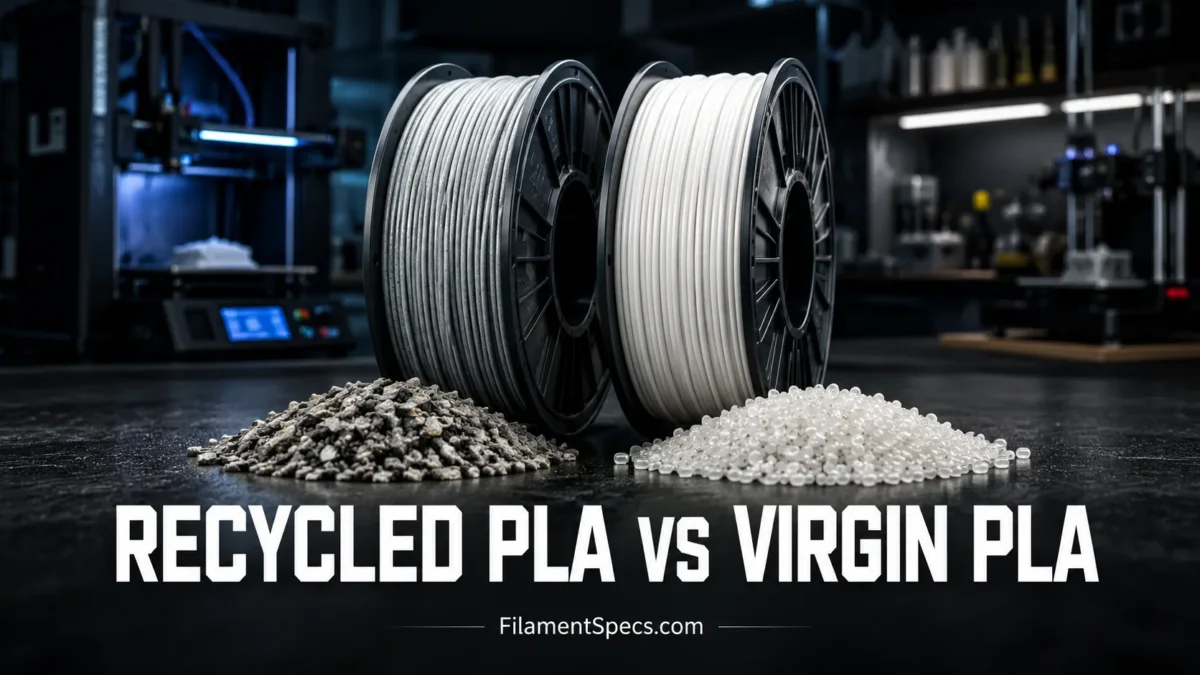
| Comparison Point | Recycled PLA | Virgin PLA | What It Means for Prints |
|---|---|---|---|
| Starting Material | Made from PLA scrap, failed prints, production leftovers, recycled pellets, or a blend of recycled and new resin. | Made from new PLA resin before it has gone through a previous melt-processing cycle. | The polymer family is still PLA, but recycled PLA carries more history from earlier processing. |
| Print Predictability | Can print very well when the feedstock is clean, dry, filtered, and extruded with tight diameter control. | Usually more predictable from spool to spool because the resin stream is easier to control. | Virgin PLA is the safer pick when repeatability matters more than material reuse. |
| Typical Nozzle Range | Often near standard PLA ranges, commonly around 190–220°C, but label guidance matters. | Often around 190–220°C for regular PLA, with PLA+ and high-speed blends sometimes asking for more. | Start with the spool label. If the recycled spool strings or looks under-bonded, tune in small steps. |
| Bed Temperature | Commonly 45–60°C, depending on brand, printer surface, and part footprint. | Commonly 45–60°C for everyday PLA printing. | The bed setting is usually not the big difference; filament dryness and flow stability matter more. |
| Strength Behavior | May be close to virgin PLA in controlled blends, yet repeated melt cycles can lower molecular weight and narrow the strength window. | Usually has a cleaner baseline for tensile strength, stiffness, and layer bonding. | For loaded brackets, clips, thin tabs, and functional prototypes, virgin PLA gives a wider safety margin. |
| Impact Behavior | Can become more brittle if the polymer has been overheated, wet during extrusion, or recycled too many times. | More consistent, although regular PLA is still a stiff and notch-sensitive material. | Neither option is a true impact material like TPU, nylon, or some engineered PLA+ blends. |
| Surface Finish | Can be clean and smooth, but mixed-color streams may show tiny specks, subtle streaking, or muted colors. | Usually easier to produce in bright, repeatable, color-matched shades. | For display pieces that must match across many spools, virgin PLA is easier to control. |
| Moisture Risk | Often needs more attention because recycled material may have seen storage, grinding, washing, and re-extrusion. | Still absorbs moisture, but the history is simpler and more controlled. | If either spool pops, strings, or prints with a rough surface, drying is the first diagnostic step. |
| Thermal Limit | Similar to PLA in general; recycled content does not make regular PLA heatproof. | Similar for regular PLA; heat resistance depends on grade, additives, crystallinity, and annealing. | Both can soften around the PLA glass-transition region, so hot-car or high-heat uses need caution. |
| Sustainability Profile | Reuses PLA that might otherwise become waste, but quality depends on sorting, drying, and controlled reprocessing. | Uses new resin, often from bio-based feedstocks, but it does not reuse existing printed waste. | Recycled PLA is attractive for draft parts, education, large non-load-bearing prints, and routine prototyping. |
| Best Fit | Draft prototypes, visual models, low-load organizers, jigs, teaching prints, fixtures, and large decorative parts. | Dimensional test parts, product prototypes, thin mechanical features, color-matched sets, and longer unattended jobs. | Use recycled PLA when reuse matters and the application has room for variation. Use virgin PLA when repeatability is the priority. |
Recycled PLA and virgin PLA are not two unrelated plastics. They are two material paths inside the same polymer family: polylactic acid, a thermoplastic polyester widely used in FFF/FDM printing because it flows at moderate nozzle temperatures, cools quickly, and is easier to print than many higher-temperature filaments.[a] The practical difference is not the three letters on the spool. It is the polymer history: virgin PLA starts from new resin, while recycled PLA has already lived at least one processing life.
That history can be harmless, well managed, or very visible. A carefully made recycled PLA filament can print clean models with stable extrusion. A poorly sorted or wet recycled blend can string, clog, vary in color, or feel slightly more brittle than expected. Virgin PLA is not automatically perfect either; it can include colorants, impact modifiers, fillers, and brand-specific additives. The label “virgin” only tells you the base resin was not previously used.
The useful question is simple: Which one is more suitable for the print in front of you? For many everyday parts, recycled PLA is a smart material. For tight tolerances, thin snap features, long production runs, and repeatable color, virgin PLA usually gives the cleaner baseline.
Table of Contents
Material Basics: What Recycled PLA and Virgin PLA Mean
Virgin PLA is made from new PLA resin before that resin has been turned into another product, ground down, remelted, or re-extruded. It can still be colored, compounded, blended, or modified. Natural virgin PLA is not the same thing as every branded PLA spool. A glossy red PLA+, a matte PLA, a silk PLA, and a high-speed PLA may all begin with virgin resin, yet behave differently because of additives.
Recycled PLA starts with PLA that already exists. The source may be factory filament waste, rejected spools, failed prints, support material, test purges, trimmed extrusion waste, or post-consumer PLA items. Some spools are 100% recycled PLA. Others are recycled-content blends, such as recycled PLA mixed with virgin PLA to stabilize melt flow, diameter control, and color.
Useful distinction: recycled PLA is about material origin. PLA+ is about formulation. A spool can be recycled PLA, virgin PLA, PLA+, matte PLA, silk PLA, or a blend of several ideas at once. Read the technical label, not only the front name.
The Polymer History Matters
PLA changes when it is exposed to heat, moisture, shear, and time. During melt processing, long polymer chains can become shorter. That process is often described as chain scission. Shorter chains can change viscosity, tensile behavior, and brittleness. Research on recycled PLA for 3D printing has linked repeated extrusion cycles with reduced molecular weight, which helps explain why recycled PLA quality depends so heavily on processing control.[b]
That does not mean recycled PLA is weak by default. It means recycled PLA is more process-sensitive. Clean feedstock, low moisture, careful extrusion temperature, filtration, and stable diameter control can make the difference between a reliable spool and a frustrating one.
- Post-industrial recycled PLA: usually easier to control because the material often comes from known production streams.
- Post-consumer recycled PLA: more variable because color, additives, labels, contamination, and unknown storage history may be involved.
- Recycled-content PLA blend: often balances reuse with more stable extrusion by mixing recycled and virgin material.
- Home-recycled PLA: possible for experienced users, but diameter control, drying, filtering, and sorting are hard to do consistently.
Print Quality and Filament Consistency
Print quality depends on a chain of small details: filament diameter, ovality, melt consistency, moisture level, pigment dispersion, spool winding, and how the printer handles flow. Virgin PLA usually has an advantage here because the manufacturer starts with a cleaner and more predictable resin stream. Recycled PLA can match it, but the manufacturer has more variables to control.
The first visible difference is often not strength. It is extrusion feel. A good recycled PLA spool should feed like normal PLA. It should not grind easily, vary in thickness, shed dusty particles, or require constant temperature changes across the same roll.
Recycled PLA Print Clues
- Possible tiny color specks from mixed feedstock
- Occasional matte or muted tone variation
- Higher need for drying if storage history is unknown
- More batch-to-batch variation when the brand gives little data
- Very good results when the filament is filtered, dried, and diameter-controlled
Virgin PLA Print Clues
- More predictable color matching across repeat orders
- Cleaner baseline for long jobs
- More consistent melt flow in standard grades
- Fewer unknowns from previous processing
- Still affected by moisture, poor winding, and weak formulation choices
Diameter Control Is More Important Than the Word Recycled
A recycled PLA spool with tight diameter control can print better than a low-grade virgin PLA spool with sloppy tolerance. The printer does not read marketing language. It pushes a strand through a drive gear, melts it, and expects predictable volume. If diameter changes too much, extrusion volume changes too.
- Good label signs: diameter tolerance, batch number, recommended nozzle range, bed range, drying note, recycled-content percentage, and feedstock type.
- Weak label signs: no tolerance data, no recycled-content percentage, no batch code, vague “eco” wording, and no print temperature guidance.
- Practical test: print a single-wall cube, measure wall thickness, and check whether the extrusion multiplier needs unusual correction.
Comparison Meters
These meters show typical tendencies for well-known PLA behavior. They are not lab scores for every spool.
Print Predictability
Material Reuse Value
Color Repeatability
Mechanical Behavior, Layer Bonding, and Brittleness
For normal desktop printing, the largest strength differences often come from print orientation, nozzle temperature, layer height, wall count, cooling, infill pattern, and part geometry. Material origin still matters, but it is only one part of the story. A well-tuned recycled PLA print can outperform a poorly sliced virgin PLA print. That happens often.
Where virgin PLA usually wins is mechanical repeatability. It has fewer unknowns in polymer chain length, additive carryover, pigment mix, and thermal history. Recycled PLA can be close, especially when it is made from controlled production scrap or blended with new resin, yet repeated recycling of PLA filament has been shown to affect molecular weight and mechanical performance in printed specimens.[c]
Tensile Strength
Tensile strength measures how much pulling force a specimen can take before failure. In PLA printing, tensile strength is strongly tied to layer orientation. A part pulled along continuous filament roads behaves differently from a part pulled across layer lines. Recycled PLA may show lower tensile strength when the polymer has degraded, but controlled recycled blends can still produce useful strength for everyday parts.
Layer Adhesion
Layer adhesion depends on how well each new strand fuses to the previous layer. Recycled PLA with lower molecular weight may flow more easily, which can help wet the previous layer, but too much degradation can reduce the final strength of the bonded material. The balance is narrow. A slightly hotter nozzle can improve bonding, but too much heat can add stringing, gloss change, or soft corners.
Impact Resistance
Regular PLA is stiff. It can crack under sudden bending, especially at sharp corners, screw holes, and thin snap clips. Recycled PLA may become more brittle if the feedstock had moisture, repeated heat exposure, or mixed unknown additives. For impact-prone parts, the better comparison may not be recycled PLA vs virgin PLA. It may be PLA vs PETG, TPU, nylon, PC blend, or a toughened PLA+ formulation.
| Printed-Part Need | Safer Choice | Reason |
|---|---|---|
| Draft prototype for shape checking | Recycled PLA | Material reuse is valuable, and small mechanical variation usually does not matter. |
| Thin latch or snap-fit tab | Virgin PLA or toughened PLA+ | Thin features punish brittleness and weak layer bonding. |
| Large visual model | Recycled PLA | Good use of recycled content if the finish is acceptable. |
| Color-matched product mockup | Virgin PLA | Color repeatability is usually easier across batches. |
| Small jig for light shop use | Either | Choose by load, heat exposure, and whether the spool has reliable diameter control. |
| Long unattended print | Virgin PLA or well-tested recycled PLA | Consistent winding, diameter, and melt flow reduce mid-print surprises. |
| Educational prints and classroom models | Recycled PLA | Reusable material story fits the use, and most parts are not mechanically demanding. |
Thermal Limits and Dimensional Stability
Regular PLA, whether recycled or virgin, has a modest heat limit. PLA can soften long before it melts. The glass-transition region is where the material begins to lose stiffness and act more rubbery. Many PLA grades sit roughly in the 55–65°C range for glass transition, while melting behavior is commonly much higher and depends on grade, crystallinity, stereochemistry, and formulation.[a]
This is why a PLA part can deform in a warm enclosed space even though it has not melted. Recycled content does not remove that limitation. Virgin PLA also keeps the same general weakness unless the material is a specialty heat-resistant grade and is processed correctly.
Annealing and Heat-Resistant PLA Are Separate Topics
Some PLA grades can gain heat resistance after annealing, but annealing can also shrink, warp, or distort a part. Recycled PLA may respond less predictably if the material contains mixed additives or has variable crystallinity. For precision parts, annealing should be tested with a spare print before using it on a final model.
Printer-safe note: do not assume a recycled PLA spool can handle more heat because it has been processed before. If a part will sit near a heater, inside a vehicle, behind a window, or near electronics that run warm, evaluate the actual use temperature before choosing PLA.
| Thermal Topic | Recycled PLA | Virgin PLA | Practical Note |
|---|---|---|---|
| Glass-transition behavior | Generally similar to PLA, but additives and processing history can shift behavior. | Generally similar to PLA, with grade-specific variation. | Both can soften in warm environments before melting. |
| Nozzle heat tolerance | May be more sensitive to overheating if molecular weight is already reduced. | Usually has more predictable melt behavior. | Avoid using extra heat as a cure for every extrusion issue. |
| Cooling response | May need tuning if the blend is more brittle or flows differently. | Often responds well to normal PLA fan settings. | Small cooling changes can affect overhangs, corners, and layer adhesion. |
| Annealing response | More testing needed because recycled streams may vary. | More predictable when the grade is known. | Measure shrinkage before using annealing on accurate parts. |
Moisture, Drying, and Melt Viscosity
Moisture is one of the easiest ways to misjudge recycled PLA. A wet spool can make a good material look bad. PLA is sensitive to hydrolysis during high-temperature processing; moisture and heat can shorten polymer chains. Recycled PLA may have more chances to pick up moisture during collection, grinding, washing, storage, or re-extrusion. That does not make it unusable. It makes drying discipline more valuable.
Virgin PLA can also arrive wet, especially after poor storage or long exposure to humid air. The difference is probability, not a hard rule. Dry filament before blaming the material.
Signs That PLA Needs Drying
- Popping, hissing, or tiny bubbles at the nozzle
- Rough, sandy, or foamy-looking extrusion
- Stringing that does not respond well to retraction tuning
- Weak layer bonding at normal PLA temperatures
- Matte patches appearing in an otherwise glossy filament
- Thin hair-like wisps on travel moves
Flow Changes in Recycled PLA
Melt viscosity is how thick or thin the polymer behaves once melted. If recycled PLA has lower molecular weight, it may flow more easily. That can look helpful at first: the printer may push it through the nozzle with less resistance. Too much flow change, though, can cause over-extrusion, glossy blobs, softer corners, or weak final parts.
Repeated extrusion studies on PLA show why this matters: recycling does not merely “reuse” a polymer in a neutral way. It can alter molecular weight, crystallinity, and mechanical behavior when processing is repeated.[b] Good filament makers manage this through controlled feedstock, stabilizing blends, drying, filtration, and process monitoring.
Small test before a large print: run a temperature tower, a stringing test, and a single-wall flow cube when opening an unfamiliar recycled PLA spool. This takes little material and can save a long print.
Sustainability, Recycling Limits, and Compostability Claims
Recycled PLA has a clear material-use benefit: it gives existing PLA another chance before disposal. That matters for failed prints, purge waste, test pieces, and production scrap. It also reduces demand for new resin in that spool. The benefit is strongest when the recycled feedstock is clean, local or efficiently collected, and processed with good quality control.
Still, recycled PLA is not an infinite loop. Each melt-processing cycle can change the polymer. Sorting also matters. A small amount of PETG, ABS, TPU, adhesive, paint, dust, metal, paper label, or unknown additive can affect extrusion. For filament, recycling is not only about melting plastic again. It is about clean material identification.
Recycled Does Not Automatically Mean Compostable
PLA is often discussed as bio-based and compostable, but printed PLA parts should not be treated as automatically compostable. Compostability depends on the finished item, additives, thickness, local facility rules, and certified testing. ASTM D6400 covers plastics and plastic products designed to compost under aerobic municipal or industrial composting conditions where thermophilic conditions are achieved.[d]
A spool labeled PLA does not mean every print made from it is accepted by a composting facility. A recycled PLA spool also does not become more compostable because it has recycled content. These are separate claims: recycled content describes origin; compostability describes end-of-life behavior under defined conditions.
| Term | What It Means | What It Does Not Prove |
|---|---|---|
| Recycled PLA | The spool contains PLA that has been reused from a previous material stream. | It does not prove strength, compostability, or purity by itself. |
| Virgin PLA | The PLA resin was newly produced before filament extrusion. | It does not mean additive-free, food-safe, or stronger in every printed geometry. |
| Bio-Based PLA | The resin is made from renewable feedstock routes such as plant-derived sugars. | It does not mean home-compostable or accepted in local recycling bins. |
| Compostable | The finished product has to meet defined test and labeling requirements. | It is not a general claim for every 3D printed PLA object. |
| Recyclable | The material can technically be reprocessed under the right conditions. | It does not mean curbside recycling will accept mixed 3D printer scraps. |
Why Home Recycling Is Harder Than It Looks
Grinding failed prints and turning them into filament sounds simple. The hard parts come later: keeping material types separate, removing dust, drying flakes, avoiding overheated zones, filtering debris, controlling filament diameter, cooling evenly, and winding without tension problems. A desktop recycler can be useful for makerspaces and heavy users, but the output still needs measurement.
- Sorting: PLA should not be mixed with PETG, ABS, TPU, filled filaments, or painted parts.
- Drying: flakes need careful drying before extrusion, not only before printing.
- Filtering: tiny debris can cause partial clogs in small nozzles.
- Diameter control: 1.75 mm filament needs stable pull speed, cooling, and measurement.
- Testing: each batch should be printed and measured before important jobs.
Print Settings for Recycled PLA vs Virgin PLA
For regular PLA, recycled and virgin spools often start in the same general setting range. The difference is how quickly you should verify the spool. Virgin PLA can usually begin from your normal PLA profile. Recycled PLA deserves a small calibration pass, especially if it is from a new brand or a recycled-content percentage is not listed.
| Setting Area | Recycled PLA Starting Approach | Virgin PLA Starting Approach | Adjustment Logic |
|---|---|---|---|
| Nozzle Temperature | Start at the label midpoint; raise 5°C if layers look weak, lower 5°C if stringing and blobs appear after drying. | Start from your usual PLA profile or the label midpoint. | Do not chase wet-filament symptoms with high heat alone. |
| Bed Temperature | 45–60°C is a common starting range for regular PLA surfaces. | 45–60°C is a common starting range for regular PLA surfaces. | Use the surface maker’s guidance for textured PEI, smooth PEI, glass, or coated beds. |
| Cooling Fan | Use normal PLA cooling, then reduce slightly if layer bonding looks weak. | Use normal PLA cooling for clean overhangs and bridges. | More fan improves detail but can reduce bonding on small, fast layers. |
| Flow Rate | Check with a single-wall cube because melt viscosity may differ from standard PLA. | Your existing PLA flow value may work. | Measure before changing many slicer values at once. |
| Retraction | Tune after drying. Wet recycled PLA can mimic poor retraction. | Tune normally if stringing appears. | Dry first, then adjust retraction distance and speed. |
| Speed | Moderate speed helps reveal whether flow is stable before pushing high-speed profiles. | Can often use established PLA speed profiles. | High-speed printing magnifies flow inconsistency. |
A Sensible Calibration Order
Do not change ten settings at once. Recycled PLA troubleshooting becomes messy when temperature, flow, cooling, and retraction are all adjusted together.
- Dry the spool if it shows moisture symptoms or has unknown storage history.
- Print a small temperature tower within the brand’s recommended range.
- Print a single-wall cube and check wall thickness.
- Print a small overhang or bridging test to tune cooling.
- Print the real part in a small version or low-height section before committing to a large job.
One clean rule: use recycled PLA for parts where a little variation is acceptable. Use virgin PLA when the same model must print the same way across many spools, many days, or many printers.
When Recycled PLA Is the Better Choice
Recycled PLA makes the most sense when the part benefits from material reuse and does not need a strict mechanical guarantee. It is especially good for prints where function is simple, geometry is forgiving, and visual perfection is not tied to exact brand color.
- Concept models and early prototypes
- Large decorative prints where small color variation is acceptable
- Classroom and makerspace prints
- Low-load organizers, trays, spacers, and labels
- Test coupons, fit checks, and draft assemblies
- Temporary fixtures and light-use jigs
- Cosplay base forms that will be sanded, filled, or painted
A high-quality recycled PLA spool is also a good daily material for users who already know their printer. Once the profile is tuned, it can become a normal workhorse filament. The first spool needs attention. The second spool from the same batch usually needs less.
When Virgin PLA Is the Better Choice
Virgin PLA is the safer choice when the material must remove as many unknowns as possible. That does not mean every virgin spool is premium. It means the starting resin stream is usually easier for the manufacturer to keep uniform, which helps print-to-print repeatability.
- Repeatable product prototypes
- Color-matched display models
- Small parts with thin walls or narrow clips
- Long unattended prints where a mid-print issue wastes many hours
- Mechanical comparison tests where the filament variable should stay stable
- Parts that will be measured with calipers and compared across revisions
- Print farms that need predictable spool-to-spool behavior
Virgin PLA is also easier to document. If a project needs material records, batch control, or a cleaner technical baseline, a virgin PLA spool with a data sheet is often simpler to justify than a recycled spool with limited feedstock detail.
Buying Notes: What to Check on the Spool
A good recycled PLA label should be specific. The more the brand explains, the easier it is to trust the spool. Vague claims are less useful than numbers.
| Label Detail | Why It Matters | Stronger Wording to Look For |
|---|---|---|
| Recycled Content Percentage | Shows how much of the spool is actually recycled material. | “70% recycled PLA content” is clearer than “eco PLA.” |
| Feedstock Type | Post-industrial and post-consumer sources have different variation risks. | “Post-industrial PLA production scrap” gives useful context. |
| Diameter Tolerance | Directly affects extrusion volume and print consistency. | Look for a stated tolerance such as ±0.02 mm or ±0.03 mm when available. |
| Batch Number | Helps repeat results and track spool behavior. | Batch codes are useful for print farms and repeat buyers. |
| Drying Guidance | Shows the brand understands moisture control. | Clear time and temperature guidance is more helpful than “keep dry.” |
| Recommended Settings | Reduces guesswork during first prints. | Nozzle, bed, fan, and speed guidance should be listed. |
| Material Data Sheet | Gives a better view of mechanical and thermal behavior. | Even a basic data sheet is better than no technical data. |
Red Flags Without Harsh Judgement
Some recycled PLA spools are made for low-cost draft printing rather than controlled engineering work. That is not a problem if the label is honest. The trouble starts when a spool gives no information but asks the user to assume premium behavior.
- No recycled-content percentage
- No material type beyond “recycled plastic”
- No diameter tolerance
- No recommended temperature range
- No drying note
- No batch identifier
- No support response from the maker or seller
Final Selection by Print Goal
The cleanest way to choose is not to ask which material is morally better or technically superior in every case. Ask what the part needs.
| Print Goal | Choose Recycled PLA If | Choose Virgin PLA If |
|---|---|---|
| Reduce material waste | The part is low-load and cosmetic variation is acceptable. | The part must match a previous material record or color. |
| Print a precise prototype | You have already tested the recycled spool and it holds tolerance well. | You need predictable dimensions from the first attempt. |
| Make display parts | Minor specks or muted colors are acceptable, or the part will be painted. | Bright color, gloss, and repeatable finish matter. |
| Run many copies | The recycled batch has been tested and enough matching spools are available. | Spool-to-spool consistency matters for production flow. |
| Print functional PLA parts | The load is light, geometry is thick, and the spool passes test prints. | The part has thin clips, screw stress, or narrow safety margins. |
FAQ
Is recycled PLA weaker than virgin PLA?
Not always. Well-made recycled PLA can print strong everyday parts, especially when the feedstock is clean and the filament is properly dried and extruded. Virgin PLA usually has a more predictable baseline. Recycled PLA is more likely to vary if the polymer has gone through repeated heat cycles, moisture exposure, or poor sorting.
Does recycled PLA print at the same temperature as virgin PLA?
Usually it starts in the same general PLA range, but the exact temperature depends on the brand and formulation. Begin with the label range. If bonding is weak, raise the nozzle slightly. If the print strings or blobs after drying, lower the nozzle slightly or tune retraction.
Is recycled PLA more likely to clog?
It can be, but only when filtering, sorting, or diameter control is poor. Good recycled PLA should not clog a normal nozzle more than standard PLA. Mixed particles, dust, degraded material, or inconsistent diameter can raise clog risk, especially with small nozzles.
Can recycled PLA be used for functional parts?
Yes, for light-duty functional parts with forgiving geometry. Use thicker walls, rounded corners, proper nozzle temperature, and enough perimeters. For thin clips, loaded brackets, screw bosses, or repeatable mechanical testing, virgin PLA or a tougher engineering filament is usually the safer choice.
Is virgin PLA always pure PLA?
No. Virgin PLA means the base resin was newly produced, not previously recycled. It may still contain pigments, nucleating agents, impact modifiers, flow modifiers, matte additives, silk-effect additives, or fillers. Always compare the spool type and data sheet, not only the word virgin.
Is recycled PLA better for the environment?
It can reduce demand for new resin and reuse existing PLA waste, which is useful. The full answer depends on collection, sorting, transport, drying, extrusion energy, and how many failed prints the material creates. A reliable recycled PLA spool that prints successfully is more valuable than a poorly made spool that causes waste.
Is recycled PLA compostable?
Recycled content and compostability are different claims. PLA-based products need proper testing and acceptance by suitable composting facilities before they should be treated as compostable. A 3D printed object made from recycled PLA should not be assumed to be compostable just because the base polymer is PLA.
Which one should beginners buy?
Beginners who want fewer variables should start with a reliable virgin PLA or a well-reviewed recycled PLA from a brand that lists diameter tolerance and settings. Once the printer profile is stable, recycled PLA becomes easier to evaluate because printing problems are less likely to be confused with machine setup problems.
References Used for This Article
- Critical Review on Polylactic Acid: Properties, Structure, Processing, Biocomposites, and Nanocomposites — Used for PLA chemistry, general property context, and thermal behavior. (NIH PubMed Central hosts peer-reviewed open-access scientific articles.)
- Recycled PLA for 3D Printing: A Comparison of Recycled PLA Filaments and Films — Used for repeated extrusion effects, viscosity, diffusion, and molecular-weight discussion. (NIH PubMed Central hosts peer-reviewed open-access scientific articles.)
- Thermal and Mechanical Degradation of Recycled Polylactic Acid Filaments for Three-Dimensional Printing Applications — Used for the relationship between successive recycling, molecular weight, and mechanical behavior in PLA filament. (NIH PubMed Central hosts peer-reviewed open-access scientific articles.)
- ASTM D6400-23 Standard Specification for Labeling of Plastics Designed to be Aerobically Composted in Municipal or Industrial Facilities — Used for compostability-scope language related to municipal and industrial aerobic composting. (ASTM International is a long-established standards organization.)
- Mechanical Property Characterization of Virgin and Recycled Polylactic Acid Filaments for Additive Manufacturing — Used for recycled and virgin PLA filament comparison context in additive manufacturing. (NIH PubMed Central hosts peer-reviewed open-access scientific articles.)