
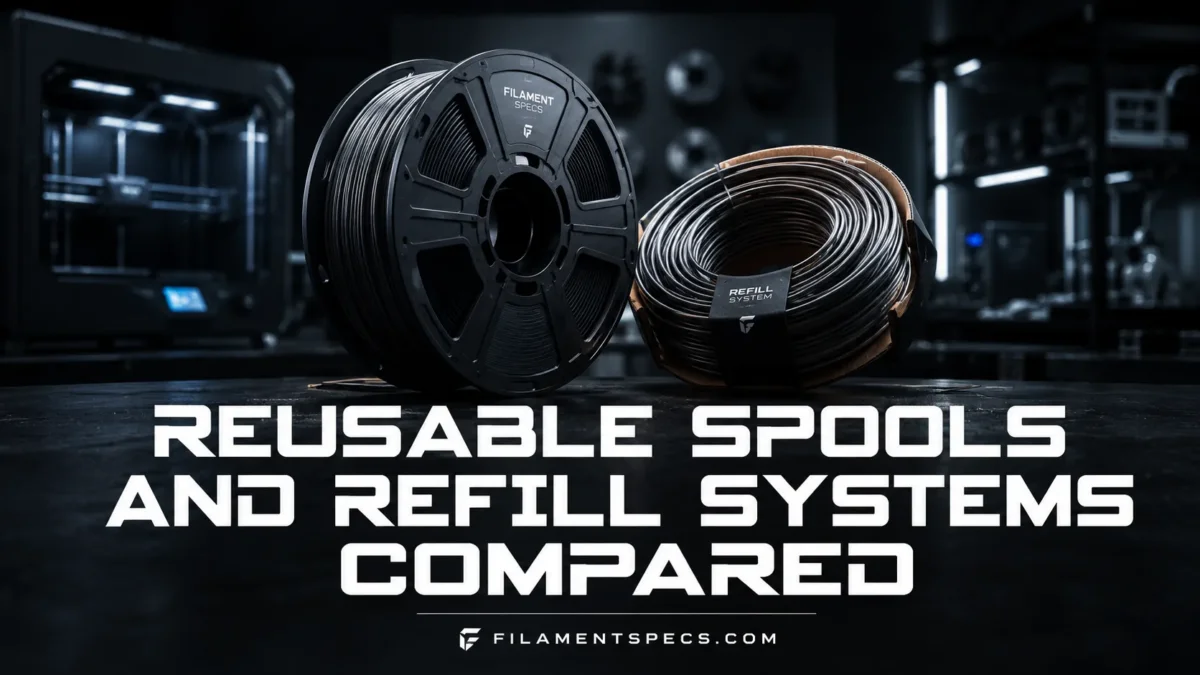
Reusable spools and refill systems both reduce how often a 3D printing user buys a full throwaway spool, but they do it in different ways. A reusable spool is the physical holder that keeps filament round, supported, and easy to feed. A refill system is the packaged filament bundle that is loaded onto that holder. The two are often sold together, yet they are not the same thing. That distinction matters for storage, drying, multi-material systems, shipping weight, and day-to-day handling.
| Comparison Area | Reusable Spool | Refill System | Practical Reading |
|---|---|---|---|
| Main purpose | A durable spool body used again and again. | A spoolless filament coil or cardboard-core refill that mounts onto a reusable body. | The spool is the holder; the refill is the filament supply. |
| Typical format | Two flanges, a center hub, and a locking or snap-fit mechanism. | Filament wound as a restrained coil, often held with bands, tape, or a light core. | The refill must stay restrained until it is secured on the spool. |
| Common size target | Many desktop systems aim near a 200 mm outside diameter and about 50–70 mm width, but there is no single universal desktop spool size. | Usually designed for one spool ecosystem or a compatible printable master spool. | Measure diameter, width, hub hole, flange lip, and side clearance before buying. |
| Spool body weight | One current manufacturer specification lists a 250 g reusable spool with 200 × 200 × 67 mm packing size.[b] | The refill itself avoids shipping a new rigid spool body, although bands, labels, bags, and boxes may still be present. | Repeated use is where the weight saving becomes meaningful. |
| Waste profile | Lower waste only when the same spool is reused many times. | Reduces rigid spool waste per kilogram of filament, especially for frequent users. | The waste reduction grows as the same spool body is used across more refills. |
| Printer feeding | Usually more stable once assembled because the flanges and hub are rigid. | Depends on how neatly the coil was wound and how carefully it was mounted. | A rushed refill installation can create crossing, snagging, or loose loops. |
| Multi-material units | Better when the spool has consistent outside diameter, firm flanges, and enough weight near the end of the roll. | Works well only if the assembled spool stays within the feeder’s size and friction limits. | Automatic filament systems care about geometry as much as filament type. |
| Drying and storage | Best when the spool material can handle the intended drying temperature. | Refills with cardboard or paper parts need more care around heat and moisture. | Nylon, PC, and filled materials make spool heat resistance more important than PLA does. |
| Labeling | The spool can outlive many materials, so labels must be updated. | Refills often include a small material label or batch sticker. | Move the label to the spool side before storage. |
| Inventory control | Good for farms and repeat material buyers. | Good for reducing spare empty spools and shelf clutter. | Best value appears when the same diameter, material family, and supplier are bought often. |
What Reusable Spools and Refills Actually Change
A normal filament purchase combines two things: the thermoplastic filament and the spool that carries it. Reusable spool systems split those jobs. The filament path still depends on diameter control, winding quality, surface finish, material dryness, and printer settings. The spool system mainly changes handling, packaging, storage, and feeding geometry.
In desktop material extrusion printing, the printer pulls filament from a supply, melts it, and deposits it through a nozzle. ASTM’s additive manufacturing standards page describes standards as tools for terminology, process performance, quality, and machine calibration, which is why spool systems should be treated as part of the material-handling chain rather than as a separate decoration.[a]
Plain meaning: a refill system does not make PLA stronger, PETG clearer, or nylon drier by itself. It changes how that filament is packaged, loaded, tracked, and fed.
Reusable Spool
A reusable spool is usually a two-piece or three-piece holder. It has side flanges to stop filament from sliding off, a center hub to carry the coil, and a locking method that keeps the spool closed while the printer pulls filament. Some are injection-molded. Some are printed at home. Some use screws. Others twist or snap together.
The main benefit is repeatable geometry. Once a spool body works well in a printer, dryer, dry box, or multi-material feeder, the user can keep that same geometry and change only the filament refill.
Refill System
A refill system is the filament product. It normally arrives as a tightly controlled coil. The coil may be wrapped with straps, tied with paper bands, wound around a cardboard core, or packed inside a sealed bag with desiccant. The refill is mounted onto the reusable spool before the restraining bands are cut.
That last part is not optional. Loose filament remembers the shape of the coil. Cut the straps too early and the bundle can expand, twist, or cross over itself. It may still look tidy for a moment. Then the print reaches the hidden loop.
Spoolless Does Not Mean Unsupported
The word spoolless can be misleading. A refill may ship without a permanent plastic spool, but it still needs a stable holder during printing. The holder can be an official reusable spool, a printed master spool, a dry-box roller with side control, or a feeder-specific cartridge. Unsupported filament coils are not a reliable feeding method for long prints.
Size, Fit, and Spool Geometry
Spool geometry matters because many printers do not only “hold” the spool. They guide it, rotate it, weigh it down, push against its flanges, or read its side clearance inside an enclosed feeder. A refill that fits one open spool holder can still rub inside another printer.
Measurements That Matter
- Outside diameter: the diameter measured across the widest circular edge of the spool.
- Spool width: the distance between the outer faces of the flanges.
- Hub hole: the center opening that sits on a rod, roller, or feeder mount.
- Core diameter: the inside support around which the filament coil is wound.
- Flange shape: round, sharp, raised, thin, thick, or textured.
- Side stiffness: how well the spool resists bending when the feeder pulls.
Many 1 kg desktop spools sit near the 200 mm outside-diameter range, and many fall around 50–70 mm wide. That is a pattern, not a legal standard. A few millimeters can decide whether a spool rubs, tilts, or fits cleanly inside a dry box.
One manufacturer’s refill documentation describes a reusable-spool approach in which plastic sides are removed from an empty spool, attached to the refill, and only then are the restraining strips cut.[c] That sequence shows why mechanical fit is part of the product, not an afterthought.
Why Multi-Material Feeders Are Pickier
Open spool holders are forgiving. A spool can be wider, lighter, or slightly uneven and still print. Enclosed multi-material feeders are less forgiving because they may have narrow spool bays, fixed rollers, lid clearance, filament buffers, rewind movement, or side contact points. The spool must rotate smoothly while the printer pulls and sometimes reverses the filament.
Three fit problems show up often:
- Too wide: the spool touches the side wall, feeder lid, or adjacent spool.
- Too light near empty: the spool jumps, slips, or unloads unevenly.
- Too much flange drag: cardboard edges, rough printed parts, or warped sides add friction.
Printed Master Spools Need Better Tolerances Than They Seem
A printed master spool can work very well, but the print itself becomes part of the feed system. Layer lines, elephant’s foot, poor screw alignment, or a slightly oval center hole can add resistance. For slow prints this may go unnoticed. For high-speed retractions or filament swaps, it can matter.
A good printed spool has clean mating faces, a round hub, smooth flange edges, and enough stiffness to keep the refill coil centered. PETG or ASA can be useful for a spool that may see dryer warmth. PLA can work for low-temperature storage, but it is less comfortable around higher dryer settings.
Waste, Weight, and Packaging Difference
The environmental value of refill systems comes from repetition. Buying one refill instead of one spooled roll removes one rigid spool body from that purchase. Buying many refills through the same spool body compounds the effect.
Plastic packaging is not a tiny category in general waste data. The U.S. EPA reports that plastic containers and packaging accounted for more than 14.5 million tons of plastic generation in 2018, and it reports an 8.7% recycling rate for plastics overall in that same dataset.[d] Filament spools are only a narrow slice of that larger packaging picture, but the same logic applies: reduce unnecessary rigid plastic when reuse is practical.
| Item | Normal Spooled Roll | Refill-Based Roll | What Still Remains |
|---|---|---|---|
| Rigid spool body | New with each roll. | Reused from earlier purchases. | Only replaced if damaged, warped, lost, or incompatible. |
| Cardboard box | Often present. | Often still present. | Shipping and shelf protection usually still need outer packaging. |
| Plastic bag or vacuum pack | Common for moisture control. | Common for moisture control. | Dry materials still need moisture protection. |
| Desiccant | Common. | Common. | Reusable drying packs can reduce waste if the supplier or user supports them. |
| Labels and ties | Spool label, box label, sometimes side stickers. | Material label, retaining strips, batch sticker. | The refill needs enough labeling to remain traceable. |
The EU Packaging and Packaging Waste Regulation (PPWR) now generally applies from 12 August 2026. It sets requirements for packaging placed on the EU market, including rules on when packaging can be treated as reusable.[h] For filament buyers, the environmental value of a reusable spool still depends on whether the spool is actually used through repeated refill cycles rather than replaced after only a small number of rolls.
EU Reuse Rules From August 2026
A filament spool that can physically be opened and used again is not automatically “reusable packaging” under the PPWR. Article 11 sets several conditions for that legal classification. Packaging must be conceived and designed for repeated use and multiple rotations, remain safe during reuse, be capable of being emptied and refilled or reloaded without losing its function, be capable of reconditioning where applicable, and meet the Regulation’s recyclability requirements when it eventually becomes waste.[h]
That distinction matters for refill systems. A durable master spool designed around repeated refill cycles may fit the practical idea of reuse, but the PPWR assessment depends on the specific packaging design and the reuse system around it. Simply calling a product “reusable,” or showing that a user can reload it at home, does not by itself establish compliance with Article 11.
The Regulation also does not set one universal rotation number for every reusable package. Article 11 requires the European Commission to adopt a delegated act by 12 February 2027 establishing minimum rotation numbers for packaging formats most frequently used in reuse, taking hygiene, logistics, and other requirements into account.[h] The Commission’s 2026 implementation guidance confirms that Article 11 criteria are part of the PPWR rules now being applied, while the minimum-rotation work remains on that delegated-act timetable.[i]
Engineering reuse and legal reuse are not identical tests. A filament spool may survive dozens of refill cycles mechanically, but whether it qualifies as reusable packaging under the PPWR depends on the Article 11 conditions and the packaging format involved.
The Real Reduction Is Rigid Plastic Per Kilogram
A reusable spool does not erase every form of packaging. It mainly targets the largest rigid plastic part attached to many filament purchases: the spool body. Refill systems may still use a bag, a small label, a paper core, and a shipping box. That is normal.
The fair comparison is not “zero packaging” versus “packaging.” The fair comparison is new spool every roll versus one spool body used across many rolls.
When the Waste Saving Shrinks
The saving becomes smaller when a refill needs adapters, a new printed spool for every supplier, extra tape, failed mounts, or a replacement spool after only a few cycles. It also shrinks when users buy refills for materials they rarely print, because the reusable spool may sit occupied for months.
Busy users see the clearest value: print farms, school labs, makerspaces, small shops, and anyone who buys the same filament families again and again.
Feeding Behavior and Print Reliability
Feeding reliability is where reusable spools and refill systems either feel smooth or become annoying. The filament itself may be excellent, but a badly mounted coil can still cause a print pause. The spool system has to preserve the winding order.
Reusable Spool: Handling Strength
Refill System: Handling Sensitivity
Tangles Usually Begin Before Printing
A true factory winding defect is possible, but many refill tangles start during loading. The coil is restrained for a reason. If the refill bands are cut before the spool sides are locked, the filament can spring outward. A single hidden crossover can wait quietly for hours.
Consistent loading habits help prevent that problem:
- Place the refill flat on the spool side.
- Keep all retaining bands in place while aligning the center.
- Close the second spool side fully.
- Confirm that the coil cannot slip between the hub and the flange.
- Cut the bands only after the spool is locked.
- Feed the filament end without letting the outer loops loosen.
Flange Quality Affects Low-Filament Printing
Near the end of a roll, the spool becomes lighter. Some feeders pull more sharply during retraction or filament switching, so a light spool can hop on rollers. A rigid reusable spool helps here, but only if the hub and flanges stay aligned.
Printed spool halves should be checked for wobble. Injection-molded spool halves should be checked for broken tabs. Cardboard-edge refills should be checked for fibers, crushed edges, or any deformation that can rub inside a feeder.
Refill Winding Tension Matters
Filament should unwind with steady resistance. Too loose and loops can fall over each other. Too tight and the coil can bite into itself. Refill systems place extra trust in the factory winding because the user does not receive a permanent spool holding every layer in place from the start.
A neat refill has even side walls, no bulging loops, no crushed edge, and a clear filament end. If a refill arrives loose, handle it as a delicate coil, not as a finished spool.
Drying, Storage, and Material Match
Reusable spool choice becomes more important as filament drying temperature rises. PLA is usually easy on spool hardware. PETG needs more care. Nylon, PC, some ASA blends, and fiber-filled materials can push users toward higher drying temperatures and longer drying cycles.
Some refill documentation separates ordinary detachable spools from spools used for advanced materials, noting that certain spool sides may be glued because some filaments require higher drying temperatures.[c] The message is clear: spool material must match the filament routine.
| Filament Family | Reusable Spool Concern | Refill Concern | Storage Reading |
|---|---|---|---|
| PLA | Low heat demand; many spool bodies are fine for normal room storage. | Refill handling is usually the main risk, not heat. | Keep dry and labeled; avoid hot enclosed spaces. |
| PETG | Moderate drying habits make spool heat resistance more relevant. | A loose coil can be harder to recover because PETG can be springy. | Store sealed with desiccant after drying. |
| ABS / ASA | Dryer warmth and enclosure storage can favor heat-resistant spool bodies. | Check that the refill core and labels tolerate the intended storage routine. | Keep away from moisture and dust; label material clearly. |
| Nylon / PA | Spool body must tolerate repeated drying cycles. | Refills need sealed storage soon after opening. | Moisture control matters every day, not only before printing. |
| PC and High-Temperature Blends | Choose spool bodies intended for warmer drying conditions. | Do not assume a paper-core refill belongs in the same dryer routine as the polymer. | Use the filament maker’s drying data first. |
| Carbon-Fiber or Glass-Fiber Filled | Strong spool sides help prevent friction and uneven pulling. | Stiffer filament can punish loose winding more quickly. | Keep sealed; avoid abrasive dust near feed gears. |
Do Not Treat the Spool Like the Filament
A filament may tolerate a drying temperature that the spool, core, label, or adhesive does not. That small mismatch can warp a spool, loosen a hub, shrink a printed part, or release a label into the filament path. The spool is hardware. Treat it like hardware.
Drying rule: use the lower safe limit when the filament, spool, refill core, and label do not share the same heat rating.
Refills Need Better Label Discipline
Once a refill is mounted, the original bag and box may be gone. The spool may look identical to the last material that was on it. This is where mistakes happen: PLA printed at PETG settings, PETG dried like nylon, or a fiber-filled material loaded into a nozzle that is not ready for abrasion.
Move the batch label onto the spool. Add material, color, diameter, nozzle notes, and opening date.
Smart Spools, NFC, and OpenPrintTag
A reusable spool solves the physical packaging problem. A smart-spool tag solves a different problem: keeping the material identity and remaining amount attached to a spool that may be refilled many times. OpenPrintTag is an open-source, rewritable NFC format designed to store spool data locally rather than using the tag only as a fixed product identifier.[g]
| Identification Method | Data Location | Can It Be Updated? | Best Use | Main Limit |
|---|---|---|---|---|
| Paper label | Printed or handwritten on the spool. | Yes, by replacing or editing the label. | Low-cost storage and manual inventory. | The printer and slicer cannot read it automatically. |
| QR code linked to a web record | Code on the spool; details may live online. | Depends on the linked system. | Opening a product page, batch record, or refill form. | The code may identify the product without tracking the current remaining amount. |
| Proprietary RFID | Vendor-controlled tag data or identifier. | Often limited by the vendor’s implementation. | Automatic recognition inside a supported printer ecosystem. | Cross-brand reading and rewriting may be restricted. |
| OpenPrintTag NFC | Material, color, and live spool data are stored on the rewritable tag. | Yes, with compatible hardware or software. | Refills, reusable spools, offline identification, and cross-brand development. | Automatic use still requires a compatible reader, printer, app, or slicer. |
The tag must follow the material, not the plastic spool sides. When a spool is refilled, update the material type, color, starting amount, and any available batch data. A reusable tag carrying old PLA data on a new PETG refill is more misleading than a plain handwritten label.
Data Worth Keeping on a Refillable Spool
- Material family and exact grade or blend
- Color and manufacturer
- Nominal diameter and starting net weight
- Estimated remaining filament
- Drying state or last drying date when the workflow supports it
- Nozzle, abrasion, or temperature notes that should not be lost when the outer box is discarded
NFC data should support the label rather than erase it. A visible material name and color remain useful when a phone, reader, printer, or software integration is unavailable.
Refill Formats Compared
Not all refill systems behave the same. Some are built around one maker’s spool. Some are broadly compatible with popular reusable spools. Some depend on printed master spools. A few are simply spoolless coils that need careful user support.
| Refill Format | How It Works | Main Strength | Main Caution |
|---|---|---|---|
| Detachable-side refill | Plastic spool sides are removed from an earlier spool and pushed onto a new filament refill. | Simple reuse path when the buyer stays inside that spool family. | Not every spool side is meant to be detached. |
| Reusable master spool | A dedicated spool body accepts compatible refill coils. | Good for repeated buying and organized storage. | Core diameter and flange width must match the refill. |
| Cardboard-core refill | The filament ships around a light core and mounts onto a compatible reusable spool. | Reduces the need for a new rigid plastic spool body. | Cardboard can be affected by moisture, edge crush, and feeder friction. |
| Printable spool ecosystem | The user prints the spool body and loads compatible refills onto it. | Flexible, repairable, and easy to duplicate in a print farm. | Print quality, material choice, and screw fit decide reliability. |
| Loose refill coil | The filament arrives as a restrained coil with minimal core support. | Lowest hardware in the package. | Highest handling sensitivity during mounting. |
Spectrum’s refill page describes refill filament wound onto a cardboard core and states compatibility with reusable spools and printable spool options.[f] That kind of hybrid model is becoming common: keep the filament protected during shipping, then let the user provide the durable holder.
Refill Systems Are Most Useful When Compatibility Is Boring
A refill system should not make each roll feel like a small engineering project. The easier it is to load, label, dry, and feed, the more likely users are to stay with it.
Look for clear dimensions, a known spool model, a stable loading method, and simple reorder choices. Compatibility should be written down, not discovered halfway through a print.
Cost, Inventory, and Shop Workflow
Refills are often bought for waste reduction, but the workflow value can be just as important. A shelf of reusable spools gives a shop known geometry. Refills reduce empty spool clutter. Material tracking becomes cleaner when labels are handled well.
Simple Payback Math
Reusable spool payback can be estimated with this plain formula:
Payback rolls = reusable spool price ÷ price difference per refill
If a refill saves only a small amount per roll, the spool pays back slowly. If the refill is cheaper and the spool is used often, the payback arrives sooner. Prices change often, so the formula is more useful than one fixed number.
Who Benefits Most
- Print farms: fewer empty spools, more repeatable feeder geometry, cleaner storage.
- Makerspaces: easier standardization when many users load the same machines.
- Schools and labs: less storage clutter and better material tracking with clear labels.
- High-volume hobby users: lower spool waste across repeated PLA, PETG, or ASA purchases.
- Occasional users: benefit depends on whether the refill stays dry and compatible while waiting.
When a Normal Spooled Roll Still Makes Sense
A normal spooled roll can be the cleaner choice when testing a new material, buying a one-off specialty color, using a printer with tight spool-bay rules, or printing a hygroscopic material that needs the maker’s original heat-safe spool and label system.
This is not a failure of refills. It is normal inventory logic. Use the format that protects the print.
Buying Checks Before Switching
The smartest refill purchase happens before checkout. A few measurements can prevent rubbing, wobble, and dry-box problems later.
- Check spool bay width
- Measure the printer holder, dry box, or multi-material unit, not only the old spool.
- Check outside diameter
- Leave space for rotation, lid clearance, and any rollers or guides.
- Check hub hole and mount type
- Some holders use a center rod; others use edge rollers. They stress the spool differently.
- Check dryer temperature
- The spool body, refill core, label, and filament should all tolerate the planned drying routine.
- Check label transfer
- Material, color, diameter, batch, and drying notes should stay with the spool after loading.
- Check refill restraint
- Do not buy refills that arrive loose, unprotected, or poorly described.
Useful Measurements to Record
- Empty reusable spool weight.
- Outside diameter.
- Overall width.
- Hub hole diameter.
- Dryer-safe temperature rating, if provided.
- Which printers, dry boxes, and feeders accept it.
Recording the empty spool weight also helps estimate remaining filament. Weigh the spool with filament, subtract the known empty spool weight, then compare the remaining mass with the slicer estimate. It is not perfect because labels and dust add tiny differences, but it is useful for long prints.
Which System Fits Which User
| User Situation | Better Fit | Reason |
|---|---|---|
| First roll of a new material | Normal spooled roll | Lower compatibility risk while testing print settings and storage behavior. |
| Repeat PLA or PETG buying | Reusable spool plus refills | Same geometry, less rigid spool waste, cleaner shelf control. |
| Enclosed multi-material unit | Reusable spool with verified dimensions | Feeder clearance and rolling behavior matter more than packaging style. |
| High-temperature drying routine | Heat-rated reusable spool | Spool body and refill core must survive the drying process. |
| Shared makerspace | Standardized reusable spool set | Reduces random spool sizes and makes material tracking easier. |
| Rare specialty color | Either format | Choose based on storage time, label clarity, and whether the refill system will be reused. |
The most dependable setup is not the most complicated one. It is the one that fits the printer, survives the drying routine, keeps the filament labeled, and loads without disturbing the coil.
FAQ
Are reusable spools and refill systems the same thing?
No. A reusable spool is the holder. A refill system is the filament package that loads onto the holder. They work together, but each one has its own compatibility rules.
Do refills print differently from normal spooled filament?
The refill format does not change the polymer by itself. Print behavior depends on filament diameter, winding quality, material formulation, moisture level, storage, and printer settings.
Can a refill be printed without a spool?
It should be supported by a spool, master spool, cartridge, or controlled dry-box holder. A loose coil can expand or cross over itself, which may cause feeding trouble during longer prints.
Are cardboard-core refills safe for automatic filament systems?
They can work when the final assembled spool fits the feeder and rotates smoothly. The feeder’s width, diameter, flange contact, and dust sensitivity matter. Always check the system’s spool-size limits first.
Is a printed master spool reliable enough?
Yes, when it is printed accurately, assembled firmly, and made from a material suited to the storage and drying routine. Poorly printed hubs, warped flanges, or rough edges can add feeding resistance.
How many times can a reusable spool be used?
There is no universal engineering number for filament spools. Service life depends on material, locking design, drying heat, handling, and whether the spool is dropped or overloaded. Retire a spool when tabs loosen, flanges warp, cracks appear, or the hub no longer runs true. For EU packaging law, a separate question applies: Article 11 of the PPWR requires reusable packaging to meet defined reuse conditions, and the Commission is due to establish minimum rotation numbers for the most frequently reused packaging formats by 12 February 2027.[h]
Does every reusable filament spool count as reusable packaging under the PPWR?
No. Physical reusability alone is not enough. If a filament spool falls within the PPWR packaging rules, Article 11 requires the packaging to satisfy conditions covering repeated-use design, rotations, safe emptying and refilling or reloading, reconditioning where applicable, and recyclability at end of life. The exact design and reuse system therefore matter.[h]
Do refill systems always reduce cost?
Not always. Some refills are cheaper; some are priced close to normal spooled rolls. Use the payback formula: reusable spool price divided by the refill saving per roll. The storage and waste benefits may still matter even when the price difference is small.
What should be written on a refill label?
Material, color, diameter, maker, batch number, opening date, drying notes, nozzle notes, and spool weight are the most useful fields. The label should stay with the spool after the refill is mounted.
Sources
- ASTM Additive Manufacturing Standards — used for additive manufacturing terminology and material-extrusion context. (ASTM is a long-standing standards organization.)
- Bambu Lab Reusable Spool Specification — used for the listed reusable spool size and 250 g product weight. (Manufacturer specification for its own spool hardware.)
- Prusament: How to Refill Your Prusament Spool — used for detachable spool-side handling, refill loading sequence, labels, and high-temperature material spool notes. (Manufacturer technical article for its own refill system.)
- U.S. EPA Plastics: Material-Specific Data — used for plastic containers and packaging tonnage and overall plastics recycling-rate context. (Official U.S. government waste data.)
- European Commission Packaging Waste — used for packaging reuse, recycling, and 2030 recyclable-packaging policy context. (Official European Commission environment resource.)
- Spectrum Filaments ReFill System — used for cardboard-core refill and reusable-spool compatibility examples. (Manufacturer documentation for its refill product line.)
- [g] OpenPrintTag — Open NFC Standard for 3D Printing Filaments — supports the open-source, rewritable, offline tag design, local remaining-filament data, reusable-tag model, and cross-ecosystem implementation purpose. (Project specification and implementation portal.)
- [h] European Union — Regulation (EU) 2025/40 on Packaging and Packaging Waste — supports the 12 August 2026 general application date, Article 11 reusable-packaging requirements, and the 12 February 2027 deadline for a delegated act establishing minimum rotations for frequently reused packaging formats. (Official EU legislation.)
- [i] European Commission — Guidance on Regulation (EU) 2025/40 on Packaging and Packaging Waste — supports the 2026 implementation reading of Article 11 and explains how the reusable-packaging criteria apply after the Regulation’s general application date. (Official European Commission guidance.)