
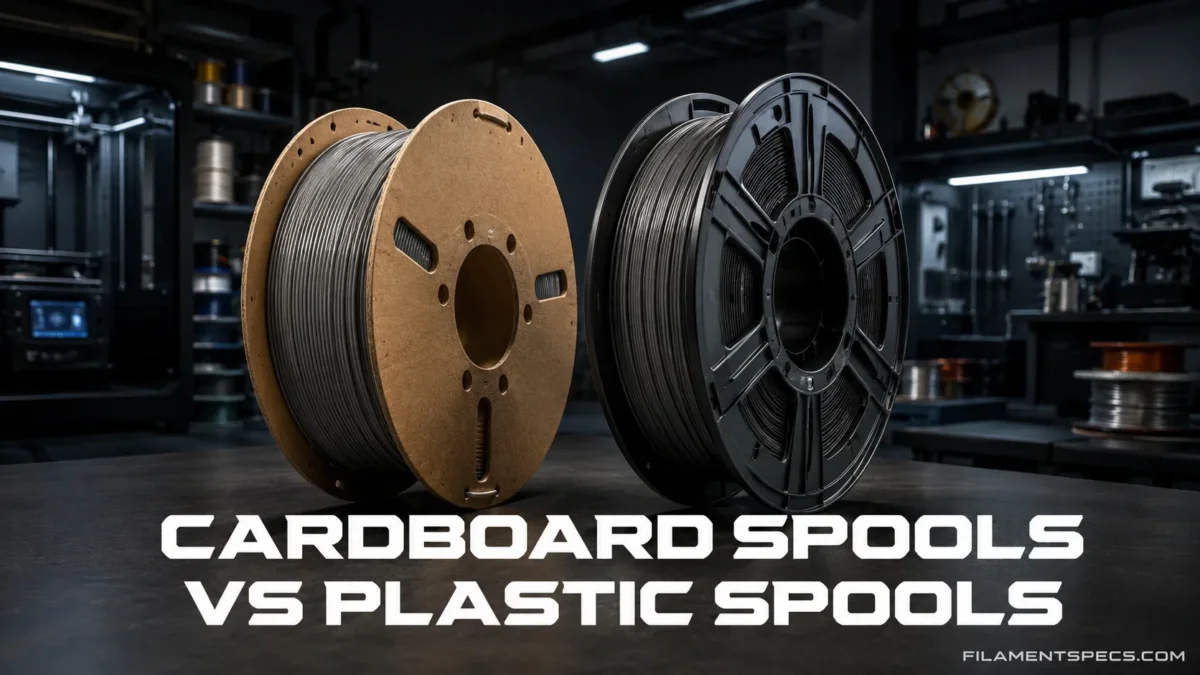
Cardboard spools and plastic spools can both carry good filament. The difference is not the filament chemistry. It is the mechanical behavior of the spool: how round the rim stays, how cleanly it rolls, how it reacts to humidity, how it handles drying heat, and whether your printer pulls filament gently or through a more demanding feeder path.
| Comparison Point | Cardboard Spools | Plastic Spools | What It Means for Printing |
|---|---|---|---|
| Typical Spool Material | Pressed paperboard, corrugated fiberboard, recycled cardboard, or a cardboard tube with printed side flanges. | Usually molded plastic such as polypropylene, polystyrene, ABS-like blends, or reusable spool systems. | The spool material does not change PLA, PETG, ABS, ASA, TPU, or nylon extrusion by itself. It changes how the roll feeds, stores, dries, and empties. |
| Roller Smoothness | Can roll well on simple holders, but raw paper edges may drag, flatten, or shed fibers on narrow rollers. | Usually smoother on rollers because the rim is harder, rounder, and less fibrous. | Plastic is usually safer for feeder systems that pull and rewind filament often. Cardboard may need a rim adapter. |
| AMS and Multi-Material Use | Possible with some brands and sizes, but rim wear, dust, deformation, and spool diameter matter. Bambu’s AMS note lists a 50–68 mm spool width and 197–202 mm diameter range for supported spools.[a] | Usually preferred for AMS-style systems because the rim shape stays more consistent under repeated feed and rewind cycles. | For multi-color or automatic feeding, spool geometry often matters as much as filament type. |
| Drying Temperature | Needs caution. Some mixed cardboard/plastic spools can loosen or deform at higher dryer temperatures, depending on glue, tube design, and side construction. | Often more tolerant, but resin type still matters. Not every plastic spool is safe at nylon or PC drying temperatures. | Always check the spool, not only the filament. A nylon-safe drying temperature may still be too much for the spool. |
| Dust and Debris | Raw cardboard rims can release paper dust when they rub against rollers, spool holders, or AMS drive parts. | Less likely to create paper dust, but cheap or brittle plastic can crack or leave small fragments if damaged. | Dust matters most in enclosed feeder paths, PTFE guides, and systems with small gears. |
| Empty Spool Waste | Often easier to recycle when clean, dry, and free of mixed inserts, though local rules still decide acceptance. | Depends on resin marking, local recycling rules, size, color, additives, and whether the spool is accepted as rigid plastic. | Cardboard is usually simpler for one-time disposal. Reusable plastic can be better when it is used many times. |
| Best Use Case | Open spool holders, standard single-material printing, brands with dense rims, users who want lower plastic waste. | AMS systems, spool rewinders, high-use printer farms, refill systems, long unattended prints, and repeated storage cycles. | The better spool is the one that fits your printer path, dryer temperature, and reuse plan. |
For a basic open spool holder, a sturdy cardboard spool can be perfectly normal. For an automatic material system, a tight dry box, a long Bowden path, or high-temperature drying, the spool starts to matter more. Small friction changes become feed changes. A slightly bent flange becomes a wobble. Paper dust becomes something you do not want inside a gear train.
What Makes Cardboard and Plastic Spools Different?
A filament spool is not only a holder. It is a rotating part in the filament path. The flange shape, center bore, rim hardness, width, outer diameter, weight balance, winding tension, and surface texture all affect how cleanly filament leaves the roll.
Cardboard spools are usually made from paperboard faces attached to a cardboard center tube. Some are dense and smooth. Others have soft edges that can fuzz after hours of rolling. A high-quality cardboard spool can feel solid in the hand, but paper fibers still behave differently from molded plastic.
Plastic spools are molded into a more repeatable shape. The rim tends to stay rounder, the faces resist humidity better, and the center hub usually handles repeated mounting with less wear. That is why plastic spools often feel more predictable in systems that pull, stop, retract, and rewind filament many times during one print.
The spool does not make PLA stronger or PETG weaker. It changes the handling around the filament. That distinction matters because many spool problems are misread as nozzle problems, extruder problems, or wet-filament problems.
Cardboard Spool Traits
- Lower plastic use per spool.
- Often easier to flatten, separate, or recycle after the filament is gone.
- Can dent, ovalize, or bend if stored under weight.
- Can shed paper fibers when the rim rubs against rollers.
- Can absorb moisture from humid rooms or damp storage boxes.
- May need an adapter ring for roller-based systems.
Plastic Spool Traits
- More consistent rim shape for rollers and rewind systems.
- Better resistance to humidity during storage.
- Often better for reusable-spool and refill workflows.
- Can crack if brittle, dropped, or made from thin material.
- May be hard to recycle locally if the resin is unmarked or not accepted.
- Takes more storage space if you keep empty spools.
Feeding Behavior: Friction, Rim Shape, and Wobble
The most practical difference appears when the spool rotates. A printer does not pull filament in one smooth motion forever. It pulls, pauses, retracts, advances, and sometimes rewinds. On a simple direct-drive machine with a rear holder, that motion may be forgiving. In a closed filament path, it becomes less forgiving.
Cardboard rims have more texture. That texture can be harmless on a wide smooth holder, but it may add drag on small rollers. If the edge becomes soft, the spool can stop rolling freely. Then the extruder has to pull harder. The symptom may look like random under-extrusion, clicking, or a layer that prints slightly lean after a long travel move.
Plastic rims usually roll with less edge wear. They are not immune to handling problems. A narrow plastic spool can still bind. A warped plastic spool can still wobble. When the rim is molded cleanly, however, plastic gives the printer a more stable rolling surface.
Why Wobble Matters
Spool wobble changes filament tension. A spool that rocks side to side may feed normally for ten minutes, then snag lightly when the flange leans into the holder wall. That tiny snag can be enough to disturb a long print.
- Round rim: keeps contact even on rollers.
- Flat flange: reduces side rubbing.
- Clean center hole: helps the spool spin without catching.
- Stable winding: keeps the filament from crossing under itself.
A cardboard spool with clean rims can beat a cheap warped plastic spool. A rigid plastic spool can beat a soft cardboard spool in an AMS. The material name alone does not tell the full story.
AMS and Automatic Feeders: Where Plastic Usually Wins
Automatic material systems are less tolerant than a basic spool arm. They may spin the spool forward and backward, pull through PTFE tubing, read filament movement, and keep several spools close together. That is where rim quality becomes more than a small convenience.
Cardboard can work in these systems when the dimensions fit, the spool stays round, and the rim is protected. ColorFabb, for example, provides a snap-fit ring for its cardboard spools to reduce dust accumulation in Bambu AMS use.[b]
Polymaker also describes a cardboard spool adapter made to reduce rolling friction and create a structured rolling surface; its note explains that a cardboard face can bend after a drop, causing wobble that the adapter helps correct.[c]
When a Cardboard Spool Needs a Ring
- The cardboard edge touches small rollers directly.
- The rim leaves visible dust after a few rotations.
- The flange is slightly bent from shipping.
- The spool is close to the width limit of the feeder bay.
- The printer rewinds filament during color or material changes.
Plastic Spools in AMS-Style Systems
Plastic spools are usually the calmer option for automatic feeding because the rim is harder and less fibrous. The printer has fewer variables to fight. For long unattended prints, that matters.
Still, plastic is not automatic compatibility. The spool must fit the bay, roll on the supported contact points, and avoid rubbing the lid or side walls. Oversized spools, narrow spools, wide spools, and unusual hub shapes can cause problems even when the material is plastic.
A Simple AMS Fit Test
- Measure the spool width across the flanges.
- Measure the outer diameter at the widest point.
- Check whether the rim is round, not crushed.
- Spin the spool by hand and watch for side wobble.
- Inspect the rim after spinning. Paper dust means the edge needs protection.
Drying and Storage: The Spool Has a Temperature Limit Too
Filament drying advice often focuses on the polymer: PLA around lower temperatures, PETG higher, nylon much higher, and engineering materials higher again. The missing part is the spool. A safe drying temperature for the filament can be unsafe for the spool.
Prusa’s drying guidance notes that some older spools with plastic sides pressed into a cardboard center can be heated safely only up to 45°C before the cardboard center may expand and loosen; another older glued spool version is described as withstanding up to 90°C because of its glue construction.[d] That is a useful lesson for every brand: spool design matters, not just spool material.
| Drying Situation | Cardboard Spool Concern | Plastic Spool Concern | Better Practice |
|---|---|---|---|
| PLA or Matte PLA at Low Temperature | Usually manageable if the spool stays dry and rigid. | Usually manageable, but very thin spools can soften or warp if overheated. | Use the filament brand’s temperature range and avoid direct hot spots. |
| PETG or TPU Drying | Humidity in the cardboard and glue strength become more relevant. | Usually more stable, but resin type still matters. | Check spool condition after the first drying cycle. |
| Nylon, PC, or High-Temperature Filaments | Often risky unless the spool maker clearly allows the temperature. | Safer only if the spool plastic is rated for the heat. | Consider transferring to a heat-safe spool or drying before rewinding. |
| Printing From a Heated Dry Box | Paper edge may soften slightly in humid or warm conditions. | Usually more stable during long warm prints. | Keep the filament path low-friction and check for side rubbing. |
Moisture Is Not Only a Filament Problem
Cardboard is a paper-based material, so it can gain or lose moisture with room humidity. That does not mean the filament is automatically wet. It means the spool may add another humidity source inside a sealed box, especially if it was stored in a damp area before use.
For PLA, this may not matter much in a normal room. For nylon, TPU, PVA, or very long prints from a sealed box, it deserves attention. A dry filament on a damp cardboard spool is not ideal.
Do not judge a dryer setting by filament name alone. Check the spool label, brand notes, glue construction, and whether the spool uses cardboard, plastic, or a mixed design.
Recycling and Waste: Cardboard Is Simpler, Reuse Can Change the Math
Cardboard spools feel easier to deal with after use because many recycling systems already handle paper and paperboard. EPA data for U.S. municipal solid waste reports that paper and paperboard reached a 68.2 percent recycling rate in 2018, while corrugated boxes reached 96.5 percent.[e] A filament spool is not always the same as a shipping box, but the comparison explains why many users see cardboard as the simpler waste stream.
Plastic spools are more complicated. EPA’s plastics data reports an 8.7 percent recycling rate for plastics in municipal solid waste in 2018, and plastic containers and packaging are handled by resin type and local acceptance rules.[f] Some filament spools are marked. Some are not. Some are too large for curbside sorting. Some are reusable, which changes the waste story entirely.
EU Packaging Rules From August 2026
Regulation (EU) 2025/40 on packaging and packaging waste, usually called the PPWR, entered into force on 11 February 2025 and applies from 12 August 2026.[i] For filament sellers and spool manufacturers supplying the EU market, the packaging definition deserves attention because Annex I specifically lists rolls, tubes, and cylinders around which flexible material is wound as examples of packaging, except where they are intended as parts of production machinery and are not used to present a product as a sales unit.[i]
The Regulation does not name 3D-printer filament spools specifically. The wording is still directly relevant to a disposable spool sold with wound filament because the spool supports and presents a flexible product as part of the sales unit. Under the predecessor EU packaging rules, the Court of Justice also held that roll cores around flexible products sold to consumers could constitute packaging because they serve support, spool, protection, and presentation functions.[j] The classification of a particular spool still depends on its design, function, and how it is supplied.
The PPWR’s application date should not be confused with the start date for the harmonised material-composition label. Article 12 states that packaging placed on the market must carry that harmonised label from 12 August 2028 or 24 months after the relevant implementing acts under Article 12(6) or 12(7) enter into force, whichever is later.[i] In other words, 12 August 2026 is not the general start date for that material-composition labelling obligation.
Recyclable and locally accepted are different questions. A cardboard or plastic spool may be made from a material capable of recycling, while a local collection or sorting system may still reject that shape, size, coating, glue combination, insert, or resin. The future harmonised EU material label is intended to help sorting; it does not turn every labelled item into something every municipal collection system must accept.
A Resin Code Is Not a Recycling Promise
Many plastic spools show a resin identification code. That code helps identify the plastic resin; it does not guarantee that your local recycling program accepts the item. ASTM D7611 describes Resin Identification Codes as a way to identify resin used in manufactured plastic articles.[g]
If a plastic spool is marked PP 5, that means polypropylene. Polypropylene is widely used in packaging because it balances stiffness, impact resistance, heat resistance, and moldability; APR’s polypropylene design guidance also notes that PP density is about 0.90–0.92 g/cm³, which lets it float in water-based separation systems.[h] Still, local acceptance decides whether that empty spool belongs in a recycling bin.
When Reusable Plastic Can Beat Single-Use Cardboard
A plastic spool that is thrown away after one roll creates waste. A reusable plastic spool that carries refill after refill is different. Spool-less refills, master-spool systems, and brand-specific refill coils reduce the number of full spools entering your workspace.
The catch is standardization. Not every refill fits every reusable spool. Some refill coils need straps, a printed spool, a brand spool, or a specific hub diameter. Cardboard has an easier disposal story. Reusable plastic has a stronger reuse story when the system is actually used.
Which Spool Should You Choose?
Choose cardboard when the spool is sturdy, the printer uses a simple holder, the filament does not need high-temperature drying, and you want less plastic waste per roll. Choose plastic when the printer path is more demanding, the spool will be reused, the print is unattended, or the system rewinds filament often.
| Printer or Workflow | Usually Better | Reason |
|---|---|---|
| Basic Bed-Slinger With Rear or Side Spool Holder | Cardboard or plastic | The filament path is short and forgiving. A good cardboard spool usually works fine. |
| Direct Drive Printer With Top-Mounted Holder | Cardboard or plastic | Spool weight balance matters more than material. Avoid bent flanges and tight center holes. |
| Long Bowden Path | Plastic, or cardboard with clean rims | Extra spool drag adds to tube friction, especially during retract-heavy prints. |
| Bambu AMS or Similar Enclosed Feeder | Plastic, reusable spool, or cardboard with adapter rings | Repeated feed and rewind cycles punish dusty, soft, or bent spool edges. |
| Filament Dryer Used at Higher Temperatures | Heat-safe plastic or verified spool design | The spool may fail before the filament does. |
| Low-Waste Filament Buying | Cardboard or refill system | Cardboard reduces single-use plastic; refill systems reduce full spool waste when reused. |
| Print Farm or Long Unattended Jobs | Plastic or proven reusable spool | Predictable rolling and lower debris risk are worth more than small packaging gains. |
Before Loading a Cardboard Spool
- Spin it on the holder before printing.
- Check both rims for dents, fuzz, and flat spots.
- Look at the center hole. Oval holes can cause pulsing tension.
- Wipe loose dust from the rim with a dry cloth.
- Use a printed rim ring if the spool runs on small rollers.
- Avoid crushing the spool in storage; store it upright or lightly supported.
Before Reusing a Plastic Spool
- Check that both sides lock together tightly.
- Remove filament scraps from the hub and anchor holes.
- Confirm the refill coil width matches the spool width.
- Inspect the rim for cracks that could snag on rollers.
- Do not mix a refill system with a spool it was not designed to hold unless the fit is secure.
Print Quality: What Spool Material Can and Cannot Affect
A spool cannot change melt temperature, layer adhesion, nozzle flow, polymer grade, pigment quality, or filament diameter tolerance. Those come from the filament itself. A spool can affect print quality only through the feed path.
That feed-path effect can still be real. A spool that drags may create slight under-feeding. A spool that snags may cause a skipped step. A dusty spool used in an enclosed feeder may create maintenance problems later. The printer sees all of that as tension.
Symptoms That May Point to Spool Handling
- Extruder clicking only when the spool is almost full or almost empty.
- Under-extrusion that appears after the spool rubs against one side.
- AMS errors that happen with one spool but not another filament of the same material.
- Visible paper dust on rollers, guides, or the bottom of the feeder bay.
- Filament feeding cleanly when unrolled by hand but failing from the mounted spool.
Storage: Stacking, Humidity, and Long-Term Shape
Plastic spools tolerate stacking better, though thin flanges can still bend if heavy boxes sit on them. Cardboard spools need more care. A roll stored under weight can flatten at the rim, especially in a humid room. That flat area may not look dramatic, but it can thump across rollers during printing.
For long-term storage, the best method is simple:
- Keep spools dry and away from floor moisture.
- Do not stack heavy boxes on cardboard spools.
- Use sealed bags or dry boxes for moisture-sensitive filament.
- Keep labels visible so dryer limits and material type are not forgotten.
- Inspect old spools before using them in a long print.
Cardboard is not fragile when made well. It just needs more care around water, heat, and edge pressure.
Cardboard vs Plastic Spools by Filament Type
| Filament Type | Cardboard Spool Fit | Plastic Spool Fit | Notes |
|---|---|---|---|
| PLA | Usually good for open holders and normal storage. | Good for all common workflows. | Low drying temperatures make cardboard easier to live with. |
| PETG | Good if the spool remains dry and rolls cleanly. | Good, especially in dry boxes and AMS-style setups. | PETG may need drying more often than PLA, so spool temperature should be checked. |
| TPU | Acceptable only when the feed path is very gentle. | Usually better, but flexible filament can still be hard for some automatic feeders. | TPU problems are usually filament-path related, not only spool related. |
| ABS and ASA | Usable if drying temperature and enclosure storage do not damage the spool. | Often easier for warm storage and repeated handling. | Keep the spool away from chamber heat unless the spool is designed for it. |
| Nylon | Needs caution because drying and dry-box use are more demanding. | Better if heat-safe and dimensionally stable. | Moisture control matters more than spool material, but the spool must survive the drying plan. |
| Carbon-Fiber Filled Filaments | Depends on printer path and spool quality. | Usually preferred for stable feeding. | The abrasive filler affects nozzles and gears; the spool choice mainly affects feed consistency. |
FAQ
Are Cardboard Spools Bad for 3D Printers?
No. A cardboard spool is not bad by default. It becomes a problem when the rim sheds dust, bends, rubs on rollers, or does not fit the feeder system. Many open spool holders handle good cardboard spools without trouble.
Are Plastic Spools Always Better Than Cardboard Spools?
No. Plastic spools are usually more predictable for automatic feeders and reuse, but cardboard spools can be better for simple disposal and lower single-use plastic. A sturdy cardboard spool on a simple holder can be the easier option.
Can Cardboard Spools Be Used in Bambu AMS?
Some can be used when the dimensions fit and the rim is protected, but cardboard edges can create dust or drag. Many users add printed rim rings or transfer the filament to a reusable plastic spool for a cleaner AMS workflow.
Do Cardboard Spools Make Filament Wet?
The spool does not make filament wet by itself, but cardboard can hold moisture if stored in a humid place. For nylon, TPU, PVA, or long dry-box storage, a damp cardboard spool is not ideal.
Can I Put a Cardboard Spool in a Filament Dryer?
Sometimes, but only at temperatures the spool can handle. Low-temperature PLA drying is usually less risky than nylon or PC drying. Check the spool maker’s notes, not only the filament drying chart.
Is It Better to Buy Refills Instead of Cardboard Spools?
Refills can reduce waste when you already have a compatible reusable spool and actually reuse it. Cardboard spools are simpler when you do not want a refill system, but they still create one empty spool per roll.
Why Does My Cardboard Spool Feed Unevenly?
The usual causes are a dented rim, soft edge, oval center hole, side rubbing, or paper dust on the rolling surface. Spin the spool by hand before printing and watch whether the rim rises, dips, or rubs.
Should I Transfer Filament From Cardboard to Plastic?
It is worth doing for AMS use, high-value long prints, repeated color changes, or high-temperature drying. For a normal open holder and a short PLA print, transfer is often unnecessary.
Did EU Material-Composition Labels Become Mandatory for Filament Spools in August 2026?
No. The PPWR began applying on 12 August 2026, but Article 12 sets the harmonised packaging material-composition label for 12 August 2028 or 24 months after the relevant implementing acts enter into force, whichever is later.[i] Whether a particular filament spool falls within the packaging rules also depends on its design, function, and how it is supplied.
Sources
- Bambu Lab Wiki — Notes for AMS — Supports AMS spool dimension guidance and automatic material system context. (Official manufacturer documentation.)
- ColorFabb Helpcenter — Bambu Printer: Cardboard Spool Ring — Supports the use of cardboard spool rings to reduce dust accumulation in AMS operation. (Official filament manufacturer support article.)
- Polymaker — Introducing Polymaker Cardboard Spool Adapter — Supports adapter function, rolling friction, rim support, and cardboard spool wobble context. (Official filament manufacturer technical note.)
- Prusa Knowledge Base — Drying Filament — Supports spool temperature cautions and mixed cardboard/plastic spool behavior during drying. (Official manufacturer documentation.)
- U.S. EPA — Paper and Paperboard: Material-Specific Data — Supports paper and paperboard recycling-rate context. (Official government waste and recycling data.)
- U.S. EPA — Plastics: Material-Specific Data — Supports plastics recycling-rate context and municipal solid-waste comparison. (Official government waste and recycling data.)
- ASTM International — D7611/D7611M Standard Practice for Resin Identification — Supports the explanation that Resin Identification Codes identify plastic resin type. (Official standards source.)
- Association of Plastic Recyclers — PP Design Guidance — Supports polypropylene properties and recycling-design context. (Specialized recycling-industry guidance.)
- European Union — Regulation (EU) 2025/40 on Packaging and Packaging Waste — Supports the 12 August 2026 application date, Annex I packaging examples for rolls, tubes, and cylinders around flexible material, and the Article 12 timing for harmonised material-composition labels. (Official EU legislation.)
- Court of Justice of the European Union — Joined Cases C-313/15 and C-530/15 — Supports the interpretation of consumer roll cores around flexible products as packaging under the predecessor EU packaging rules. (Official EU case-law record.)