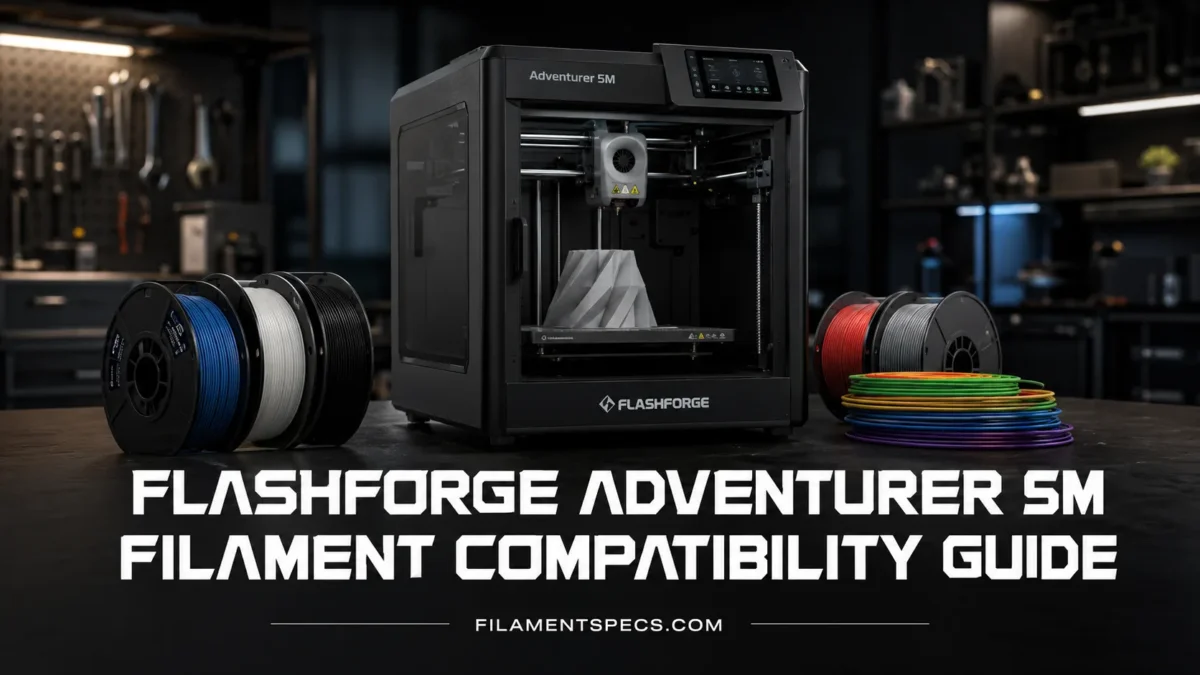
Flashforge Adventurer 5M works best when the filament choice matches three real limits: the 280°C direct-drive hot end, the removable PEI build plate, and the open-frame body on the standard 5M. PLA and PETG are the easiest matches. TPU and carbon-fiber blends can work well too, but nozzle size matters. ABS, ASA, nylon, and PC need more care because they ask for higher chamber stability, better ventilation, or stricter drying than everyday PLA printing.
| Filament Type | Adventurer 5M Fit | Best Nozzle Choice | Typical Starting Range | Bed / Enclosure Notes | Practical Use |
|---|---|---|---|---|---|
| PLA | Excellent everyday match | 0.4 mm stock nozzle | 180–230°C nozzle, about 50°C bed | No enclosure needed; use normal part cooling | Models, toys, prototypes, decorative parts |
| PLA+ | Excellent if the brand profile is tuned | 0.4 mm stock nozzle | 200–225°C nozzle, 50–60°C bed | No enclosure needed | General parts with better toughness than basic PLA |
| High-Speed PLA | Very good match for the 5M motion system | 0.4 mm stock nozzle | 200–230°C nozzle, 50–60°C bed | No enclosure needed; slicer flow tuning helps | Fast drafts, batches, larger simple models |
| Silk PLA | Good, but slower than basic PLA | 0.4 mm stock nozzle | 200–225°C nozzle, 50–60°C bed | No enclosure needed; reduce speed for shine | Display pieces, figures, color-shift prints |
| PETG | Very good functional match | 0.4 mm stock nozzle | 220–250°C nozzle, 70–85°C bed | Open frame is usually fine; avoid too much fan | Clips, boxes, brackets, outdoor-ish parts |
| TPU | Compatible, best with slower profiles | 0.6 mm or 0.8 mm recommended | 210–240°C nozzle, 40–60°C bed | No enclosure needed; keep filament path low-friction | Bumpers, feet, soft grips, flexible joints |
| PLA-CF | Compatible with the right nozzle | 0.6 mm or 0.8 mm recommended | 210–235°C nozzle, 50–60°C bed | No enclosure needed; dry before printing | Matte rigid parts, fixtures, clean-looking prototypes |
| PETG-CF | Compatible with the right nozzle | 0.6 mm or 0.8 mm recommended | 240–260°C nozzle, 70–85°C bed | Dry storage matters; tune retraction carefully | Rigid brackets, functional housings, stiff parts |
| ABS | Possible, but not the easiest fit on the open 5M | 0.4 mm or 0.6 mm | 230–260°C nozzle, 90–100°C bed | Enclosure and ventilation are strongly preferred | Heat-tolerant housings, sandable parts |
| ASA | Possible with enclosure control | 0.4 mm or 0.6 mm | 240–270°C nozzle, 90–100°C bed | Better with enclosure, steady temperature, and ventilation | Outdoor parts when tuned carefully |
| Nylon / PA | Borderline; only some blends are practical | 0.6 mm preferred | 250–280°C nozzle, 70–100°C bed | Dry box is important; open-frame cooling can hurt layers | Wear parts and tough parts after testing |
| PC / PC Blend | Not a natural match for most users | 0.6 mm preferred | Often near or above the 5M comfort zone | Usually wants hotter chamber conditions | Only use printer-friendly PC blends if the spool label fits the machine |
| Wood, Glow, Metal-Filled PLA | Usable with nozzle care | 0.6 mm preferred for filled blends | Follow the spool; usually PLA-like ranges | No enclosure needed; clogs are more likely with tiny nozzles | Decorative texture, glow effects, display parts |
| PVA / HIPS Support | Limited value on this single-extruder printer | Depends on material | Brand-specific | PVA needs dry handling; HIPS usually pairs with ABS-style conditions | Not the main reason to buy filament for the 5M |
Table of Contents
⚙️ Printer Limits That Decide Filament Choice
The Adventurer 5M is a CoreXY FDM printer with a direct-drive extruder, quick-release nozzles, a 220 × 220 × 220 mm build volume, and a flexible removable PEI steel plate. Flashforge lists the extruder temperature at 280°C, the platform temperature at 100°C on the 5M product page, and the standard shell as open rather than enclosed.[a]
Those numbers explain the real compatibility picture. The 5M has enough hot-end temperature for PLA, PETG, TPU, PLA-CF, PETG-CF, and many ABS or ASA spools. The open body is the catch. Materials that shrink while cooling need a steadier print environment than PLA. That is why the same nozzle can print PETG comfortably but make ABS more sensitive to corners, drafts, and layer splitting.
Compatibility is not only “can the nozzle melt it?” A filament also has to match the bed temperature, nozzle material, part cooling, enclosure needs, spool path, drying needs, and slicer profile.
The 0.4 Mm Stock Nozzle Is Not the Same as the Whole Printer
The installed 0.4 mm nozzle is the normal choice for PLA and PETG. Flashforge’s own nozzle table lists PLA and PETG for 0.25 mm and 0.4 mm, while TPU, PLA-CF, and PETG-CF are listed under larger 0.6 mm and 0.8 mm options.[a] That does not mean every TPU print will fail on 0.4 mm. It means the cleaner, safer recommendation is a larger opening, slower speed, and a material profile that does not push filament too hard through a small path.
Third-Party Filament Is Allowed, With One Simple Size Rule
Flashforge says other filament brands can be used, limited to 1.75 mm diameter filament, with parameter changes when brand temperatures differ.[c] That matters more than brand loyalty. A well-made 1.75 mm PLA, PETG, or TPU spool can run nicely if the slicer profile matches the material.
🧵 Best Filaments for the Stock 0.4 Mm Setup
For most Adventurer 5M owners, the best starting materials are PLA, PLA+, high-speed PLA, silk PLA, and PETG. They fit the machine’s open layout, PEI plate, direct-drive extruder, and temperature range without asking for a heated chamber.
PLA: The Easiest Match
PLA is the cleanest first material for the Adventurer 5M. It melts at moderate nozzle temperatures, sticks well to PEI, and does not need an enclosure. It also works well with the 5M’s fast motion system when the filament is designed for speed.
- Use 0.4 mm for normal models, toys, grid bins, signs, and detailed prints.
- Start around 200–220°C if using a generic PLA profile, then adjust by small steps.
- Use roughly 50–60°C on the bed if first-layer adhesion is uneven.
- Keep part cooling on for clean bridges, overhangs, and sharp edges.
Basic PLA is still the safest choice for first prints. PLA+ adds toughness. Silk PLA adds shine but may prefer slower outer walls. Matte PLA can hide layer lines, though some matte blends are more abrasive than plain PLA. Small profile changes matter.
PETG: Better for Functional Parts
PETG is also a strong fit for the 5M. It usually prints hotter than PLA and can be stringier, but it gives better layer toughness, better moisture resistance in finished parts, and more ductility. Flashforge’s material notes place PETG around 220–250°C nozzle temperature and 75–90°C heated bed range.[e]
- Use the stock 0.4 mm nozzle for normal PETG.
- Reduce cooling compared with PLA; too much fan can weaken layers.
- Use a clean PEI plate, but avoid smashing the first layer too hard.
- Use glue stick as a release layer if PETG bonds too strongly to PEI.
PETG can grip PEI more aggressively than PLA. If parts are hard to remove, let the plate cool fully and consider a thin release layer on future prints.
High-Speed PLA: The 5M’s Natural Fast Material
The Adventurer 5M has fast travel capability, but filament flow is still the limit. High-speed PLA is made to melt and flow better at faster print speeds. On simple shapes, it can take advantage of the printer’s motion system. On small detailed parts, speed still needs restraint because the layer has less time to cool.
Use high-speed PLA when speed matters more than maximum heat resistance. For brackets near heat, PETG or a tuned ASA setup may be a better material path.
🧩 Flexible and Composite Filaments
The 5M’s direct-drive extruder is helpful for TPU because the drive gears sit close to the hot end. Less distance means less filament buckling compared with long Bowden paths. Still, TPU is soft. It does not like high pressure, sharp bends, or aggressive retraction.
TPU: Compatible, but Speed Is the Real Limit
Flashforge lists TPU under the 0.6 mm and 0.8 mm nozzle options for the Adventurer 5M.[a] A larger nozzle gives soft filament more room to flow and lowers back pressure. That is good for flexible material.
- Choose 95A TPU before very soft 85A TPU.
- Start slow: 20–50 mm/s is more realistic than PLA speed.
- Keep retraction short and gentle.
- Dry TPU before long prints because wet TPU strings, pops, and leaves rough walls.
- Use a simple filament path from spool to extruder.
TPU is not difficult because the 5M is weak. It is difficult because flexible filament behaves like a spring. Slow feed, dry spool, low friction. That trio solves many TPU issues.
PLA-CF and PETG-CF: Use the Larger Nozzle Path
Carbon-fiber-filled PLA and PETG are listed by Flashforge for 0.6 mm and 0.8 mm nozzle use on the 5M.[a] These blends are usually stiffer, more matte, and more dimensionally calm than their base polymers. They also contain hard fibers that can wear ordinary nozzles faster than plain filament.
- Use 0.6 mm when you want a balance of detail and lower clog risk.
- Use 0.8 mm for stronger flow and thicker functional parts.
- Dry PLA-CF and PETG-CF before printing.
- Expect less glossy surfaces and a more technical matte finish.
- Do not use tiny 0.25 mm nozzles with filled filaments.
Nozzle Choice by Material
0.25 mm: fine PLA/PETG detail, slower printing, not for filled filaments.
0.4 mm: normal PLA, PLA+, silk PLA, PETG, and general models.
0.6 mm: TPU, PLA-CF, PETG-CF, wood-filled PLA, glow PLA, faster functional parts.
0.8 mm: thicker walls, soft materials, filled blends, fast strong parts with less fine detail.
🌡️ Enclosure Materials: ABS, ASA, Nylon, and PC
The standard Adventurer 5M is open. That is fine for PLA, PETG, and TPU. It becomes more important with ABS, ASA, nylon, and PC because these materials can shrink more as they cool. Corners lift. Tall parts split. Thin walls curl inward. The nozzle may be hot enough, yet the print environment may still be unstable.
ABS: Possible, Not the Smoothest First Choice
ABS can fit the 5M’s nozzle temperature range, but the open frame makes it more sensitive. Flashforge’s FAQ also notes that ABS should be printed with ventilation in mind, and that PLA is a preferred choice for children’s activity spaces.[c]
- Use an enclosure if ABS parts are more than small pieces.
- Keep the room free from drafts.
- Use a brim for corners and long flat shapes.
- Let the part cool slowly before removal.
- Use good ventilation and follow the filament brand’s safety data.
ASA: Outdoor-Friendly, but Chamber Stability Matters
ASA is often chosen for outdoor parts because it handles weathering better than PLA. On the 5M, ASA belongs in the “tuned material” category. It wants a hot bed, controlled airflow, and a steady print area. Small ASA parts are easier than large flat panels.
If the part is a small clip or bracket, ASA can be realistic after tuning. If it is a wide flat cover, the 5M will benefit from an enclosure and a careful brim setup.
Nylon and PA Blends: The Drying Test Comes First
Nylon is not only a temperature question. It absorbs moisture quickly, and wet nylon prints rough, weak, and stringy. Some PA blends can print inside the 5M’s temperature range. Others want more heat, a hotter chamber, or a dedicated dry box during the print.
- Check the spool label before buying; do not assume all nylon blends fit 280°C.
- Dry the spool fully before testing.
- Use a larger nozzle for fiber-filled PA.
- Expect slower print speeds than PLA.
- Use small test parts before long functional prints.
PC and PC Blends: Usually Not the Best Match
Polycarbonate and many PC blends demand high nozzle heat, high bed heat, and warm chamber conditions. Some “easy PC” blends may be printable if the spool label stays inside the Adventurer 5M’s limits, but plain PC is not a natural match for this open-frame machine.
Do not buy a high-temperature filament only because the 5M nozzle reaches 280°C. Check bed temperature, enclosure needs, drying needs, and the exact nozzle range printed on the spool.
🧪 Material Notes By Filament Type
PLA Family
PLA, PLA+, matte PLA, marble PLA, and silk PLA are the lowest-stress materials for this printer. They are also forgiving on the PEI plate. If a new 5M owner asks what to buy first, a clean 1 kg spool of PLA or PLA+ is the sensible answer.
- Basic PLA: easiest, low warp, good detail.
- PLA+: similar print setup, usually tougher.
- Silk PLA: glossy, slower outer walls help surface quality.
- Matte PLA: hides layer lines, may prefer slightly warmer nozzle settings.
- Glow PLA: use nozzle caution because glow additives can be abrasive.
PETG Family
PETG is the material to choose when PLA feels too brittle or too heat-sensitive for a part. It is still friendly to the Adventurer 5M, but the profile should not be treated like PLA. PETG often needs hotter extrusion, lower fan, and more patient retraction tuning.
Stringing is normal during tuning. Small changes to nozzle temperature, retraction speed, travel speed, and filament dryness can clean it up.
Flexible Filaments
TPU is the main flexible option. TPE can be softer and harder to control, so TPU 95A is the better first flexible spool. The direct-drive extruder helps, yet a soft material still needs low speed and low pressure.
- Use fewer sharp bends in the filament path.
- Disable aggressive pressure advance if it causes under-extrusion.
- Keep infill low for soft parts.
- Use more walls when the part needs shape memory.
Filled and Abrasive Filaments
Filled filaments include carbon fiber, wood, glow-in-the-dark, stone-like, and metal-filled PLA blends. Some are mild. Some are harsh on nozzles. The safer approach is simple: use a larger nozzle, keep the filament dry, and avoid very long prints until a small test piece confirms flow.
For filled materials, clog risk and nozzle wear are the real compatibility issues. The printer can move fast; the filled filament may not want to.
🔧 Setup and Tuning Details That Affect Compatibility
Use the PEI Plate Differently for Each Material
The removable PEI steel plate is a good match for PLA, PETG, and TPU, and Flashforge describes it as usable for these filament types on the Adventurer 5M series.[b] The surface still needs material-specific handling.
- PLA: clean PEI, normal first-layer squish, easy removal after cooling.
- PETG: avoid over-squishing; consider a release layer.
- TPU: do not press the first layer too deeply into PEI.
- ABS / ASA: use brim, steady heat, and enclosure support when possible.
Match Speed to Flow, Not to the Printer’s Maximum Number
The Adventurer 5M can move fast, but filament has to melt fast enough to keep up. A small nozzle, low-flow filament, cold nozzle, or soft TPU can all limit real speed. This is why PLA may print fast while TPU needs patience. Same printer. Different material behavior.
| Material Family | Speed Behavior | What to Tune First | Common Symptom |
|---|---|---|---|
| PLA / High-Speed PLA | Can run fast when cooling keeps up | Nozzle temperature, max volumetric flow, cooling | Soft corners or dull overhangs if too hot |
| Silk PLA | Looks better at moderate outer-wall speeds | Outer-wall speed and temperature | Loss of shine or uneven gloss |
| PETG | Medium speed is safer for strength | Retraction, fan, nozzle temperature | Stringing or blobs |
| TPU | Slow by nature | Print speed, retraction, feed path | Under-extrusion or filament buckling |
| PLA-CF / PETG-CF | Moderate speed with larger nozzle | Nozzle size, drying, flow rate | Clogs, rough walls, weak infill |
| ABS / ASA | Moderate speed with thermal control | Bed heat, brim, enclosure, fan reduction | Warped corners or split layers |
Create Separate Slicer Profiles
Do not run every spool through one generic profile. The Adventurer 5M supports FlashPrint, Orca-Flashforge, and Orca Slicer according to Flashforge’s product specification.[a] Save profiles by material and, when useful, by nozzle size.
- Create a PLA 0.4 mm baseline profile.
- Duplicate it for PLA+, silk PLA, and high-speed PLA.
- Create a PETG 0.4 mm profile with lower cooling and tuned retraction.
- Create a TPU 0.6 mm profile with slow speed and mild retraction.
- Create separate PLA-CF and PETG-CF profiles for the larger nozzle.
💧 Drying and Storage Compatibility
Some filament problems look like printer problems. Wet filament can cause popping, stringing, rough walls, weak layers, and random under-extrusion. Flashforge publishes drying references for common materials: PLA at 50°C for 4–6 hours, PETG at 70°C for 6 hours, ABS at 80°C for 8–12 hours, TPU at 50°C for 6 hours, PLA-CF at 60°C for 6 hours, and PETG-CF at 70°C for 8 hours.[d]
- Least Sensitive
- PLA is usually forgiving, though old or poorly stored PLA can still become brittle.
- Moderately Sensitive
- PETG and PLA-CF benefit from dry storage and controlled humidity.
- Very Sensitive
- TPU, nylon, PA-CF, and PETG-CF should be dried before serious prints and stored sealed with desiccant.
A dry box is not only for nylon. It helps TPU and PETG-CF too. For long prints, feeding from a dry container can be the difference between smooth walls and rough, stringy surfaces.
🛠️ Compatibility Problems and What They Usually Mean
The Filament Loads but Does Not Extrude Cleanly
This usually points to a clog, a temperature mismatch, wet filament, or too much pressure through a small nozzle. With TPU and filled materials, move to a 0.6 mm nozzle before blaming the filament.
- Raise nozzle temperature by 5°C steps within the spool’s safe range.
- Slow the print speed.
- Dry the spool.
- Use a larger nozzle for filled or soft materials.
- Run a purge after switching from high-temperature filament back to PLA.
The First Layer Does Not Stick
Flashforge’s FAQ suggests checking bed temperature, brim use, glue, bed cleanliness, and leveling when a model warps or does not adhere well.[c] On the 5M, start with the cleanest fix first: wash the PEI plate, run leveling, and check the first-layer height.
PETG Strings Too Much
PETG often strings when it is too hot, too wet, or retraction is not tuned. Lower the nozzle temperature slightly, dry the spool, and adjust retraction in small moves. Do not use PLA-level cooling without testing layer strength.
ABS or ASA Corners Lift
That is usually a temperature stability issue, not a random failure. Add a brim, reduce drafts, use an enclosure if available, raise the bed within safe limits, and let the part cool gradually. Wide flat parts are harder than compact shapes.
TPU Under-Extrudes
TPU under-extrusion often comes from speed and pressure. Use slower print speed, less retraction, a larger nozzle, and a clean feed path. If the spool is old or exposed to air, dry it before another test.
🎯 Best Filament Choices by Print Goal
| Print Goal | Best First Choice | Second Choice | Avoid as a First Test |
|---|---|---|---|
| First prints and learning | PLA | PLA+ | ABS, nylon, PC |
| Fast draft printing | High-Speed PLA | Basic PLA | TPU, PETG-CF |
| Decorative models | Silk PLA | Matte PLA | ABS for large show pieces |
| Functional brackets | PETG | PETG-CF with 0.6 mm nozzle | Basic PLA near heat |
| Flexible parts | TPU 95A | TPU 98A | Very soft TPU before tuning |
| Stiff matte prototypes | PLA-CF with 0.6 mm nozzle | PETG-CF | Carbon-filled filament with 0.25 mm nozzle |
| Outdoor use | PETG for simple parts | ASA with enclosure tuning | PLA for hot sun exposure |
| High heat parts | ASA after tuning | ABS with enclosure and ventilation | PC unless the blend fits the printer limits |
The Adventurer 5M is strongest as a fast PLA, PETG, TPU, and light-composite printer. That is a wide material range. It just should not be treated like a fully enclosed high-temperature machine unless the setup has been changed to support that job.
FAQ
Can the Flashforge Adventurer 5M print PLA?
Yes. PLA is one of the best matches for the Adventurer 5M. Use the stock 0.4 mm nozzle, a clean PEI plate, normal part cooling, and a PLA profile close to the filament brand’s label.
Can the Adventurer 5M print PETG?
Yes. PETG works well on the Adventurer 5M with the stock 0.4 mm nozzle. It usually needs higher nozzle and bed temperatures than PLA, lower cooling, and careful retraction tuning to reduce stringing.
Can the Adventurer 5M print TPU?
Yes. TPU is compatible, especially because the 5M uses a direct-drive extruder. Flashforge lists TPU under the larger 0.6 mm and 0.8 mm nozzle options, so a larger nozzle and slower print speed are the safer setup.
Can the Adventurer 5M print carbon fiber filament?
It can print PLA-CF and PETG-CF when the setup matches the material. Flashforge lists PLA-CF and PETG-CF with 0.6 mm and 0.8 mm nozzle options. Use dry filament and avoid small nozzles with abrasive blends.
Can the Adventurer 5M print ABS?
ABS is possible, but the standard Adventurer 5M is open-frame, so ABS is more sensitive to warping, drafts, and layer splitting. An enclosure, good ventilation, a brim, and slow cooling make ABS more realistic.
Can the Adventurer 5M print ASA?
ASA can be printed after tuning, but it is not as easy as PLA or PETG. It prefers a warm, stable print environment and good bed adhesion. Small ASA parts are easier than wide flat parts.
Can the Adventurer 5M use third-party filament?
Yes. Flashforge says third-party filament can be used if it is 1.75 mm diameter, but slicer parameters may need adjustment because each brand can have different temperature and flow behavior.
What nozzle should I use for PLA-CF or PETG-CF on the Adventurer 5M?
Use 0.6 mm or 0.8 mm. These nozzle sizes reduce clog risk and match Flashforge’s material listing for PLA-CF and PETG-CF on the Adventurer 5M.
Is nylon a good filament for the Adventurer 5M?
Nylon is possible only for certain blends that fit the printer’s temperature range, but it is not a beginner material on the 5M. It needs strong drying discipline, controlled storage, and often a more stable print environment than PLA or PETG.
What is the safest first filament for a new Adventurer 5M owner?
PLA is the safest first filament. After PLA, PETG is the next practical step for stronger functional parts. TPU and carbon-filled blends are good later choices once nozzle size and speed tuning are understood.
References Used for This Article
- [a] Flashforge Adventurer 5M product page — used for the official 280°C extruder temperature, 100°C platform temperature, nozzle sizes, build volume, slicer support, and listed filament/nozzle combinations. (Manufacturer source for the exact printer model.)
- [b] Flashforge Wiki: Introduction to Adventurer 5M Series — used for the CoreXY structure, PEI build surface, hot-end description, heated bed notes, and nozzle/material suggestions. (Official Flashforge technical documentation.)
- [c] Flashforge Wiki: FAQ for Adventurer 5M — used for third-party 1.75 mm filament compatibility, ABS ventilation notes, and adhesion troubleshooting steps. (Official Flashforge support documentation.)
- [d] Flashforge Wiki: Drying Temperature and Time for Common Filaments — used for drying temperatures and drying times for PLA, PETG, ABS, TPU, PLA-CF, and PETG-CF. (Official Flashforge filament handling reference.)
- [e] Flashforge material printing article — used for general PLA, PETG, ABS, and TPU temperature and handling notes. (Manufacturer educational reference connected to FDM filament use.)