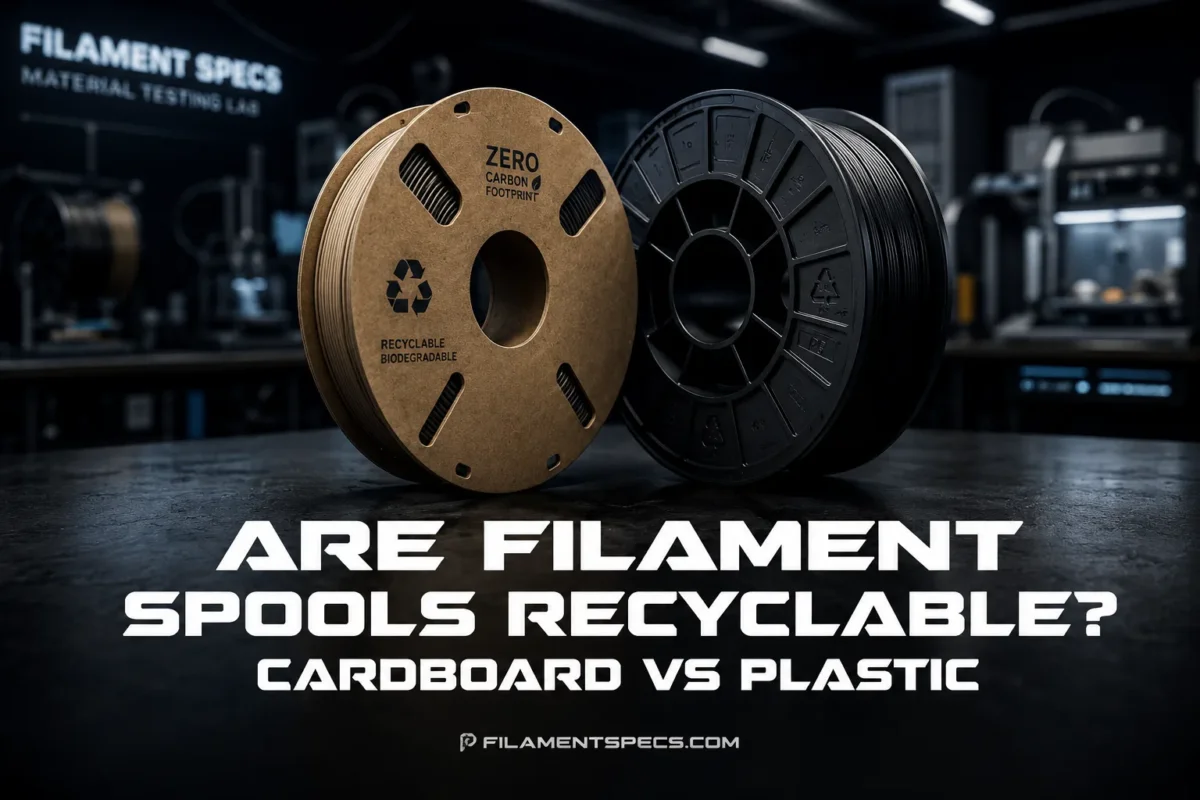
| Spool Question | Cardboard Filament Spool | Plastic Filament Spool |
|---|---|---|
| Most Likely Recycling Answer | Often recyclable when clean, dry, and accepted as paperboard or corrugated cardboard by the local program. | Only recyclable when the local program accepts that resin, shape, and size. A molded number alone does not prove acceptance. |
| Common Material Clues | Paperboard, corrugated cardboard, kraft board, pressed fiber, paper labels, sometimes a plastic center ring. | PP #5, PS #6, ABS/other #7, mixed plastic, or unmarked rigid plastic. |
| Best First Use After Empty | Reuse for loose filament, small cable storage, labels, test winding, or craft/shop organization if still round and dry. | Reuse as a refill master spool, storage reel, cable reel, filament sample holder, or parts-bin organizer. |
| Recycling Weak Point | Moisture, heavy glue, plastic hubs, laminated coating, tape buildup, or dirty surfaces can make the spool harder to process. | Unclear resin, black or dark color, composite parts, oversized flanges, metal hardware, labels that cover too much area, or poor local demand. |
| Printer Handling | Light and low-plastic, but edges can dent and paper dust can appear on tight rollers. | More durable for long storage and repeated refill use, but creates more rigid plastic waste when discarded. |
| Most Practical Rule | Recycle only if clean and dry. Remove any obvious non-paper part first. | Recycle only if the exact plastic type is accepted locally. Reuse or return when local acceptance is unclear. |
Empty filament spools are recyclable in some cases, but the right answer depends on the spool body, the resin code, local recycling rules, and whether the spool is a single material or a mixed-material part. A cardboard spool usually has a simpler recycling path when it is clean and dry. A plastic spool can be recycled only when the local program accepts that plastic resin and that object shape. The safest order is simple: reuse first, recycle when accepted, and avoid placing doubtful spools into the curbside bin because non-accepted items can contaminate the recycling stream.[a]
Table of Contents
♻️ Recyclable Answer
A filament spool is not recyclable just because it looks recyclable. It must be collectable, sortable, and usable by an established recycling program. That matters because recycling systems sort by material type, object shape, size, contamination level, and market demand for the recovered material.
For filament users, the practical answer is:
- Clean cardboard spools are usually the easier recycling candidate.
- Single-resin plastic spools may be recyclable, especially if the resin code is accepted locally.
- Unmarked plastic spools are risky in curbside recycling unless the recycler says yes.
- Mixed-material spools need separation before recycling whenever the parts come apart without tools or force.
- Loose filament scraps are a different waste stream. They should not be treated the same as the empty spool.
In the United States, the recycling claim itself has a defined meaning in consumer guidance: a product or package should not be called recyclable unless it can be collected, separated, or recovered through an established program; broad recycling claims need limits when access is not available to a large share of consumers.[b] That idea translates well to 3D printing: a spool can be made from recyclable material and still not be accepted in a local bin.
Plain answer: cardboard filament spools are usually easier to recycle than plastic spools, but plastic spools are often better for repeated reuse. The lowest-waste choice is a durable reusable spool paired with refills, or a cardboard spool that your local paper stream accepts clean and dry.
📦 Cardboard Spools
Cardboard filament spools are usually made from paperboard or corrugated fiberboard. They are attractive for recycling because the material belongs to a well-developed paper recovery stream. Cardboard also avoids the awkward question that plastic spools often create: what resin is this, and does my local recycler want it?
When Cardboard Spools Are Good Recycling Candidates
A cardboard spool is a good recycling candidate when it meets four conditions:
- The spool is dry.
- The paper surface is not heavily coated, waxed, or laminated.
- Filament scraps, tape knots, zip ties, and plastic rings are removed.
- The local paper or cardboard stream accepts shaped paperboard items, not only flat boxes.
Paper and cardboard are widely recycled materials, and U.S. paper-industry data lists a 2024 cardboard recycling rate range of 69% to 74%.[c] That does not mean every cardboard spool in every city is accepted, but it does explain why cardboard spools often have a clearer end-of-life path than unmarked rigid plastic.
Where Cardboard Spools Can Cause Trouble
Cardboard is fiber-based, so it hates bad storage. A spool that gets damp may warp, soften, shed paper dust, or lose flange stiffness. That can affect printing before recycling ever becomes a question. The issue is not the cardboard idea itself; it is the storage condition.
- Moisture: humid rooms can make flanges swell or bend, especially near the rim.
- Dust: rough cardboard edges can leave fine paper particles on rollers or spool holders.
- Deformation: a dented flange may rub against a spool holder wall during long prints.
- Mixed parts: some cardboard spools use plastic hubs, plastic edge rings, metal staples, or heavy labels.
None of these make cardboard a bad choice. They simply change the handling. Keep the spool dry, avoid crushing the rim, and remove non-paper parts before recycling. Small paper labels are usually less of a problem than plastic hubs, but local rules still decide the final answer.
Cardboard Spool Benefits for Filament Buyers
- Less rigid plastic enters the waste stream.
- Paper-based spools are easier for many users to understand and sort.
- They are lighter in many cases, which can reduce shipping material weight.
- They can be flattened or broken down more easily than hard plastic when the local program accepts that preparation.
- They fit well with brands that want lower-plastic packaging without forcing every buyer into a refill system.
Useful handling note: if a cardboard spool is going into a dry box, enclosed holder, or tight roller system, check the flange edge before a long print. A clean, round spool feeds well. A swollen or crushed one can drag.
🧵 Plastic Spools
Plastic filament spools are durable. That is their best feature. They resist dents, handle repeated winding, tolerate humid storage better than cardboard, and often run smoothly on roller-style holders. For recycling, that same durability becomes more complicated because a plastic spool must match a local recovery stream.
Common Plastic Spool Materials
Plastic spools may be molded from several resins. The most useful clue is the resin identification code, usually molded into a flange or inner hub. ASTM describes the Resin Identification Code system as a way to identify resin content, with categories for PET, HDPE, PVC, LDPE, PP, PS, and other materials.[d]
| Marking | Material Name | What It Means for a Spool | Recycling Caution |
|---|---|---|---|
| #5 PP | Polypropylene | Often used for rigid molded items and reusable spool parts. | Some programs accept PP containers but may not accept non-container rigid parts. |
| #6 PS | Polystyrene | Can appear in rigid spool parts, not only foam products. | Local acceptance is often narrower than for paper, metal, or common bottles. |
| #7 Other | Other or mixed resin | May include ABS, PC, blends, or multi-resin materials. | Often needs special handling, take-back, reuse, or trash if no program accepts it. |
| No Marking | Unknown plastic | The recycler cannot easily confirm the resin by consumer label alone. | Do not place it in curbside recycling unless your local program accepts unmarked rigid plastic spools. |
The resin code is a sorting clue, not a guarantee. A #5 PP spool may be made from a recyclable resin, but the object may still be rejected if the facility does not accept rigid non-container PP, if the spool is too large for the sorting line, or if the part includes other materials that cannot be separated.
Why Plastic Spools Are Not Automatically Accepted
Curbside recycling programs are usually built around common household packaging: bottles, jugs, jars, cans, paper, cardboard, and similar items. A filament spool is a specialty object. It may be rigid, clean, and made from a known resin, but it is still outside the everyday packaging group in many local lists.
- Shape: a spool flange is flat, wide, and ring-shaped, not like a bottle or tub.
- Size: small spools can slip through sorting screens; large spools may be removed manually.
- Color: black or very dark plastic can be harder for some optical sorting systems.
- Labels: wide labels, glue, stickers, or mixed sleeves can lower the value of the plastic stream.
- Material uncertainty: unmarked spools create a sorting problem.
EPA guidance for household recycling is direct: accepted materials depend on the local area, and items should not go in the recycling bin unless they are accepted because non-recyclable items can contaminate a load.[e] For filament spools, that makes local confirmation more useful than guessing from the triangle symbol.
Where Plastic Spools Still Make Sense
Plastic spools are not only waste. A strong plastic spool can last for many refill cycles, and that changes the math. If one durable master spool replaces many disposable spools, reuse can beat one-time recycling. It is also better for filament that needs stable winding, long storage, or repeated handling in a shop.
- Refill systems need a reusable core or master spool.
- Plastic flanges stay flatter during long-term storage.
- They resist humid workshop conditions better than paperboard.
- They are useful for respooling brittle, flexible, or tangled filament.
- They can serve as storage reels for wire, cable, string, gasket material, or sample coils.
So the better comparison is not “cardboard good, plastic bad.” The better comparison is single-use plastic spool versus repeated-use plastic spool. A plastic spool reused ten times is a different object from a plastic spool thrown away after one kilogram.
🏷️ Codes and Labels
Filament buyers often look for a recycling triangle first. That is useful, but it is not enough. A recycling decision needs three pieces of information: the material, the local acceptance list, and the condition of the spool.
What to Look For on the Spool
- Material marking: PAP, cardboard, paperboard, #5 PP, #6 PS, #7 Other, ABS, or another molded code.
- Separable parts: plastic hub inside cardboard, metal clips, labels, tape, or embedded reinforcement.
- Tare weight: many spools list an empty spool weight, which helps reuse and filament tracking.
- Brand return note: some sellers offer return, take-back, or refill programs.
- Condition: clean, dry, unbroken, and free of loose filament scraps.
What the Label Does Not Tell You
A molded resin number does not tell you whether your city accepts the item. It only helps identify the plastic family. This distinction matters for spools because they are not common food or drink containers. Some programs accept #5 tubs but not #5 rigid specialty objects. Some accept bulky rigid plastics at a drop-off site but not curbside. Small detail. Big difference.
- Best label to see on cardboard
- Paperboard, corrugated cardboard, PAP marking, or clear “recycle if clean and dry” instruction.
- Best label to see on plastic
- A molded resin code plus a local program that accepts that resin in rigid object form.
- Most uncertain label
- No material marking, no resin code, no return option, and a mixed cardboard-plastic construction that cannot be separated.
Clean and Dry Is Not Just Packaging Language
How2Recycle’s label instructions include “Recycle If Clean & Dry,” “Check Locally,” “Empty Before Recycling,” and “Flatten before Recycling.”[f] Those same ideas fit filament spools well. A cardboard spool with damp paper fibers or oily shop residue is not the same as a clean dry spool. A plastic spool wrapped with leftover filament tails is not the same as an empty rigid plastic item.
🔁 Reuse Options Before Recycling
Recycling is useful, but it sits below reduction and reuse in the waste hierarchy. EPA describes source reduction and reuse as preferred over recycling in the hierarchy of waste management choices.[g] With filament spools, reuse is often easy because the object is already a reel.
Best Uses for Plastic Spools
- Refill master spool: use it with compatible refill coils when the width, hub diameter, and locking method fit.
- Respooling: move tangled filament onto a clean, stable spool.
- Material samples: store short coils of PLA, PETG, TPU, ASA, nylon, or support material.
- Cable storage: wind USB cables, low-voltage wire, LED strip wire, or sensor leads.
- Workshop holder: use the hub as a simple rotating organizer for tape, string, cord, or gasket material.
Best Uses for Cardboard Spools
- Short-term filament storage: useful for dry, light-duty storage when the spool remains round.
- Labels and inventory: easy to write on without stickers.
- Shop sorting: good for cable ties, hook-and-loop straps, twine, thin rope, or template materials.
- Test winding: useful for small recycled-filament or experimental filament batches.
- Breakdown for recycling: easier to flatten or separate when the local program requests it.
When Reuse Is Not Worth It
Do not keep every spool forever. A pile of damaged reels is not reuse; it is delayed disposal. Keep the spools that solve a real problem, then recycle or discard the rest according to local rules.
- Cracked plastic flanges can snag filament.
- Warped cardboard can drag on rollers.
- Spools with sharp broken edges can damage filament paths.
- Unknown dirty spools can carry dust into dry boxes and enclosed holders.
- Very narrow or odd-width spools may not fit standard spool holders.
🧼 Preparation Steps
Preparation decides whether a spool is a clean recyclable item or a problem item. The work is small. Usually less than a minute.
| Step | Cardboard Spool | Plastic Spool | Why It Matters |
|---|---|---|---|
| Remove Filament Tail | Pull out the last strand and remove tangled pieces. | Cut away leftover strand from flange holes and hub slots. | Loose filament is not the same material stream as cardboard or a molded spool. |
| Check Material Marking | Look for paperboard, corrugated, or PAP-style markings. | Look for #5 PP, #6 PS, #7 Other, ABS, or a molded resin mark. | Sorting depends on material, not only object name. |
| Separate Parts | Remove plastic rings or hubs if they detach cleanly. | Remove metal clips, paper inserts, or detachable cardboard sides. | Single-material items are easier to process. |
| Clean Surface | Keep it dry; brush away dust and loose paper fibers. | Remove labels only if they are large, loose, or plastic-film based. | Clean material is more useful to recyclers. |
| Choose Path | Recycle with accepted paper/cardboard or reuse if the spool is round. | Reuse, return, drop off, or recycle only when the resin and object type are accepted. | The right path prevents wishful recycling. |
Cardboard Spool Preparation
- Let the spool dry fully if it has been stored in a humid room.
- Remove plastic center rings if they can be separated without shredding the spool.
- Peel off loose plastic film labels. Paper labels can often stay unless the local program says otherwise.
- Remove any metal staple, wire tie, clip, or zip tie.
- Break down or flatten the spool only if your local program prefers flattened cardboard.
Plastic Spool Preparation
- Find the molded resin code before choosing the bin.
- Remove leftover filament from holes, slots, and the hub.
- Separate paper inserts or cardboard side disks if present.
- Keep the spool whole if the recycler accepts rigid plastic objects; do not shred it at home for curbside recycling.
- Use a drop-off or take-back path when curbside rules mention only bottles, tubs, jugs, and jars.
Do not put doubtful spools in the bin to “see what happens.” Recycling systems work better when the input is clean and accepted. If the local list does not mention rigid plastic spools, check first or use reuse, return, drop-off, or normal disposal.
⚖️ Cardboard Versus Plastic Spool Choice
The best spool material depends on how the filament will be used. A cardboard spool suits users who want a lower-plastic package and have a reliable paper/cardboard recycling path. A plastic spool suits users who reuse spools, buy refills, store filament for long periods, or need stronger flanges for automated spool handling.
Choose Cardboard When
- Your local program accepts clean, dry paperboard or cardboard.
- You use filament soon after purchase and store it in a dry place.
- You do not need the empty spool for refill systems.
- You want less rigid plastic packaging from each filament purchase.
- Your printer setup does not abrade the cardboard flange edge.
Choose Plastic When
- You often buy refill coils.
- You respool filament or keep many partial rolls.
- Your storage area is humid.
- Your spool holder uses tight rollers, side pressure, or enclosed feeding paths.
- You have a return, drop-off, or local rigid-plastic recycling path.
The Spool-Free Refill Option
Spool-free refills reduce disposable spool count, but they only work well when the reusable spool is durable, compatible, and easy to lock. A refill coil that tangles or shifts can waste filament, time, and patience. The better setup uses a rigid master spool, a clear loading method, and a dry storage routine.
For frequent printing, a reusable spool system can be the neatest path. For casual printing, cardboard may be simpler because it does not ask the user to maintain another spool format. Both can be reasonable. The winner is the one that fits the actual printer workflow.
🧩 Common Spool Scenarios
| Situation | Most Sensible Action | Reason |
|---|---|---|
| Clean all-cardboard spool | Recycle with accepted cardboard or reuse for light storage. | Single-material paperboard is easier to sort than mixed material. |
| Cardboard spool with plastic hub | Remove the hub if possible, then recycle each accepted material separately. | Mixed parts reduce recycling clarity. |
| Plastic spool marked #5 PP | Reuse first; recycle only if local rules accept rigid PP objects. | PP is identifiable, but object acceptance still varies. |
| Plastic spool marked #6 PS | Reuse, return, or check for a special drop-off path. | Local acceptance may be narrower than for common containers. |
| Plastic spool marked #7 Other | Reuse or return when possible; avoid curbside unless accepted. | #7 may include blends or other plastics that need separate handling. |
| Unmarked plastic spool | Reuse or ask the recycler before binning it. | Unknown resin makes sorting less reliable. |
| Broken spool with sharp edges | Do not reuse for filament; recycle only if accepted and safe to handle. | Broken flanges can snag filament and create handling issues. |
| Spool covered with leftover filament strands | Remove strands before any recycling attempt. | Filament scrap is separate from the spool material. |
🧪 Spools Are Not Filament Scraps
An empty spool and a failed print are different recycling problems. A cardboard spool may belong in a paper stream. A plastic spool may belong in a rigid plastic stream. Failed prints, purge lines, support structures, brim pieces, and filament tails are small polymer scraps with no resin label on each piece.
That matters because PLA, PETG, ABS, ASA, TPU, nylon, PC, and filled filaments do not melt or process the same way. Carbon-fiber-filled PLA is not plain PLA. Wood-filled PLA is not just paper and plastic. Glow, metal-filled, glass-filled, and flame-retardant blends add another layer. Clean sorting is the whole point.
Simple Rule for Filament Scraps
Do not mix loose filament waste into normal household recycling unless a program specifically accepts 3D printing scrap. Keep scraps separated by material if a maker space, recycler, or filament take-back program asks for them.
🛒 Buying Checks for Lower-Waste Filament
Spool recyclability is easiest to solve before buying. Product photos and packaging notes often reveal enough to make a better choice. Look for clear material labeling, not vague claims.
- Spool material named: cardboard, paperboard, PP, PS, ABS, or reusable spool system.
- Resin code visible: useful for plastic spools, especially #5 PP.
- Refill option: lowers repeated spool waste if the system fits your hardware.
- Return option: helpful for users who print enough to collect many empty spools.
- Tare weight listed: useful for inventory and avoiding leftover-filament waste.
- Minimal mixed parts: fewer glued plastic-paper combinations means easier sorting.
Be careful with broad phrases such as “eco,” “green,” or “recyclable” when the material and pathway are not named. A stronger claim tells you what the spool is made from and how it should be handled.
FAQ
Are cardboard filament spools recyclable?
Usually, yes, when they are clean, dry, mostly paper-based, and accepted by the local cardboard or paperboard program. Remove plastic hubs, metal clips, heavy tape, and loose filament first.
Are plastic filament spools recyclable?
Sometimes. A plastic spool needs a known resin code and a local recycling program that accepts that resin in rigid spool form. A resin code is helpful, but it is not a promise that the item belongs in curbside recycling.
Is a cardboard spool always better than a plastic spool?
No. Cardboard often has an easier recycling path, but plastic can be better when the spool is reused many times with refill coils or respooling. Single-use plastic spools are the weaker case.
Can PLA filament spools go in compost?
The spool material decides the answer, not the filament type. A cardboard spool is paper-based, while a plastic spool may be PP, PS, ABS, or another resin. A spool should not be composted unless the product is clearly labeled for that pathway and local composting rules accept it.
Should I remove labels from a spool before recycling?
Remove large plastic labels, loose stickers, tape buildup, and anything that peels away easily. Small paper labels on cardboard are less of a concern, but local rules decide the final preparation.
Can failed prints and filament tails be recycled with the spool?
No. Failed prints and filament tails are separate polymer scraps. They should be sorted by material and sent only to a program that accepts 3D printing waste. Do not mix them into cardboard or rigid plastic spool recycling.
What should I do with an unmarked plastic spool?
Reuse it if it is still in good condition. If you want to recycle it, ask the local recycler whether unmarked rigid plastic spools are accepted. If the answer is unclear, keep it out of the curbside bin.
Do refill spools reduce waste?
They can, especially for frequent printing. The reusable spool must fit the refill coil, lock securely, and feed smoothly. A poor refill setup can cause tangles and waste filament, so compatibility matters.
Sources Used for This Article
- [a] EPA Recycling Basics and Benefits — used for the waste-management hierarchy and the preference for reduction and reuse before recycling. (Official U.S. environmental agency source.)
- [b] eCFR 16 CFR § 260.12 Recyclable Claims — used for the definition of recyclable claims, local access limits, and the rule that material, shape, size, or components can affect recyclability. (Continuously updated Code of Federal Regulations publication.)
- [c] American Forest & Paper Association Paper & Cardboard Recycling Facts — used for 2024 U.S. paper and cardboard recycling rate ranges. (Industry association publishing paper recovery statistics.)
- [d] ASTM Modernizing the Resin Identification Code — used for Resin Identification Code categories and the purpose of identifying plastic resin content. (International standards organization.)
- [e] EPA Frequent Questions on Recycling — used for local acceptance and contamination guidance. (Official U.S. environmental agency source.)
- [f] How2Recycle Label Explorer — used for label instructions such as clean and dry, check locally, empty before recycling, and flatten before recycling. (Established packaging disposal-labeling program by GreenBlue.)
- [g] EPA How Do I Recycle Common Recyclables — used for cardboard, plastic, local-program variation, and clean-material recycling guidance. (Official U.S. environmental agency source.)