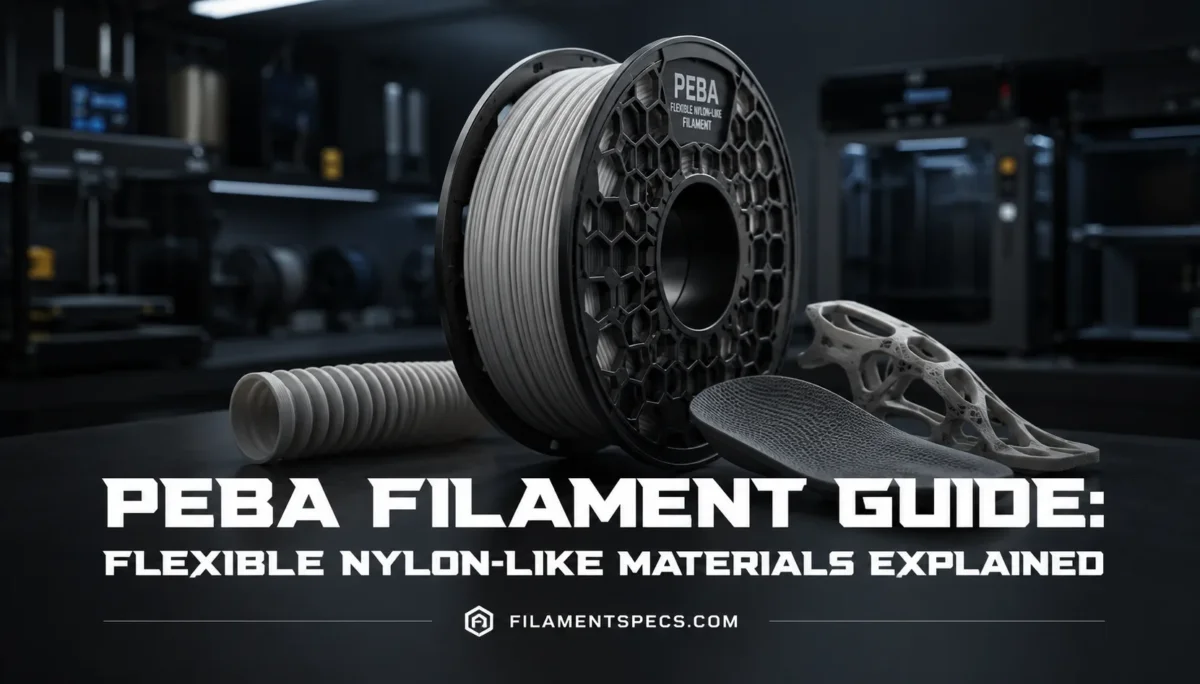
PEBA filament is a flexible thermoplastic elastomer made from rigid polyamide segments and softer polyether segments. The polyamide portion gives it some of the toughness, wear resistance, and chemical behavior associated with nylon, while the polyether portion allows repeated bending and elastic recovery. PEBA is therefore better described as a nylon-based elastomer than as ordinary flexible nylon. It is well suited to lightweight parts that must flex, survive impact, and return to shape, but it requires careful drying and controlled filament feeding.
| Property or Setting | Common Published Range | Practical Meaning |
|---|---|---|
| Commercial hardness examples | 90 Shore A to 95 Shore A | Flexible, but usually firmer and easier to push than very soft 60A or 70A elastomers |
| Filament density | About 1.00–1.01 g/cm³ | Parts can be lighter than those printed from many TPU formulations |
| Nozzle temperature | 225–260°C | The correct value depends on the grade, printing speed, and hotend temperature accuracy |
| Build plate temperature | 60–100°C | Larger parts may need the upper part of the product’s stated range |
| Drying conditions | 50–75°C for 4–8 hours | Drying temperature must follow the spool manufacturer’s instructions |
| Published print speeds | 20–120 mm/s | A conservative 20–60 mm/s starting range is more suitable for an untested printer profile |
| Nozzle type | Standard brass for unfilled grades | A hardened nozzle is not normally required unless the filament contains abrasive additives |
These ranges combine recommendations from several PEBA filament manufacturers and are not universal material limits. Fillamentum specifies 225–245°C and 20–40 mm/s for Flexfill PEBA 90A, while eSUN and Siraya Tech publish broader processing windows for their PEBA products.[b] [c] [d]
Why PEBA Feels Like Flexible Nylon
PEBA stands for polyether block amide. Its polymer chain contains alternating hard and soft regions. The rigid regions are polyamide, the polymer family that includes PA6, PA11, and PA12 nylons. The flexible regions are polyether. Changing the chemistry, length, and ratio of these regions allows manufacturers to produce grades ranging from soft elastomers to much firmer engineering materials.
Arkema describes its Pebax® PEBA family as block copolymers containing rigid polyamide segments and soft polyether segments. Standard Pebax grades generally use PA12 segments, while the partially bio-based Pebax Rnew range uses PA11 segments derived from castor oil.[a] Other PEBA suppliers may use different polyamide or polyether chemistry, so the acronym does not define one exact recipe.
PEBA is not a softened version of a standard nylon filament. It is a separate block-copolymer family. A PEBA 90A filament, PA12 filament, and flexible nylon blend can all contain polyamide chemistry while behaving very differently during feeding, extrusion, bending, and long-term loading.
PEBA Compared with TPU and Conventional Nylon
| Characteristic | PEBA Filament | TPU Filament | Conventional Nylon Filament |
|---|---|---|---|
| Material type | Polyamide-polyether block copolymer | Polyurethane elastomer | Mostly rigid polyamide |
| Typical printed feel | Flexible, springy, and relatively light | Ranges from soft and rubber-like to firm | Tough and slightly compliant, but normally not elastomeric |
| Energy behavior | Often selected for high rebound and low hysteresis | Many grades absorb and damp motion effectively | Resists impact but does not normally behave like a rubber spring |
| Moisture control | Drying is normally required | Moisture sensitivity varies; many grades still benefit from drying | Usually highly moisture-sensitive |
| Filament feeding | Best with a short, constrained path | Depends strongly on hardness; soft grades can buckle easily | Feeds more like a rigid filament |
| Dimensional stiffness | Lower than rigid nylon | Depends on hardness and formulation | Better for load-bearing geometry that must retain precise shape |
| Typical selection reason | Repeated flexing, impact recovery, low weight, or dynamic response | Grip, cushioning, seals, vibration damping, or general flexibility | Tough brackets, gears, fixtures, housings, and structural components |
PEBA is often compared with TPU because both materials are thermoplastic elastomers, but Shore hardness alone does not predict how they will feel in use. Two 95A materials can have different tensile modulus, compression behavior, rebound, tear strength, and creep. A PEBA part may feel more energetic when compressed and released, while a TPU part may dissipate more of that movement as heat.
This distinction matters for soles, impact-return elements, flexible couplings, and moving components. It matters less for a static bumper or cable grommet where energy return is not the design priority. PEBA should be selected for measured behavior, not only for its hardness label.
How Much PEBA Properties Vary by Grade
PEBA is a broad material family. A filament manufacturer can change the polyamide-to-polyether ratio, stabilizers, pigments, processing aids, and other modifiers. The resulting spool may differ in hardness, melt behavior, moisture absorption, surface friction, and heat response.
Published filament data illustrates this variation. eSUN reports a density of 1.01 g/cm³, flexural modulus of 80 MPa, elongation at break above 500%, and a Vicat softening point of 110°C for its PEBA 90A material. Fillamentum reports a density of 1.0 g/cm³, flexural modulus of 65 MPa, elongation above 1,000%, and 42 Shore D hardness for Flexfill PEBA 90A.[b] [c]
Those values should not be merged into an average. The manufacturers use different test standards, specimen conditions, and reporting formats. A filament sold as 90 Shore A can also have a published Shore D result because Shore A and Shore D are separate scales with an overlapping measurement region. The values are not interchangeable by subtracting or adding a fixed number.
Pellet-grade PEBA data should also be kept separate from printed-part data. For example, Arkema’s Pebax 7233 SA 01 pellet sheet lists a tensile modulus of 542 MPa, a flexural modulus of 513 MPa, and 69 instantaneous Shore D hardness. That is a much firmer PEBA grade than the flexible 90A and 95A filaments commonly sold for desktop printing. It also represents standardized pellet processing rather than a generic FFF result.[g]
Printer and Extruder Requirements
A Short, Constrained Filament Path
A direct-drive extruder normally gives the most predictable PEBA feeding because the distance between the drive gears and hotend is short. The filament path should provide little room for the material to bend sideways after leaving the gears. Worn gears, wide gaps, sharp tube transitions, and excessive spool drag can cause intermittent extrusion even when the nozzle is clear.
A Bowden printer can process some 90A or 95A PEBA filaments, but success depends on tube length, internal clearance, connector alignment, and extruder design. Retraction must usually be kept lower than it would be for PLA. Very fast reversals can stretch or compress the filament inside the tube, reducing extrusion consistency.
Hotend and Nozzle
Current PEBA filament recommendations commonly reach 245–260°C, so the hotend must be rated for the selected spool’s upper printing temperature. An all-metal heat break is preferable when a printer’s PTFE-lined hotend is not approved for sustained use at the required temperature.
A clean 0.4 mm brass nozzle is suitable for unfilled PEBA. A 0.6 mm nozzle can lower extrusion pressure and make feeding less sensitive to short flow interruptions. Hardened steel is necessary only when the specific filament contains abrasive fibers or mineral additives; the PEBA polymer itself does not automatically require an abrasion-resistant nozzle.
Spool Resistance
Flexible filament can stretch between the spool and extruder when the spool holder turns poorly. eSUN specifically recommends a low-resistance feeding system and unworn drive gears for its PEBA 90A filament.[b] A bearing-supported holder or filament dryer with a smooth outlet can reduce drag during long prints.
Do not compensate for spool drag by applying excessive extruder tension. Too much gear pressure can flatten or notch the filament, increasing friction in the guide path and making flow less stable.
Starting Print Settings
The spool manufacturer’s profile should be used before a generic PEBA profile. Products currently on the market show a wide processing range: Fillamentum recommends 225–245°C, eSUN recommends 230–260°C, and Siraya Tech recommends 230–260°C.[b] [c] [d]
| Setting | Starting Point | Adjustment Direction |
|---|---|---|
| Nozzle temperature | Middle of the manufacturer’s range | Increase for weak bonding or under-extrusion; decrease for excessive oozing or heat-softened detail |
| Build plate | 70°C when permitted by the product sheet | Increase for corner lift; reduce if the first layer remains overly soft |
| Print speed | 30–40 mm/s | Raise only after extrusion remains stable through curves and travel moves |
| First-layer speed | 15–20 mm/s | Keep slow until line placement and adhesion are repeatable |
| Retraction | Low; about 0.4 mm for a direct-drive trial | Increase in small steps only when the filament is dry and stringing remains |
| Part cooling | Moderate | Increase for overhangs; reduce when layers split or the surface turns brittle |
| Flow ratio | Calibrated near the slicer default | Use a measured wall or flow test rather than judging only by surface gloss |
These settings are diagnostic starting points, not a replacement for product instructions. Siraya Tech suggests low retraction, a slower first layer, and an initial print speed around 40–60 mm/s for its 95A grade. Fillamentum advises starting near 20–30 mm/s and increasing speed after stable extrusion is established.[c] [d]
Bed Adhesion and Enclosure Use
PEBA does not have one universal build-surface requirement. eSUN specifies PEI for its PEBA 90A, while Fillamentum warns that its product can be challenging on PEI and recommends glass or mirror with PVA glue or a nylon-compatible adhesive.[b] [c] Following the individual product sheet is safer than assuming all PEBA grades bond to the same surface.
An enclosure is not always required for small PEBA parts, but it can help large footprints, sharp corners, and tall models that cool unevenly. Siraya Tech recommends up to a 100°C bed for large full-plate prints to control warping.[d] The enclosure should not become hotter than the printer or filament manufacturer allows.
Mechanical Behavior in Printed Parts
Rebound and Hysteresis
Rebound describes how much energy a material returns after deformation. Hysteresis is the energy lost during a loading and unloading cycle, usually as heat. PEBA grades developed for dynamic parts often return more energy and lose less through hysteresis than damping-oriented elastomers.
eSUN reports 70% maximum resilience under ASTM D2632 for its PEBA 90A filament.[b] That result describes one formulation under one test method. It should not be presented as the rebound value for every PEBA filament or compared with a TPU percentage measured by another procedure.
Tensile Strength and Print Orientation
PEBA can stretch far without breaking, but layer orientation still matters. eSUN reports more than 16.5 MPa tensile strength and more than 520% elongation for XY-oriented printed samples. Its Z-oriented samples are reported at 7.5 MPa tensile strength and 150% elongation under GB/T 1040.[b]
The difference shows that a highly extensible polymer does not eliminate weak interlayer geometry. A loop, hinge, or strap should be oriented so its main tensile load travels along deposited roads rather than pulling layers apart. Increasing nozzle temperature can improve bonding within the permitted range, but overheating may reduce dimensional control and accelerate material degradation.
Abrasion, Tear, and Impact
PEBA is used for parts exposed to repeated movement because many grades combine abrasion resistance with high elongation and impact tolerance. Fillamentum reports an abrasion volume below 48 mm³ under ISO 4649 and no break in notched Izod testing at both 23°C and −40°C for Flexfill PEBA 90A.[c]
These values do not guarantee that a thin printed hinge or tread surface will last for a stated number of cycles. Layer orientation, wall thickness, surface texture, infill, contact pressure, temperature, and exposure to fluids all affect wear. A representative test piece should be cycled under the intended load before the part is treated as production-ready.
Heat Resistance Is Product-Specific
PEBA should not be treated as a high-temperature material merely because it contains polyamide segments. eSUN publishes a Vicat softening point of 110°C for PEBA 90A, while Siraya Tech publishes 92°C for Rebound PEBA 95A.[b] [d] The difference reflects formulation and test conditions rather than an error that can be resolved by averaging the values.
Vicat softening temperature is also not a safe continuous-use temperature. A flexible printed part can creep or lose shape at a lower temperature when it carries a steady load. Thin walls, compression, sunlight, confined hot air, and cyclic stress can further reduce usable temperature. Functional validation should reproduce both the temperature and mechanical load expected in service.
Moisture Absorption and Drying
PEBA is hygroscopic, meaning that it absorbs moisture from surrounding air. The absorbed water can turn into vapor in the hotend, producing popping sounds, bubbles, rough extrusion, stringing, weak surfaces, and inconsistent flow. A spool may therefore require drying even when it does not feel damp.
Published water-absorption values vary by grade and test method. Siraya Tech lists 1.69% under ISO 62 for its PEBA 95A filament, while Arkema lists 0.7% equilibrium absorption at 23°C and 50% relative humidity for the much firmer Pebax 7233 pellet grade.[d] [g] These values cannot be used as a single PEBA-wide moisture figure.
- Fillamentum specifies 70°C for five hours for Flexfill PEBA 90A.
- eSUN specifies 70–75°C for six to eight hours for PEBA 90A.
- Siraya Tech specifies 50–60°C for at least four to six hours for Rebound PEBA 95A.
- The spool should be stored in a sealed container or bag with active desiccant after drying.
- Long prints may benefit from feeding directly from a dryer or low-humidity dry box.
The different drying limits are important. Using the hottest value found for another brand can soften the filament, distort the spool, or alter additives. Drying temperature must come from the documentation for the exact product.
Common PEBA Printing Problems
| Symptom | Likely Cause | First Correction |
|---|---|---|
| Popping or foamy extrusion | Moist filament | Stop the print and dry the spool according to its product sheet |
| Heavy stringing after drying | High nozzle temperature, excessive travel time, or unsuitable retraction | Lower temperature in small steps before applying long retractions |
| Intermittent under-extrusion | Filament buckling, spool drag, worn gears, or a restricted nozzle | Inspect the feed path and reduce mechanical resistance |
| Weak layer bonding | Nozzle too cool, print too fast, or excessive cooling | Raise nozzle temperature within the approved range and reduce fan speed |
| Corners lifting | Insufficient bed adhesion or uneven cooling | Use the product-approved surface or adhesive and add a brim |
| Soft details and rounded edges | Too much heat or insufficient cooling | Lower nozzle temperature slightly or increase part cooling |
| Filament wraps around the drive gear | Unsupported gap after the gear or excessive feed pressure | Constrain the path and reduce idler pressure |
| Supports fuse to the model | Strong layer bonding and insufficient interface clearance | Increase support Z distance and reduce support density |
Stringing should not automatically be corrected with more retraction. When PEBA is wet, retraction tuning cannot remove the vapor and unstable melt flow caused by absorbed water. Drying, temperature verification, and feed-path inspection should come before aggressive slicer changes.
Suitable Uses for PEBA Filament
PEBA is most useful where a part must deform repeatedly and recover without behaving like a soft damping pad. Its low density is also useful where reducing moving mass matters.
- Flexible couplings and return elements: components that bend or compress and then restore their original geometry.
- Protective bumpers: parts requiring impact tolerance without the stiffness of conventional nylon.
- Sports prototypes: sole structures, pads, and elastic components used for fit or motion testing.
- Cold-environment components: flexible parts that must resist embrittlement at lower temperatures, subject to product validation.
- Wearable structures: straps, flexible frames, and body-conforming components that do not require certified skin-contact status.
- Bellows and flexible covers: geometries designed to accommodate movement while protecting an internal mechanism.
- Wheels and compliant rollers: light-duty prototypes where rebound and wear behavior are more useful than soft grip.
PEBA is less suitable for rigid brackets, dimensionally precise gears, heavily loaded fixtures, or parts that must remain compressed for long periods without creep. Conventional nylon, polycarbonate, or a reinforced engineering filament may fit those tasks better.
Chemical, Food-Contact, and Medical Limits
The polyamide content can give PEBA useful resistance to selected fuels, automotive fluids, ozone, and chemicals, but resistance is not universal. Fillamentum rates its PEBA product differently across water, oils, alcohols, hydrocarbons, acids, and solvents, and advises testing a sample against the intended substance.[c]
A material-family reputation is not enough for a sealed fluid component. The printed surface contains layer boundaries and possible voids, while colorants and processing aids may differ from the base resin. Chemical testing should use the exact filament, printed geometry, exposure temperature, fluid concentration, and contact duration.
PEBA does not automatically make a print food-contact compliant or medically approved. Fillamentum’s PEBA 90A data sheet states that its product is not recommended for food-contact or medical applications.[c] Product pages that list medical or wearable applications do not replace certification for the exact grade, printer process, additives, cleaning method, and finished object.
Processing Safety
Fillamentum’s safety data sheet does not classify Flexfill PEBA 90A as hazardous under the cited European classification regulation, but it warns that molten polymer can cause severe burns and that decomposition vapors may irritate the respiratory system. It advises adequate ventilation and avoiding overheating.[e]
NIOSH recommends controlling desktop 3D-printer particle and vapor emissions through suitable ventilation, enclosed systems, local exhaust, or evaluated filtration rather than assuming a filament is emission-free.[f] PEBA should be printed within the manufacturer’s temperature range in a ventilated area, with damaged thermistors, thermal-control faults, and smoking material treated as equipment or overheating failures.
PEBA Filament FAQ
Is PEBA filament the same as nylon?
No. PEBA contains rigid polyamide segments, but it also contains flexible polyether segments. Conventional nylon filament is mostly rigid, while PEBA behaves as an elastomer that can stretch, bend, and rebound.
Is PEBA easier to print than TPU?
Some 90A and 95A PEBA products can print faster than soft TPU because they are firm enough to feed more reliably. PEBA is still moisture-sensitive and can buckle in an unsupported filament path. Ease of printing depends on hardness, extruder geometry, spool drag, and the individual formulation.
Does PEBA require a direct-drive extruder?
A direct-drive extruder is preferred because it provides a shorter and better-constrained path. A well-designed Bowden system may print firmer PEBA grades, but long tubing, large internal clearances, and high retraction values make flow control more difficult.
Does PEBA filament require an enclosure?
Not for every print. Small parts may print successfully on an open machine when bed adhesion is stable. An enclosure can help large parts and sharp corners by reducing uneven cooling, but chamber temperature must remain within the printer and filament manufacturer’s limits.
Why does a new PEBA spool need drying?
Packaging reduces moisture exposure but does not prove that the spool reached the printer in a fully dry condition. Several PEBA manufacturers recommend drying before printing, including new material. The correct temperature ranges from about 50°C to 75°C among the cited products, so the exact spool instructions must be followed.
Can PEBA parts replace rubber components?
PEBA can replace some flexible components when its hardness, rebound, tear behavior, chemical resistance, and temperature response match the application. It is not a universal substitute for silicone, vulcanized rubber, or TPU. Seals, pressurized parts, and safety-related components require testing under the intended load and environment.
Can PEBA filament be used for food or medical parts?
Only when the exact material grade, additives, manufacturing process, and finished object meet the applicable requirements. A general PEBA label or a manufacturer’s application example is not enough. Some consumer PEBA filament documentation specifically advises against food-contact and medical use.
Sources
- Arkema — Pebax® Elastomer Family — Supports the description of PEBA block chemistry, grade variation, and PA11- or PA12-based segments. (Official polymer manufacturer reference.)
- eSUN — PEBA-90A Technical Data Sheet — Supports product-specific physical properties, printed XY and Z test results, drying conditions, and printing parameters. (Official filament technical data sheet.)
- Fillamentum — Flexfill PEBA 90A Technical Data Sheet — Supports mechanical values, low-temperature impact behavior, chemical-resistance cautions, printing settings, and stated application restrictions. (Official filament technical data sheet.)
- Siraya Tech — Rebound PEBA 95A Technical Data Sheet — Supports product hardness, moisture behavior, drying guidance, printing ranges, extruder recommendations, and support-removal limits. (Official filament technical reference.)
- Fillamentum — Flexfill PEBA 90A Safety Data Sheet — Supports handling, ventilation, molten-polymer burn, overheating, and decomposition-vapor precautions. (Official product safety document.)
- NIOSH — Approaches to Safe 3D Printing — Supports ventilation and engineering-control recommendations for desktop material-extrusion printers. (Official occupational safety guidance.)
- Arkema — Pebax® 7233 SA 01 Technical Data Sheet — Supports the example of a firmer pellet-grade PEBA and its standardized mechanical, thermal, density, and water-absorption values. (Official polymer technical data sheet.)