
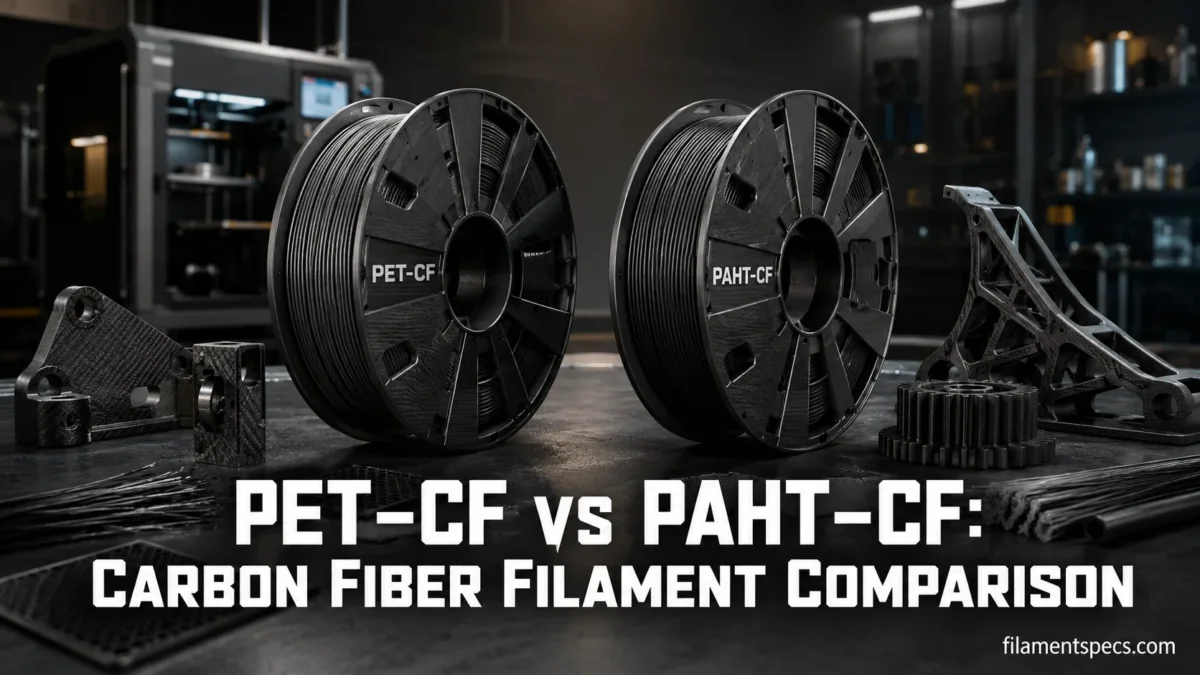
| Comparison Point | PET-CF [a] | PAHT-CF [b] | Practical Reading |
|---|---|---|---|
| Base Polymer | PET, carbon fiber | PA 12 and other long-chain polyamides, carbon fiber | PET-CF behaves more like a stiff, low-moisture polyester composite; PAHT-CF behaves more like a heat-rated nylon composite. |
| Density | 1.29 g/cm³ | 1.06 g/cm³ | PAHT-CF can produce lighter parts for the same printed volume. |
| HDT at 0.45 MPa | 205 °C | 194 °C | PET-CF has the higher light-load heat deflection number. |
| HDT at 1.8 MPa | 182 °C | 170 °C | PET-CF also leads under the higher HDT load, but HDT is not the same as long-term service temperature. |
| Vicat Softening Temperature | 226 °C | 220 °C | Both sit in high-temperature FDM territory; PET-CF is slightly higher on this metric. |
| Melting Temperature | 250 °C | 225 °C | PET-CF has the higher melting point in the referenced data. |
| Saturated Water Absorption | 0.37% at 25 °C, 55% RH | 0.88% at 25 °C, 55% RH | PET-CF absorbs less moisture, which helps dimensional stability and storage behavior. |
| Young’s Modulus, X-Y | 4730 ± 260 MPa | 3860 ± 230 MPa | PET-CF is stiffer in the printed plane. |
| Young’s Modulus, Z | 2160 ± 170 MPa | 2180 ± 130 MPa | Z stiffness is nearly even in the referenced tests. |
| Tensile Strength, X-Y | 74 ± 6 MPa | 92 ± 7 MPa | PAHT-CF has higher tensile strength in the printed plane. |
| Tensile Strength, Z | 35 ± 5 MPa | 47 ± 5 MPa | PAHT-CF has better Z tensile strength, useful for parts that cannot be oriented perfectly. |
| Breaking Elongation, X-Y | 4.5 ± 1.2% | 8.4 ± 1.8% | PAHT-CF allows more strain before breaking in the printed plane. |
| Bending Modulus, X-Y | 5320 ± 270 MPa | 4230 ± 210 MPa | PET-CF is the stiffer bending material. |
| Bending Strength, X-Y | 131 ± 6 MPa | 125 ± 7 MPa | Both are strong in bending; PET-CF is slightly higher in the referenced X-Y number. |
| Impact Strength, X-Y | 36.0 ± 2.7 kJ/m² | 57.5 ± 3.4 kJ/m² | PAHT-CF handles impact loads better. |
| Impact Strength, Z | 4.5 ± 0.6 kJ/m² | 13.3 ± 0.8 kJ/m² | PAHT-CF has the clear advantage for interlayer impact resistance. |
| Nozzle Temperature | 260–290 °C | 260–290 °C | Both need a printer that can run high nozzle temperatures. |
| Bed Temperature | 80–100 °C | 80–100 °C | The bed setup is similar, with glue often used as a release and adhesion aid. |
| Recommended Nozzle | 0.6 mm hardened steel recommended; 0.4 and 0.8 mm supported | 0.6 mm hardened steel recommended; 0.4 and 0.8 mm supported | Carbon fiber is abrasive. Hardened nozzles are the normal choice. |
| Main Advantage | Stiffness, low moisture uptake, dimensional stability, high HDT | Tensile strength, impact resistance, Z bonding, lighter density | Pick by part load, not by name alone. |
PET-CF and PAHT-CF are both carbon-fiber-filled engineering filaments, but they are not close substitutes once the part has a job to do. PET-CF is the better match when the printed part needs high stiffness, low moisture pickup, and stable dimensions. PAHT-CF is the stronger choice when the part needs higher tensile strength, better impact behavior, and safer performance across layer lines.
The short material names hide a lot. PET-CF is a PET-based composite. PAHT-CF is a polyamide-based composite, often described as high-temperature nylon. Both are much more demanding than PLA, PETG, or standard nylon. Both need drying, a hardened nozzle, careful bed setup, and a printer that can hold a warm chamber environment. The real difference is not “which one is stronger” in every direction. It is which material keeps the right balance of stiffness, strength, heat resistance, moisture control, and layer bonding for the part being printed.
Table of Contents
⚙️ Material Chemistry and What It Changes
PET-CF is based on polyethylene terephthalate, reinforced with chopped carbon fiber. It should not be treated as PETG-CF. PET and PETG share chemistry in name, but PET-CF usually aims for higher heat resistance, better stiffness, and lower moisture behavior than common PETG blends. In the referenced PET-CF data, the base composition is listed as polyethylene terephthalate and carbon fiber, with a 250 °C melting temperature and 75 °C glass transition temperature.
The carbon fiber does several things at once. It raises stiffness, reduces shrinkage, gives the surface a matte technical finish, and reduces how much the printed part behaves like a soft thermoplastic. It also makes the filament abrasive. A brass nozzle may still extrude it for a short test, but long prints are a different story. Hardened steel or a more wear-resistant nozzle is the normal setup.
PAHT-CF is a carbon-fiber-filled polyamide material. In the referenced data, its composition is PA 12 and other long-chain polyamides with carbon fiber. That matters because polyamide chemistry gives PAHT-CF better toughness and interlayer behavior than a stiffer, more brittle composite. Nylon-based composites still need serious moisture control, but PAHT-CF is designed to keep useful mechanical performance when exposed to moisture better than many older nylon-CF materials.
Useful distinction: PET-CF is usually the more dimensionally calm material. PAHT-CF is usually the more forgiving structural material when impact, tensile load, or Z-direction stress is part of the design.
Why Carbon Fiber Does Not Mean “Always Stronger”
Carbon fiber raises stiffness more predictably than it raises every type of strength. A carbon-fiber filament can feel rigid and print beautifully while still having weak Z impact behavior if the polymer matrix does not bond layers well. That is why PET-CF and PAHT-CF should be compared through several numbers, not one headline value.
- Stiffness describes resistance to bending or stretching.
- Tensile strength describes how much pulling stress a sample handles before failure.
- Impact strength describes how well the sample handles sudden energy.
- Z performance describes how well printed layers work together.
- Heat deflection describes deformation under a defined load and test setup.
🧩 Mechanical Behavior: Stiffness, Strength, and Layer Direction
PET-CF wins on stiffness. The referenced PET-CF flexural modulus in X-Y is 5320 ± 270 MPa, compared with 4230 ± 210 MPa for PAHT-CF. That makes PET-CF feel more rigid in brackets, fixture plates, arms, housings, and parts where bending deflection is the main problem.
PAHT-CF wins on tensile strength and impact resistance. Its X-Y tensile strength is 92 ± 7 MPa, compared with 74 ± 6 MPa for PET-CF. Its X-Y impact strength is also higher: 57.5 ± 3.4 kJ/m² against 36.0 ± 2.7 kJ/m² for PET-CF. This is why PAHT-CF often fits parts that may see vibration, bolt load, clips, knocks, or awkward load directions.
Mechanical Reading Without the Noise
Stiffness in X-Y PET-CF Leads
Tensile Strength in X-Y PAHT-CF Leads
Impact Strength in Z PAHT-CF Leads
X-Y Strength vs Z Strength
Most FDM parts are weaker between layers than along the print paths. This is more visible with carbon-fiber materials because the chopped fibers mostly align with extrusion direction. PET-CF has very high bending stiffness in X-Y, but its Z tensile strength is 35 ± 5 MPa. PAHT-CF reaches 47 ± 5 MPa in Z tensile strength and 13.3 ± 0.8 kJ/m² in Z impact strength. That is a real design difference.
Use PET-CF when the part can be oriented so the main loads stay inside the X-Y plane. Use PAHT-CF when the part shape creates layer-line stress that cannot be avoided. Orientation still matters. It matters a lot.
🌡️ Heat and Moisture Behavior
On heat deflection numbers, PET-CF is slightly ahead. The referenced data lists PET-CF at 205 °C HDT under 0.45 MPa and 182 °C under 1.8 MPa. PAHT-CF is listed at 194 °C under 0.45 MPa and 170 °C under 1.8 MPa. These are high values for FDM materials, especially when compared with everyday PLA, PETG, or ABS families.
HDT needs careful reading. ISO 75-1 describes the temperature of deflection under load test and notes that the results do not directly predict actual end-use performance or long-term endurance at elevated temperature.[c] In plain terms, a 205 °C HDT number does not mean every PET-CF part should be used continuously at 205 °C. Geometry, load, wall thickness, annealing, creep, airflow, and the exact time under heat all matter.
Moisture is where PET-CF gets a clean advantage. Its saturated water absorption rate is listed at 0.37% under the stated condition, while PAHT-CF is listed at 0.88%. That does not make PET-CF moisture-proof, but it means PET-CF is usually less reactive to storage humidity and print-room humidity. Lower moisture uptake helps with cleaner extrusion, tighter dimensions, and less variability across repeat parts.
Drying Is Still Required
Both materials should be treated as dry-box materials. The referenced printing settings list 80 °C for 8–12 hours before printing, with printing and storage humidity kept below 20% RH in a sealed container with desiccant. PAHT-CF is more moisture-sensitive by chemistry, but PET-CF also loses print quality when moisture is allowed into the filament.
Practical drying note: moisture can show as rough surface texture, popping, inconsistent extrusion, weak layer bonding, and fuzzy edges. With carbon-fiber materials, those defects can be harder to judge visually because the matte surface hides small extrusion problems.
🖨️ Printing Setup and Hardware Needs
PET-CF and PAHT-CF sit in the same general print-temperature range. Both use 260–290 °C nozzle temperature, 80–100 °C bed temperature, and a recommended chamber temperature of 45–60 °C in the referenced data. Both are listed with 0.4, 0.6, and 0.8 mm nozzles, with 0.6 mm recommended. That recommendation is not random. A larger nozzle gives chopped fiber and filled polymer more room to flow.
The print speed limit is also similar: under 100 mm/s. These materials can print cleanly, but they are not ideal when the goal is maximum speed. They reward steady extrusion, stable heat, clean drying, and controlled cooling. Fast does not always mean better here.
Cooling Fan Difference
PET-CF is listed with 0–60% cooling fan. PAHT-CF is listed with 0–40%. In practice, that means PET-CF may tolerate a little more part cooling when details or overhangs need help. PAHT-CF usually wants warmer conditions to protect layer bonding and reduce stress.
| Printer Area | PET-CF Setup | PAHT-CF Setup | Reason |
|---|---|---|---|
| Nozzle | Hardened steel, 0.6 mm preferred | Hardened steel, 0.6 mm preferred | Carbon fiber is abrasive and can wear softer nozzle materials. |
| Build Surface | Engineering plate, high-temperature plate, or textured PEI with glue | Engineering plate, high-temperature plate, or textured PEI with glue | Glue helps adhesion and can also protect the build surface during release. |
| Chamber | 45–60 °C recommended | 45–60 °C recommended | A warm chamber reduces stress and helps larger parts stay stable. |
| Support Material | Support for PA/PET | Support for PA/PET | Breakaway support designed for these polymer families can improve supported surfaces. |
| Post-Processing Heat | Annealing range listed as 80–140 °C for 6–12 hours | Annealing range listed as 80–130 °C for 6–12 hours | Annealing may improve heat and mechanical behavior, but part shape can distort. |
📐 Part Design: Where Each Filament Makes More Sense
PET-CF is the better pick when the part needs to stay rigid under steady load. A flat jig plate, camera mount, gauge holder, machine spacer, electronics bracket, or heat-exposed cover may benefit from PET-CF’s higher stiffness and lower moisture absorption. The part feels firm. It also tends to hold shape well when printed and dried correctly.
PAHT-CF is the better pick when load paths are mixed. Think of a bracket with screws pulling across layers, a fixture that may be bumped, a part with ribs in several directions, or a mount that cannot be printed in the perfect orientation. PAHT-CF’s higher tensile strength, higher elongation, and better Z impact performance give it a wider safety margin in those shapes.
Fastener Bosses, Inserts, and Holes
Both materials can work with threaded inserts, bolts, and press-fit features, but the design should not rely on thin walls. Carbon-fiber composites are stiff, and stiff materials can concentrate stress around holes. PAHT-CF has better strain and impact behavior, so it is usually friendlier around fasteners. PET-CF can still work very well, but it prefers thicker bosses, generous radii, and load paths that do not pry layers apart.
- Use larger fillets around screw bosses.
- Keep hole edges away from thin walls.
- Avoid printing long load-bearing arms in an orientation that pulls layers apart.
- Use more perimeters rather than relying only on infill percentage.
- Test one real part before making a full batch.
Annealing and Dimensional Planning
Annealing can improve heat behavior, but it adds a second design step. Both referenced data sheets note that annealing results depend on time, temperature, model size, structure, infill, and print settings. Some prints may warp or deform during annealing. That is not a defect in one material. It is part of working with semi-crystalline engineering polymers.
For tight-tolerance parts, measure after drying and annealing, not before. PET-CF usually has the better case for tight dimensional work because of lower moisture uptake and high stiffness. PAHT-CF can still be accurate, but nylon-based materials need more disciplined storage and print-room control.
🧪 Better Use Cases for PET-CF and PAHT-CF
PET-CF Fits Best When the Part Needs
- High flexural stiffness with limited deflection.
- Better moisture stability than nylon-based carbon fiber materials.
- High heat deflection under a defined test load.
- Low shrinkage and controlled shape on functional prints.
- Fixture plates, brackets, covers, arms, holders, and gauge components.
PAHT-CF Fits Best When the Part Needs
- Higher tensile strength in X-Y and Z directions.
- Better impact behavior, especially across layers.
- More elongation before break compared with PET-CF.
- Lighter printed volume due to lower density.
- Fixtures, tool mounts, functional prototypes, fastener-loaded parts, and production aids.
| Part Requirement | Better First Choice | Why |
|---|---|---|
| Maximum stiffness in a flat printed part | PET-CF | Higher X-Y flexural modulus and higher X-Y Young’s modulus. |
| Higher tensile strength | PAHT-CF | Higher X-Y and Z tensile strength in the referenced data. |
| Impact resistance | PAHT-CF | Higher impact strength in both X-Y and Z directions. |
| Lowest moisture uptake | PET-CF | Lower listed saturated water absorption rate. |
| Thin bracket with screw load across layers | PAHT-CF | Better Z tensile and Z impact numbers. |
| Heat-exposed rigid cover or shield | PET-CF | Higher HDT and strong dimensional behavior when the load is controlled. |
| Large flat fixture plate | PET-CF | Stiffness and low moisture behavior help repeatable geometry. |
| Part with unavoidable mixed load direction | PAHT-CF | Better balance of strength, impact resistance, and interlayer behavior. |
📊 Reading the Test Data Correctly
The referenced mechanical values are dry-state specimen values. They are not a promise that every printed part will match the same number. The PET-CF and PAHT-CF data sheets list specimen conditions such as 100% infill, defined nozzle and bed temperatures, print speed, drying, and annealing. A real part may use different walls, infill, layer height, orientation, cooling, chamber temperature, and geometry.
ISO 527-1 gives general principles for determining tensile properties of plastics and plastic composites under defined conditions.[d] That phrase matters: defined conditions. The value is useful for comparison, not for ignoring part design. When comparing against other brands, also check whether the data uses ISO 527, ASTM D638, ISO 178, ISO 179, or another method. Different test standards and specimen shapes can give numbers that should not be mixed casually.
ASTM D638 is another widely used tensile test method for plastic materials and is designed to produce tensile property data for material control, specification, and characterization.[e] If one filament brand reports ISO 527 and another reports ASTM D638, the numbers may still be helpful, but they are not a perfect one-to-one comparison.
Material choice rule: choose PET-CF for stiff, stable, heat-resistant parts with controlled load paths. Choose PAHT-CF for stronger, tougher, more layer-tolerant parts where the load direction is less friendly.
FAQ
Is PET-CF stronger than PAHT-CF?
PET-CF is stiffer, but PAHT-CF has higher tensile strength and higher impact strength in the referenced data. PET-CF has higher X-Y flexural modulus, while PAHT-CF has higher X-Y tensile strength, Z tensile strength, X-Y impact strength, and Z impact strength.
Which filament handles heat better, PET-CF or PAHT-CF?
PET-CF has the higher listed HDT values: 205 °C at 0.45 MPa and 182 °C at 1.8 MPa. PAHT-CF is listed at 194 °C at 0.45 MPa and 170 °C at 1.8 MPa. HDT should be read as a test value, not as a guaranteed long-term operating temperature.
Which is easier to store, PET-CF or PAHT-CF?
PET-CF is usually easier to manage because its listed saturated water absorption rate is lower. Still, both materials should be dried before printing and stored in a sealed dry container with desiccant.
Do PET-CF and PAHT-CF need an enclosure?
An enclosure is strongly preferred for both. The referenced settings list a 45–60 °C chamber temperature. A warm, stable chamber helps reduce internal stress, improves layer behavior, and makes larger technical parts more repeatable.
Can PET-CF or PAHT-CF print with a brass nozzle?
A brass nozzle is not a good long-term choice. Carbon fiber is abrasive and can enlarge the nozzle opening, changing extrusion width and surface quality. Hardened steel, or another abrasion-resistant nozzle, is the safer setup.
Which one is better for functional parts?
Both can make functional parts. PET-CF is better for stiff, dimensionally stable parts. PAHT-CF is better for stronger, tougher parts with fasteners, impact, or mixed load directions. The part design decides the winner.
Is PET-CF the same as PETG-CF?
No. PET-CF is based on PET, while PETG-CF is based on glycol-modified PET. PET-CF is usually aimed at higher heat resistance and engineering stiffness. PETG-CF is usually easier to print but does not target the same heat and stiffness level.
Should PET-CF and PAHT-CF parts be annealed?
Annealing can improve heat and mechanical behavior, but it can also change dimensions or cause deformation. For accurate parts, print a test sample, anneal it using the same process planned for the final part, and measure after cooling.
References Used for This Article
- [a] Bambu PET-CF Technical Data Sheet V3.0 — used for PET-CF composition, print settings, HDT, water absorption, mechanical values, and annealing notes. (Primary manufacturer technical data sheet for the referenced PET-CF material.)
- [b] Bambu PAHT-CF Technical Data Sheet V3.0 — used for PAHT-CF composition, print settings, HDT, water absorption, mechanical values, and annealing notes. (Primary manufacturer technical data sheet for the referenced PAHT-CF material.)
- [c] ISO 75-1:2020 — used for the explanation of heat deflection temperature testing and why HDT values should not be treated as direct long-term service temperatures. (International Organization for Standardization page for the plastics HDT test method.)
- [d] ISO 527-1:2019 — used for the tensile-test context behind the reported tensile strength and modulus values. (International Organization for Standardization page for plastics tensile-property testing principles.)
- [e] ASTM D638 — used to clarify why tensile values from different datasheets should be compared only when the test method is understood. (ASTM International standard page for tensile properties of plastics.)