
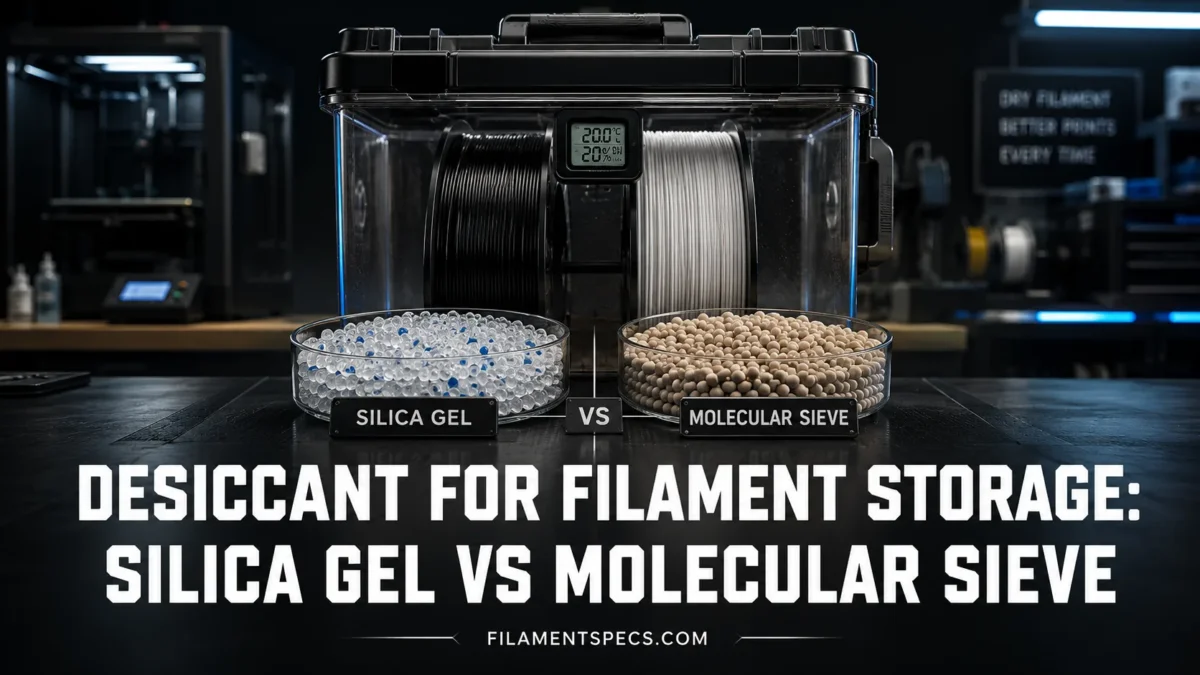
Desiccant choice matters most after the filament is already dry. Silica gel and molecular sieve both remove moisture from sealed air, but they do it with different strengths: silica gel is easier and cheaper for everyday filament storage, while molecular sieve can hold very low humidity more aggressively in a tightly sealed box. For most PLA, PETG, ABS, ASA, and occasional TPU users, silica gel is the practical default. For nylon, PVA, BVOH, PC blends, and long storage in humid rooms, molecular sieve becomes more interesting.
| Comparison Point | Silica Gel | Molecular Sieve | Filament Storage Meaning |
|---|---|---|---|
| Best Everyday Use | General dry boxes, vacuum bags, storage bins, filament cabinets | Low-RH storage for moisture-sensitive filaments and sealed systems | Silica gel is easier for most hobby setups; molecular sieve is better when the goal is very dry air. |
| Material Type | Porous amorphous silica, commonly based on silicon dioxide [b] | Crystalline aluminosilicate zeolite with uniform pores | Silica gel adsorbs across a broad humidity range; molecular sieve is more size-selective. |
| Typical Filament Target | Good for keeping many spools below about 20–30% RH in a sealed box | Better for pushing a well-sealed box toward very low RH | Use the hygrometer reading, not the desiccant name, as the final check. |
| Low-Humidity Performance | Works, but may not pull very low RH as strongly once the air is already dry | Strong performance at low RH because water fits into small pores very well | Helpful for nylon, PVA, BVOH, TPU, PC, and long-term engineering filament storage. |
| Ease of Reuse | Easy to regenerate in many home ovens or dedicated desiccant dryers, depending on product label | Usually needs much higher heat for proper regeneration | Silica gel is simpler to maintain. Molecular sieve can become “spent” if it is never fully reactivated. |
| Visual Indicator | Often available as orange/green or other color-changing beads | Usually no built-in color indicator | Silica gel is easier to monitor visually, but a digital hygrometer is still better. |
| Cost and Availability | Low cost, widely sold in packets, beads, and canisters | Usually more expensive per gram | Silica gel wins for many spools. Molecular sieve is worth using selectively. |
| Main Limitation | Can saturate faster in humid rooms or leaky containers | Harder to regenerate and easier to waste in a leaky box | The container seal often matters more than the desiccant upgrade. |
| Best Verdict | Best default choice | Best low-RH specialist | Use silica gel first. Add molecular sieve when the filament or climate demands it. |
Table of Contents
🧵 Which Desiccant Should You Use for Filament Storage?
For a normal 3D printing setup, start with rechargeable silica gel. It is affordable, easy to find, easy to regenerate, and easy to use in spool boxes, cereal-container dry boxes, vacuum bags, plastic storage totes, and AMS-style filament storage systems.
Molecular sieve is not a universal replacement. It is more like a specialist tool. It makes sense when the container is genuinely sealed, the room humidity is high, or the filament is highly moisture-sensitive. Think nylon, PVA, BVOH, PC, flexible TPU, and filled engineering filaments.
Practical Verdict: Use silica gel for most spools. Use 3A molecular sieve when you need lower humidity than silica gel can maintain in the same sealed container.
The common mistake is buying stronger desiccant before fixing the box. A leaky container, loose PTFE exit, poor lid gasket, or frequently opened dry box can defeat both materials. Desiccant is not magic. It needs trapped air.
- For PLA: silica gel is usually enough unless the room is very humid.
- For PETG: silica gel works well if the box seals properly and the beads are recharged.
- For TPU: silica gel can work, but molecular sieve is useful for longer storage.
- For nylon and PVA: molecular sieve or a controlled dry cabinet is more fitting.
- For wet filament: use heat-based filament drying first, then store with desiccant.
⚙️ How Desiccants Work Inside a Filament Box
Adsorption, Not Just “Moisture Absorbing”
Most filament storage desiccants work mainly by adsorption. Water molecules attach to internal surfaces inside porous beads rather than simply soaking into the material like liquid into a sponge. IUPAC defines adsorption capacity as the amount of substance an adsorbent can hold under defined conditions, and that condition part matters: temperature, humidity, pore structure, and exposure time all change the result [a].
This is why two dry boxes with the same amount of desiccant can behave differently. One has a good gasket. The other leaks around the lid. One is opened once a month. The other is opened twice a day. Same beads. Very different RH.
Relative Humidity Is the Number That Matters
Filament does not care whether the label says “premium desiccant.” It cares about the moisture around it. A small digital hygrometer gives the most useful feedback because the real question is simple: what RH does the sealed box hold after it stabilizes?
For many storage setups, a stable reading under 30% RH is acceptable for less sensitive materials. More moisture-sensitive filaments often benefit from lower storage humidity, especially if they will sit unused for weeks. Some filament dry boxes list targets such as below 30% RH for PLA/ABS and below 20% RH for PETG, TPU, PVA, PC, and BVOH [g].
Desiccant Maintains Dryness Better Than It Dries Wet Filament
This point is easy to miss. A sealed box with desiccant can slow moisture pickup and preserve a dry spool. It is not the same as actively drying a wet spool from the inside.
Filament moisture is inside the polymer, not only on the surface. Once nylon, TPU, PETG, or PVA has absorbed enough water, the reliable fix is controlled heat for the right time and temperature. Prusa’s filament drying guidance separates prevention from drying and recommends closed storage with desiccant while also listing active drying temperatures for different materials [f].
Storage Rule: Dry first. Store second. If a spool already pops, bubbles, strings badly, or prints with a rough surface, desiccant alone may only hide the problem slowly.
🔵 Silica Gel for Filament Storage
What Silica Gel Is
Silica gel is a porous form of silica, commonly associated with silicon dioxide chemistry [b]. The bead is full of tiny internal surfaces where water vapor can attach. That makes it useful in packaging, electronics, camera storage, museum storage, and 3D printer filament boxes.
In filament storage, silica gel is popular because it is forgiving. You can buy it as packets, loose beads, canisters, printed cartridge inserts, refillable pods, or color-indicating beads. It also fits the way most people actually store filament: simple sealed boxes, vacuum bags, and printer-side dry boxes.
Where Silica Gel Works Well
- Everyday PLA storage: useful for preventing slow moisture pickup after opening a spool.
- PETG storage: works well when the box is sealed and the gel is regenerated before it is fully saturated.
- ABS and ASA: generally practical for storage, especially if the spool is not left open on the shelf.
- Mixed filament bins: affordable enough to use in larger amounts.
- Visual maintenance: indicating beads make it easier to see when a recharge is due.
Silica gel also tolerates casual use better. If you forget a packet in a box for a while, you can usually regenerate it and return it to service, as long as the product label allows heat reactivation. Simple. Useful.
Where Silica Gel Starts to Struggle
Silica gel can saturate quickly if the container leaks or the room is humid. It can also be less aggressive once the box is already at very low RH. Laboratory and engineering studies show that silica gel adsorption behavior depends heavily on vapor pressure, pore structure, and temperature; one tested silica-gel-based desiccant material reached about 0.285 g of water per gram under the study’s tested high-humidity conditions, but that number should not be treated as a universal value for every bead sold for hobby storage [e].
That last part matters. Retail silica gel products vary in bead size, indicator type, pore distribution, packet material, and regeneration instructions. A cheap packet from random packaging is not the same as fresh rechargeable beads in a breathable canister.
Best Form of Silica Gel for 3D Printing
Recommended Silica Gel Format
Use rechargeable orange or non-indicating silica gel beads in a vented container, mesh bag, or printed cartridge. Add a hygrometer. Recharge the beads when the box can no longer stay near the target RH.
For hobby 3D printing, orange/green indicating silica gel is usually more convenient than old blue/pink indicating gel. Some blue indicating silica gel uses cobalt chloride; the U.S. National Park Service has advised replacing cobalt-indicating silica gel in museum microclimate work and using precautions when handling silica gel dust [h].
This does not mean every silica gel packet is unsafe. It means filament users should choose clean, sealed, clearly labeled products, avoid breathing dust, and keep loose beads away from children, pets, fans, food surfaces, and open electronics.
🧪 Molecular Sieve for Filament Storage
What Molecular Sieve Is
Molecular sieve is usually a synthetic zeolite desiccant. Its pores are more uniform than silica gel. The name comes from the molecular sieve effect: pore access depends on molecule size, so smaller molecules may enter while larger ones are excluded [c].
This is why molecular sieve is attractive for moisture control. Water is small and strongly attracted to many zeolite structures. In a sealed filament box, molecular sieve can pull the internal air down to lower RH than basic silica gel in many cases.
3A vs 4A Molecular Sieve
The number matters. 3A and 4A are not marketing names; they refer to pore opening size in angstroms. Sigma-Aldrich describes 3A molecular sieve as a potassium-modified type A sieve with an effective pore size around 3 Å, while 4A has an effective pore opening around 4 Å [d].
| Type | Approximate Pore Size | Main Behavior | Usefulness for Filament Storage |
|---|---|---|---|
| 3A | About 3 Å | Very selective for water and very small molecules | Usually the best molecular sieve choice for filament dry boxes because it focuses strongly on water. |
| 4A | About 4 Å | Adsorbs water and some slightly larger small molecules | Can work for dry boxes, but 3A is often preferred when the goal is selective moisture removal. |
| 5A | About 5 Å | Adsorbs a broader range of small molecules | Usually not needed for filament storage. |
| 13X | Larger pore zeolite | Broader adsorption profile | More common in industrial gas drying than simple spool storage. |
Where Molecular Sieve Works Well
- Nylon storage: useful because polyamide absorbs moisture readily and print quality can change fast.
- PVA and BVOH support material: useful for materials that can degrade badly with moisture exposure.
- TPU storage: useful when flexible filament sits unused for a long time.
- PC and engineering blends: useful when dry handling matters for strength and surface quality.
- Very humid rooms: useful if the box is sealed well enough to hold the low-RH benefit.
Molecular sieve shines when the target is not just “less humid,” but very dry and stable. A well-sealed dry box with molecular sieve can stay impressively low on a hygrometer. A leaky one will simply consume expensive desiccant.
Where Molecular Sieve Is Less Convenient
The main issue is regeneration. Molecular sieve often needs higher reactivation temperatures than simple silica gel products. A filament dryer that reaches 50–80°C may dry filament, but it may not fully regenerate molecular sieve. Thermal cycling also affects adsorbents differently; published work on temperature swing adsorption found capacity loss patterns in zeolites and silica gels after thousands of high-temperature cycles [i].
For home users, that means one thing: check the product’s data sheet before buying. If the molecular sieve requires a regeneration temperature your oven or dryer cannot safely and accurately reach, it may become a disposable desiccant in practice.
Buying Note: For filament storage, look for 3A molecular sieve beads, not random “molecular sieve powder.” Beads are cleaner, easier to contain, and less likely to spread dust in a dry box.
🧶 Desiccant Choice by Filament Type
Not every filament deserves the same storage effort. PLA on a desk for a few days is not the same as nylon in a humid room for a month. The more hygroscopic the polymer, the more a low-RH storage box matters.
| Filament | Moisture Sensitivity | Suggested Storage RH | Better Desiccant Choice | Storage Comment |
|---|---|---|---|---|
| PLA | Low to moderate | Below 30% RH is a good target for controlled storage | Silica gel | Usually forgiving, but wet PLA can still string, pop, or print rough. |
| PETG | Moderate | Below 20% RH is a better target for dry-box storage | Silica gel or molecular sieve | PETG often shows moisture through stringing, tiny bubbles, and dull surface texture. |
| ABS | Low to moderate | Below 30% RH is usually practical | Silica gel | Keep sealed between prints, especially in humid rooms. |
| ASA | Moderate | Below 30% RH, lower if possible | Silica gel or molecular sieve | Dry storage supports cleaner surfaces and more stable printing. |
| TPU | Moderate to high | Below 20% RH, ideally lower for long storage | Molecular sieve for long storage | Flexible filaments can absorb moisture and become stringy or inconsistent. |
| Nylon / PA | High | As low as your sealed setup can reliably maintain | Molecular sieve | Drying before printing and sealed storage after drying are both strongly recommended. |
| PVA / BVOH | Very high | Below 20% RH or controlled dry cabinet conditions | Molecular sieve | Store sealed immediately after use. These support materials dislike open-air storage. |
| PC / PC Blend | High | Below 20% RH | Molecular sieve | Best stored in a serious dry box or dry cabinet after active drying. |
| Carbon-Fiber Filled Nylon | High | Very low RH preferred | Molecular sieve | The fiber does not remove the polymer’s moisture sensitivity. Treat it like nylon. |
Why Nylon Needs More Attention Than PLA
PLA can often tolerate casual storage for a while. Nylon cannot. Polyamide materials can absorb moisture quickly enough that a spool may print well one week and poorly the next, especially in warm and humid rooms. Wet nylon may show steam bubbles, rough extrusion, weak layer bonding, surface fuzz, and louder extrusion through the nozzle.
Desiccant does not replace drying here. It protects the drying work you already did.
Why PETG Sits in the Middle
PETG is not as demanding as nylon, but it benefits from dry storage more than many beginners expect. If PETG prints with extra stringing, tiny surface pits, or inconsistent gloss, moisture can be one possible cause. A sealed box with fresh silica gel is usually enough. If PETG sits for months, molecular sieve becomes reasonable.
📦 Best Storage Setups for Each Desiccant
Vacuum Bags
Vacuum bags are cheap and space-saving. They work best with silica gel packets because the desiccant only needs to manage the small amount of air left in the bag and any minor leakage over time.
- Use one dry packet or small bead pouch per spool.
- Add a humidity indicator card if the bag allows easy reading.
- Do not trust the “vacuum look” alone; bags can slowly leak.
- Replace or recharge desiccant when the indicator shows moisture.
Molecular sieve can also work in vacuum bags, but it may be overkill unless the filament is nylon, PVA, BVOH, or another moisture-sensitive material.
Single-Spool Dry Boxes
A single-spool box is where silica gel makes the most sense. Use enough bead volume, keep the desiccant exposed to the internal air, and place the hygrometer where it can read the box air rather than touching the beads.
If the box has a PTFE feed-through, the hole should be as sealed as possible. Small leaks matter. A molecular sieve cartridge can improve low-RH performance, but only if the lid, tube outlet, and gasket are doing their job.
AMS-Style Multi-Spool Systems
Multi-spool systems need more desiccant because they contain more air volume and get opened more often. Silica gel is practical here because it is cheap enough to use in several cartridges. Molecular sieve can work in custom pods, but frequent opening will exhaust it faster.
Better AMS Habit
Use multiple rechargeable silica gel pods, check the internal RH after the system has been closed for a while, and refresh the beads before the reading climbs above the material target.
Large Storage Totes
Large plastic totes are useful for many spools, but they need more desiccant and a better seal. A gasketed tote beats a loose lid. Place desiccant in more than one area so the air can circulate around the beads.
For a large tote holding mixed PLA and PETG, silica gel is usually enough. For a tote dedicated to nylon, TPU, PVA, or PC, molecular sieve is worth considering, especially if the tote stays closed most of the time.
Dry Cabinets
A dry cabinet is the cleaner solution for large filament collections. If the cabinet has active dehumidification, loose desiccant becomes a backup rather than the main system. Silica gel can buffer door openings. Molecular sieve can help in smaller sealed drawers inside the cabinet.
♻️ Regeneration and Maintenance
How to Know When Desiccant Is Spent
The easiest signal is RH drift. If the box used to settle at 15–20% RH but now sits at 35–45% RH with the same spool and same room, the desiccant may be saturated or the seal may have failed.
- Color-changing silica gel: recharge when the color has shifted to the wet state.
- Non-indicating silica gel: use the dry-box hygrometer as the maintenance signal.
- Molecular sieve: use RH behavior because most beads do not change color.
- Any desiccant: suspect leaks if freshly regenerated beads cannot lower the RH.
Regenerating Silica Gel
Silica gel is the easier material to reuse. Many rechargeable products are designed for oven reactivation, but the exact temperature and time depend on the product, indicator chemistry, packet material, and container. Loose beads in a metal tray are different from a sealed plastic cartridge.
Use the product label. Do not put plastic dry-box parts, printed PLA cartridges, paper packets, or unknown pouches into a hot oven unless the manufacturer says they are safe for that temperature.
Regenerating Molecular Sieve
Molecular sieve usually needs more heat for full regeneration. This is its biggest home-use drawback. If it is only warmed mildly, it may release some moisture but still keep a reduced capacity. Then the user thinks molecular sieve is overrated. Often, it was never properly reactivated.
Heat Safety: Regenerate desiccants only according to the product instructions. Use heat-safe containers, avoid dust, do not use food-contact trays afterward, and never heat unknown packets or mixed materials.
✅ How Much Desiccant Should You Use?
There is no perfect gram number because air volume, seal quality, room RH, spool moisture, and opening frequency all change the load. A dry box opened twice a day needs more help than a sealed storage bin opened once a month.
| Setup | Silica Gel Starting Point | Molecular Sieve Starting Point | How to Tune It |
|---|---|---|---|
| Vacuum Bag, One Spool | 10–20 g | 10–15 g for sensitive filament | Increase if the indicator changes quickly or the bag leaks. |
| Small Single-Spool Box | 50–100 g | 25–50 g | Watch the RH after 1–3 hours closed; add more if it cannot reach the target. |
| AMS-Style Multi-Spool Unit | Several pods totaling 100–250 g | Use only in sealed pods if low RH is hard to maintain | Refresh when RH rises after normal stabilization. |
| Large Tote With Many Spools | 200–500 g depending on volume | 100–250 g for sensitive-material storage | Use multiple bead containers for better air contact. |
| Engineering Filament Cabinet | Useful as backup | Useful inside sealed sub-boxes | Prefer active drying or dry-cabinet control for expensive filaments. |
These are starting points, not laws. The hygrometer decides. If a sealed single-spool box with 50 g of fresh silica gel holds 18% RH, adding 200 g may not improve the print. If it sits at 42% RH, the issue is likely saturation, leakage, or a wet spool inside the box.
🛠️ Common Mistakes That Waste Desiccant
Putting Desiccant Next to a Wet Spool and Expecting Fast Drying
This is the biggest one. Desiccant can slowly reduce moisture in the surrounding air. It does not heat the polymer, move moisture out of the spool core quickly, or replace a filament dryer. If the spool is already wet, dry it properly first.
Using a Leaky Box
A poor lid seal turns desiccant into a room dehumidifier. Silica gel will saturate. Molecular sieve will saturate too, only more expensively.
Blocking Airflow Around the Beads
Desiccant should be exposed to the air inside the container. A sealed plastic bag full of beads inside a dry box does almost nothing. Use mesh bags, perforated canisters, printed pods with openings, or breathable packets.
Trusting Color Alone
Color indicators are useful, but they do not tell you the exact RH. A hygrometer gives better information. The best setup uses both: color for bead status, RH reading for storage quality.
Mixing Unknown Desiccants
Avoid random packets when storing valuable filament. Some packets are clay, some are silica gel, some are calcium chloride, and some are unknown. Calcium chloride can turn into liquid brine after absorbing moisture, which is not something you want near filament, bearings, electronics, or cardboard spools.
🛒 What to Buy for a Filament Storage Setup
Best Simple Choice
Buy rechargeable orange silica gel beads, a small digital hygrometer, and a gasketed storage box. This combination solves most filament storage problems without making the setup expensive or hard to maintain.
Best Low-Humidity Choice
Buy 3A molecular sieve beads, a sealed dry box, and a hygrometer that can read low RH accurately. This is better for nylon, PVA, BVOH, TPU, and PC storage, especially when the spool will sit for weeks.
Best Mixed Setup
Use silica gel for general spools and molecular sieve only for the sensitive-material box. That keeps cost down while giving the most demanding filaments a drier environment.
- Best for most users
- Rechargeable silica gel beads in a sealed box.
- Best for nylon and soluble supports
- 3A molecular sieve in a very well-sealed box after active filament drying.
- Best monitoring tool
- A digital hygrometer placed away from direct bead contact.
- Best habit
- Dry filament when needed, then store it sealed immediately.
❓ FAQ
Is silica gel or molecular sieve better for filament storage?
Silica gel is better for most everyday filament storage because it is cheap, reusable, easy to monitor, and easy to place in dry boxes or vacuum bags. Molecular sieve is better when the goal is very low humidity, especially for nylon, PVA, BVOH, TPU, and PC.
Can silica gel dry wet filament?
Not reliably. Silica gel can help keep dry filament dry, but wet filament usually needs active drying with controlled heat. Desiccant is best used after drying, not as the main drying method.
Can molecular sieve dry filament without heat?
It can create very dry air in a sealed container, but it still does not replace proper filament drying for a wet spool. Moisture trapped inside the polymer moves slowly at room temperature.
Which molecular sieve type is best for filament?
3A molecular sieve is usually the best choice for filament storage because it is very selective for water. 4A can also remove moisture, but 3A is often the cleaner fit when the storage goal is water control.
Do I need molecular sieve for PLA?
Usually no. PLA is normally fine with silica gel in a sealed bag or box. Molecular sieve is more useful for nylon, TPU, PVA, BVOH, PC, and long storage in humid rooms.
How low should humidity be for filament storage?
For many common filaments, below 30% RH is a useful storage target. PETG, TPU, PVA, BVOH, PC, and nylon benefit from lower humidity, often below 20% RH when the storage system can maintain it.
Is color-changing silica gel enough?
It is useful, but it should not be the only check. Color tells you the desiccant is getting wet. A hygrometer tells you whether the box is actually dry enough for the filament.
Can I mix silica gel and molecular sieve?
Yes, but it is usually better to keep systems simple. Silica gel can handle general moisture buffering, while molecular sieve can be reserved for the most sensitive filament box. Mixing them makes maintenance harder because they may need different regeneration temperatures.
How often should I recharge desiccant?
Recharge it when the storage box no longer returns to its normal low RH after being closed. In a good sealed box, that may be weeks or months. In a leaky or frequently opened box, it can be much sooner.
Should desiccant touch the filament?
No. Keep beads in a breathable pouch, canister, or cartridge. Loose beads can spill, create dust, jam mechanisms, or get pulled into printer hardware.
Sources
- [a] IUPAC Gold Book — adsorption capacity definition; used for the adsorption-capacity explanation. IUPAC is a global chemistry terminology authority.
- [b] PubChem — silica compound record; used for the silica/silicon dioxide identity note. PubChem is maintained by the U.S. National Library of Medicine.
- [c] IUPAC Gold Book — molecular sieve effect; used for the molecular-sieve mechanism. IUPAC is a recognized source for chemistry terms.
- [d] Sigma-Aldrich — molecular sieve technical reference; used for 3A and 4A pore-size behavior. Sigma-Aldrich is a long-standing laboratory supplier with technical documentation.
- [e] MDPI Processes — water vapor adsorption on desiccant materials; used for silica-gel adsorption behavior and tested water uptake context. It is a peer-reviewed journal article.
- [f] Prusa Knowledge Base — drying filament; used for hygroscopic filament behavior and active drying context. Prusa is a major 3D printer and filament manufacturer.
- [g] Prusa Knowledge Base — USS Drybox; used for drybox RH targets and the note that a drybox maintains dryness rather than drying wet filament. Prusa publishes official support documentation.
- [h] U.S. National Park Service — Cobalt Indicating Silica Gel Health and Safety Update; used for the cobalt-indicating silica gel handling note. NPS is a U.S. government source used in museum microclimate guidance.
- [i] Chemical Engineering Journal / ScienceDirect — desiccant degradation in temperature swing adsorption; used for the note that repeated high-temperature regeneration affects adsorbents differently. It is an academic publisher page for a research article.