
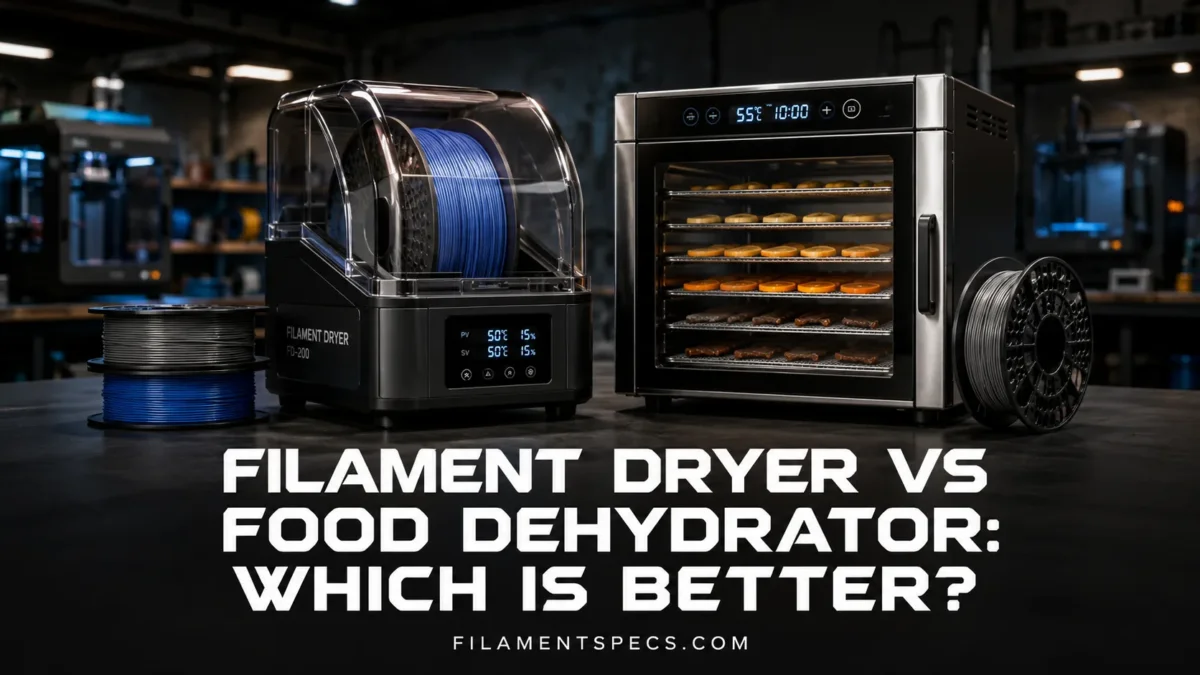
| Comparison Point | Filament Dryer | Food Dehydrator | Better Choice |
|---|---|---|---|
| Main Purpose | Built for filament spools, controlled drying, and often printing directly from the box. | Built for drying food with warm air, fan movement, and venting. It can dry filament if the spool fits and the temperature range is suitable. | Filament dryer for printing workflow; food dehydrator for batch drying. |
| Typical Temperature Fit | Commonly supports low-to-mid drying ranges for PLA, PETG, TPU, ASA, ABS, and some nylon models depending on the dryer. | Many food dehydrators work around food-safe drying ranges near 140°F / 60°C, though exact settings vary by model. | Depends on filament. Food dehydrator is fine for PLA/PETG/TPU if accurate; filament dryer is safer for mixed materials. |
| Printing While Drying | Usually the stronger option because many models include filament exits, rollers, spool support, and humidity display. | Possible only after modification. Feeding filament from a dehydrator can be awkward. | Filament dryer. |
| Airflow | Designed around a spool, but airflow strength and venting vary a lot between models. | Often has strong fan circulation because food drying depends on moving humid air out. | Food dehydrator for raw airflow; filament dryer for spool-ready use. |
| Capacity | Usually 1–2 spools; larger units may hold 4 spools. | Can hold multiple spools if the tray stack or chamber is large enough. | Food dehydrator for several spools at once. |
| Humidity Control | Often includes humidity display, timer, and sealed or semi-sealed chamber. | Usually has no filament-focused humidity display; it dries by heated airflow and venting. | Filament dryer for monitoring. |
| Spool Safety | Usually has spool clearance and feeding path, but cardboard/plastic spool limits still matter. | Spool fit, tray height, and hot spots must be checked before use. | Filament dryer for less setup. |
| Best Use Case | Daily printing, nylon/TPU/PVA support, humid rooms, direct-from-box printing. | Pre-drying several spools before sealing them in dry storage. | Different jobs. Not one winner for every printer. |
A filament dryer is usually better if you want a clean printing workflow: load the spool, set the temperature, feed the filament to the printer, and keep the chamber warm during a long print. A food dehydrator can be better if your goal is drying several spools before storage, especially when it has steady temperature control and enough internal space. The real answer is not “dryer good, dehydrator bad.” The better tool depends on the filament, the humidity in your room, the drying temperature needed, and whether you want to print while drying.
For most PLA and PETG users, either tool can work. For nylon, PVA, TPU, carbon-filled nylon, and long multi-hour prints, a dedicated filament dryer becomes much more useful because it can keep the spool dry while the printer is actively pulling filament.
Table of Contents
🏆 Which One Is Better for Filament Drying?
A filament dryer is better for active printing. It is made around the shape and movement of a filament spool. Many models include a feed hole, PTFE tube path, rollers, timer, temperature setting, and humidity display. That makes it easier to print nylon, TPU, PETG, PVA, or support material without exposing the spool to room air during the print.
A food dehydrator is better for batch drying. It moves warm air through a chamber and can remove moisture from several spools at once if the chamber is tall enough. Many makers use one as a practical drying station, then move the dry spool into a sealed box or vacuum bag with desiccant.
Best Choice by Situation
- Choose a filament dryer if you print from the dryer, use hygroscopic materials often, or want a compact setup near the printer.
- Choose a food dehydrator if you want to dry multiple spools before storage and do not need a polished printing path.
- Choose neither as your only storage plan if the spool will sit unused for weeks. Drying removes moisture; storage prevents the moisture from returning.
That last point matters. Drying is not permanent. Filament starts exchanging moisture with the air again after it leaves the warm chamber. Polyamide/nylon can absorb moisture fast in humid conditions, and one study measured nylon filament reaching around 5.5 wt.% moisture after 72 hours at 40°C and 80% relative humidity.[d]
⚙️ How a Filament Dryer and Food Dehydrator Work
Filament Dryer
A filament dryer is a small heated chamber made for 3D printer spools. The better designs do three jobs at once:
- Warm the filament below a safe softening range.
- Keep the spool protected from open room air.
- Let the printer pull filament through a guided exit path.
This is useful because FFF 3D printing melts thermoplastic filament and deposits it through a moving extruder.[a] If moisture is inside the filament, it can turn to steam in the hotend. The result may be popping sounds, bubbles, stringing, rough surfaces, or weaker layer bonding. Sometimes the print still finishes. It just looks worse than it should.
Food Dehydrator
A food dehydrator is a heated airflow appliance. It normally uses an electric heating element, fan, and vents to move warm air through the chamber.[b] That basic mechanism also works for filament: warm air helps moisture leave the polymer, and airflow carries humid air away.
The catch is physical design. A food dehydrator is not made for a 1 kg filament spool. Many round tray models need tray removal or a printed spacer ring. Box-style dehydrators may fit spools more easily, but the spool still needs room, stable support, and protection from direct hot spots.
Useful rule: a food dehydrator is a drying chamber, not a filament handling system. A filament dryer is both a drying chamber and a spool-feeding accessory.
🌡️ Drying Performance: Heat, Airflow, Venting, and Time
Drying filament is not only about setting a temperature. Four things decide the result: temperature accuracy, airflow, moisture exhaust, and time. A device with a high number on the screen can still dry poorly if humid air stays trapped inside. A lower-temperature device with steady airflow may perform better for PLA or PETG.
Temperature Accuracy
Temperature matters because filament should be dried hot enough to drive off moisture but not so hot that the filament softens, sticks together, ovalizes, or deforms on the spool. Prusa’s drying table lists examples such as PLA/rPLA at 45°C for 6 hours, PETG at 55°C for 6 hours, TPU at 60°C for 4–6 hours, ASA at 80°C for 4 hours, and PA11 carbon fiber at 90°C for 6 hours for its own materials.[c]
Do not treat those numbers as universal for every brand. They are still helpful because they show the pattern: PLA needs a lower drying temperature, PETG sits higher, TPU needs more care, and nylon-family materials often need more heat and more time.
Airflow and Moisture Exhaust
A food dehydrator often wins on airflow. It was built to remove moisture from wet food, so fan movement and venting are part of the design. A filament dryer may be more sealed, which helps hold heat but can slow drying if humid air is not vented or refreshed.
This is why a small vent, periodic lid opening, or a dryer with controlled air exchange can matter. Moisture has to leave the chamber. Warm, humid air sitting around the spool is not ideal.
Drying Time
Drying time depends on the material, starting moisture level, spool size, chamber airflow, and whether the spool is cardboard or plastic. A lightly exposed PLA spool may improve after a few hours. Wet nylon can need much longer.
There is no perfect timer that fits every spool. The most reliable home method is simple: weigh the spool before drying, dry it, weigh it again, and stop when weight loss slows down. That weight loss is not magic. It is water leaving the spool and filament. Tiny changes still matter.
🧵 Filament Types: Which Tool Fits PLA, PETG, TPU, ABS, ASA, and Nylon?
| Filament | Moisture Sensitivity | Filament Dryer Fit | Food Dehydrator Fit | Practical Notes |
|---|---|---|---|---|
| PLA | Low to moderate. Old or poorly stored PLA can still become brittle or print rough. | Very good, especially at low temperature. | Good if temperature control is accurate and low enough. | PLA is the easiest case. Watch spool deformation and avoid excessive heat. |
| PETG | Moderate. Wet PETG often shows stringing, popping, and rougher surfaces. | Very good. | Good if the unit can hold a steady PETG-safe setting. | Drying can reduce stringing that retraction settings alone cannot fix. |
| TPU | Moderate to high, depending on hardness and brand. | Very good because printing from a dry box helps during long flexible prints. | Good for pre-drying, less convenient for direct feeding. | TPU benefits from dry storage after drying. |
| ABS | Moderate. Moisture can affect surface quality and printed part strength. | Good if the dryer reaches the required range. | Model-dependent; many food dehydrators may be near the lower edge. | ABS also needs normal print settings managed well, not only drying. |
| ASA | Moderate. Often dried hotter than PLA/PETG. | Good with a dryer that reaches higher settings. | Only suitable if the dehydrator reaches and holds the needed range. | Check spool material before using higher heat. |
| Nylon / PA | High. It can absorb moisture quickly in humid air. | Usually the better choice, especially if printing from the chamber. | Useful only if it reaches the needed temperature and has enough time/airflow. | For nylon, drying before printing and keeping the spool dry during printing are both important. |
| PVA / BVOH Support | Very high. These support filaments are strongly moisture-sensitive. | Better choice for active printing. | Possible for pre-drying, but storage and direct dry feeding matter more. | Leaving support material exposed can cause print problems quickly. |
PLA
PLA does not usually need the same level of drying discipline as nylon, but it can still absorb enough moisture to cause poor surface quality. A food dehydrator can work well for PLA because the needed temperature is low. The risk is overheating. PLA softens more easily than many other filaments, and a cheap dehydrator may run hotter than its dial suggests.
PETG
PETG is where the difference becomes clearer. A food dehydrator can dry PETG well, but a filament dryer is more convenient if you want to print right after drying. PETG can pick up moisture again while sitting open, and wet PETG often looks like a slicer problem: strings, blobs, and rougher extrusion. Sometimes it is not the slicer. It is water.
TPU
TPU benefits from drying and dry feeding. Flexible filament prints slowly, so the spool may sit exposed for many hours. A filament dryer has an advantage here because it can act as the print-side dry chamber. A food dehydrator is still useful for restoring a damp spool before the print starts.
Nylon and Carbon-Filled Nylon
Nylon is the strongest argument for a dedicated filament dryer. Not because a food dehydrator cannot remove moisture, but because nylon can absorb moisture again during the print. In humid air, a long nylon print can start dry and become less stable as the spool sits open. A dryer with a feed path solves that workflow problem.
There is another detail: some nylon and carbon-filled nylon materials need drying temperatures that a basic food dehydrator may not reach. If your dehydrator tops out around 60–70°C, it may be useful for PLA, PETG, and TPU, yet weak for nylon that needs hotter and longer drying.
🔥 Temperature Risk: The Part Many Buyers Miss
The biggest drying mistake is chasing heat without checking the spool and material. Filament is not just loose plastic. It is wound tightly on a spool. Heat affects the filament, the spool, the cardboard core, adhesives, labels, and sometimes the winding tension.
Check three limits before drying: the filament brand’s drying recommendation, the spool’s heat tolerance, and the real chamber temperature measured with a separate thermometer.
Why the Display Temperature May Be Misleading
Small dryers and dehydrators often measure temperature near the heater, not at the center of the spool. A chamber set to 55°C can have warmer and cooler zones. That difference may not matter for food slices. It can matter for PLA on a tight plastic spool.
A simple thermometer inside the chamber helps. Even better, place it near the spool, not near the heater. If the reading swings widely, lower the setting or use a different machine for low-temperature filaments.
Spool Material Can Decide the Safe Limit
Cardboard spools can absorb moisture too, and some plastic spool sides can deform or loosen with heat. Older or cheaper spools may not behave like premium high-temperature spools. This is one reason a dryer that says “70°C” is not automatically safe for every roll on your shelf.
Do Not Reuse a Filament Dehydrator for Food
If a food dehydrator has been used for filament, keep it as a filament tool. Filaments can contain pigments, additives, fillers, dust, and small plastic particles. The simple approach is best: one machine for filament, not for snacks.
🛒 Buying Decision: Which One Should You Buy?
| Your Situation | Recommended Tool | Why |
|---|---|---|
| You mostly print PLA in a normal indoor room | Either one | A low-temperature filament dryer is easier; a food dehydrator can be better value if you dry several spools. |
| You print PETG often and fight stringing | Filament dryer | Drying and printing from the same chamber keeps the workflow simple. |
| You print TPU slowly | Filament dryer | Flexible prints can run for many hours, so protected feeding helps. |
| You print nylon, PA-CF, PVA, or BVOH | Filament dryer with enough heat range | These materials benefit from both pre-drying and dry feeding during the print. |
| You own many open spools | Food dehydrator plus sealed storage | Batch drying is easier when the chamber fits multiple rolls. |
| You have limited desk space | Single-spool filament dryer | It can sit beside the printer and feed directly into the extruder path. |
| You want the lowest setup effort | Filament dryer | No cutting trays, no spacer ring, no improvised spool stand. |
Choose a Filament Dryer If
- You want to print directly from the drying chamber.
- Your room humidity is often high.
- You use nylon, TPU, PVA, BVOH, PETG, or carbon-filled filaments.
- You want a cleaner desk setup with less modification.
- You prefer built-in timer, temperature display, and humidity readout.
Choose a Food Dehydrator If
- You want to dry several spools in one session.
- You already have a dehydrator that can fit a spool safely.
- You dry filament first, then store it in sealed bags or dry boxes.
- You are comfortable checking chamber temperature with a separate thermometer.
- You do not need direct feeding from the drying chamber.
The Best Setup for Many Makers
The strongest setup is often not one device. It is a three-part moisture system:
- Dry the spool in a filament dryer, dehydrator, or suitable drying oven.
- Print from a dry chamber when using nylon, TPU, PVA, or long PETG prints.
- Store the spool sealed with fresh desiccant after printing.
This matters because drying fixes the current moisture level, while storage controls what happens next. ABS research has shown that ambient humidity and storage method can change filament moisture, and moisture variation can affect printed part quality and strength.[e]
🧯 Common Mistakes When Drying Filament
Using Too Much Heat
More heat is not automatically better. PLA can soften, spools can warp, and tightly wound filament can stick to itself. Use the filament brand’s guidance first. If there is no clear guidance, start lower and verify with a thermometer.
Drying Without Storage
Drying a spool and leaving it open on the desk wastes effort. Once dry, move it to a sealed box, vacuum bag, or dry cabinet with desiccant. The dryer removes water. The storage system keeps it from coming back.
Assuming All Food Dehydrators Are the Same
They are not. Some have weak temperature control. Some have strong hot spots. Some round tray models only fit a spool after modification. Some box-style units are easier. The best food dehydrator for filament is the one that fits the spool, holds a stable low temperature, and moves humid air out.
Ignoring the Spool
The filament may survive the temperature while the spool does not. Cardboard can sag. Plastic sides can loosen. Glue can soften. Labels can curl. Check the spool after the first hour when trying a new setup.
Printing Wet Filament and Blaming the Slicer
Wet filament can look like bad retraction, wrong nozzle temperature, poor pressure advance, or cheap filament. Before changing ten slicer settings, dry the spool and test again. It is a simple test. Often, it saves time.
✅ Practical Verdict for Real Printing
For Most Users
Buy a filament dryer if you print often and want less friction. It is the easier tool to live with beside a 3D printer.
For Many Open Spools
Use a food dehydrator if you need batch drying. It can be very effective when the temperature is checked and the spool fits without touching hot surfaces.
For Nylon and Support Filaments
Use a filament dryer that reaches the required material temperature and lets you print directly from the chamber. Nylon, PVA, and BVOH are not ideal “dry once and leave open” materials.
A good filament dryer is the better everyday printing accessory. A good food dehydrator is the better bulk drying station. If you print mostly PLA, the difference may be small. If you print nylon, TPU, PVA, or long PETG jobs, the difference becomes clear during the print, not just before it.
FAQ
Can I Use a Food Dehydrator Instead of a Filament Dryer?
Yes, if the spool fits, the temperature range matches your filament, and the chamber has steady airflow. A food dehydrator is best for pre-drying spools before storage. A filament dryer is better when you want to print while the spool stays dry.
Is a Filament Dryer Worth It for PLA?
It can be worth it if your PLA is old, brittle, stringy, or stored in a humid room. For fresh PLA in a dry room, sealed storage with desiccant may be enough. PLA is usually the least demanding common filament, but it is not immune to moisture.
Is a Food Dehydrator Better Than a Cheap Filament Dryer?
Sometimes, yes. A food dehydrator with strong airflow and stable temperature can dry very well. A cheap filament dryer may be more convenient for printing but weaker at exhausting humid air. The better machine is the one with stable heat, enough airflow, and safe spool fit.
Can I Print Directly From a Food Dehydrator?
Yes, but it usually needs modification. You need a smooth filament exit path, a spool holder or roller, and enough clearance so the filament does not scrape, bend sharply, or touch a hot surface. A filament dryer is simpler for direct feeding.
What Temperature Should I Use to Dry Filament?
Use the filament brand’s recommendation first. As a general pattern, PLA uses lower heat, PETG and TPU sit in the middle, and nylon-family materials often need higher heat and longer drying. Always check spool heat tolerance and verify the chamber with a separate thermometer.
Can Filament Be Over-Dried?
The larger risk for home users is overheating rather than simply removing too much water. Too much heat can soften filament, deform a spool, or make coils stick together. Long drying at the right temperature is usually safer than short drying at an aggressive temperature.
Should I Store Filament in the Dryer?
Some filament dryers can act as short-term dry boxes, especially with desiccant. For long-term storage, sealed bags, airtight boxes, dry cabinets, or vacuum containers with fresh desiccant are usually better. A dryer is an active drying tool; storage needs a moisture barrier.
Can I Use the Same Food Dehydrator for Filament and Food?
It is better to keep a filament-used dehydrator for filament only. Filaments may contain colorants, additives, fillers, dust, and plastic residue. Once the appliance becomes part of your printing setup, treat it as a workshop tool.
Sources
- [a] CDC/NIOSH — Explains fused filament fabrication as melting thermoplastic filament through a moving extruder. Used for the FFF process explanation. (Reliable because it is a U.S. federal public health agency.) ↩
- [b] National Center for Home Food Preservation, University of Georgia — Describes food dehydrators as appliances with heat, fan, and vents for air circulation. Used for the food dehydrator mechanism. (Reliable because it is a university-based food preservation reference center.) ↩
- [c] Prusa Knowledge Base — Lists drying temperature/time examples for Prusament materials and explains dryer, oven, and food dehydrator considerations. Used for practical drying ranges and device cautions. (Reliable because it is an official technical support resource from a major 3D printer and filament manufacturer.) ↩
- [d] Gong, H. et al., Technologies, 2025 — Measures nylon filament moisture under controlled humidity and temperature conditions. Used for nylon moisture absorption behavior. (Reliable because it is a peer-reviewed academic journal article.) ↩
- [e] Hamrol, A. et al., Materials, 2023 — Studies ABS filament moisture, ambient humidity, storage method, and effects on FFF product quality. Used for the storage and moisture-quality relationship. (Reliable because it is a peer-reviewed academic journal article.) ↩