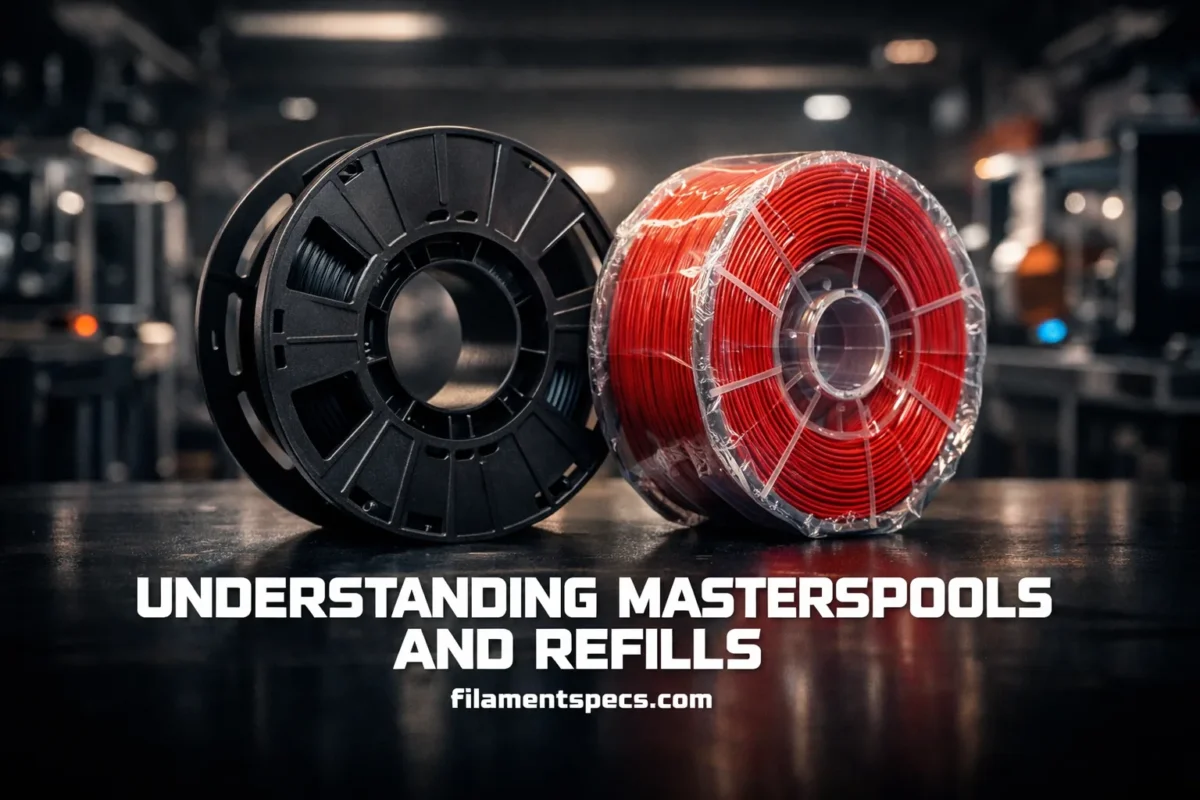
Masterspools and refills solve a plain, practical problem: most filament rolls still arrive with a spool that stays behind after the material is gone. A refill keeps only the filament coil and its core. A reusable spool gives that coil the sidewalls, hub, and shape it needs for stable feeding. The idea is simple. The real difference comes from fit, coil control, drying limits, and feeder geometry. When those four things line up, refills feel tidy and efficient. When they do not, even good filament can become annoying to use.[a]
| Point | Full Spool | Refill Coil | Masterspool / Reusable Spool |
|---|---|---|---|
| What arrives | Filament already mounted on a spool | Filament coil with ties, banding, or a cardboard core | Reusable sidewalls and hub used to hold a refill |
| Ready to print | Usually yes | No | Only after the refill is captured correctly |
| Waste after one roll | Higher | Lower | Spread across many rolls |
| Storage before opening | Easy | Very space-efficient | Needs a separate place when empty |
| Main failure point | Damaged spool edges or poor winding | Coil loosening during loading or storage | Poor fit, weak lock, or wrong size for the printer |
| Best match | Plug-and-play convenience | Lower packaging use and smaller shipping volume | Repeat users staying inside one refill ecosystem |
Table of Contents
🔄 What Masterspools and Refills Actually Are
A refill is not a new filament category. It is a packaging format. The polymer is still PLA, PETG, ABS, ASA, TPU, nylon, or another material. What changes is the way that material reaches the user. Instead of shipping every kilogram with its own permanent spool, the manufacturer ships the filament as a coil that can be mounted onto a reusable support.
That reusable support can be a printed masterspool, an injection-molded reusable spool, or the reusable side discs from a previous spool. The names vary across brands, but the job stays the same: hold the coil flat, centered, and under control while the printer pulls filament from it.
eSUN describes refill filament as a spool-less format that removes the need for plastic or cardboard spools and pairs with reusable spool systems such as eSpool.[b]
Important distinction: a refill is the consumable. A masterspool is the reusable carrier. They are related, but they are not the same product.
⚙️ How the System Works
The workflow is straightforward, but the order matters. A refill arrives compressed and restrained. The reusable spool captures the core and sidewalls. Only after the spool is fully assembled should the retaining strips come off. Prusa’s own refill instructions make that sequence very clear: mount one side, mount the other side, confirm the spool is firmly assembled, and only then cut the strips that keep the coil from expanding.[c]
- Keep all ties or straps in place while the refill is loose.
- Seat the first spool half evenly against the core.
- Add the second half and check that the core is centered.
- Lock the spool fully before releasing the coil.
- Secure the filament end immediately after loading.
That last point matters more than many users expect. A refill does not forgive rushed handling. Once the coil expands unevenly, it can rub the sidewalls, ride over itself, or feed with extra drag. Small mistake. Big mess.
📏 Compatibility Is About Geometry First
Brand names help, but geometry decides the outcome. For a refill system to work well, you need three dimensions to make sense together: the refill core, the reusable spool, and the printer’s spool path. If you use an AMS-style feeder, outer spool size becomes even more important. Bambu lists AMS support for spools with a width of 50–68 mm and a diameter of 197–202 mm.[d]
This is why refill systems are not fully universal. There is visible convergence, but not total standardization. Prusament’s refill core is listed at about 94 mm inner diameter and 60 mm width.[e] ROSA3D lists its 1000 g refill core at 94 mm inner hole diameter and 60 mm width, while its reusable spool sits at 200 mm outer diameter and 65 mm width.[f] Those numbers are close enough to show a pattern, but they are not a promise that every refill will fit every reusable spool or every multi-material feeder.
| Example | Official Figure | Why It Matters |
|---|---|---|
| Prusament Refill Core | Inner diameter ±94 mm; width ±60 mm | Shows the size range a reusable spool must capture cleanly |
| ROSA3D ReFill Core | Inner hole 94 mm; width 60 mm | Useful second reference for cross-brand size checks |
| ROSA3D Reusable Spool | Outer diameter 200 mm; width 65 mm; weight 250 g | Shows the envelope the printer actually sees |
| Bambu AMS Support Window | Width 50–68 mm; diameter 197–202 mm | Explains why a refill may fit a spool but still not fit an AMS |
What To Verify Before Buying a Refill
- Refill core inner diameter
- Refill width between sidewalls
- Finished spool outer diameter and total width
- Locking method of the reusable spool
- Whether your dryer temperature exceeds the spool’s heat limit
- Whether your printer or AMS expects a certain spool envelope
🧵 Loading a Refill Without Creating a Mess
The most common loading error is removing the outer restraint too early. Polymaker says its refill coils are wound for smooth, tangle-free operation, but also notes that if the outer strap is removed early, the user should pull only a short length before loading so the winding stays under control.[g]
That one note explains a lot. Refill coils are stable while they stay compressed. Once they spring outward, the coil can shift from a neat cylinder into loose layers that no reusable spool was designed to catch. Manual spool holders sometimes forgive that. Closed or semi-closed feeders usually do not.
Best habit: treat the refill like a spring under control. Capture first. Release second. Never the other way around.
Bambu also maintains a troubleshooting page for problems caused by unlocked or detached spools, which shows how easily loose wraps can turn into feed issues once the spool loses its structure.[j]
🌡️ Drying and Storage Change the Experience More Than Most Users Expect
Refills save space before opening. After opening, they demand better habits. A full spool already has rigid sides, so it tolerates casual handling a bit better. A refill does not. Once opened, it should either stay mounted on a reusable spool or stay tightly restrained inside dry storage.
Material behavior does not disappear just because the spool did. eSUN’s PETG refill still needs the usual PETG care: the company lists 230–250°C nozzle temperature, 75–90°C bed temperature, and drying at 65°C for more than 3 hours.[h]
Reusable spools also have temperature limits. Bambu sells both a low-temperature reusable spool rated to ≤70°C and a high-temperature version rated to ≤90°C.[i] That is a useful reminder that dryer compatibility is not automatic. Some materials and some spool constructions ask for more heat than a basic reusable spool should see.
If you print engineering materials, check the drying workflow before you commit to a refill ecosystem. The refill itself may be fine. The spool may be the limiting piece.
🧪 Print Quality: What Changes and What Does Not
A refill should not change the polymer’s core printing behavior by itself. PLA is still PLA. PETG is still PETG. What changes is the risk around handling, drag, moisture, and spool stability. That distinction matters. It keeps troubleshooting focused on the right place.
- If the filament is brittle, wet, or stringing badly, think material condition first.
- If the filament jerks, catches, or feeds unevenly, think spool geometry and coil control first.
- If the feeder hesitates only near the edge of the roll, think sidewall rub or a loose winding stack.
- If the same material prints well on a full spool but poorly as a refill, inspect the reusable spool before touching slicer settings.
This is where many users lose time. They start tuning retraction, temperature, or flow when the real issue is mechanical. A refill system lives or dies by smooth unwinding. Good winding and a good polymer still matter, of course, but refill problems often begin at the spool, not the nozzle.
A Practical Reading of Refill Print Quality
Think of refill quality in two layers. The first layer is the material itself: diameter control, additives, moisture sensitivity, and recommended temperatures. The second layer is delivery: winding tension, how well the reusable spool captures the core, and whether the printer can pull filament with low, steady resistance. Both layers matter.
♻️ When Refills Make More Sense Than Full Spools
Refills make the most sense when the user has already settled into a spool system and wants less packaging bulk. Polymaker positions its refill line the same way: lower waste, less shipping volume, simpler storage, and compatibility with common reusable spool systems, including Bambu, Prusa, Sunlu, and others.[k]
- Choose refills first if you go through a lot of one-kilogram rolls, already own matching reusable spools, and store filament carefully.
- Stay with full spools if you constantly test new brands, swap half-used materials, or want the least amount of setup time.
- Use extra caution if you run very soft, very hygroscopic, or dryer-heavy materials, because the spool itself may become part of the workflow.
For many users, PLA and PETG are the easiest starting point for refill adoption. The handling is simpler, the drying limits are gentler, and there are more refill-compatible spool options on the market. That does not make refills “better” in every case. It just makes them easier to live with.
❓ FAQ
Are masterspools and reusable spools the same thing?
Usually yes in practical use. “Masterspool” often refers to a reusable spool made for refill coils. Some brands use their own product names, but the function is the same: give the refill sidewalls, a hub, and a stable shape.
Are refill filaments universal?
No. Many systems are close in size, but not fully universal. Core diameter, refill width, finished spool diameter, and feeder limits still need to match.
Can a refill lower print quality?
Not by format alone. The material properties stay the same. Most refill-related quality problems come from poor loading, loose winding, sidewall rub, or moisture.
Do refills work well with AMS units?
They can work very well, but only when the finished spool matches the feeder’s supported diameter and width, and the coil stays locked and centered during feeding.
Should a refill ever be stored loose after opening?
That is rarely a good idea. Once opened, the refill should stay mounted on a reusable spool or remain tightly restrained in dry storage.
Are refills always cheaper?
Not always. The real value often comes from lower packaging use, smaller shipping volume, and reusing the same spool many times rather than from a guaranteed lower shelf price.
References
[a] Bambu Lab Wiki: Refill Filament With Bambu Reusable Spool / Refill — supports the refill-system concept and the statement that Bambu’s reusable spool system reduces plastic waste in filament consumption. (Reliable because it is official product documentation from the manufacturer.)
[b] eSUN: What Is Refilament? — supports the definition of spool-less refill filament and its pairing with reusable spool systems. (Reliable because it is the official manufacturer page for the refill format.)
[c] Prusament: How To Refill Your Prusament Spool — supports the loading order, keeping retaining strips on during assembly, and only cutting them after the spool is fully closed. (Reliable because it is the official Prusament loading procedure.)
[d] Bambu Lab AMS Product Page — supports the supported spool size window used in the compatibility section. (Reliable because it is the official product specification page for the feeder system.)
[e] Prusa: Prusament PLA Vanilla White 900g Refill — supports the listed refill core dimensions used as an official example of refill sizing. (Reliable because it is an official product page with manufacturer specifications.)
[f] ROSA3D: Spool and Packaging Dimensions PDF — supports the ROSA3D refill core and reusable spool dimensions used in the geometry discussion. (Reliable because it is an official manufacturer specification sheet.)
[g] Polymaker Wiki: Panchroma PLA Refill — supports refill compatibility across common reusable spool systems and the warning about handling the outer strap correctly. (Reliable because it is the official Polymaker product wiki.)
[h] eSUN: PETG Refilament — supports PETG refill drying guidance, print temperatures, and the note about orderly wrapping without overlap or tangle. (Reliable because it is the official product page with technical parameters.)
[i] Bambu Lab: Reusable Spool — supports the low-temperature and high-temperature reusable spool variants mentioned in the drying section. (Reliable because it is the official store page for the reusable spool hardware.)
[j] Bambu Lab Wiki: How To Fix Filament Issues Caused by Unlocked Spools — supports the point that loose or detached spool assemblies can create feed problems. (Reliable because it is official troubleshooting documentation from the manufacturer.)
[k] Polymaker Store: Panchroma PLA Refill — supports the lower-waste, lower-volume refill positioning and the broad reusable spool compatibility claim used in the adoption section. (Reliable because it is the official Polymaker product page.)