
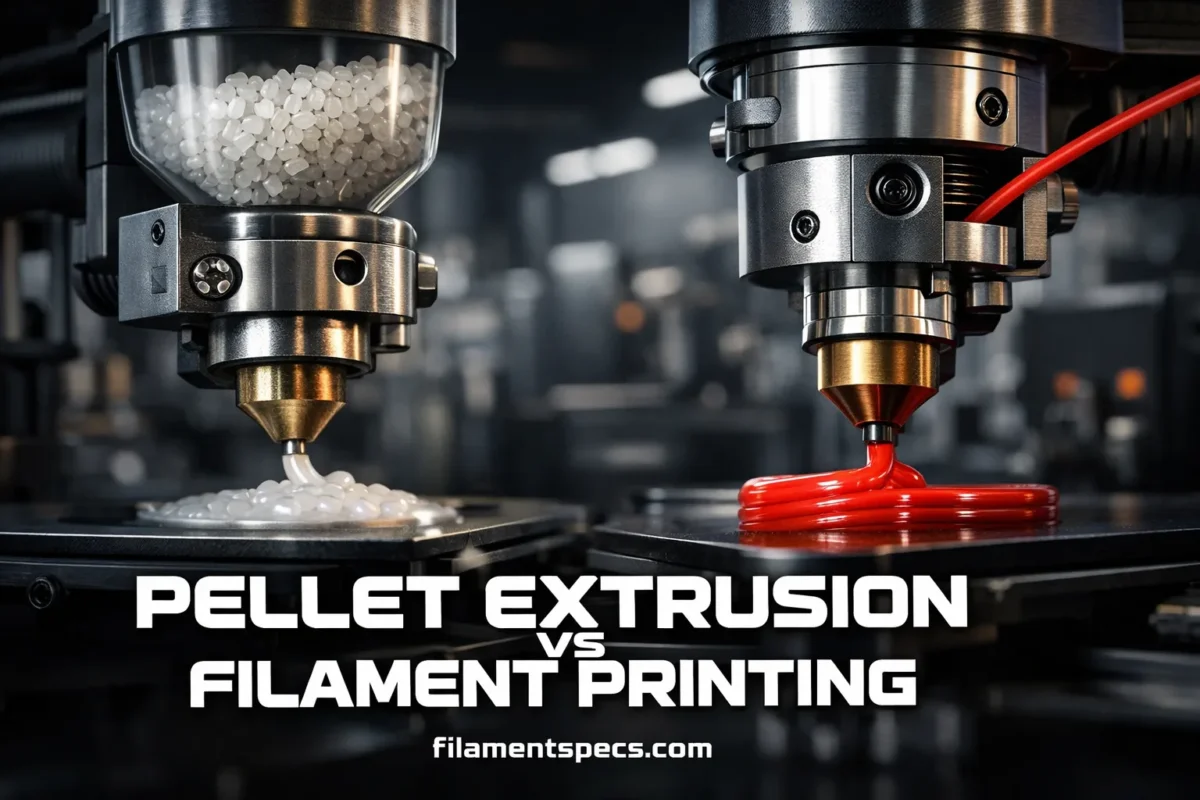
Pellet extrusion and filament printing both sit inside material extrusion, yet they behave like two very different production tools. One pushes raw pellets or granules through a screw-based melt path built for high output. The other feeds calibrated filament through a lighter and more controlled path built for steadier detail. That single feedstock change reshapes print speed, surface finish, machine design, drying needs, post-processing load, and even which materials make economic sense on the shop floor.
| Category | Pellet Extrusion | Filament Printing |
|---|---|---|
| Feedstock | Raw polymer pellets, granules, or in some systems recycled flakes after screening and drying. | Pre-made, diameter-controlled filament on a spool. |
| Typical Machine Direction | Usually aimed at large parts, tooling, molds, furniture, forms, and industrial output. | Usually aimed at desktop, benchtop, and medium-size parts where detail and setup simplicity matter. |
| Output Rate | BAAM-class systems in one NIST-cited review reach about 50 kg/h, with pellet feedstock described as about 200× faster than conventional polymer systems [b] | A PEI study reports build-up rates around 2 mm³/s on low-cost filament systems and about 15 mm³/s on high-end filament systems [e] |
| Nozzle Range | Large-format pellet systems often use much larger nozzles; one review reports 2.54 mm to 10.16 mm on BAAM-class equipment [b] | Smaller nozzles are normal, which helps with finer bead placement and cleaner small features. |
| Feedstock Cost | Usually lower because there is no separate filament-making step; ORNL links pellet feedstock to lower material cost [a] | Usually higher because the material has already been compounded, extruded to diameter, cooled, measured, and spooled. |
| Material Access | Strong for commodity resins, filled compounds, and some engineering polymers that are rare or costly in filament form [e] | Strong for ready-to-print consumer and prosumer grades, with wide slicer presets and easier purchasing. |
| Surface Finish | Usually rougher. Large beads often mean visible roads and more machining or sanding on finished surfaces [b] | Usually cleaner straight off the bed, especially on small parts and tighter curves. |
| Mechanical Result | Can be closer to filament than many buyers expect; one PLA study found no statistically meaningful difference in tensile, flexural, and impact results between granule and filament prints under its tested conditions [d] | Very mature and predictable when feedstock quality, drying, and print settings are under control. |
| Recycling Route | Very flexible for pelletized regrind and, in some workflows, direct flake-based printing experiments [f] | Possible, but usually needs an added step to turn scrap back into diameter-stable filament first. |
| Procurement Scale | Bulk industrial supply is still common, but small-batch options now exist. Prusa sells pre-dried Prusament pellets in packages from 3.5 kg to 14 kg for small-scale use [h] | Single-spool retail supply is widespread, making small purchases and material changes easy. |
| Who It Fits | Large-format shops, polymer labs, workshops, desktop filament-extrusion users, and teams prioritizing throughput or material freedom. | Users chasing detail, easy operation, cleaner finish, and a larger plug-and-play machine ecosystem. |
Plain answer: Pellet extrusion usually makes more sense when size, throughput, and feedstock cost lead the decision. Filament printing usually makes more sense when detail, process stability, and cleaner out-of-printer surfaces carry more weight.
What Changes When the Feedstock Changes
Filament printing depends on a pre-calibrated strand with a known diameter, stable winding, and predictable drive behavior. Pellet extrusion removes that conversion step and feeds the printer with the same basic form used in many plastics manufacturing lines. In practice, that means pellet systems can open the door to cheaper raw material input, broader compounding options, and easier entry into large-format printing, while filament systems keep an edge in cleaner feed consistency and easier machine tuning. ORNL’s economic work ties pellet feedstock directly to higher deposition speed and lower material cost, while NIST’s roadmap highlights filament extrusion, uniformity, and interlayer bonding as central quality concerns in polymer material extrusion [a]
- Pellet path: hopper, screw, melt zone, nozzle, large bead, high mass flow.
- Filament path: spool, drive gears, hot end, nozzle, smaller bead, lower mass flow.
- Main result: pellet systems trade some finesse for output; filament systems trade output for finer control.
Where the Real Difference Shows Up First
Priority Match
Speed and Cost Usually Push Buyers Toward Pellets
The economic case for pellets is not subtle. It starts with the missing middle step: you do not need to turn pellets into tightly controlled filament before printing. ORNL’s work states that shifting from wire-like feedstock to pellet feedstock raises deposition speed and lowers material cost because the printer can use low-cost injection-molding feedstock directly [a]
NIST’s 2019 review goes further for large-format systems. It reports BAAM-class platforms around 6 m × 2.4 m × 1.8 m, pellet-fed deposition around 50 kg/h, and a material cost reduction around 20× compared with conventional polymer systems. The same review also notes nozzle diameters from 2.54 mm to 10.16 mm, which helps explain why pellet systems move so much more material per unit time but leave a rougher surface behind [b]
- Feedstock economics: pellets are usually cheaper per kilogram than finished filament.
- Throughput: screw-based extrusion can move much more molten polymer.
- Scale: larger nozzles and larger gantries keep long prints realistic.
- Downtime: there is no spool change cycle in the usual pellet workflow.
Important limit: faster extrusion does not always mean a faster finished part. Machining, sanding, flattening, drilling, and tolerance cleanup can eat into the time saved at the nozzle, especially when the part has visible surfaces or mating features.
Quality and Strength Are More Nuanced Than “Pellet Is Rough, Filament Is Better”
That simple rule is too shallow. Yes, pellet systems often show larger roads, rougher skins, and more post-finishing. NIST’s review points out that the large nozzle and high-speed deposition used in BAAM-class printing hurt surface quality and can leave voids between adjacent beads unless consolidation is improved [b]
Still, part strength is not automatically worse with pellets. A 2023 Elsevier study on PLA compared granule-based and filament-based material extrusion and found no statistically meaningful difference in tensile behavior, flexural strength and modulus, or impact strength for the tested prints. The same paper did report differences in hardness and bending strain at break, which matters because “similar” does not mean “identical” once the use case becomes more demanding [d]
The deeper quality issue is bonding and flow stability. NIST notes that filament-based printing deals with void formation, fast solidification, limited chain diffusion across layers, and the need for better control of filament uniformity. NIST also reports that weld formation in material extrusion happens on a very short timescale, roughly one second, which is why thermal control and feed rate matter so much [c]
- Pellet Printing Often Wins On
- Bulk deposition, large tools, molds, forms, furniture-scale parts, and jobs where machining is already part of the route.
- Filament Printing Often Wins On
- Small holes, thin walls, cosmetic faces, crisp corners, and assemblies that need better as-printed tolerance.
- What Decides the Gap
- Drying, melt control, bead overlap, nozzle size, cooling rate, and part geometry.
Material Access Is a Bigger Deal Than Many Comparisons Admit
Filament marketplaces are easy to browse, but pellet systems can reach materials that are awkward, costly, or lightly available in filament form. A 2022 study on PEI pellet extrusion notes that pellets offer lower cost and a wider material choice, then shows why that matters for engineering polymers: printing calibrated filament at very high processing temperatures is expensive, and the study reports a typical price ratio of about 1 to 10 between a 25 kg quantity of ULTEM/PEI 1000 pellets and comparable filament purchases in that material family [e]
That same paper matters for another reason. It moves the conversation beyond hobby materials and into high-temperature functional parts. With the right machine and thermal window, pellet-fed PEI reached mechanical results that the authors describe as comparable to injection-molded PEI 1000 for the tested setup. So the pellet route is not only about cheap large parts; it can also be about accessing expensive engineering polymers more sensibly when the machine is built for them [e]
Small-Batch Pellet Supply Is No Longer Limited to Industrial Orders
Pellet sourcing has traditionally favored industrial quantities, but that is no longer the only route. On October 13, 2026, Prusa opened Prusament Pellets to small-scale buyers in packages from 3.5 kg to 14 kg, with PLA, PETG, ASA, and PC Blend offered in natural-color raw-material batches.[h] The pellets are shipped pre-dried and are positioned for large-format FGF printing as well as small-scale polymer research and development.
That changes the access side of the comparison. A laboratory, workshop, or university team no longer has to assume that controlled pellet feedstock requires a purchase measured in hundreds of kilograms. Prusa also identifies desktop filament extruders as a use case, so small teams can buy a known raw material, produce experimental 1.75 mm or 2.85 mm filament, or test pellet-fed processes without starting from industrial bulk quantities.[h] Pre-dried packaging lowers the preparation burden on arrival, although exposed hygroscopic material still needs normal moisture control during storage and use.
- Filament-first material groups: mainstream PLA, PETG, ABS, ASA, TPU, support materials, and many pre-profiled desktop blends.
- Pellet-friendly material groups: commodity resins, filled compounds, custom blends, shop-specific compounds, and engineering polymers where pellet supply is easier than filament supply. Small-batch retail supply now also covers selected common polymers.
- Watch closely: moisture uptake, additive distribution, fiber breakage, contamination, and rheology.
Workflow, Drying, and Recycled Feedstocks Can Flip the Decision
Pellet extrusion looks simple from a distance: pour material in, print part out. On a real line, it is more sensitive than that. Pellet shape, bulk flow, dryer performance, hopper design, contamination control, and residence time all matter. Recycled feedstocks make the picture even more interesting. An MDPI study showed direct printing of rPET from shredded water bottles with fused particle or fused granular routes, but it also reported that flow consistency and moisture control had a strong effect on print quality and mechanical result [f]
ORNL’s recycled CF-ABS work lands on the same practical point from a different angle. It shows that machining scrap can be turned back into pellet feedstock for large-format printing, but also shows where the risks enter: contamination, particle shape, viscosity shift, and fiber attrition during recycling and machining. In other words, pellet printing can support a more circular workflow, yet feedstock preparation becomes part of process control, not an afterthought [g]
What Usually Needs More Attention in Pellet Printing
- Drying before printing and sometimes during long runs.
- Steady hopper feeding without bridging or starvation.
- Purge behavior when changing materials.
- Screening or repelletizing recycled material for steadier flow.
- Post-machining plans when surfaces or tolerances matter.
Filament printing has its own quality traps, of course. Diameter variation, spool drag, moisture, and poor winding can still create under-extrusion, jams, and weak layers. The difference is operational: filament normally arrives as a dimension-controlled printing feedstock, while pellet users take on more responsibility for hopper behavior, drying, melt control, and material changeover. Small pre-dried batches such as Prusament Pellets reduce some sourcing and preparation friction, but they do not turn a pellet extruder into a spool-fed workflow.[h]
Which One Fits Which Job
For many buyers, the smarter question is not “Which technology is better?” It is which bottleneck hurts more: slow output and expensive feedstock, or surface cleanup and tuning overhead.
| If Your Main Goal Is… | Leaning Choice | Why |
|---|---|---|
| Large tooling, molds, and patterns | Pellet extrusion | High output and lower feedstock cost usually matter more than fine cosmetic finish. |
| Small functional parts with cleaner surfaces | Filament printing | Smaller beads and steadier feed usually reduce cleanup and tuning time. |
| Short-run furniture or architectural parts | Pellet extrusion | Large build size and fast material laydown are often the deciding factors. |
| Prototyping with frequent material swaps | Filament printing | Spool-based workflows are simpler for quick changeovers and easier profile reuse. |
| Using recycled plastic in-house | Pellet extrusion | The route is more open to flakes, regrind, and repelletized streams when prep is controlled. |
| Small-scale polymer R&D or desktop filament extrusion | Pellet feedstock | Small pre-dried pellet batches can support lab trials and experimental filament production without industrial-volume purchasing [h] |
| Dimensional fit right off the machine | Filament printing | It usually needs less machining and gives tighter small-feature control. |
| High-temperature engineering polymers at lower feedstock cost | Pellet extrusion | Some engineering polymers are easier to source and far cheaper in pellet form [e] |
- Choose pellets first when the job is big, the material bill matters, and machining is already normal in your route.
- Choose filament first when the part is smaller, visual finish matters, and you want a shorter path from material purchase to repeatable printing.
- Do not assume pellets are weaker. Check the exact material, nozzle size, thermal settings, and testing method first.
- Do not assume filament is always cheaper overall. On slow large parts, machine time can cost more than the feedstock difference.
FAQ
Is pellet extrusion always cheaper than filament printing?
No. Raw feedstock is often cheaper with pellets, but the full job cost also includes drying, tuning, post-machining, scrap handling, and machine cost. Pellets tend to look better economically as part size and material usage rise.
Can pellet-printed parts be as strong as filament-printed parts?
They can be closer than many people expect. In one PLA study, granule-based and filament-based prints showed very similar tensile, flexural, and impact results under the tested conditions. Strength still depends on material, thermal control, layer bonding, and geometry.
Why do pellet-printed parts often need more finishing?
Pellet systems often use larger nozzles and lay down wider, thicker beads. That raises output, but it also makes surface roads more visible and small features less sharp.
Is filament printing only for hobby machines?
No. Filament printing spans hobby, prosumer, and industrial systems. Its main advantage is not “small only”; it is steadier feed control and easier detail on many part types.
Does pellet extrusion make recycled plastics easier to use?
Usually yes, but not automatically. Pellets, regrind, and even flake-based routes can work, yet moisture, contamination, particle size, and flow consistency become more important.
Which route is better for engineering polymers?
It depends on the polymer and the machine. Filament systems are easier to run for many prepared grades, while pellet systems can make more sense when the polymer is expensive or hard to source in filament form and the printer can manage the thermal load.
Are polymer pellets only practical to buy in industrial bulk quantities?
No. Industrial bulk supply is still common, but small-batch options now exist. Prusa sells pre-dried Prusament Pellets in packages from 3.5 kg to 14 kg for large-format FGF printing and small-scale polymer research, including use with desktop filament extruders.[h]
Sources
- [a] Oak Ridge National Laboratory — The Economics of Big Area Additive Manufacturing (used for the link between pellet feedstock, higher deposition speed, and lower material cost; reliable because it is an ORNL research publication page from a U.S. national laboratory).
- [b] NIST / ASME Review — Additive Manufacturing Processes for Composites (used for BAAM machine size, pellet deposition rate, nozzle range, surface-finish limits, and void behavior; reliable because it is hosted by NIST and published through an engineering conference route with cited literature).
- [c] NIST — Measurement Science Roadmap for Polymer-Based Additive Manufacturing (used for filament uniformity, voids, chain diffusion, and weld-formation timing; reliable because it is a NIST publication built from expert workshop input and measurement-science discussion).
- [d] Additive Manufacturing — Granule-Based Material Extrusion Is Comparable to Filament-Based Material Extrusion in Mechanical Performances of Printed PLA Parts (used for the PLA mechanical comparison between granule and filament routes; reliable because it is a peer-reviewed journal article on a major scholarly platform).
- [e] Journal of Manufacturing and Materials Processing — Extrusion Additive Manufacturing of PEI Pellets (used for pellet-versus-filament material access, high-temperature polymer economics, and example build-up-rate figures; reliable because it is a scholarly article with method details, test conditions, and cited prior work).
- [f] Materials — Towards Distributed Recycling with Additive Manufacturing of PET Flake Feedstocks (used for direct printing from shredded PET feedstocks and the role of moisture and flow consistency; reliable because it is a peer-reviewed materials paper with experimental detail).
- [g] OSTI / ORNL — Recycling of CF-ABS Machining Waste for Large Format Additive Manufacturing (used for recycled pellet feedstock, contamination risk, viscosity shift, and fiber attrition during recycling; reliable because it is distributed through the U.S. Department of Energy’s OSTI repository).
- [h] Prusa Research — Prusament Pellets: Raw Material Batches for Large-Format 3D Printing or Small-Scale Polymer Research & Development (used for small-batch package sizes, pre-dried supply, material range, large-format FGF use, and desktop filament-extruder research use; reliable because it is the manufacturer’s dated product announcement.)