
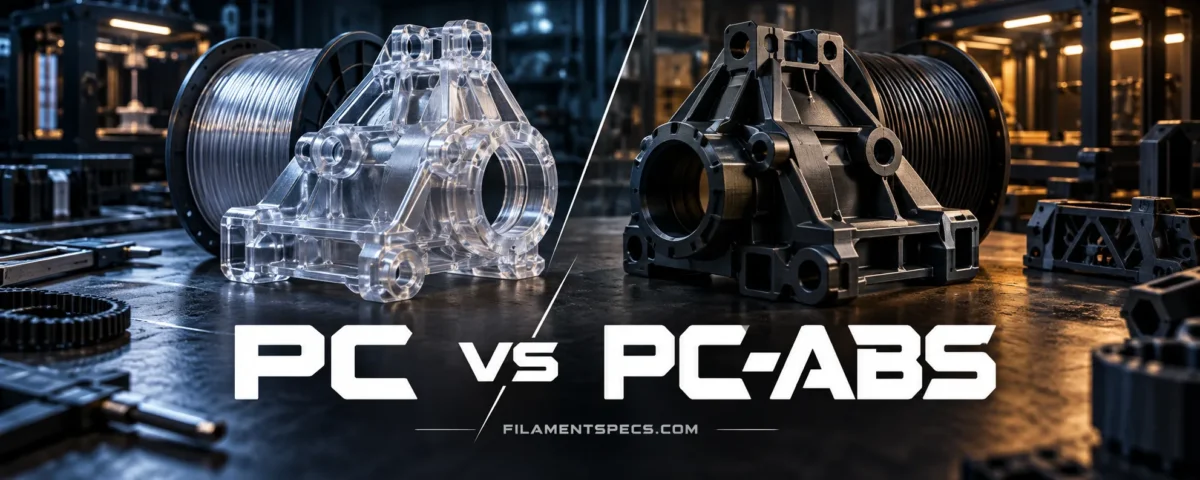
PC is usually the better starting point when tensile strength, rigidity and load-bearing performance matter most, while PC-ABS is often chosen when impact resistance, housing-style parts and a balance of toughness and surface quality are more important. The distinction is not absolute. PC-ABS is a family of polycarbonate/ABS blends rather than a fixed recipe, and printed-part performance can change with formulation, print orientation, chamber temperature, moisture and test method. It is also unsafe to assume that PC-ABS is simply an easier-to-print version of PC.
| Property | PC | PC-ABS | Practical Meaning |
|---|---|---|---|
| Material structure | Polycarbonate-based formulation | Polycarbonate/ABS polymer blend | PC-ABS properties depend strongly on the blend formulation. |
| Tensile strength | Often higher in comparable engineering grades | Often lower than a strength-oriented PC grade | PC is generally the stronger starting choice for parts dominated by tensile load. |
| Rigidity | Usually higher | Often somewhat less rigid | PC is useful where deflection must be limited. |
| Impact behavior | High in suitable grades | Often a major design strength | PC-ABS is well suited to impact-prone housings and covers. |
| Low-temperature impact | Grade-dependent | Some grades are specifically optimized for it | The exact datasheet matters more than the material name. |
| Heat resistance | High | High, with substantial grade variation | Compare HDT at the same load rather than comparing one temperature number. |
| Warping tendency | High | Still high in many grades | Large parts benefit from controlled chamber temperature. |
| Heated enclosure | Often recommended; more important as part size rises | May be required by the filament manufacturer | PC-ABS should not be assumed to work well on an open-frame printer. |
| Moisture control | Drying and sealed storage are commonly required | Drying and sealed storage are commonly required | Wet filament can obscure the real mechanical difference between the materials. |
| Surface finish | Grade-dependent | Many formulations target good housing surfaces | PC-ABS is commonly attractive for functional exterior shells. |
| Transparency | Clear or translucent grades are available | Normally opaque | PC is the relevant family when optical appearance matters. |
| Typical selection | Structural brackets, fixtures, mounts, heat-loaded functional parts | Protective housings, tool shells, clips and impact-prone enclosures | The expected failure mode should decide the material. |
These are material-family tendencies, not guaranteed specifications. Additives, PC/ABS ratio, impact modifiers, flame-retardant packages and other formulation choices can change the result.
What Changes When ABS Is Blended with Polycarbonate?
PC-ABS is not produced by assigning one universal percentage of ABS to one universal PC resin. Commercial PC/ABS grades are engineered blends with different flow, impact, thermal and processing targets. Covestro’s Bayblend range, for example, includes multiple PC+ABS grades with different Vicat softening temperatures, flow characteristics, impact modifications and flame-retardant packages.[d]
The PC portion generally contributes much of the blend’s heat resistance, stiffness and engineering strength. The ABS phase can alter impact response, flow, surface appearance and the way the material behaves under deformation. Compatibilizers and other modifiers can further change the balance. This is why two spools labeled PC-ABS can produce noticeably different results even when their printing temperatures look similar.
PC-ABS should be treated as its own engineering-material family. It is not simply ABS with a small amount of PC added, and a product labeled only “PC blend” should not automatically be classified as PC-ABS.
Printing Requirements Are Closer Than the Names Suggest
Both materials normally sit in the high-temperature end of desktop FFF printing. As current manufacturer examples, Bambu Lab lists 250–270 °C nozzle and 90–110 °C bed temperatures for its PC filament, while Polymaker lists 250–270 °C nozzle and 90–105 °C bed temperatures for its PC-ABS.[c] [a] Those numbers are product recommendations, not universal PC or PC-ABS settings.
| Setting | PC Example | PC-ABS Example |
|---|---|---|
| Product | Bambu Lab PC | Polymaker PC-ABS |
| Nozzle temperature | 250–270 °C | 250–270 °C |
| Bed temperature | 90–110 °C | 90–105 °C |
| Drying example | 80 °C for 8 h | 75 °C for 6 h after moisture uptake |
| Chamber guidance | Printer- and geometry-dependent | Closed chamber specified; heated chamber recommended for large parts |
| Part cooling | Profile-dependent | Off in the manufacturer’s reference conditions |
Do not transfer these settings to another brand without checking its current technical guidance. Modified PC grades in particular can have very different processing windows.
PC-ABS therefore does not automatically remove the printer requirements associated with high-temperature polymers. Polymaker’s current PC-ABS technical guidance specifies a closed chamber and lists a 90–100 °C chamber condition in its recommended settings, with a heated chamber recommended for large parts.[a] A small clip may print successfully under less demanding conditions than a wide electronics enclosure, but that does not make the material intrinsically open-frame friendly.
Printed Test Data Shows Why “Stronger” Needs a Definition
A controlled comparison is more useful when both products come from the same manufacturer and use comparable printed-specimen methods. Polymaker publishes ISO-based XY and Z results for PolyMax PC and PC-ABS. In those specific formulations, PC has substantially higher tensile strength and Young’s modulus, while PC-ABS posts the higher XY notched Charpy impact value.[b] [a]
| Printed Property | PolyMax PC | Polymaker PC-ABS | Test Method |
|---|---|---|---|
| XY Young’s modulus | 2435.5 ± 63.6 MPa | 1835.5 ± 65.5 MPa | ISO 527 / GB/T 1040 |
| Z Young’s modulus | 2149.8 ± 119.9 MPa | 1677 ± 94 MPa | ISO 527 / GB/T 1040 |
| XY tensile strength | 53.4 ± 0.6 MPa | 39.9 ± 1.0 MPa | ISO 527 / GB/T 1040 |
| Z tensile strength | 41.4 ± 1.5 MPa | 22.9 ± 1.2 MPa | ISO 527 / GB/T 1040 |
| XY elongation at break | 4.5 ± 0.4% | 4.2 ± 0.3% | ISO 527 / GB/T 1040 |
| XY bending strength | 81.3 ± 1.5 MPa | 66.3 ± 0.9 MPa | ISO 178 / GB/T 9341 |
| XY notched Charpy impact strength | 21.3 ± 1.7 kJ/m² | 25.8 ± 1.3 kJ/m² | ISO 179 / GB/T 1043 |
These values describe these two formulations and their stated test specimens. They should not be applied to every PC and PC-ABS filament on the market.
For Constant Structural Load, the PC Example Has the Advantage
The XY tensile result is about 53.4 MPa for the PC example and 39.9 MPa for PC-ABS. Young’s modulus is also higher for the PC grade. For a bracket, fixture or mount where the main requirement is resisting tensile load while limiting elastic deflection, those differences favor this PC formulation.
This does not mean a part made from PC will always carry more load. Wall count, infill strategy, local stress concentrations, print temperature, voids, layer bonding and orientation can dominate the final result. Datasheet strength is most useful when the specimen preparation and failure direction resemble the intended part.
For Impact, PC-ABS Can Move Ahead
The same comparison reverses for the reported XY notched Charpy test: PC-ABS reaches 25.8 kJ/m² versus 21.3 kJ/m² for PolyMax PC. The PC-ABS datasheet also reports a low-temperature XY impact value of 13 ± 2 kJ/m² at −30 °C.[a] That makes impact behavior a separate decision criterion from tensile strength rather than another way of expressing the same property.
Use the expected failure mode to make the comparison. A rigid bracket that slowly bends under load and a protective enclosure that receives a sudden impact do not need the same material response.
XY and Z Strength Can Change the Practical Winner
FFF parts are anisotropic: their properties depend on direction. In the Polymaker data, PolyMax PC drops from 53.4 MPa XY tensile strength to 41.4 MPa in Z. PC-ABS falls from 39.9 MPa to 22.9 MPa.[b] [a] The polymer name therefore tells only part of the story.
| Material Example | XY Tensile Strength | Z Tensile Strength | Z Relative to XY |
|---|---|---|---|
| PolyMax PC | 53.4 MPa | 41.4 MPa | About 78% |
| Polymaker PC-ABS | 39.9 MPa | 22.9 MPa | About 57% |
A part whose highest tensile stress crosses layer interfaces may fail earlier than an XY datasheet value suggests. Reorienting a loaded feature, increasing bonded cross-section or improving thermal conditions during printing can matter more than changing from one high-performance polymer to another.
Heat Resistance Cannot Be Ranked with One Temperature
Glass transition temperature, heat deflection temperature and Vicat softening temperature describe different thermal behavior. For functional printed parts, heat deflection temperature (HDT) is especially useful when the part will carry a mechanical load while hot. HDT is measured under a specified stress, so values measured at different loads are not interchangeable.
| Thermal Property | PolyMax PC | Polymaker PC-ABS |
|---|---|---|
| Glass transition temperature | 113 °C | 109.1 °C |
| HDT at 0.45 MPa | 114.1 °C | 111.7 °C |
| HDT at 1.8 MPa | 99.3 °C | 106.4 °C |
| Vicat softening temperature | 116.9 °C | 135.1 °C |
The result is a useful warning against ranking filaments with a single “heat resistance” number. At 0.45 MPa, the listed PC grade has the higher HDT. At 1.8 MPa, the listed PC-ABS grade is higher. Both sets of HDT data use ISO 75 conditions reported by the manufacturer.[b] [a]
Vicat values should not be substituted for HDT values either. Vicat measures penetration under its own defined loading and heating conditions; it does not tell how much a complete printed bracket will deflect under its real service load. Part geometry, print orientation and residual stress remain part of the thermal design problem.
For a hot, loaded part, compare HDT at the same test load. A higher Tg or Vicat number alone does not prove that one filament will maintain geometry better in the intended application.
Warping Depends on the Whole Part, Not Only the Polymer Label
PC and PC-ABS both develop substantial thermal contraction as a hot deposited part cools. If the lower layers have already cooled while new material is being deposited much hotter above them, internal stress can lift corners from the bed or promote splitting between layers. Prusa identifies PC-family materials among the high-temperature filaments where temperature differences can drive warping, particularly on larger objects.[e]
Part geometry amplifies the problem. A large flat enclosure with sharp corners and thick infill stores more contraction stress than a compact part with shorter spans and more uniform wall thickness. An enclosure reduces drafts, while an actively heated chamber can reduce the temperature gradient through a large print. This is one reason chamber requirements become more demanding as the part grows.
- Large flat bases increase the distance over which shrinkage stress can accumulate.
- Sharp corners concentrate stress and are common starting points for lifting.
- Very dense infill places more contracting material inside the shell.
- Cold drafts can cool one side of the part faster than the other.
- Poor chamber temperature can reduce interlayer bonding even when bed adhesion remains acceptable.
PC-ABS can be formulated for improved processing behavior, but that does not justify a blanket claim that it always warps less than PC. The exact grade and print geometry must be considered together.
Moisture Can Distort a PC vs PC-ABS Comparison
Both material families should be evaluated in a controlled dry condition. Bambu Lab specifies 80 °C for 8 hours for its PC product and storage below 20% relative humidity in a sealed container with desiccant.[c] Polymaker specifies 75 °C for 6 hours for PC-ABS after the filament has absorbed moisture.[a]
Moisture can show up as popping at the nozzle, rough surfaces, bubbles, unstable extrusion or reduced layer quality. Mechanical testing becomes misleading if one spool is properly dried and the other is printed wet. A fair material comparison should keep drying state, nozzle, layer height, orientation, wall strategy and chamber conditions as similar as practical.
Surface Finish, Transparency and Post-Processing
PC-ABS has a strong history as a housing material because blends can combine impact resistance with a surface suitable for finished exterior components. Polymaker specifically positions its PC-ABS formulation around good surface finish and lists automotive interior parts among its applications.[a] This property balance can be more useful for an enclosure than maximizing tensile strength.
PC has another option that PC-ABS generally does not: translucent and transparent grades. FFF layer lines, internal voids and surface texture still prevent an ordinary printed PC part from behaving like optical sheet polycarbonate, but the material family offers clear-grade possibilities that opaque PC-ABS does not.
Do not assume PC-ABS can be solvent-smoothed exactly like standard ABS. The response depends on the blend and additives. Solvent exposure can also promote stress cracking in some PC-containing materials, so compatibility should be checked for the exact filament before using a chemical finishing process.
Chemical and Outdoor Performance Remain Grade-Specific
Neither “PC” nor “PC-ABS” is enough information to guarantee chemical compatibility. Polymaker’s PC-ABS data, for example, rates its own formulation differently for weak acids, strong acids, alkalis, oils and grease.[a] Another PC-ABS grade may use a different resin package and should be evaluated from its own technical data.
The same rule applies outdoors. A product intended for prolonged UV and weather exposure should state the relevant stabilization or weathering performance. The base material name alone is not evidence that a printed part will maintain color, impact properties and surface condition during long outdoor service.
Ventilation Deserves More Attention with PC-ABS
High-temperature FFF printing can release ultrafine particles and volatile or semi-volatile compounds. NIOSH recommends exposure-control approaches such as ventilation, local exhaust and appropriate filtration for 3D-printing environments rather than treating an enclosed printer as a complete air-quality control by itself.[f]
PC-ABS also contains an ABS component. UltiMaker’s current Proposition 65 information specifically includes PC-ABS and PC-ABS FR among filaments carrying a styrene exposure warning during printing and directs users to operate them in a well-ventilated area.[g] Product SDS instructions and printer ventilation guidance should take priority for the exact filament in use.
Which Material Fits the Part?
| Application | Better Starting Point | Reason |
|---|---|---|
| Load-bearing bracket | PC | Higher tensile strength and stiffness are often useful. |
| Precision fixture or jig | PC | Higher rigidity can reduce deflection under load. |
| Warm structural mount | PC, after checking HDT | Strength and rigidity favor PC, but service load must be compared with HDT data. |
| Electronics enclosure exposed to impacts | PC-ABS | Impact behavior and housing-oriented surface properties are often the priority. |
| Tool shell | PC-ABS | Toughness and controlled deformation can matter more than maximum modulus. |
| Snap or clip feature | Grade-dependent, often PC-ABS | Impact toughness and deformation behavior deserve more weight than tensile strength alone. |
| Transparent or translucent guard | PC | Clear PC grades are available; PC-ABS is normally opaque. |
| Large enclosure | PC-ABS only if printer conditions support it | Its housing properties can be useful, but chamber requirements remain demanding. |
| Outdoor component | Neither by name alone | Select a grade with stated UV and weathering performance. |
| Chemical-contact component | Neither by name alone | Compatibility must be checked against the exact chemical and filament grade. |
| Part printed on an open-frame machine | Neither is an ideal default | Both families can suffer from thermal gradients, warping and layer-bonding problems. |
Printer Capability Can Matter More Than the Material Ranking
A PC grade with higher laboratory strength does not provide that advantage if the printer cannot keep the part thermally stable enough to form sound layers. The same applies to PC-ABS. Before selecting between them, the printer should be able to meet the temperature and environmental requirements of the exact spool.
- Hotend: must sustain the filament’s recommended nozzle temperature without exceeding hardware limits.
- Heated bed: must hold the required temperature across the usable build area, not only near the center.
- Enclosure or heated chamber: becomes more important for large parts and formulations that explicitly require elevated chamber temperature.
- Build surface: should follow the manufacturer’s adhesion and separation-layer instructions because PC-family materials can bond strongly to some surfaces.
- Drying: the dryer must reach the temperature specified for the spool without damaging it.
- Ventilation: thermal enclosure and emissions control should be treated as separate functions.
A well-printed PC-ABS part can outperform a poorly bonded PC part in the application that matters, even when the PC datasheet contains the higher tensile number. Material selection and process capability cannot be separated for these filaments.
PC-ABS Is Not Interchangeable with Every PC Blend
Filament names such as PC blend, PC-ABS, PC-PBT, PC-FR and PC-CF describe materially different systems. A manufacturer may also modify an otherwise ordinary PC formulation for lower-temperature FFF processing without using ABS at all. Prusament PC Blend, for example, is identified as a polycarbonate blend; the name itself does not state that it is PC-ABS.[e]
Fillers and flame-retardant additives can change the comparison further. Carbon or glass reinforcement may raise stiffness and improve dimensional behavior while also changing impact response, nozzle wear and anisotropy. Flame-retardant PC or PC-ABS should likewise be judged from its own mechanical and thermal data rather than assuming that the base resin properties remain unchanged.
Choose PC first when stiffness, tensile performance and structural load dominate the design. Choose PC-ABS first when impact, housing behavior and toughness are the main demands. For hot loaded parts, large prints, outdoor exposure or chemical contact, the exact grade data can override that general preference.
PC vs PC-ABS FAQ
Is PC-ABS stronger than PC?
Not in every sense of strength. In the comparable Polymaker printed-specimen data, PolyMax PC has higher XY and Z tensile strength and a higher Young’s modulus, while PC-ABS has the higher XY notched Charpy impact value. PC is therefore stronger in those tensile tests, while PC-ABS performs better in that impact test.[b] [a]
Is PC-ABS easier to print than PC?
It can be in some formulations, but the name does not guarantee easier printing. Polymaker’s PC-ABS still specifies a closed chamber and recommends a heated chamber for large parts, with nozzle temperatures of 250–270 °C.[a] Printer capability and the exact filament formulation matter more than the assumption that adding ABS makes PC easy to print.
Does PC-ABS warp less than PC?
Some PC-ABS formulations may be optimized for processing and dimensional behavior, but there is no universal rule that every PC-ABS filament warps less than every PC filament. Part size, geometry, chamber temperature, bed adhesion, infill and cooling conditions can all alter the result.
Which has better heat resistance, PC or PC-ABS?
The answer depends on the grade and the thermal test. In the Polymaker comparison, PolyMax PC has a slightly higher HDT at 0.45 MPa, while PC-ABS has the higher HDT at 1.8 MPa. Comparing values measured under the same load is more useful than treating Tg, HDT and Vicat as interchangeable heat-resistance numbers.[b] [a]
Does PC-ABS need a heated chamber?
That depends on the product and part size. Some PC-ABS products explicitly require a closed chamber; Polymaker lists a 90–100 °C chamber condition in its current technical guidance and recommends a heated chamber for large parts.[a] Always use the requirements for the actual spool rather than a generic PC-ABS profile.
Can PC-ABS be acetone-smoothed like ABS?
It should not be assumed. PC-ABS is a multi-phase blend, and solvent response depends on the specific formulation. PC-containing materials can also be vulnerable to stress cracking with incompatible chemicals. Chemical finishing should only be used when the filament manufacturer confirms compatibility or appropriate testing has been performed for the exact grade.
Which is better for a hot car interior?
Both can be candidates, but the choice should be based on the actual temperature, mechanical load, UV exposure and exact grade data. PC-ABS is widely used as a material family for automotive interior applications, while PC can offer higher stiffness in a structural part. HDT under the relevant load is more useful than selecting by material name alone.[d]
Sources
- Polymaker — Polymaker PC-ABS Technical Data — Supports PC-ABS composition, printing conditions, drying guidance, printed XY/Z mechanical properties, impact data and thermal test values. (Official manufacturer technical documentation.)
- Polymaker — PolyMax PC Technical Data — Supports printed PC tensile, modulus, impact, Tg, HDT and Vicat values used in the same-manufacturer comparison. (Official manufacturer technical documentation.)
- Bambu Lab — PC Filament — Supports the cited PC nozzle, bed, drying and storage-condition example. (Official filament manufacturer product specification.)
- Covestro — Bayblend PC+ABS Blends — Supports the existence of multiple PC+ABS formulations with different thermal, impact, flow and flame-retardant characteristics. (Engineering polymer manufacturer technical portfolio.)
- Prusa Research — Polycarbonate (PC) — Supports PC-family printing requirements, warping behavior, high bed temperatures and the distinction between a named PC Blend and PC-ABS. (Official 3D-printer manufacturer technical documentation.)
- NIOSH — Approaches to Safe 3D Printing — Supports statements about ultrafine particles, volatile compounds and ventilation or engineering controls for filament 3D printing. (U.S. government occupational-safety publication.)
- UltiMaker — Proposition 65 Material Warnings — Supports the manufacturer warning concerning styrene exposure from PC-ABS and the recommendation for ventilation. (Official manufacturer safety information.)